by Raghu Raman, TheWire.In, March 19, 2026
Trump believes he is playing chess against Iran and winning. He is not only wrong about the chess, he is catastrophically wrong about the game.
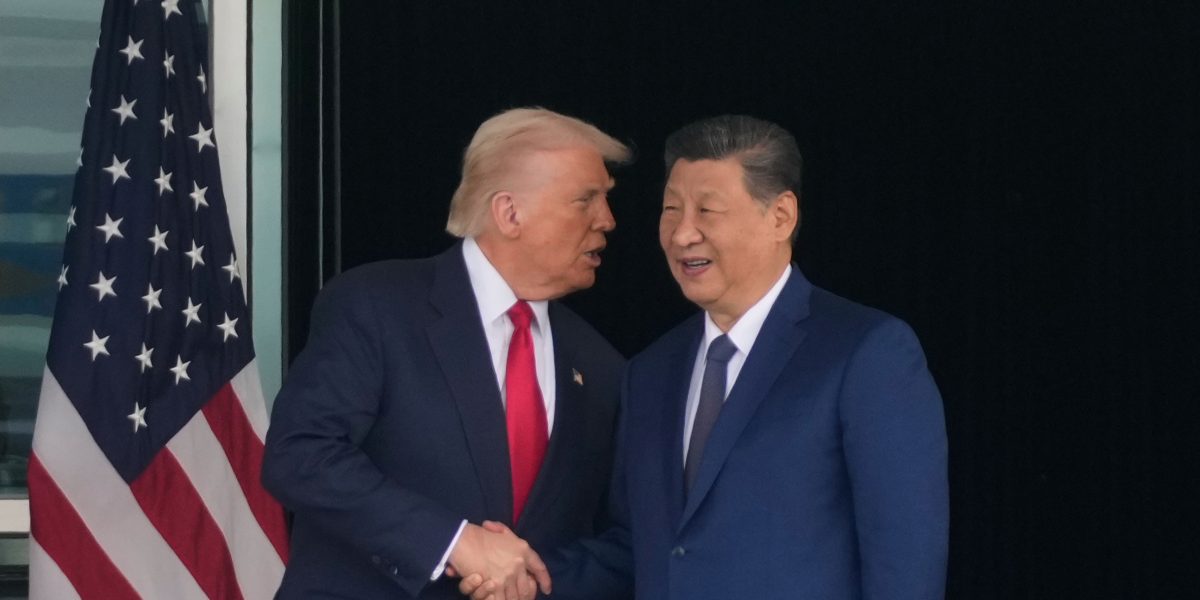
President Donald Trump, left, and Chinese President Xi Jinping, shake hands after their U.S.-China summit talk at Gimhae International Airport Jinping in Busan, South Korea, Thursday, Oct. 30, 2025. Photo: AP/PTI.
Chess originated in India. It is played on a board of 64 squares, with 16 pieces per side arrayed against each other from the opening move. Every piece has a defined power, ranked in a strict hierarchy. The queen is the most formidable. The king is the only one that matters. And the entire objective of the game, every sacrifice, every gambit, every exchange is singular: capture the opponent’s king. Once that is achieved, nothing else counts. The positions of every other piece, the material lost or gained, the territory held or ceded – all of it is irrelevant. The king falls. The game ends.
This is how Donald Trump thinks about Iran. Find the king. Apply overwhelming force. Make it submit. He has said as much in his demand for Iran’s capitulation, his dismissal of its leaders as ‘losers’, his framing of the conflict as a simple matter of American will against Iranian weakness. It is the language of chess: hierarchical, confrontational, centred on a single decisive objective and premised on the belief that sufficient force applied to the right target ends the game.
But China is not playing chess.
The other game
The Chinese strategy game is ‘igo’, known in the West as go. It is played on a board of 19 by 19 lines, creating 361 intersections compared to chess’s 64 squares. The pieces, called stones, are identical. No stone is more powerful than another. There is no king. There is no queen. There is no hierarchy at all.
Illustration: Pariplab Chakraborty.
The objective of go is not to capture any single piece or achieve any decisive blow. It is to surround a larger total area of the board with your stones before your opponent surrounds theirs. Stones are placed on intersections to deny ‘liberty’, or manoeuvrability to the opponent. Territory is accumulated gradually, patiently, across the entire board simultaneously. A player who fixates on one corner while his opponent quietly encircles the rest of the board will lose – not in a single dramatic moment, but through the slow accumulation of positions he never saw coming.
The Japanese word ‘igo’ derives from a Middle Chinese compound word meaning ‘board game of surrounding’. And that, with a precision no chess metaphor can capture, is exactly what China is doing to the United States.
The stones already placed
While Trump has been focused on the chess board, Iran as the opponent’s king and military force as the decisive piece, China has been quietly placing stones across the entire global board for two decades. Each stone, individually, appears unremarkable. Together, they form a pattern of encirclement that is now far advanced.
In the economic sphere, China has made itself the indispensable manufacturer of the global supply chain, including components that sustain American military hardware. It holds over a trillion dollars of US debt. It has positioned the yuan in bilateral trade agreements across Asia, Africa and Latin America, quietly eroding the petrodollar’s monopoly. These are not aggressive moves in the chess sense. They are stones placed on intersections, each one reducing America’s liberty to act without consequence.
In the diplomatic sphere, China brokered the Saudi-Iran normalisation in 2023 – a move unimaginable under American stewardship a decade earlier. It has deepened ties with every Gulf state, offered reconstruction finance across West Asia and Africa, and positioned itself as a partner that asks for commerce rather than compliance. Each relationship is a stone. None required a military alliance or military bases.
In the technological sphere, Huawei’s presence in over 170 countries is not a commercial achievement. It is a stone on 170 intersections of the global board, each one quietly reducing those nations’ liberty to align exclusively with Washington.
And now, in the military sphere, China has Iran. Not as an ally in the chess sense but as a final stone on the board: a position that ties down the US military, depletes its arsenal, exhausts its political will and prevents it from focusing on the corner of the board that China actually cares about. Taiwan.
What the chess player cannot see
The chess player’s fatal weakness against a go opponent is not lack of intelligence or courage. It is a category error. He evaluates every move through the wrong lens: is this piece more powerful than that piece? Is this position closer to capturing the king?
These are the wrong questions. In the game, go, there is no king. Destroying any individual piece, or many pieces, is irrelevant if the opponent has surrounded more territory. The chess player can win every tactical exchange and still lose the game, because he has been optimising for the wrong objective on the wrong board.
This is precisely America’s position today. Trump can bomb Iran’s nuclear facilities, kill its supreme leader, degrade its conventional military and declare victory in the Persian Gulf. None of it will dislodge a single stone China has placed on the global board. The petrodollar will continue to erode. The Belt and Road will continue to extend. Huawei will continue to wire the developing world. And Taiwan will sit there, surrounded by a strategic environment growing incrementally less favourable to American intervention with every passing month.
Worse: every move Trump makes in the chess game actively helps China in the go game. The destruction of the rules-based order removes institutional constraints that slowed China’s accumulation of territory. The alienation of US allies drives them toward the one major power offering partnership without preconditions. The exhaustion of American military and political capital in Iran clears the board in the Pacific. Trump is not just playing the wrong game. He is playing it in a way that hands his real opponent the stones it needs to win.
The game America doesn’t know it’s losing
Step back from the chess board and look at the go board. China has placed stones across West Asia, Africa, Southeast Asia, Latin America, European ports and Pacific island chains. It has placed Russia, once a rival, now a dependent – as a stone that supplies its energy needs and absorbs Western military attention in Ukraine.
Each stone, individually, is not a casus belli. No single one justifies the military response the chess player reaches for instinctively. But together, they form a pattern of unmistakable clarity to anyone who knows what game is being played: the steady, patient encirclement of American liberty, its freedom to act, to lead, to enforce its preferences on a world running out of reasons to defer to Washington.
There is a particular defeat the chess player never sees coming: the one that arrives not through a dramatic capture, not through the fall of any single piece, but through the quiet realisation that the board has been surrounded while he was focused elsewhere. No single moment of loss. No decisive blow. Just the slow, inexorable recognition that there is nowhere left to move.
Sun Tzu – who understood the principle behind go as deeply as he understood war – wrote that the supreme art of warfare is to subdue the enemy without fighting. China is not fighting America. It is surrounding it. One stone at a time, on a board that America does not even know exists.
Trump believes he is playing chess against Iran and winning. He is not only wrong about the chess, he is catastrophically wrong about the game. Because while he manoeuvres for the kill on a 64-square board, China is quietly surrounding the world on a board of 361 – and the outcome of that game will define the rest of this century. The real loser in any contest is not the one who makes bad moves. It is the one who does not realise which game is being played.
Captain Raghu Raman is the founding CEO of NATGRID and an author.