Beginning his Second Tenure as the Chief Minister
by Sachi Sri Kantha, March 24, 2026
Comments from R. Kannan
MGR biographer Kannan’s comments for Part 85 was received on Jan 31, 2026. These were as follows:
“I read your Part 85 with interest, and as always, it excels in its research. I had met Pandian once at the Madras Institute of Development Studies (MIDS). S. Guhan (IAS retd.), who was Karunanidhi’s advisor, introduced him to me and gave me a book from MIDS on Tamil Nadu’s economics, saying, ‘This will be useful when you become a MP.’ Pandian then went to JNU.
MGR perhaps had more than one eye surgery, and owing to the constant use of glasses, had slightly hollow eyes. But the more scathing criticism of Pandian is that he described MGR’s rule as one that ‘enjoyed massive support from the poor, but served the interests of the rich,’ creating an illusion of welfare through populism (such as free midday meals, uniforms, and footwear…). I am expecting the next part to rebut this with the same rigour with which you have you rebutted Pandian’s criticism of MGR’s looks.”
My response sent on Feb 1 was,
“Thanks a lot for your thoughts about M.S.S. Pandian and also about MGR’s eye surgery details. Has this been recorded officially in any available documents, or is this hearsay from family/friends circle? I did watch a Youtube video of Dr. K. Kantharaj [a younger brother of K. Rajaram, initially DMK and later ADMK leader, who became one of MGR’s confidants] few weeks ago, in which he talks about MGR’s vision loss. But as you know, what comes out from his mouth need double or triple confirmation from other reliable sources. To give the devil its due, I do agree with Pandian’s criticism on MGR’s tenure from 1980 to 1984, to a degree. As such, I have to balance my comments. Also, I don’t wish to repeat the details what you have splendidly covered in your book.”
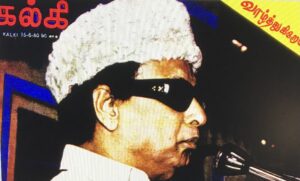
MGR greeted in Kalki weekly cover (June 15, 1980)
Beginning of Second Tenure in June 1980
MGR’s second tenure at the Chief Minister of Tamil Nadu began on June 9, 1980.
An editorial in the Kalki weekly (June 16, 1980) portrayed the co-existing public camaraderie and rivalry between MGR and Karunanidhi with the caption ‘Kalaignar’ [literal meaning, Artist] as follows:
‘One should show magnanimity when he had been a victor. MGR who showed magnanimity for Kalaignar’s birthday [Kalaignar refers to Karunanidhi’s popular moniker in Tamil Nadu], slipped from that rank while answering a reporter’s question.
To the question, ‘Will you embrace Karunanidhi if he comes forward to join you?’ MGR’s response ‘Can a thief and a police officer jointly run a company?’ appears like a witty retort and maybe true, but at this occasion, sounds like a nonharmonic note.
Even Karunanidhi’s attempt to throw back the dart at MGR was unsuccessful. First he attempted to equalize by quipping, ‘MGR had pointed me as the police officer’. Then, he re-adjusted his defense by an alternate suggestion: ‘If MGR says that Karunanidhi was the thief, how could he run a government, when the police chief greets the thief for latter’s birthday.’ What a silly rebuttal?
What was noted above, was politician Karunanidhi. Simultaneously, we also witnessed the Karunanidhi as a literatus. His acknowledgment of his defeat with word play was mesmerizing, and brings us tears. It brims with literary beauty as well. His birthday message to fellow Tamilians was this.
“Fellow Tamilians,
Even if you throw me in the sea, I’ll float like a catamaran, and you can travel in it. Even if you throw me in the fire, I’ll morph into cooking wood, and you can make your meals.
Even if you bash me in a rock, I’ll not be crushed into small pebbles. I’ll split like a coconut, which you can taste.
Therefore, Tamilians, Tamilians, please do whatever you can do to me. I’ll always be of help to you.
How many defeats I face, I’m your house dog. Please do not think, I wait for your handout…”
So many beautiful words, thoughts and citations from literary works, in the speech of Kalaignar. But, what did folks expected from him? It was this. ‘During my tenure, there were quite a few mistakes of omission and commission. I do apologize for these and ask your forgiveness.’ Such simple, non-decorative, non-arrogant and sincere words.’
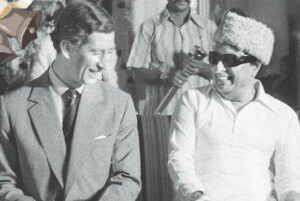
MGR and then Prince Charles – visit to Madras Nov 4, 1980
A preceding sentiment expressed by Karunanidhi in his speech had been tactfully omitted in the Kalki editorial. This referred to an excretory function of a baby and how a mother would handle it. In his autobiography, Karunanidhi had included the missed sentiment.
“To thank the DMK voters for their support and also to felicitate my 57th birthday, a public meeting was held at [Chennai] beach on June 3, 1980, with Sadiq Paksha, the treasurer of DMK presiding. That morning, MGR conveyed his birthday greeting by phone. I also returned his greeting by expressing greeting for his election victory, and thanking for calling me. I ended by my speech like this.
‘When the mother holds the baby and kisses, occasionally the baby urinates in mother’s forehead. For this, mother won’t throw the baby. She would calmly place the baby nearby, change the urine-spilled clothes, wash the baby, dress with new clothes, and continue to kiss the baby again with words – my darling. I accept the results of this election, like this analogy….’
But, comparing himself to a peeing baby, and the Tamil Nadu voters as the baby’s mother was a tasteless analogy to humor majority of Tamil Nadu voters for his indulgences and grievances. As a father of six children, born between 1948 and 1968, Karunanidhi should have known. A baby’s bodily needs, who couldn’t even walk and talk, with incomplete muscle-regulatory urinary functions, will be easily excused by it’s loving mother. How cheap it was for a 56 year old Karunanidhi compare himself to the bodily needs of that of a baby? Since expelling MGR from DMK party in 1972, Karunandhi continued to wallow in the game of self-pity for his transgressions. As usual, Karunanidhi had omitted mentioning his verbal retort to MGR’s comment, indicated in the Kalki editorial. A Kalki cartoon (June 29, 1980) aptly portrayed the forthcoming political duel that both MGR and Karunanidhi would be engaging till MGR’s death in 1987. As the leader of Opposition, Karunanidhi would never miss a chance in scoring one against MGR, whether in their political links with Indira Gandhi, or in the issue of Sri Lankan Tamil militants or farmers’ agitation in Tamil Nadu or even in mis-judging the voter sentiments during MGR’s health debacle in 1984.
Cabinet Picks
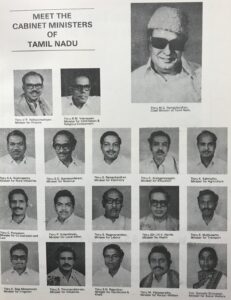
MGR’s 17 Cabinet Members in June 1980
Now, to MGR’s Cabinet picks. During his first tenure, MGR had two Cabinets. The first constituted Cabinet (from June 30, 1977 to May 6, 1978) had 14 members, including MGR – 13 men and one woman. The second constituted Cabinet, from May 7, 1978 till Feb 17, 1980, had 4 additional members – 16 men and two women. These added four were, S.D. Somasundaram (1930-2001), K.A. Krishnaswamy (1932-2010), Tiruchi R. Soundararajan (1933-2009), and Subbulakshmi Jagadeesa (b. 1947). Among these four, Tiruchi R. Soundarajan was a fellow drama and cinema actor, who had acted in quite a number of MGR’s late period movies..
Two women Cabinet ministers P.T. Saraswathi and Subbulakshmi Jagadeesan during MGR’s first tenure deserted Anna DMK party, in addition to four other male ministers (Nanjil K. Manoharan, G.R. Edmund, P. Soundarapandian and K. Narayanaswamy mudaliyar) prior to the May 1980 election. Thus, MGR had to choose a new woman representative. His choice was a new face Gomathi Srinivasan, who had won in his party’s label for the first time. Senior hand V.R. Nedunchezhian (1920-2000), replaced Nanjil K. Manoharan, for the ‘number two’ slot. Other new comers to MGR Cabinet of 18 were Dr H.V Hande, S. Thirunavukkarasu, M. Vijayasarathy, S.N. Rajendran and S. Muthusamy. Those who retained their Cabinet ranks were, R.M. Veerappan (MGR’s man Friday), Panruti S. Ramachandran, S.D. Somasundaram, K. A. Krishnaswamy, C. Aranganayagam, K. Kalimuthu, S. Raghavanandam, C. Ponnaiyan, P Kolandaivelu, and K. Raja Mohammed. Their faces and designated ministerial slots in the June 1980 Cabinet are presented nearby composite photo.
In his autobiography, fellow actor-politician S.S. Rajendran (aka SSR, 1928-2014) also informed that MGR had offered him a Cabinet position, that he rejected. [check my review of SSR autobiography in the link https://sangam.org/autobiography-actor-politician-s-s-rajendran/]. SSR was also an elected MLA in MGR’s party, for the first time. But, he was an old hand during Anna’s period, having contested twice previously in DMK party label in 1957 and 1962 elections. Though SSR lost in 1957, he won the 1962 election at Theni constituency, and a senior to MGR in legislative experience. When MGR asked him any other position he needed, SSR had jokingly quipped ‘Chief Minister’ position, for which MGR acknowledged his humor with a smile.
Interview to Kalki reporter on June 10, 1980
For more than 90 minutes, MGR gave an interview to K.S. Ramanujam, a Kalki reporter, on the following day after he took the oath of Chief Minister. It was recorded on tape. Kalki published the interview in two installments, MGR’s answers to only 8 questions were in print. There had been criticism among the intellectuals and journalists that MGR was a dolt and inefficient in implementation of his political responsibilities. During his first truncated tenure, what he could achieve and whether he had grasped the difficulties of running a ‘political ship’ was somewhat translucent, due to the image promoted about the secrecy component highlighted by his rivals. Chief complaints promoted by the defectors from his party were, (1) files were not moving, (2) delegation of duties among the Cabinet members was ineffective, (3) powers held by the state officials were truncated and due to this, they lost their work efficiency.
Though there may be a semblance of truth, the answers MGR had given in this interview, at the beginning of his second tenure do offer little glimpse on MGR’s thoughts and how he handles issues. Thus, I have made an attempt to faithfully translate his answers to the 8 questions. Excerpts:
Question 1: Currently, we note that public had lost interest in politics and political parties. This is believed as some disinterest and resignation in state of affairs. But when you took oaths near the statue of Anna and addressed the assembled crowd, there was enthusiasm and trust. What do you think?
MGR: The State of Tamil Nadu differs from other States. Here, electors had a real choice on which party should be chosen for ruling and who would be elected. In other States, this situation didn’t prevail. After Janata Party lost the power hold, in other States there was lack of interest among the voters, but not in Tamil Nadu. We could note that the voter percentage recorded in the Northern states were comparatively lower than that in Tamil Nadu.
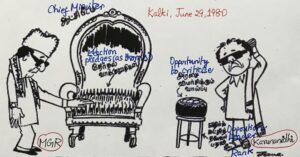
Kalki cartoon (June 29, 1980) on MGR’s election pledges
Question 2: What do you plan to achieve in the future? What you expect as stumbling blocks?
MGR: We have given our plans in the election manifesto. To achieve these, whether five years are enough is a different issue. But, we need to make an effort. The problems we face is not one or two, but numerous. For example, we state that price reduction in cost of living is essential. But sole responsibility is in the hands of Central government. Most vital are the costs of agricultural products, rice. Due to instructions from the Central government, the price of needed additive materials keep increasing. Now, they had increased the chemical fertilizer price. Due to this, the production cost of farmers keep increasing. But farmers cannot increase the price of their products. Here also, the control of Central government exist….Especially, farmers in Tamil Nadu suffer from credit loan problems…They are forced to arrange credit loan at high interest rates from lenders…Considering these issues, we plan to establish a Farmers Commission…Farmers ask me a question, for which I couldn’t provide an answer. Items like pen and textiles are being produced. And who set the selling price for these? Those who produce these items. But for farmers, why those who produce cannot set the selling price, and only the government decides. Only the Central Government can offer an answer.
Question 3: What is your opinion on village economy and city economy?
MGR: The Janata Party government showed interest in village economy. Due to this 150,000 – 200,000 folks were able to find jobs. We could pay in food and little salary. This is not a cheap issue. There is a humorous trend here. Women will request/demand the officials to hand over the rice to ‘him’, and the ‘salary’ to ‘her’. Women worry that if the salary was given to husband, it would be spent carelessly…Gandhian policy of village economy needs to be implemented in a realistic angle. During the Prakasam period of late 1940s], he called that even the policemen had to wear [locally produced] khadar dress. It was khadar in everything. Textile mills were not needed. This would be a dangerous [trend]. Simultaneously, ignoring the village economy brings bad outcome. Thus, we need to produce a mixed economy, in which village folks have to be helped and at the same time, modern productivity also deserves encouragement…But the current policies of the Central Government in encouraging village economy are ineffective.
Question 4: What are your thoughts on the labor problems?
MGR: Let’s put aside the problem between the workers and the bosses. Sometimes, the ‘anti-worker’ conflict prevailing between fellow workers brings sadness to me. I refer to the recent conflict between sugarcane mill workers and the farmers. Labor union leaders, irrespective of to which party they belong, should attend to this conflict. Many arrive at cities from villages [for jobs]. Due to this, the city economy becomes affected. To prevent this trend, we need to provide education, food, dress, bus transport, employment opportunities and cinema entertainment in the village itself. Then, their move to cities will not become an issue.
Question 5: Do you have any plan to solve this issue?
MGR: Yes, we have implemented some. I mention one thing, which was done without any advertisement. There are 374 Panchayat Unions. Among these, 70 Unions were chosen and during [19]79-80, I gave instructions to provide stored drinking water first. Then, transportation facility, job opportunities, education, medical facilities, research on local materials, irrigation to be actively considered. When officials are instructed, for the delays in implementation, they mention about ‘red tape’. To prevent such road blocks, I issued special instructions so as not to circulate the files round and round and implement this program speedily. This had not been attempted until now. I wish to continue this, during the current tenure. We do have good and talented officials here. But, they have become rusted due to routine type formalities. Officials need to take responsibilities for their deeds and work effectively.
Question 6: For the growth of village level economy, helping small scale industry is suggested by you. Do you face any obstacle to implement such?
MGR: A small issue – take the [production of] box of matches. [Central Minister George] Fernandes did something good. He transferred the production of box of matches from big industries to small scale industries. He was firm on it. Because of this, many were able to find jobs. We trained women for a month, and 25,000 to 30,000 were able to work and earn from their home. Like this, many other small industry jobs can be created…Those who capture the ruling handle depend on rich folks, and they don’t wish to antagonize their moneybags (industrialists). In this situation, how can the plight of the poor can be solved?
Now, a big industrialist has in his hands, few MPs. Even if the current rule is dethroned and the Opposition party comes to power, still they maintain their sponsorship. There are industrialists who say ‘Our MLAs and MPs are there. They’ll take care of this.’
When Anna DMK contested the general election for the first time, the party was not well endowed in funds. We thought of nominating those who are relatively wealthy and searching for them. Unexpectedly, within 4 or 5 days, we had received 25 million (2.5 crores) rupees as deposit funds. Was it that the Anna DMK supporters had such money flow Not at all. We found out that the industrialists were backing our chosen candidates, at the rate of 25,000 or 30,000 rupees per head. We had rejected such kind of deals.
What is needed is the situation that money flow is unnecessary for winning the election at the Center or State levels. Once the wines are not bonded with the wealthy, then only they can help the poor openly. True democracy will prevail only then.
Question 7: You indicate reform in the election program. How it should be reformed?
MGR: Government may prepare posters. Voting booth can be reached by voters within 15 or 20 steps. Those who opt not to exercise their voting privileges can be taken to task. In one constituency, some folks told me ‘No candidates bother about us. So, we will not vote.’ I asked them ‘If you don’t vote, ignoring your requests would increase. Whom you can talk to? And who will suffer?’ Then, they realized their folly. If we cannot prevent voter fatigue, proportional representation has to be introduced. Otherwise, minorities get elected with a majority. Without considering this issue, it’s inappropriate to give voting privileges for all and sundry. Also, elected representatives, if they behave irresponsibly, the right to recall by voters should prevail. This right exists in other countries. This deserves serious consideration.
The practice of voting on the basis of castes should be eliminated. One day, I was talking to a few who came to join my party. One woman told me ‘I’m surviving doing sundry jobs. We live in a roof-less compound. Have children. Husband is sick and cannot work.’
I asked. ‘Amma, I shouldn’t ask this, but your face prompted me to ask. To which caste, you belong?’ She said, ‘brahmin’. To which category, we can group folks like her? Many who belong to higher caste are also poor and without means.
Those who claim underprivileged status now and demand equal status,
Question 8: During the election campaign, R.V.[i.e., R. Venkataraman, a senior Congress Party leader and Cabinet Minister] had stated that Tamil Nadu’s rank had dipped in industries?
MGR: Is it without our efforts? For how many jobs, we had recommended to the Central government. You should understand and research the responses we had received. For this only, we demand more rights, to solve our problem. Central [government] don’t feel our demands. Therefore, we need the power to implement our demands.”
MGR’s reference to ‘Prakasam period’ in answer to Question 3, needs some context. Tanguturi Prakasam (1872-1957) served as the premier of then Madras Presidency from 1946 to 1947. He was a Gandhian nationalist, from landholding, estate owning family of Andhra origin. His (then geriatric 74 years) power hold in Madras Presidency was toppled by young K. Kamaraj (44 years) in Congress Party internal squabbles; and subsequently he was the Chief Minister of Andhra state between 1953 and 1954.
MGR’s 1980 responses in detail about his thoughts on governing Tamil Nadu is included for another important reason. In his 1992 disjointed tract, M.S.S. Pandian had conveniently omitted any reference to this published interview, in his 128 foot-note citations and 115 bibliography items. Isn’t this another example of Procrustean logic, indulged by Prof Pandian, prompted by his leanings of pro-Marxist sympathies? Compared to the Gandhian model of ‘kadhar-only cloth’ policy (all wearing the cotton, hand-spun clothes, promoted by Prakasam in late 1940s) of preferring the 19th century Luddite view of village economy, MGR’s view of integrating village economy with textile mills was indeed an advance of adapting to 20th century needs.
As one could note, that among the 8 questions MGR answered, not one was related to the Sri Lankan Tamil issue. In June 1980, he wouldn’t have anticipated this issue to engage his energy; but from 1981 onwards, MGR had to allocate hours in his office (officially and unofficially) before he fell sick in October 1984. He had deal deftly with various groups of Tamil militants and suave TULF parliamentarians who had their own agenda, Eelam Tamil refugees, confront Karunanidhi’s wily maneuvers to steal the show from him, make appeal to the Central Government, blunt the decisions approved by the calculating mandarins in New Delhi, as well as overrule the RAW officials dealing with Eelam issue.
Nine Newly elected Faces in the Anna DMK Party
Brief profiles of MGR’s MLA selections are given. Among the nine, MGR chose two (though first timers) for inclusion in his Cabinet.
Gomathi Seenivasan (or Srinivasan, as in later records) – elected from Valangaiman (SC) constituency. In the 1980 electoral register, she carried only her given name Gomathi, devoid of surname. Daughter of a police constable. B.A. degree and completed teacher’s graduation. Her husband Seenivasan is a respected attorney in Tanjavore. She also likes Karnatic music, and plays veena. Assumed the Minister position for social welfare. She won the 1980 election against the DMK candidate with a vote margin of 11,165 (56.1%). In the 1977 election, there was an Anna DMK candidate P. Srinivasan who had lost to DMK candidate A. Chellappa in the same Valangaiman constituency. It may be, this Srinivasan was the husband of Gomathi, but needs checking.
P.Vijayalakshmi – elected from Veerapandi constituency. She is a sibling of Poolavaari Sukumarn, who was shot and killed for political reasons. She is one of the youngest elected to the Assembly, convincingly. She states that, ‘Our constituency mostly needs drinking water supply and transport facilities.’ She won against the DMK rival with a vote margin of 15,973 (58.0%).
- Vijayasarathy – elected from Arakkonam constituency. Considered as the ‘baby’ among the 1980 election victors. Only 26 years old. B.A degree (English literature). Interested in cricket and weight lifting. He did win, despite the death of his younger sister during election time, with a narrow vote margin of 921, against Congress Party candidate. Assumed the Minister position for Harijan welfare.
- Subramanian – elected from Thiruvaiyaru constituency. Aged 29. M.A degree from Annamalai University. Unmarried. From a farming family. Following his victory, with a vote margin of 9,669 (55.1%) against the DMK candidate, due to political hostilities his sibling M. Ulaganathan was killed. He considers MGR as his guide.
- Thavasi: elected from Paramakudi constituency. A farmer, who had received ‘best farmer’ award for growing IR 20 brand paddy with high yield. Twice, he was the President of Panchayat. He won against the DMK rival with a vote margin of 8,834 (54.2%).
- Angusamy: elected from Thiruvadanai constituency. A farmer, aged 40. But, has 27 year experience in politics. The first question he asked at the Legislative assembly was, ‘Will three be permitted to travel in auto rickshaw?’ He won against the Congress Party candidate with a vote margin of 1,986 (38.0%).
- Thangarasu: elected rom Kurinjipaadi constituency. A farmer, with political experience. He was grateful for the poor folks who helped him win against the moneybags who supported his rival. He won against a DMK rival with a vote margin of 2,959 (49.7%).
- Gurusamy alias Annadasan: elected from Thiruverambur constituency. Though belonging to a farming family, he also owns a meal shop. He lost his job due to harassment from officials. This was the factor for his entry into politics. Due to his attraction to arts and opposing father, left home voluntarily and supported by one Thyagaraja mudaliyar of Thanjavur. He won against the DMK candidate with a vote margin of 11,965 (56.2%).
- Kesava Athithan: elected from Tiruchendur constituency. Affiliated to the Subramania swamy temple, and holds a rank. 47 years old, from agrarian family. A devotee of Lord Muruga. He won against the DMK candidate with a vote margin of 1,205 (49.5%).
Overall, profiles of the above nine MLAs who were elected for the first time in 1980 indicated MGR’s acumen in choosing educated youth from agrarian families, not so well endowed. Those who had experienced family trauma and vengeance from rival parties and authorities were also preferred.
Sanjay Gandhi
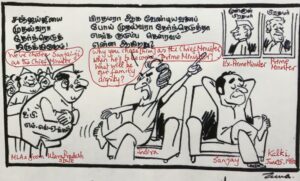
Indira Gandhi – Sanjay cartoon (Kalki weekly, June 15, 1980)
Following Indira Gandhi’s elevation to the prime minister rank, for the fourth and final time, on Jan. 14, 1980, it became an open secret that, whatever political baggages he had to carry, second son Sanjay would be her political successor. To seal this elevation, in May 1980, Indira appointed Sanjay as the general secretary of the Congress Party (AICC). Thus, he became the influential hand for satrap lords of States (Congress Party as well as non-Congress Parties like DMK) to pander him. A Kalki weekly cartoon (June 15, 1980) offered humor on this political ploy of Congress Party satraps. Congress Party MLAs from Utar Pradesh state pleading with Indira Gandhi that they would make Sanjay as the State’s Chief Minister. To this, Indira was scowling at them about the family dignity – with the thought ‘He is of Prime Minister grade and not as a State’s Chief Minister’. I also remember a question and answer item, published in the Thuglak magazine, edited by humorist Cho Ramaswamy (1934-2016) which was accompanied by a short cartoon. This was after the defeat of DMK-Congress alliance by MGR’s party. Karunanidhi was consulting a palmist, about his future. Palmist’s answer was, ‘Not your hand, but I should check Sanjay’s hand.’ It conveyed double-barrel humor (1) Hand was the symbol of Indira’s Congress party, and Sanjay was the decision maker then. (2) Was Karunanidhi, a rationalism propagator, so down in luck to the extent of consulting a palmist about his future? Nevertheless, Grim Reaper played his hand swiftly on Sanjay.
A week after the appearance of this cartoon, Indira’s hopes on the future of her politically active son received a knockout blow from the Grim Reaper. Sanjay was killed on June 23, 1980 while he and his flight instructor Captain Subash Saxena were engaged in acrobatic loop maneuvers in a small plane in New Delhi. From Sept 1979 till the day of his death, Karunanidhi was closer to Sanjay, than MGR. Indira Gandhi’s biographer Inder Malhotra had offered a critical evaluation of Sanjay’s shenanigans, sycophancy of his acolytes and inferred, ‘The posthumous personality cult built around Sanjay proved ephemeral.’ Karunanidhi, proving himself as one such sycophants when it suited his motives, was one who could prove his mastery of weasel words in alliteration. In his autobiography (written in 1997), Karunanidhi reminisced, “During Sept 1979, when I visited Delhi, I met Sanjay at Murasoli Maran’s house and remember more than one hour discussions we had. Subsequently, when he received welcome at Chennai rom National Muslims Assembly, I remembered my speech addressing him as ‘Neruvin perapillai – Indiravin veerapillai [Nehru’s grandchild, Indira’s hero child].”
Though Indira and Sanjay were in opposing camps during the May 1980 Tamil Nadu State Assembly elections, accompanied with 11 of his Cabinet ministers MGR did attend Sanjay’s funeral and offered words of solace to Indira on her personal loss. He and Minister Nedunchezhian watched the funeral rites, while seated in the ground. To a reporter’s question about his attendance, MGR’s quip was ‘though politically we were in opposite camp, one should rise above politics to condole the unexpected loss of a vibrant young soul and feel the pain of a mother who had lost her son.’
Prince Charles
In December 1980, Prince Charles (then, a bachelor) visited Chennai. According to the available records, MGR hosted a tea party to him on Dec 4th. What transpired between them during the brief meeting is lost to history now. Prince Charles also visited Mahabalipuram temple, and MGR had chosen his able understudy and namesake Panruti S. Ramachandran (b. 1937) to do the escort function for the Prince.
Cited Sources
Anon: New faces in the Legislative assembly. Kalki (Madras), June 29, 1980, p.63.
Anon: Sanjay. Kalki (Madras), July 6, 1980, pp. 4-6.
Anon: New faces in the Legislative assembly. Kalki (Madras), July 6, 1980, p.16.
editorial: Kalaignar, Kalki (Madras), June 15, 1980, p.7.
Clyde Haberman: Sanjay Gandhi is killed in crash of a light plane in New Delhi. New York Times, June 23, 1980, section A, p. 1
Karunanidhi M. autobiography Nenjukku Neethi, vol. 3, Thirumagal Nilayam, Chennai, 1997, pp. 407-431.
Inder Malhotra: Indira Gandhi – A personal and political biography, Coronet Books/ Hodden and Staughton, London, 1989, pp. 221-225.
M.S.S. Pandian: The Image Trap -M.G. Ramachandran in Film and Politics, Sage Publications, New Delhi, 1992, 166 pp.
S.S. Rajendran: autobiography Nan Vantha Pathai [The Path I Trod], Akani Veliyeedu, Vandavasi, 2014.
K.S.Ramanujam. Interview with MGR – part 1. Kalki, June 29, 1980, pp. 1-3.
K.S. Ramanujam. Interview with MGR – part 2. Kalki, July 6, 1980, pp. 17-19.
Sikki: New faces in the Legislative assembly. Kalki (Madras), June 15, 1980
Sikki: New faces in the Legislative assembly. Kalki (Madras), Aug 31, 1980, p. 58.
Thanks to Dr Sachi for the wealth of information that he shared, in particular the detailed interview given by MGR to Kalki, I never expected that he had such knowledge on diverse issues and answered with so much data on so many issues outlining visionary concepts like mixed economy. One particular aspect of him is amazing that he gives credit to deserving people like George Fernandez. As usual he was always one step ahead of Karunanidhi in every issue and those instances are amazing to read in retrospect! MGR as a person stands out as a unique human being with his response ” ‘though politically we were in opposite camp, one should rise above politics to condole the unexpected loss of a vibrant young soul and feel the pain of a mother who had lost her son.’” on attending funeral of Sanjay Gandhi, Overall this episode is also a treasure trove of history of Tamil Nadu politics of yesteryears!