An Auto-Obituary ahead in Time
by Sachi Sri Kantha, April 12, 2026
Front Note by Sachi
In Japan, during the past decade or so, the word ‘shu-katsu’ (終活Planning for the End), has become a popular one in mass media. Businesses have bloomed on this concept for the geriatric folks to prepare for their final departure. If one have accumulated property, land assets, art materials of interest to the auction houses in New York and London, wealth dispersed in Swiss banks or elsewhere, these businesses will be of great help. But for me, a life-time drifter and a man of meager means, my immediate family members know what my life-time savings are. I don’t even have to prepare a ‘will’ for them. What they still don’t know (excluding my younger sister) was about my first 28 years spent in Sri Lanka.
When he was 65, Bertrand Russell (1872-1970) wrote his auto-obituary (printed in the Listener, 1937) and lived for another 33 years. On the verge of reaching 73 in May 8, I don’t think my physical life will last for another three decades. Thus, I opt to write my auto-obituary. This may be of some help for my small circle of fans, antagonists and critics, in the future. When my life ends, my obituary will NOT appear in any traditional newspapers or journals or other visual media outlets in the three countries (Sri Lanka, USA and Japan) I have lived, because I’m no Bertrand Russell. I thought, who else but me can describe the highs and lows of my life?
My inspiration to write this auto-obituary was another Russell – American humorist Russell Baker. His wonderful ‘Foreword’ (more than 7 pages long) to the collection of New York Times obituaries ‘The Last Word: The New York Times Book of Obituaries and Farewells’, edited by Marvin Siegel (1997) was a delight to read and cherish. Russell Baker wrote, “The rule here is: no giants, thank you. Giants may have walked among us, manhandling history, but the nature of twentieth-century life has also been shaped by multitudes of whom most of us have never heard…” I do belong to this category of ‘multitudes of whom most of us have never heard.’
Sachi’s Auto-Obituary
A native of Puloly, Point Pedro, Ceylon, Sachi was born in 1953 at Chilaw; his father Sachithanantham (1923-2003) was working as a hospital clerk there. His mother was Puvaneswary (1936-2024), also from Puloly, Point Pedro. Both were Tamil Hindus. Appu’ was the nickname, by which his parents called him. His secondary schooling at the Colombo Hindu College at Bambalapitiya and Ratmalana lasted the whole of 1960s. What he considers as the most humiliating event of his life happened in 1962. He was cane-whacked (below the knees) in front of his peers by the then principal Mr. T. Subramaniam during lunch recess. His crime – repeatedly saying ‘Master’ ‘Master’, while the principal was telling him to address him as ‘Sir’. He got caught, while running in the corridor, when the principal was teaching a class during lunch recess. The tears he shed on that day became the fertilizer for him to study English intensively, and his romance with dictionaries of all sorts. [https://sangam.org/notes-on-reaching-70-not-out-part-6/]
During the 1930s and early 1940s, Sachi’s father didn’t have the means to enter the university or learn music/drama from traditional scholars. Vicarious interests of his father were routed to Sachi in 1960s for training as a musician and teacher. Thus, Sachi’s pedagogy was groomed with split interests – Appu (the artist) and Sachi (the scientist). Appu learned flute from Radio Ceylon artist Palayamkottai T.P. Jesudas from Tamil Nadu. Other Radio Ceylon artists Mrs. Manoranjitham Lokeswaram (1914-1977) and A.K. Karunaharan (1945-2022) from Jaffna tutored him in vocal for a few years. This initiation of musical training reflected later in Sachi’s research on art forms in Tamil and English.
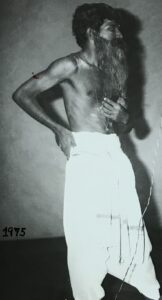
A rare photo of bare-chested Sachi, enacting the role of sangam-period Tamil poet Nakkirar (May 25, 1975)
During his university days in Sri Lanka, Sachi also dabbled in drama acting and directing. In 1975, for a university Tamil play set in rhythm (thaala-laya nadagam), Sachi donned the role of ancient Tamil poet Nakkirar. A single photo of this act was preserved by him as remembrance. For science learning, he had a role model among his kin, Dr. Kartigesu Sivapalan (1932-1985), a biochemist at the Tea Research Institute, Talawakelle, Sri Lanka. Sivapalan also instilled in Sachi, the practical value and use of humor in science and daily interactions, as a weapon of offense and defense.
Sachi entered the University of Colombo in January 1972, via Aqinas College, Borella. His was the second batch affected by the notorious and discriminatory ‘media-wise standardisation scheme’ implemented by the then United Front government, led by Sirimavo Bandaranaike.
Sachi’s tag line in Research Gate platform of scientists was ‘Muhammad Ali of Tramp Scientists in Japan’, due to his vagrant life in three countries – Sri Lanka (Ceylon, when he was born in 1953), USA and Japan. [https://www.researchgate.net/profile/Sachi-Sri-Kantha]. As one of his teachers in zoology, Dr Mano Sabaratnam had correctly observed (in early 1977) while writing a reference letter for his admission to the Post Graduate Institute of Agriculture, Peradeniya, Sachi was a poor exam student, and graduated between sixth and eighth in Dec 1975, in a class of eight.[ https://sangam.org/professor-mano-sabaratnam-1931-2014/]
It was his boast that since graduating from the University of Colombo with a lowly ‘pass’ degree in zoology in 1976, until his ‘forced’ retirement in 2016, his work station had rotated in each Olympic year repeatedly. He had taught and researched at University of Colombo (1976), University of Peradeniya (1980), University of Illinois (1984), University of Tokyo (1988), Osaka Bioscience Institute (1992), Nikken Foods Ltd. (1996), Gifu University – Faculty of Agriculture (2000), Kyoto University (2004), Gifu Pharmaceutical University (2008), Gifu University – Center for General Education (2012) and Gifu University – United Graduate School of Agricultural Sciences (2016). This sort of impermanence was the risk he lived with, to be a functional scientist.
Sachi composed a humorous ditty to describe his plight in tackling the blockheads of Japanese academia. This was,
‘Bad at fart catching – for which he was punished
He always published – so he was banished!’
Sachi’s version was a ‘steal variant’ from American humor scholar Prof Arthur Asa Berger (b. 1933); his original, in an Americana journal issue was.
‘Good at committees – for which he was cherished
He never published – and he never perished.’
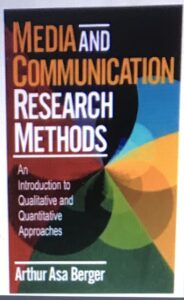
Asa Berger’s text book – 1st edition (2000)
Prof Asa Berger’s textbook ‘Media and Communication Research Methods’ (2000) has received iconic status now. Sachi neither met nor corresponded with Prof. Berger, but,Sachi’s 1999 study ‘Sexual humor on Freud as expressed in limericks’ receiving a citation as a good example of a scientific paper composition in Berger’s textbook (shown in the clip, nearby) delighted him. The abbreviation IMRD, in the citation, refers to the conventional format of a research paper’s four components – Introduction, Methods, Results and Discussion. He attributed the origin of this paper, for his eccentric thought of linking triangular sex-related themes (sexual humor, Freud and limericks) simultaneously.
To prove that denial of tenure at the Japanese universities where he worked, lack of research funds and a research group were not hindrances on his creativity, Sachi was prolific in publishing over 190 research items (original papers, reviews, commentaries, editorials and letters) in peer reviewed journals. Also, as a vindication of his lateral thinking, in collaboration with his colleagues and students he did publish original papers on 15 animal genera- namely, abalone, clam, lobster, scallop, sea cucumber, Asian stingray fish, laboratory rat, Asian chipmunk, wild boar, common marmoset, cotton top tamarin, owl monkey, squirrel monkey, macaque monkey and human, in a wide range of journals from A (Asian Medical Journal) to Z (Zoological Science).
Sachi delighted in tweaking the anti-educational sentiments of sex-prudish curriculum chaperones of the institutions which employed him. He used Leonardo da Vinci’s human coitus sketch for homework exercise and was reprimanded for sexual harassment of a few demented students. He did publish a paper on this episode in a Japanese medical journal.
Sachi set up his own website at the Gifu University in 2011 under the name ‘Sri Kantha Library’, and used a photo of him standing next to a whale’s penis. [A photo frame is presented nearby.] His rollicking logic was, ‘if exhibiting a human penis is a taboo for teaching, why not a whale’s penis?’ and subtly critiqued the bombast of the university pedagogues with his point of view: “I visited the whaling town Taiji in the Wakayama prefecture long time ago. At the whale museum there, I was tickled to see a specimen of whale penis exhibited there. As a student of zoology, I took a photo of myself standing next to this whale penis exhibit. In length and width, the dimensions of the exhibit exceeded that of my physical frame. I became aware that in the natural world, there is bound to be something living amongst us, which can exceed one’s imagination. Gifu University’s global ranking is somewhat akin to my diminished physical frame in comparison to that of whale penis.” Understandably the administrators at the university were NOT appreciative of Sachi’s humor. And the ‘Sri Kantha Library’ has gone missing in the digital world since 2018.
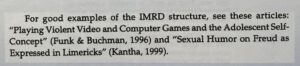
Citation for Sachi Sri Kantha’s study in Asa Berger’s text book
Sachi was NOT honored with any award for his scientific contributions. He was content, to quip ‘Let Time be the ultimate arbiter’ on the merits of what he had published. But, Sachi did receive Sahitya literary award in Sri Lanka for authoring a book on Tamil music in 1977, and two prizes in Japan as an essayist on science themes. That he had received recognition in the ‘Contemporary Authors’ series (Gale, Farmington Hills, Michigan) in 2000, for authoring two reference books in science was his literary zenith as an author. These two books were, Prostitutes in Medical Literature an annotated bibliography (1991) and An Einstein Dictionary (1996). During 2004, while holding the Sri Lankan passport, Sachi’s name was passed into the ‘No Fly List’ of Uncle Sam’s edict, and had described his agony. [https://sangam.org/i-got-trapped-in-the-secret-no-fly-list-of-the-transportation-security-administration/] Eventually, Sachi became a naturalized Japanese citizen in 2016.
By nature, Sachi was a loner, contrarian, bibliophile and fan of 20th century films. He considered that the films of 21st century suffer from senility overreach akin to over-ripe fruits. A Gandhian of sorts for his passion for writing letters and frugality of not owning an automobile, Sachi distinctly lacked financial management skills and was a borderline case of pauperism. His pretense was that he was a descendant of goliardic Tamil saint-poets of south India who traveled to places and engaged in debates and defense of Hindu bhakthi tradition. But, instead of employing Tamil, Sachi used English language to propagate his views to non-Tamils and international audience. He modeled himself as ‘the R.K. Narayan among scientists’.
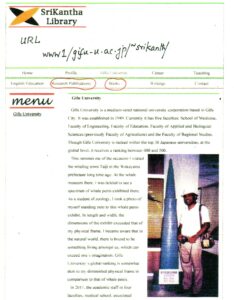
Sachi’s whale penis joke, in his Gifu Univ. website, 2011
Goliards were also identified as wandering entertainers in medieval Europe of Germany and France. To honor this path of his calling, in some of his early popular columns and commentaries, Sachi had used pseudonyms such as C.P. Goliard (C.P., standing for Cotton Port – the direct English translation of his native place Paruthi-thurai) and Oorkakam (‘village crow’). In the true goliardic tradition, Sachi stood up as a ‘pen fighter’ for Tamil interests in the letter columns of pre-digital era journals and Tokyo newspapers to engage in duels with Fr. Tissa Balasuriya (in Tribune, Colombo), Izeth Hussein and H.L.D. Mahindapala (in Lanka Guardian, Colombo https://sangam.org/a-debate-on-the-ethnic-identity-of-tamils/, and https://sangam.org/h-ldon-mahindapala-1931-2024/), Prof. Carlo Fonseka (in Asiaweek, Hongkong, https://sangam.org/prof-carlo-fonseka-1933-2019/) and handful of Tamil as well as non-Tamil correspondents. He was especially harsh on academic commentators on Tamil affairs, who were illiterate on Tamil language, and scribbled from poor secondary or tertiary sources.
Though he suffered a mild stroke, located in the region of left eye socket by MRI scan, at the age of 55 in 2008, due to hypertension and diabetes, Sachi considered that his immediate family (sister, wife, two daughters and sons-in-law as well as three grandsons) were his blessings for his life that lasted for [at least] 73 years.
Sachi’s death leaves a hole among Eelam Tamil diaspora that may not be easily filled for years to come. He touched many bases – Tamil archivist/chronicler, biographer, bibliographer, diarist, music teacher and translator. A plurilinguist, he was adept in four languages – Tamil, English, Japanese and Sinhalese, but wrote only in Tamil and English. His only dream was that Tamils of posterity will acknowledge that during the first three decades of digital biography production in installments, LTTE leader Prabhakaran and Tamil Nadu legend M.G. Ramachandran MGR) were well served by Sachi, the biographer. He wished to have as his epitaph, the ditty of American humor poet Ogden Nash, ‘When I consider how my life is spent, I hardly ever repent.’
Cited Sources
Conversations with scholars of American popular culture.
Featured guest- Prof. Arthur Asa Berger. Americana, Fall 2005; 4(2): https://www.americanpopularculture.com/journal/articles/fall_2005/berger.htm
Russell B. Obituary (1937). In: Unpopular Essays, Unwin Paperbacks, London, 1976 (originally published in 1950), pp. 188-190.
W.W. Goliardic verse. In: The New Princeton Encyclopedia of Poetry and Poetics, edited by A. Preminger and T.V.F. Brogan, M.J.F. Books, New York, 1993, pp. 479-480.
Siegel M (ed). The Last Word – The New York Times book of Obituaries and Farewells, William Morrow and Co, New York, 1997, pp. v-xii.
Sri Kantha S. Leonardo da Vinci’s coitus sketch and its interpretation by the Japanese undergraduate students. International Medical Journal, Oct 2019; 26(5): 423-425.
Nice Obituary indeed, Dr. Sachi lives up to the value instilled by Dr. Sivapalan about the practical value and use of humor in science and daily interactions, as a weapon of offense and defense. A few examples which I enjoyed a lot are Dr. Sachi’s tag line in Research Gate platform of scientists, ‘Muhammad Ali of Tramp Scientists in Japan’, his description of impermanence describing the risk with which he lived with, to be a functional scientist, by tying the timeline of his academic positions with Olympic years. Dr, Sachi have nicely demonstrated that in spite of denial of tenured position, hard work pays by his volume and quality of work which is evidenced by citation by Prof Asa Berger. It is so inspiring that Dr. Sachi always gave tough time to his detractors by his humorous acts and at the end prevailed over them and hence fully deserves the title ‘R.K. Narayan among scientists’. I whole heartedly wish him to live for another 33 years after this auto-obituary like Bertrand Russell. Even though his contributions to science will be understood by academia only, his biographies of LTTE leader Prabhakaran and Tamil Nadu legend M.G. Ramachandran MGR) will cement his position among the Tamils all over the world as a remarkable author.