To ensure every vote carries equal weight’
Shruti Rajagopalan, economist and professor at George Mason University, argues that any future effort to enlarge the Lok Sabha and apportion seats by population requires fundamental changes to the Indian polity
by: Shruti Rajagopalan, Indian Express, Mumbai, April 20, 2026
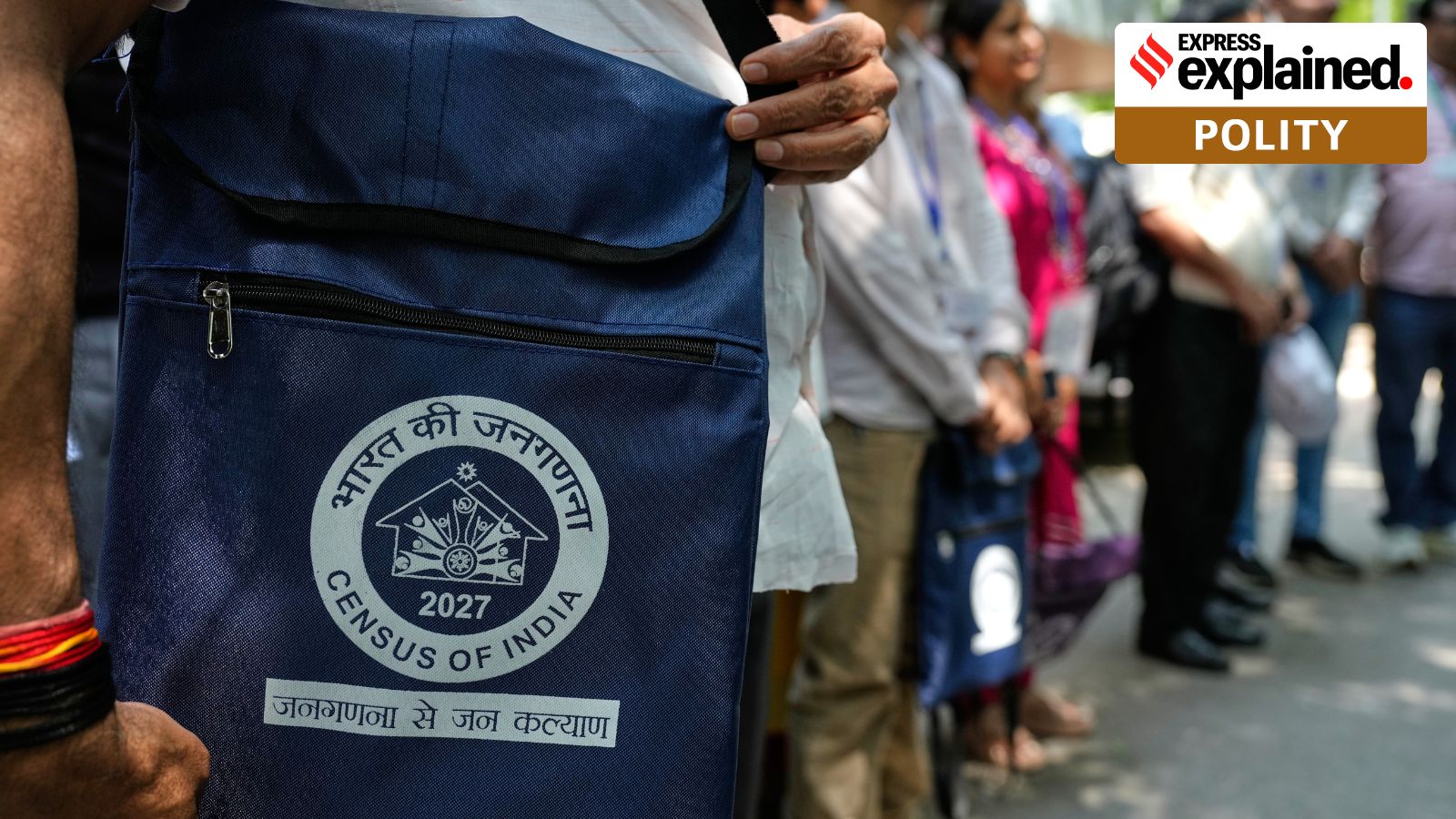
Officials prepare to begin mapping for door-to-door surveys to collect information on housing, available facilities, and living conditions as part of the national population count in New Delhi, India, Thursday, April 16, 2026. (AP)
Delimitation is the act of drawing political lines. In Indian politics, it means three things done together. Fixing the total number of Lok Sabha seats, calculating how many each state gets, and drawing the boundaries of each constituency. A Delimitation Commission handles this, separately from the Election Commission, using decennial census numbers. The exercise recurs because populations do not grow or decline evenly across states, given the changing fertility and migration.
Article 81 of the original Constitution created a simple rule. Each state should get seats in proportion to its population, and the population per MP ratio should be, so far as practicable, the same across states. Article 82 required redistricting after every decennial census so that representation tracked demography and each constituency remained roughly equal.
The reason was not just states’ interests, though that is the tenor of the current political moment. It is more fundamental than that, about treating every Indian equally within democratic politics. The core principle of Indian constitutionalism is one person, one vote. One expression of that is universal adult franchise, where every adult enjoys the right to vote irrespective of religion, caste, language, income, or education, enshrined, since the beginning, in 1950. But to give this principle life, equally foundational is the requirement that every vote should carry roughly the same weight, which requires constituencies of roughly equal size.
In India, both the Lok Sabha and the Rajya Sabha allot seats on the basis of population. This is unusual, but the framers wanted to avoid the tyranny of regionalism as the country was being stitched together during Partition. In federal bicameral polities, one house is typically apportioned by population while the other gives every state equal weight regardless of size. The American Congress is a familiar example: the House of Representatives is apportioned by population, and the Senate allocates two seats to each state, irrespective of size. India does not follow this pattern. A smaller population share means a loss of power in both houses of Parliament.
Why did Parliament freeze the constituencies based on the 1971 census?
In 1976, at the peak of the Emergency, Indira Gandhi’s government passed the Forty-Second Amendment, which gave enormous powers to the Union Cabinet and the Prime Minister’s Office. Among its many changes, the amendment froze the number of seats allotted to each state during the 1971 census for a period of twenty-five years until 2001, instead of revising seat counts and boundaries after each decennial census.
The ostensible justification was demographic fairness. Southern states said they had pursued family planning more effectively than the North, and their politicians argued that honest reapportionment would penalise them electorally for complying with the Union’s population policy. This was not the real reason. Fertility patterns depend on economic development and are long-run phenomena with roots in the colonial period, not the family planning programmes of the sixties and seventies.
But the main reason was fiscal. In the 1970s, at the height of socialism and central planning, state finances were controlled almost entirely by the Union government. Even when tax revenue was generated within a state, its distribution depended on formulae set by the Union, which in turn depended on the relative political power of each state in Parliament. Freezing the seats to the 1971 census gave greater representation to richer states where fertility rates fell sooner.
Since the original Constitution was adopted, Indian states have been reorganised along linguistic and ethnic lines, especially in the Northeast. When states are purely administrative units with diverse populations, population-based representation leaves the politics of representing different linguistic, caste, and ethnic groups to be worked out within each state. Once states themselves were reorganised along linguistic and ethnic lines, the state ceased to be purely administrative. Its relative power in Parliament became the relative power of the languages, castes, and ethnicities that define it.
Even with a single party running most of the country, this was a problem. When the Forty-Second Amendment was passed, most states and union territories were under Congress rule. Within the Congress itself, which governed across the Hindi heartland, east, west, and south, the relative power of states was politicised by ethnic, caste, and linguistic fractionalisation, while the purse strings were controlled by the Union cabinet.
What has changed since the 1971 Census?
But in the twenty-five years before seat shares were due for revision in 2001, three things changed. First, economic outcomes across states diverged, especially after the 1991 liberalisation. Second, this hastened the divergence in population growth, since fertility rates are lower in richer states. Third, coalition politics was at its peak. When 2001 arrived, the Vajpayee government, reliant on partners like DMK, Telugu Desam Party, and Shiv Sena from states that stood to lose seats, extended the freeze through the Eighty-Fourth Amendment, pushing the reckoning to the first census after 2026.
As a result, even today, Indians vote based on constituency sizes and state populations based on a 55-year-old census from 1971, when India’s population was 550 million. Today, the population is estimated to be over 1.4 billion!
Two distinct consequences follow. These must be held apart even though public debate tends to collapse them into one.
The first is under-representation across the board. Every Indian constituency has grown far beyond the size the constitution contemplated. Kerala, which today has the smallest constituencies among the states, has one MP for every 1.75 million citizens. No Indian state is anywhere near the original cap of one MP per 750,000. An Indian MP represents a population larger than that of several European nations. An MP cannot know, serve, or answer to a constituency of that size in the way the constitutional design assumed.
The second consequence is malapportionment, which is the graver violation of the fundamental constitutional principle of one person, one vote. Under-representation is a failure of scale, shared by all Indians. Malapportionment is a failure of equality, borne unevenly. It refers to the asymmetry between a state’s share of the population and its share of Lok Sabha seats. Bihar has one MP for every 3.1 million, compared to Kerala’s MP representing 1.75 million citizens. The same ballot, cast in Kerala, carries almost twice the electoral weight of the ballot cast in Bihar. The power of the vote has become a function of birth accident.
Back to what this means for the states and why the southern states are up in arms over it. Today, by most projections, if we allocate the 543 Lok Sabha seats based on the 2026 population, Tamil Nadu will lose 10 seats, and Kerala will lose seven; Uttar Pradesh will gain 12 seats and Bihar, nine.
Uneven population growth is not the whole story. The deeper problem is uneven economic growth. Richer states are growing faster than poorer ones, and the gap is widening. Lower fertility in the richer states means smaller populations, but higher incomes mean far larger tax revenues. India remains heavily centralised. The Union devolves only 41 per cent of tax revenue to the states, and the horizontal distribution of that pool across states is weighted by population and by relative poverty. Wealthier states have little say over their own finances. The share of their revenue that stays within the state is decided in the Lok Sabha. Losing seat share there would leave the richer states with even less control over revenue generated because of the productivity of their people.
The current attempt, through the 131st Constitution Amendment Bill, to expand the Lok Sabha to 850 seats and reallocate state shares by the most recent census, has failed to pass in the Lok Sabha. The issue has not disappeared, nor have the fault lines.
Any future effort to enlarge the Lok Sabha and apportion seats by population will require two fundamental changes to the Indian polity. First, most of a state’s resources must stay within the state, which means the formula for financial devolution must change in favour of the states. Second, the Rajya Sabha must be redesigned to give each state power independent of its population share, and to grant it a veto over money bills, so that states retain control over their own finances. Without reimagining India’s fiscal federalism, India cannot fulfil the original constitutional promise that each Indian’s vote carries equal weight.
Shruti Rajagopalan is an economist and leads the Indian Political Economy program at the Mercatus Center at George Mason University.