A veteran correspondent who covered the civil war in Sri Lanka reflects on how photographs become fodder for conferences and fellowships, even as their subjects recede into oblivion
by Shyam Tekwani, New Lines Magazine, Washington, DC, June 15, 2026
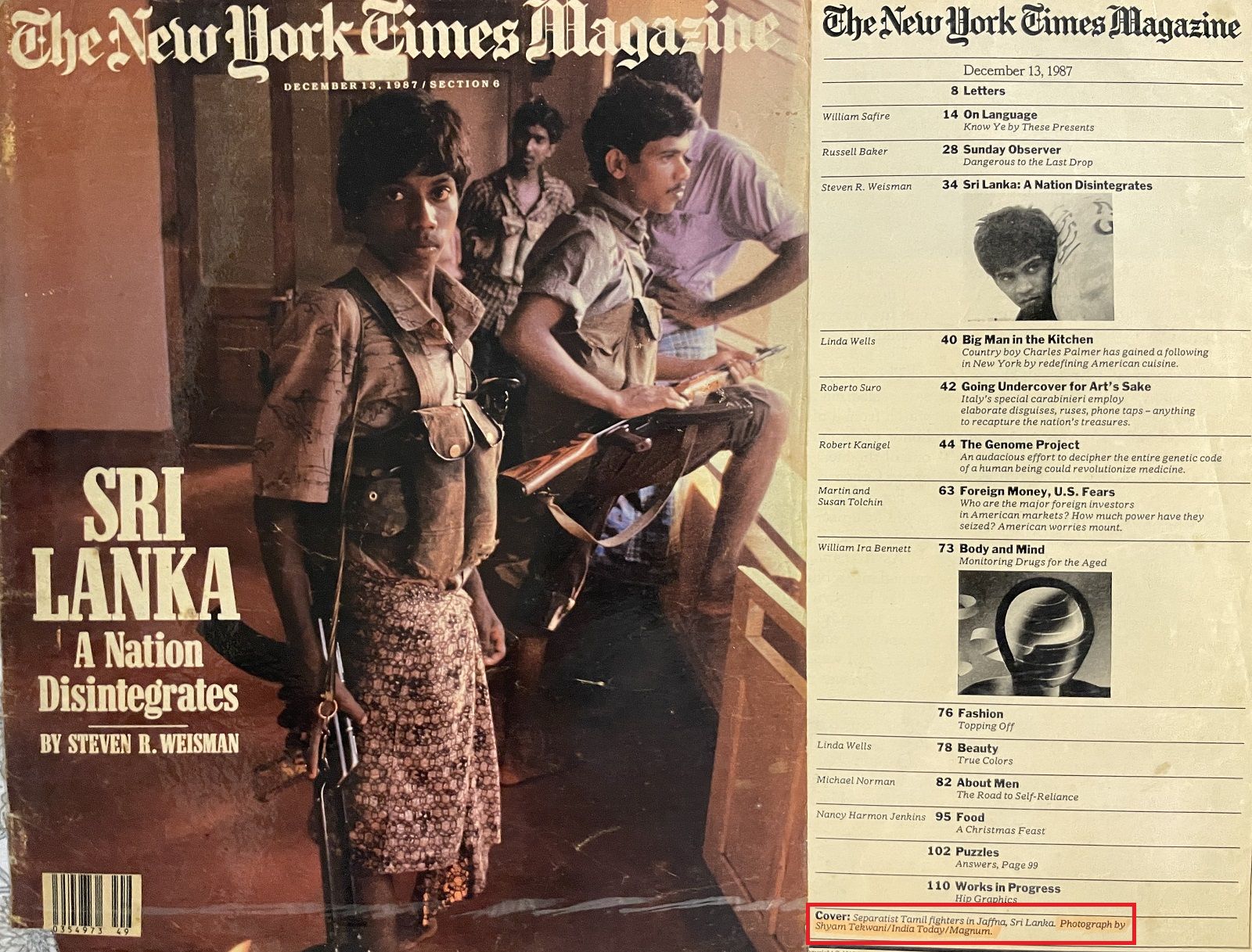
The author’s photo of Tamil fighters on the front page of The New York Times Magazine. (Shyam Tekwani)
By the time I questioned whether I should photograph, I already had.
There is a moment, before the shutter falls, when the world arranges itself into something that can be carried away. It lasts less than a second, and yet it is long enough for a choice to harden into habit. I did not hesitate. I framed. As the Tamil rebels raised their rifles to finish the last two, my camera rose in tandem. We were both shooting. They, to kill. I, to preserve. The difference felt slighter than it should have.
Kokuvil, a suburb of the northern Sri Lankan city of Jaffna, was narrower than it appears in reproduction. Bougainvillea spilled over the courtyard walls on either side, red blooms so dense they seemed staged. The houses were low, their gates ajar, the noon air thick with the ordinary heat of Jaffna in that season.
I remember adjusting focus more clearly than I remember their faces.
In the frame, 13 jawans lay where the violence had settled them. Some had fallen forward; others twisted at angles that looked less painful than interrupted. The earth beneath them had begun to darken, not dramatically, but steadily, as blood found the shallow depressions in red dust and gathered there with a patience that felt almost ceremonial. One soldier had slumped against a wall, a tiffin box beside him, puris and aloo sabji half-spilled. A folded letter protruded from his breast pocket, its edge stained where sweat and blood had met. A fly settled on one soldier’s cheek and remained there, as if the afternoon had already claimed him. The composition was not mine: It was given to me by chance and by the rebels’ choreography of killing. What I chose was only the aperture, the moment and which death to center.
In 1987, Sri Lanka’s civil war had drawn India into its orbit. Indian soldiers, the Indian Peace Keeping Force (IPKF), had been sent to Jaffna to enforce a peace accord between the Sri Lankan government and Tamil separatist fighters, the Liberation Tigers of Tamil Eelam (LTTE). The accord collapsed, and the Indians found themselves fighting the very Tigers they had once sheltered in India. What follows is an accounting of how careers are built on proximity to such violence, how photographs of the dead become credentials for the living. I took the photograph in Kokuvil, where 13 Indian soldiers died. I never learned their names. But the image made mine.
The Tigers stepped through the lane with a competence that was neither hurried nor hesitant. Weapons were lifted, ammunition checked, small objects pocketed: ID tags, helmets, whatever the dead no longer needed. One fighter pulled tubes of Smarties from a fallen jawan’s pocket and held them up, uncertain. He tried to distribute them among the others. There were no takers. The tubes were tossed aside.
When it was over, they withdrew as swiftly as they had arrived, dissolving into courtyards and side roads whose turns they knew by memory. The bodies remained. I walked the lane again, this time slower, as if surveying rather than witnessing. I checked the edges of the frame, the intrusion of shadow, the line of retreat. One jawan’s eyes remained open, fixed somewhere above the bougainvillea. I bent and closed them with my fingers. The lids resisted briefly before settling.
My photograph was soon traveling. The boy fighter portrait became the cover of The New York Times Magazine in December 1987. Inside, the Kokuvil landscape appeared as a two-page spread. The fortnightly news magazine I worked for had cropped the same photograph for its cover. The flowers disappeared. The version that would circulate longest — the reprints, the exhibitions, the lecture slides — was the cropped one. What critics would later write about, the contrast between bloom and ruin, was present only in the frame that traveled less. The image that made my name carried something the image itself had mostly lost.
Editors wrote of its rawness, its refusal to look away. Invitations followed — panels on insurgency, seminars on asymmetric warfare, fellowships framed as recognition of field courage. My name began to move with the photograph, attached by an invisible thread. When colleagues introduced me, they mentioned the image before anything else.
I never learned the names of the 13. I knew the date. I knew the intersection. I knew the precise distance between myself and the soldier beneath the flowers. I could still calculate the depth of field from memory. But their names did not enter my notebook. In the years that followed, I made attempts to find them. Every attempt was blocked — by the government of India, by the Indian army. The 13 remained officially unnamed, not only by me, but by the state that had sent them.
After the Tigers withdrew and before reinforcements arrived, the lane was empty of motion but not yet claimed by explanation. A dog wandered uncertainly between courtyards. Somewhere, a radio crackled faintly in a house whose door remained open. The sky held no expression. I stood there longer than necessary, as if proximity might grant additional depth. But the scene did not deepen. It remained what it was: heat, dust, flowers, 13 men.
When I left Kokuvil, the film canisters traveled tucked inside my underwear, the only place Indian troops were unlikely to search. They felt too light.
Before Kokuvil, there were the boats.
The lagoon crossing felt procedural, as though we were executing instructions handed down from a place that did not need to show itself. The boat arrived after midnight, low in the water, little more than a hollowed log patched with ambition. Salt crusted our lips before we reached the reeds. Halfway across, someone signaled for the engine to be cut, and the oars took over, dipping in a disciplined rhythm.
I had stripped off my white shirt before boarding. It seemed too declarative for the dark. One of the boys handed me a sarong. The cameras rested against my chest. Occasionally, someone would lend me rubber flip-flops — Hawaiian chappals, they called them with faint irony — but more often I walked barefoot, the red earth rising between my toes and drying there.
I embedded first with the ragged constellation of groups that would later disappear — ideologues who quoted pamphlets by memory, exiles who spoke of international law. Their certainties had edges that seemed already worn. One by one they receded, absorbed or erased, until only the Tigers remained.
And so I walked with them.
I was Indian. The jawans in Kokuvil were my compatriots. The Tigers I traveled with had been fighting the Sri Lankan government for a Tamil homeland and were now fighting the Indian force that had arrived to prevent them from winning it. I walked in their formations, crouched in their trenches, photographed their kills. When the photograph appeared on an Indian magazine cover, I was called names: anti-India, anti-national. The same image that opened lecture halls and fellowship offices abroad closed doors and friendships at home.
The first nights in camp were quieter than I had imagined. There were no speeches, no declarations of destiny. Tea boiled in dented kettles. Rice was eaten from enamel plates. Rifles were cleaned with a concentration that bordered on tenderness. I moved among them with the uncertain posture of someone who does not yet know which silences are safe and which must be filled. In the shallow trenches dug into red soil, I crouched low enough that my body began to anticipate incoming fire even when none arrived.
They called me “annai.” Elder brother. Among the youngest, the false kinship was most carefully maintained. They watched me with a discipline that felt rehearsed.
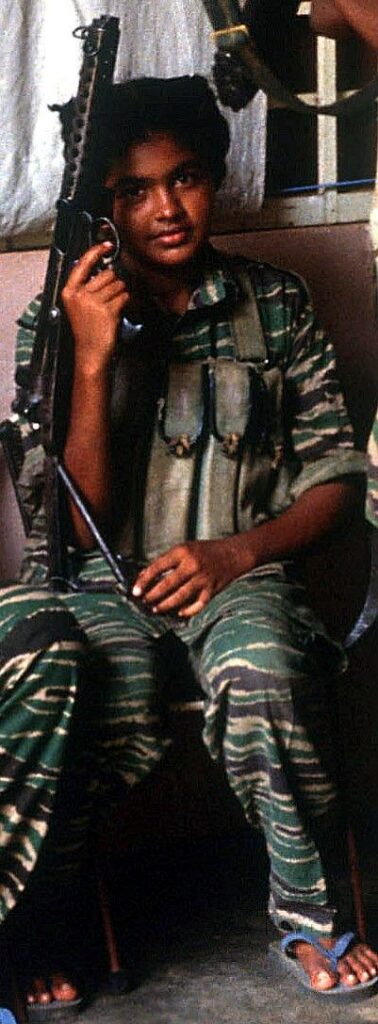
The author’s photo of a young fighter. (Shyam Tekwani)
Her name was Mali. Fourteen, maybe younger. A cyanide vial hung around her neck on a leather cord, nestled against her collarbone. She had a half-smile — not quite shy, not quite defiant — and a stillness in her posture that did not belong to childhood. When I lifted the camera the first time, she straightened slightly, adjusted the strap of her rifle, found her angle. Days later, she was gone. Not into a grave — but into that silence war keeps for its youngest. Her name was spoken once in passing.
One evening, as the sun dropped low, I photographed a group of boys — perhaps a dozen of them — standing in a loose line in their sarongs, bare-chested, cyanide vials hanging against their skin. They had not arranged themselves theatrically. They simply stood, as if for muster, and the vials caught the last light. Some looked at the camera. Others looked past it. It was not defiance I saw, but a kind of patient solemnity. Like Mali, they understood the photograph would outlast them.
Months later, in one of his jungle hideouts, just after the IPKF had arrived, I found Velupillai Prabhakaran again. He had led the Tigers since their formation, and by now his name carried weight not only in Jaffna but in New Delhi and Colombo. I had met him before, in his safe house in Madras when India still hosted the Tigers, and then in later hideouts, photographing the image he was building of himself: the leader, the strategist, the man of history. I remembered his first handshake: the hand soft, the grip delicate and limp. Now, in Jaffna, he was less uncertain, more assured in his performance.
He allowed the camera this time, turning slightly, as if aware of what an image could command. Then he summoned a leopard cub named Sita, cradling it with the ease of possession — a name that echoed the old Indian epic, in which Ravana, the demon king of Lanka, abducts Sita and sets into motion a war foretold. He posed for the camera, one hand stroking the animal’s back. His voice, when he spoke, was soft, almost gentle, the kind of quiet authority that does not need to raise itself to be heard. It was not affection I saw, but ownership: of beast, of image, of narrative.
The boys came and went, rotating through the front, some returning, others not. There was a boy who wore a faint smear of sandalwood paste on his forehead, its ocher fading each day under sweat and dust. He told me, in a voice steadier than his years, to make sure they knew he had been there. I took his photograph in a tractor that was taking him to the front lines. He grinned — a wide, bucktoothed grin, unguarded despite the rifle in his hands. That evening, he died in an exchange so brief it hardly felt like battle.
One afternoon, a rebel from another group was brought forward with his hands tied and his jaw broken. A Tiger suggested I take the picture. The angle was clear, the light sufficient. I lowered the camera. The refusal did not feel heroic. Some images do not travel without altering the one who carries them. The Tiger did not insist. The man was led away and shot.
The jungle resisted geometry. Light fractured through leaves and refused alignment. The camp did not resolve. It lingered in fragments — the smell of kerosene lamps, the sound of someone retching quietly behind trees after a firefight, the shuffle of cards played by boys whose fingers had learned war before they learned women.
I began to sense that Kokuvil had not ended when I left the lane. It had entered the mechanism by which I looked. Faces were measured against that afternoon. The camera no longer merely recorded; it anticipated.
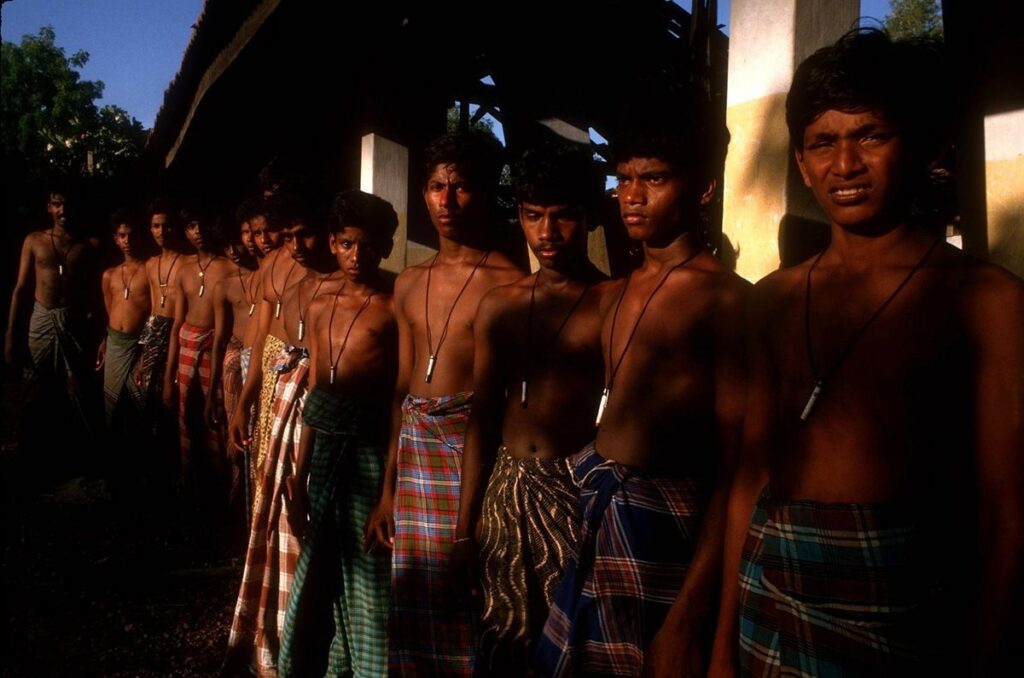
The author’s photo of a group of boys, with cyanide vials hanging from their necks. (Shyam Tekwani)
The conference room in Delhi was cold. Bottles of water stood aligned before each speaker, labels turned outward with quiet deliberation. I wore a jacket out of conformity, and felt the unfamiliar weight across my shoulders. The cameras were no longer around my neck. My hands rested lightly on notes I knew I would not consult.
The retired general began by charting operational miscalculations, his analysis precise in the manner of someone accustomed to converting loss into diagrams. A professor followed, invoking Hobbes in tones that carried the comfort of repetition. The phrases were well-worn; they arrived without the friction of dust or blood. When my turn came, a ministry official leaned forward and asked what the Tigers had ultimately sought. I spoke first of territory, then of recognition, then of redress — words that sit easily in policy rooms because they are sufficiently abstract to travel without stain. What I did not say was: They wanted to matter. To be seen. To leave some mark that said they had been here, even if only for a moment.
When I advanced the slide, the photograph appeared, enlarged far beyond the proportions of the street. Under projection, the bodies were flattened into legibility. The image no longer carried heat; it carried clarity. I described angles, timing, terrain familiarity. I spoke of ambush in constricted space. I did not mention the fly. I did not mention the letter in the pocket. Those details had no function in that room. The image had adapted to this environment. It had shed its immediacy and acquired authority. The 13 no longer felt proximate; they felt illustrative. The lane in Kokuvil had become a reference point rather than ground I had walked.
What the room did not know, and what I did not say, was that in India the same image had made me a traitor.
In Colombo, the high commissioner’s residence stood in a neighborhood of leafy streets and diplomatic quiet, its lights calibrated to flatter faces rather than reveal them. The war, though never absent, arrived here only in abstraction — as briefing notes, as talking points, as a problem to be managed rather than endured.
The linen on the long table had been pressed into submission. Through the tall windows, the sea lay dark and composed. The high commissioner sat at the far end, drawn and distracted, sucking on his pipe. Both Tamils and Sinhalese called him “the viceroy” — the same title the British had given their colonial governors in India. It was not meant as a tribute. India had twisted arms on both sides: compelling the Tigers to negotiate when they were near defeat, pressuring Colombo to accept terms it resented. The IPKF was called, by Tamils, the “Innocent People Killing Force.” Truculent and overbearing, the high commissioner behaved as though India were doing them all a favor by keeping their country from breaking apart.
An official seated two places to my right leaned forward to make a point. He held his whisky in one hand and adjusted his turban with the other. “All we need,” he said evenly, “to teach these fellows a lesson is to have our people stand at the southern tip of India and piss into the Palk Strait. The whole island would drown.”
The peace accord India had underwritten was unraveling violently, and the Indian mission felt betrayed by all parties — the Tamils they had come to protect, the Sinhalese government they had pressured into compromise. The remark was aimed at the entire island: perfidy everywhere, no one exempt. A few at the table laughed, softly at first, then more confidently as the cue was absorbed.
In Kokuvil, where 13 men had been reduced to stillness within minutes, no one had spoken of oceans as weapons. Here, the ocean was metaphor, and the metaphor was meant to entertain.
It was in a conference center in Geneva that I first saw the photograph without my name attached to it. The room had been arranged in the neutral geometry favored by international gatherings. Outside the windows, the lake held its composure. The slide appeared midway through a presentation on postconflict reconciliation. It filled the screen cleanly. A caption beneath it read: “Escalatory Incident, Jaffna, Late 1980s.” The presenter spoke of retaliatory cycles, of perception management. The image remained behind him, illuminating the argument efficiently. No one in the room knew I was sitting in the third row.
The photograph had entered circulation fully — available to explanation without the inconvenience of its maker. A man from a European foundation later remarked that the slide had been “visually persuasive,” that images such as that help secure funding for longitudinal studies on conflict transformation. He did not ask where it had come from, and I did not offer.
It was 1988. The Khalistan insurgency was at its height. Jarnail Singh Bhindranwale had been dead for four years — killed in the Golden Temple during Operation Blue Star — but the violence he had catalyzed was still burning through Punjab. An Indian Punjabi journalist who had just returned from covering it told a joke one evening in Colombo, where we sat at a bar safely distant from the daily violence:
The Sikh homeland of Khalistan is finally achieved and, at the first Cabinet meeting, the agriculture minister speaks earnestly about irrigation canals, the industry minister promises textile corridors and then the defense minister proposes: “Attack America!”
“Why?” the prime minister asks.
“Look at Japan,” the defense minister replies. “They attacked America. And now — bullet trains, robots, economic miracle.”
There is applause and cries of “Khalistan Zindabad” — “Long Live Khalistan.”
And then, at the far end of the table, an older man leans forward and gently asks: “But son … what if we win?”
The laughter arrived on cue. Someone slapped the wood. Someone else shook his head.
The photograph from Kokuvil precedes me now in ways that no longer feel accidental. In new cities and unfamiliar auditoriums, it appears before my voice does. Enlarged, it acquires a composure that the afternoon itself did not possess. Under controlled lighting, the blood — rendered in pigment and grain — settles into something that resembles design. The photograph has become an instrument through which the room is tuned.
It is not always the 13 who are invoked first. Someone remembers the girl with the cyanide vial, her slight adjustment of posture before the lens as though aligning herself with permanence. Sometimes, it is the boys at dusk with their vials gleaming. At other times, it is the boy with sandalwood paste fading under heat, grinning wide and bucktoothed in a tractor on his way to die. On other evenings, a student will ask about the rebel with the broken jaw, why I did not take that photograph, whether refusal is a form of intervention.
Their names are rarely spoken. Their images circulate.
Repetition alters memory. The sequence of slides settles into familiarity; transitions become instinctive. The story, once immediate and unstable, acquires edges. The photograph, which began as record, has become credential. It establishes authority before argument, proximity.
This is the part we do not include in the panels or the publications. Men like Prabhakaran, like Bin Laden, like Bhindranwale, like others whose names we mark with asterisks and caveats — they gave us material. They gave us frameworks, fellowships, entire careers. They made us necessary. We built around them. We circled them like planets around a dark sun, held in orbit by the gravity of their violence. And we kept spinning, long after they were gone.
The machinery of expertise adapts swiftly. When a figure like Bin Laden enters the frame, entire markets organize themselves around him — books rushed to publication, fellowships announced, consultancies formed. Certainty circulates faster than evidence; what takes years to understand is explained in days. Some of these accounts are later discredited, their claims overstated or their sources unreliable, but by then the authors have moved on, their authority established by speed rather than depth.
Once, over a beer, a colleague said to me, “If not for Bin Laden, I’d be teaching political science basics to undergraduates who don’t read the syllabus.” We laughed. The truth had a bite that we could only acknowledge through laughter.
I am not certain, any longer, whether I am preserving what happened in Kokuvil, or preserving the version of myself who stood there and framed it. Memory, once raw, adapts to framing. It begins to anticipate its own retelling. Someone once said we ought to build shrines for monsters. Not to glorify them. Not to mourn them. But to admit what they allowed us to become. The shrine does not demand confession; it demands maintenance. It requires attention, and attention is easily mistaken for reverence.
In a Jaffna schoolroom, years after Kokuvil, I stood before a blackboard chalked with the remnants of arithmetic. The desks were smaller than I expected. Sunlight entered through slatted windows, carrying dust into its beam. The teacher, who had once been a student in that very room, told me that the fighting had ended long ago, that the children now studied geography and literature without interruption. A boy in the front row raised his hand and asked whether I had known the men who died in the photograph.
I began to answer and then stopped.
I could describe the lane. I could describe the flowers. I could describe the way the fly had settled and refused to move. I could describe the Tigers’ retreat. I could describe the aperture and the shutter speed and the way the image had traveled — to the national fortnightly, to covers abroad, to Geneva, to Delhi, to syllabuses I had not written, to arguments I had not made, to rooms I would never enter.
I could not give him a name.
In that moment, the architecture that had grown around the war — the conferences, the panels, the reports, the lectures, the syllabuses — seemed to recede slightly, not collapsing but thinning. The boy’s question did not fit cleanly into the corridors I had walked for years. It did not seek framework. It sought recognition.
I had kept things, small objects from the field that never made it into my reports. A torn ID card. A letter I had photographed. Evidence of proximity that I could not convert into story without compromising someone still living, or dishonoring someone newly dead. I told myself I was protecting them. But the truth was simpler: I was protecting myself. From having to explain what I had done there. Who I had thought I was. What right I had claimed to witness and survive and profit from their dying.
I began a sentence about context and found it trailing.
The photograph had ensured that Kokuvil would be remembered. It had secured its place within narratives of escalation and reprisal. It had entered archives and arguments and institutional memory. Yet in the schoolroom, beneath dust and sunlight, the memory that returned was less orderly. It did not arrange itself into a thesis. It resisted completion.
I stood before the class longer than necessary, aware of the distance between what could be explained and what remained suspended. The sentence did not conclude. Through the window, red dust rose from the playground where children kicked a ball. The same red dust that had gathered in the creases of my feet in Jaffna, that had entered the seams of my skin and never fully washed out. I had carried it here, to this classroom, to this question I could not answer.
 Shyam Tekwani is a faculty member at the Daniel K. Inouye Asia-Pacific Center for Security Studies and a former photojournalist