A 1985 commentary in the Nation (New York) weekly and my Unpublished Letter
by Sachi Sri Kantha, March 4, 2026
Prelude
In the previous posting of Chapter 27, I had inferred that the beginning of civil war in Sri Lanka should be dated to Jan 9, 1985, which resulted in the killing of LTTE’s then leader of Jaffna region, Capt. Pandithar (aka, P. Ravindran), aged 24, was killed in Jan 9th, 1985, in an encounter with the Sri Lankan army at Achuvely, Jaffna. Here, I provide another document in the form of a 2,025 word commentary by Richard Greenberg that appeared in the Nation (New York) weekly, edited by Victor Navasky (1932-2023), recognized as a contrarian Liberal voice in American journalism. A footnote indicated that Greenberg (an ex-Nation intern) had spent six weeks in India and Sri Lanka. While being a student at the University of Illinois, I subscribed to this weekly, which had the reputation as America’s oldest weekly news magazine.
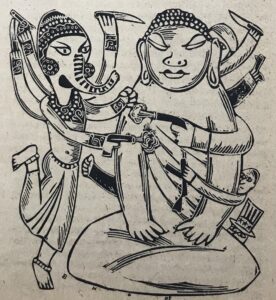
Caricature of Lord Ganesa against Lord Buddha with Uncle Sam (in top hat) watching
One should appreciate the candor of this commentary. Especially to be noted is the three sentences in the third paragraph, which have been totally ignored by the Sinhalese analysts and gullible sympathizers of ‘Sri Lanka as a country’ from all over the globe. Historical facts remain, (1) Current avatar of Sri Lanka (aka Ceylon, prior to 1972) was a phony creation of British imperialism in 1833. (2) Also note, ONLY two ethnic communities (namely Sinhalese and Tamils) based on language spoken in the iisland were identified, and NOT Muslims. But some facts stated are error prone. For instance, LTTE cadres were not trained by George Habash’s Palestine group. Few individuals associated with Uma Maheswaran (PLOTE group) were the ones identified as receiving Palestine training, which eventually came to nothing in Eelam battlefields. As LTTE’s ideologue Anton Balasingham had quipped, terrains in the Middle East were not the same as in the Tamil regions of the island.
I sent my reader comment to a combined caricature of Hindu god Lord Ganesa (portrayed as Tamil militants) and Sinhalese army (hiding behind a Buddha statue), which accompanied this commentary. My submission went unpublished, but I had retained a copy of my submission. Thus, this chapter has three components.
First, the original commentary by Greenberg. Secondly, my unpublished submission in 1985. Thirdly, my current comment follows.
Sri Lanka Lurches toward Civil War
by Richard Greenberg [The Nation, New York, Nov 30, 1985, pp. 582-585]
[Note by Sachi: word use and spelling pattern has NOT been corrected, from the original text. One unusual usage I noted was ‘Jaffnan’ – referring to an individual from Jaffna. As a new coinage to Sri Lankan English dialect, it has some merit, being short and a gender-neutral term.]
The island of Sri Lanka is shaped like a tear, and in the past two years its people have had much reason to grieve. Ethnic violence between the Sinhalese majority and the Tamil minority has left more than 2,500 dead and made hundreds of thousands refugees. For months now, the country has been teetering on the brink of civil war.
A cessation of hostilities implemented in June by Tamil guerrillas seeking a separate state and the Sri Lankan government was breached by both sides. In August negotiations initiated by Indian Prime Minister Rajiv Ghandi and held in the remote mountain kingdom of Bhutan broke down. Tamil leaders walked out of the talks, prompted by reports of mass killings of Tamils and by the government’s failure to make substantive proposals to meet rebel demands. No date has been set for the resumption of the talks, and with reports of the collapse of a second cease-fire, which took effect in October, the prospects for a settlement are dim.
The case of Sri Lana demonstrates the enduring effects of colonialism. The forcible union of two ethnic communities with a history of rivalry was supposed to forge a national identity and create a productive, stable society. Instead, as in so many former colonies in Africa and Asia, it has wreacked havoc.
‘You have to understand’, a Sri Lankan official told me, ‘under the British, Tamils were privileged.’ That view is widely held among Sinhalese, and it is borne out in statistics. In 1946, although Tamils constituted only 10 percent of the population, they held 27 percent of civil service jobs and accounted for 29 percent of university enrollments. The proportion of Tamils in technical occupations was even greater. To leaders of the Sinhalese nationalist and religious revival that took place after independence in 1948, the undue influence of the largely Hindu Tamils posed a threat to the culture of the Buddhist Sinhalese. The majority’s fear of the minority was and continues to be exacerbated by Sri Lanka’s proximity to India. ‘Sri Lanka is the only place in the world where Sinhalese culture exists,’ the official said. ‘We are merely 10 million, but a few miles away there are 50 million Tamils in southern India.’
Since independence, Sinhalese chauvinism has inspired legislation aimed at curbing the Tamils’ power. One of the first such acts disenfranchised nearly a million Tamils of Indian origin, whose forebears the British had brought from southern India to work on the tea plantations in the island’s central highlands. The indigenous, or Ceylon Tamils, who were concentrated in the northern and eastern regions and had little contact with the plantation Tamils,, understood the resulting loss of seven legislative seats as an attack on their political power. In 1956, Sinhalese was adopted as the country’s official language. The constitutions of 1972 and 1978 reaffirmed the primacy of the Sinhalese language and granted ‘the foremost place’ to Buddhism.
And so it was the minority’s turn to be threatened. In the 1950s and 1960s the Tamils of the north and east responded with calls for a federal system. Protests, which occasionally erupted in violence, prodded the government into making agreements in 1957 and 1965 promising official recognition of the Tamil language and greater Tamil autonomy. These concessions were never implemented, however, because of opposition by Sinhalese politicians and Buddhist clergy. Changes in the education system, especially the ‘standardization of marks’ in the early 1970s, further alienated the Tamils, requiring them to score higher than Sinhalese on examinations for entrance to universities.
In 1976, having realized that their federalist aims were unattainable, the Tamil political parties merged in the Tamil United Liberation Front (TULF), which called for the creation of a Tamil state known as Tamil Eelam. Although the United National Party (UNP) government of President J.R. Jayewardene again offered limited concessions on the issues of language and devolution of power, separatist sentiment grew. A number of disillusioned young people organized militant separatist groups and turned to armed struggle. Members of one of those groups, the Liberation Tigers of Tamil Eelam, went to the Middle East for training in guerrilla warfare from George Habash’s Popular Front for the Liberation of Palestine.
The Sinhalese responded in kind. The years 1977, 1981 and 1983 were marked by attacks on Tamils, their houses and businesses. In 1983 the Sixth Amendment to the Constitution outlawed the advocacy of separatism, forcing the TULF out of Parliament. Most provocative have been the mass arrests and torture of Tamil youths under the 1979 Prevention of Terrorism Act (well documented by Amnesty International and the International Commission of Jurists).
In addition to detaining and torturing youths, the police and army have frequently responded to guerrilla attacks by going on rampages against Tamil civilians. On a recent visit to Jaffna, the Tamil ‘capital’, located at the island’s northern tip, I heard widespread condemnation of the security forces, often described as ‘an army of occupation’. As in many Tamil towns, the skeletons of burned-out houses, shops and even the public library serve as grim reminders of the violence that has taken place.
‘The Sri Lankan security forces have been our best recruiter’, said V. Balakumar, a leader of the Eelam Revolutionary Organization of Students, in his headquarters in the south Indian port of Madras. A few years ago the militant groups could claim several hundred members. Today the five major ones, four of which have formed a coalition, have an estimated 10,000 trained guerrillas, known as ‘the boys’. Atrocities have also intensified support for the guerrillas among the Tamils, many of whom have lost faith in the moderate policies of the TULF. A prominent Jaffnan active in the field of human rights told me, ‘Tamils have been stepped on for forty years, but the boys have restored our pride.’
Many Tamils do not approve of the robberies and other acts of violence attributed *carried out mostly by ‘opportunistic criminal elements’, according to militant leaders), but in a crisis most of them would side with the boys. B. Deogupillai, the Bishop of Jaffna and an outspoken critic of guerrilla violence, characterizes the situation this way: ‘Many people are afraid of the boys, but they are even more afraid of the army.’
Washington has followed a low-key policy on the Sri Lankan conflict. It refuses to extend military aid (US officials regard the army as one of the most undisciplined in the world) but continues to provide economic assistance at an average of $75 million per year, and no cutoff is contemplated. ‘We prefer to rely on moral suasion,’ one of them told me. Washington has approved of India’s efforts to mediate the conflict, mainly out of a desire to court Rajiv Gandhi. The Administration considers Sri Lanka important because of its strategic location. The main US presence consists of Voice of America transmitters on the island; new ones, capable of beaming propaganda throughout Southeast Asia and as far away as Iran, are planned.
Strategic concerns have impelled Washington to facilitate indirect military support by opening an Israeli interest section in the US Embassy, which has provided Sri Lanka with Israeli intelligence reports to conduct antiterrorist training. In a country in which Moslems make up almost 8 percent of the population, a country that suspended relations with Israel in 1970 and depends heavily on remittances from nationals working in Arab countries, the Israeli presence has been controversial. But the hawkish National Security Minister, L. Athulathmudali, defends the policy, saying that Sri Lankan troops ‘have never had such good training.’
British mercenaries, former members of the Special Air Services (SAS) have also provided training. Officials of the British government, which has turned down repeated requests for military aid, admit they are mildly embarrassed by the role of the ex-SAS men, some of whose trainees have tortured Tamil suspects, but the officials claim that Britain can do nothing to prevent them from operating. SAS officers on active duty have been spotted in Colombo and are believed to be playing a covert advisory role.
The Sri Lankans buy gunboats, armored cars and basic weapons from British companies, as well as from Israel, Pakistan and China, while Tamil militants purchase sophisticated weaponry with funds taken in bank robberies and contributed by Tamils overseas. They have also seized arms in raids on military and police installations. Aside from the limited training obtained in the Middle East, most guerrilla training has been conducted in Sri Lanka and in the southern Indian state of Tamil Nadu, where militant leaders have operated openly for two years. The Sri Lankans have accused India of allowing Tamils to train on its soil and to use Tamil Nadu as a base from which to launch attacks on their territory. The Indians have denied the charges, but an official told me that Indira Gandhi ‘may have turned a blind eye’ to such activities. Another source contended that under Indira, India gave material support to Tamil groups and even helped establish the Tamil Eelam Liberation Organization which the source described as ‘India’s baby’.
In contrast to his mother, Rajiv has been willing to take political risks at home in hopes of gaining a settlement in Sri Lanka. Earlier this year he declared his opposition to Tamil Eelam, which has strong support among Indians in Tamil Nadu, and cleared the way for the confiscation of Tamil arms shipments in southern India. In the spring he and Foreign Secretary Romesh Bhandari combined pressure with assurances of concreate results in persuading the Sri Lankan government and Tamil groups to negotiate.
The main stumbling block to a negotiated settlement is the question of autonomy. The Jayewardene government refuses to relinquish control over the Northern and Eastern provinces. &The facts are simply against it,& says National Security Minister Athulathmudali, pointing to the presence of 250,000 Sinhalese and an extensive Muslim population in the Eastern Province. A.S. Balasingham, a spokesman for the Liberation Tigers, gave the militants& reply only days before his deportation to England in August’ &The colonization of the Tamil homeland by Sinhalese settlers is part of a deliberate policy aimed at the genocide of the Tamil people’. In the Eastern Province, he pointed out, the Sinhalese share of the population has grown from 8,4 percent in 1946 to 24.9 percent in 1981. ‘We will never accept anything less than the union of the two provinces which make up the Tamil homeland,’ Balasingham stressed.
Rajiv Gandhi continues to pressure both sides to reach an agreement similar to the one he signed recently with Sikh moderates in Punjab, who accepted a lesser degree of autonomy than the extremists had demanded. His intention to silence Tamil militants was evident in his ordering the arrest of 3,500 activists in Tamil Nadu who were demonstrating against the deportation of Balasingham and two other leaders (one of whom subsequently was allowed to return to India).
The militants remain opposed to a compromise. Recently they killed several former parliamentary representatives from the TULF after that moderate group showed signs of considering a government proposal that would allot greater autonomy to provincial councils but would fall far short of establishing a Tamil state.
‘If it’s war, it must be war’, President Jayewardene declared in a speech after the collapse of the Bhutan talks. But the ‘war’ has already cost millions of dollars, which have been diverted from development. Even with a military budget eight times larger than that of 1977, the army leader has admitted that a victory on the battlefield is virtually impossible, and the Finance Minister is predicting huge deficits and potential economic ruin if the fighting continues. It is not clear that the guerrillas could sustain a prolonged war either.
The expulsion of some Tamil leaders from Madras inspired others to agree to a second ceasefire promoted by the Indians, on the condition that it be monitored by a multi-ethnic citizens’ group. Despite the government’s contention that the ceasefire is still in effect, fighting continues and the death toll mounts. Until now the conflict has been primarily a regional concern. Yet if it’s war, then powers with interests in the area, such as the United States, may implicate themselves more directly in the conflict.
*****
My Unpublished Rebuttal Letter to the Nation, dated Dec 22, 1985
I had titled my letter with a caption ‘Scene in Sri Lanka’.
“The Editor,
‘The Nation’,
72 Fifth Avenue, New York, NY 1011.
Dear Sir,
Being a Sri Lankan Tamil, I enjoyed reading the contribution by Richard Greenberg (‘Sri Lanka lurches toward Civil War’, Nov 30). It was informative, analytical and thought provoking. However, please permit me to make the following comments.
First, only two former parliamentary representatives from the Tamil United Liberation Front were murdered in September, and not ‘several’ as mentioned by Greenberg.
Secondly, I wonder, with what sort of symbolism the cartoon (or is it a caricature?) was drawn by the artist? Whatever it had tried to portray, I feel that the artist must have bene ignorant of the roles played by the Hindu pantheon of Gods. The Tamil rebels were portrayed with an elephant head and a slim belly. In Hinduism, the elephant headed god, Ganesa has a characteristic pot belly, and he is symbolized as the God of wisdom, remover of obstacles and for his static charm. Contrastingly, it is Ganesa’s younger brother Muruga (with a slim belly and devoid of elephant head) is the celebrated God of war for the Tamils.
Thirdly, it should be emphasized that the Sinhalese government is adept in trying to eat their cake and have it also! When it comes to statistics, they find it convenient to quote the 1946 figures of Tamils holding 27 percent of civil service jobs and accounting for 29 percent of university enrollments. After nearly forty years of Sinhalese domination, these figures had been drastically reduced now, well below the ethnic percentage of the Tamil speaking population. However, when the Tamils claim the Eastern Province of Sri Lanka, as their ‘traditional homeland’, the same Sinhalese government refuse to relinquish control over the Eastern Province, which has an increased Sinhalese population of 24.9 percent in 1981 (from a meager 8.4 percent in 1946). Any keen observer should agree with the stand of the Tamils that the colonization of the Tamil homeland by successive Sinhalese governments was part of a deliberate policy aimed at the genocide of the Tamil speaking ethnic groups. What many westerners doesn’t know is that, this state-aided colonization of Sinhalese in the Eastern Province was supported during the last four decades mainly by the funds originating from Britain, Canada, USA, West Germany, Netherlands, Sweden, Norway and Japan. The donor countries provided these funds for rural development and technical assistance and not for changing the prevailing ethnic distribution in the Eastern Province of Sri Lanka.
Sincerely,
Sachi Sri Kantha”
I have not changed a word or sentence now, in re-typing this 40 year old document.
*****
My current analysis of the above Report by Richard Greenberg
For convenience, I list the facts missed by Richard Greenberg.
Item 1: Named sources in the report were V. Balakumar (leader of EROS), B. Deogupillai (then Bishop of Jaffna), Lalith Athulathmudali (then National Security Minister) and A.S. Balasingham (LTTE spokesman). Two unnamed sources include, ‘a Sri Lankan [Sinhalese] official and also an Indian official.
Item 2: The three deported Tamils by Rajiv Gandhi were, Anton Balasingham, and unnamed ‘two other leaders’. These were Nadesan Satyendra and S.C. Chandrahasan. Of course, Chandrahasan was allowed to return to India, and subsequently he became a handle and ‘informant’ to India’s RAW intelligence folks.
Item 3: Rajiv Gandhi’s ‘specific directions’ to RAW officials on handling the Eelam Tamils, especially the TULF folks had been omitted. But, Greenberg’s comment about Rajiv’s ‘intention to silence Tamil militants’ was appropriate.
Item 4: The generic use of ‘[Tamil] militants’ was deplorable. Greenberg’s observation, ‘Recently they killed several former parliamentary representatives from the TULF’ was exaggerated. In late 1985, two TULF MPs (V. Dharmalingam and M. Alalasundaram) were killed, and that too was by TELO group, at the instigation of India’s RAW plumbers.
Item 5: Greenberg’s final sentence was indeed an appropriate prediction. ‘If it’s war, then powers with interests in the area, such as the United States, may implicate themselves more directly in the conflict.’ First, it was India in 1987. Then, following India’s lead, Pakistan’s general Musharraf moved in from 2000. Also Uncle Sam during President Clinton’s tenure twisted the leg of LTTE in 1997, by declaring LTTE as a ‘foreign terrorist organization’ with a spurious logic. Finally, China invested heavily with the Rajapaksas since 2005.
“””