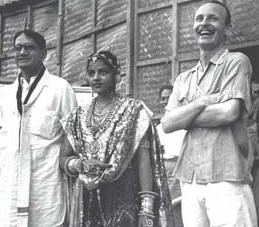
T.Sadasivam (lt), M.S. Subbulakshmi(middle), Ellis Dungan (rt) – during a shooting interval of ‘Meera’
by Sachi Sri Kantha, December 9, 2025
Introduction
This year marks the 80th anniversary of the release of the Tamil version of the Meera movie on November 3rd 1945 in Chennai. Also, December 11th marks the 21th death anniversary of Carnatic Music diva Madurai Shanmugavadivu (M.S.) Subbulakshmi (1916-2004). It also happens to be the birthday of her step daughter Radha (1934-2018). Both had starred in Meera. In addition, December 1st marked the 24th death anniversary of Ellis Dungan (1909-2001), the American director of the movie. To commemorate all these dates mentioned, I present this essay, consisting of three sections.
Section 1: Dungan’s reminiscences in directing Meera movie of 1945 [excerpted from his 2001 memoir]
Section 2: Specific details on the 1945 Meera movie – a mythological story telling without historical validity.
Section 3: Extrinsic factors that influenced Meera movie’s success in box office.
I follow the format of my previous essays on iconic Tamil movies: Sivaji Ganesan’s debut movie Parasakthi (1952)
[https://sangam.org/parasakthi-movie-and-tamil-politics/]
and M.G. Ramachandran (MGR) – Bhanumathi’s classic Malaikallan (1954).
[https://sangam.org/malai-kallan-mountain-dacoit-movie-and-its-five-variants/]
Both these movies were scripted by M. Karunanidhi (1924-2018). But, Meera movie was scripted by another Titan in Tamil literature of 20th century, ‘Kalki’ R. Krishnamurthy (1899-1954). He was a generation older than Karunanidhi, and died young at 55.
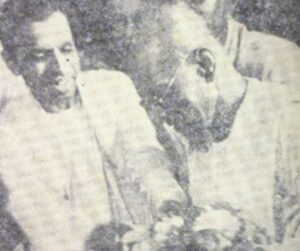
Kalki Krishnamurti (lt) with C. Rajagopalachari (rt), in 1945
Dungan’s Reminiscences in directing Meera movie of 1945 [pages 80-87. 93, 98-99]
Dungan’s descriptions of outdoor ‘takes’ for the Meera in Jaipur, Udaipur, directing M.S. and the big animal battalion of camels and elephants are interesting to read.
“On several occasions I invited groups of men from the rest camps, along with their nurses, to witness a theatrical film I was directing at the time titled Meera (a historical drama) at nearby Newtone studios. They appeared quite thrilled to meet M.S. Subbulakshmi, who acted the role of Meera, and to hear her sing. Of all the Tamil theatrical motion picture films that I directed in India, the film Meera was considered by my peers and local film critics to be my best – and I am inclined to agree. The picture was produced by Chandraprabha Cinetone, a company formed by M.S. and her husband, T. Sadasivam. I directed the Tamil version and later the Hindi version of Meera.
An innovation I brought to Indian films was the ‘shooting script’, where the script would be broken down into scenes and shots, with action on the left half of the page and dialogue on the right half. First I would have each scene translated for me from Tamil into English, and then I’d go to the hill country for a month or two to write the shooting script. Since I directed many feature films in Madras studios and in other cities of India, and during the war years produced quite a number of documentaries for the Madras and Calcutta governments, I was given the opportunity to spend much time in the hill stations writing scripts over the years. I enjoyed many friendships among the tea and coffee planters who were permanent residents in the hill stations.
I told Sadasivam I wanted to go to Coonoor to work on the Meera script. He readily agreed and even offered to set me up in a small cottage with cook and servant. Having acquired a taste for South Indian food, as spicy hot as some of the dishes are, I accepted his kind offer. Every Sunday M.S. and Sadasivam would pay me a visit to check on the progress of the script and on my welfare. They would pick up the script pages and take them down to Madras for typing in English. Coonoor is a small hill station in the Nilgiri Hills, about an eight-hour drive from Madras. It has an elevation of 6,500 feet and was, at that time, a popular British vacation spot for the European community during the hot weather months down on the plains. Normally during the week it became a quiet, sleepy little village with no excitement or distractions, and I found that I could concentrate and turn out productive work there. The Nilgiri Hills were known as the ‘blue hills’ due to the bluish halo that surrounded them. I also like to visit another of my favorite hill stations there – Ootacamund, or ‘Ooty’ for short, with an elevation of 7,500 feet. Ooty was where the Madras governor’s summer residence was located and was located only a short distance from Coonoor.
Coonoor, surrounded by tea and coffee plantations, sported a planter’s club and several small English-owned and operated hotels, restaurants, and shops. While working on the Meera script, for a change of pace I’d dine out at one of the local restaurants that served English-style London mixed grill or delicious roast beef and Yorkshire pudding. Then after dinner I’d wander over to the planter’s club to trip the light fantastic with the local belles.
At the end of a month I was back in Madras with the completed shooting script preparing to cast the film, conduct dialogue and music rehearsals, and construct sets at Newtone studio. We first had the extensive ‘in-studio’ filming to do in Madras. There is one scene of which I was particularly proud in this film. M.S. had beautiful large eyes, and I wanted to highlight them during one of her songs, I used a special lighting with equipment that I’d brought with me from the US and isolated the area of her eyes with two ‘gobos’ – one at the top of her eyes and one underneath – and feathered the edges of the gobos by putting a diffusion screen on the top and bottom edges to soften them. The final cut showed only a close-up of her eyes, which filled the screen. It was a beautiful effect.
After the studio work, we headed north with an entourage of some twenty people, including a camera crew, two grips, three musicians, a few minor actors, the celebrated writer Kalki Krishnamurti, producer T, Sadasivam and his family and household staff, plus myself. We took off from the Madras Central Railway Station for the long trip north for a month of location filming. Our first stop on the tour, a purely sightseeing one, was the Taj Mahal at Agra, one of the ‘must-see’ tourist attractions in the world. It is magnificent, awe-inspiring.
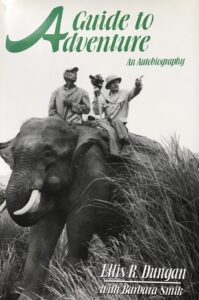
Ellis Dungan’s 2001 memoir
One of our stops on the tour was Jaipur, known as the ‘Pink city’ due to its rose-coloured stone buildings, where we filmed many of its palaces, both interior and exterior, and some of its fortifications, such as the Amber Fort and Palace. Camel caravans still plied their trade in Rajasthan and other sandy areas of north India, even as far away as Kabul, Afghanistan. Jaipur seemed to be the headquarters for the buying and selling of camels or, as in our case, renting them by the day. We rented a small caravan of a dozen or so well-outfitted camels at a local bazaar – including a palanquin (or conveyance) for M.S. and took them to a desert location on the outskirts of Jaipur. It was a scorching hot, dusty day, typical desert weather. Most of the time it was necessary to keep the cameras covered to protect them from the blowing dust and sand. Due to the heavy weight of M.S.’s palanquin, her camel started biting, kicking and slobbering all over anyone who came near. Apparently the camel didn’t like performing before the cameras. After three exhausting, exasperating ‘takes’, the heat and the rolling motion of the camera got to M.S,, so we called it quits for the day and returned to our lodgings.
Since we were traveling by train throughout the Meera tour, most of my nights were spent in railway stations (and without television). The rest of the group stayed in a nearby Indian hotel. The producers brought their own cooks and servants along, so there was no food problem. Railways, at that time, were still under the guardianship of the British regime in India. Most rail lines carried first class compartments, overnight accomodations, and both English and Indian cuisine. At most stations the food was excellent.
Following the filming in Jaipur, our entourage packed up for a short train journey to Chitorgarh, formerly named Chitor, the fortress capital of the former Rajput kingdom of Mewar. The Chitor fort is situated 500 feet above the surrounding plains. To reach it, one must zigzag his way through seven magnificent gateways with guard rooms at their base. Our mode of transportation was by foot or by tonga (horse and two-wheel carriage). As with Jaipur, we filmed many palaces and towers with and without M.S. in the takes.
Following the fall of Chitor at the hands of the Mogul emperor Akbar the great in 1567, the Rajput Sesodian capital was moved to nearby Udaipur, famous as the ancient stronghold of Sesodian Rajuputs. Udaipur today is noted for its beautiful white palaces, particularly the marble palaces built on two small islands in Pichola lake. The massive white palace of the Maharana, situated on a ridge overlooking the town, was built around 1570, three years after Akbar’s attack on Chitor.
Due to the kindness and assistance of the Maharana’s prime minister, we were given carte blanche to film practically anything anywhere in and around the palaces and gardens. We also were granted the use of such facilities as the royal barge, elephants, a royal procession, the palace dancing girls, hundreds of film ‘extras’ and all of the water fountains in and around the palaces. These were ready made sets that would have cost us a fortune to reproduce in a studio setting, if they could be reproduced at all. Filming in Udaipur was one of the most delightful and pleasurable experiences I enjoyed in all of my years of filmmaking in India. Whereever I looked there was a scene that I wanted to photograph. It was like stepping back in time two or three hundred years or walking onto a set in the Arabian nights. It was exciting! And so were the people. The Maharana, a kind and gentle man – short, middle aged – and his staff were very kind to us. I think they all enjoyed being in the ‘spot light’. We filmed at least a week, and I could have stayed for another two weeks of shooting. We had so much usable footage available and at so little cost. It became a difficult decision to cut scenes from the script – even more difficult at the time of editing….” [two paragraphs omitted]
“Back in Madras, during our forced breaks in the Meera shooting schedule (due mostly to the rationing of film, processing chemicals, and photographic supplies during the war years), I often took on ‘still’ photographic assignments for Kalki, the popular Tamil weekly magazine published by T. Sadasivam and Kalki Krishnamurti. These assignments included several of M.S.’s musical concerts. Notwithstanding her worldwide name and fame as a musical genius, M.S.’s personal life has always been a very simple one. She is unaffected by her celebrity status and international renown and is of almost childlike innocence and naivete.
As an actress she worked hard to perfect her art. Since M.S. understood a smattering of English at the time I first met her, I was later able to communicate well with her during the making of her films. When time permitted I also taught her a few words of English. By the time we completed Meera, she had mastered enough English to carry on a decent conversation all of which held her in good stead later when she visited Europe, England and the US on concert tours. Since she was always surrounded by musicians in her home, rehearsing songs for a recital somewhere, I had to literally wait my turn to conduct film rehearsals. She was quite a busy lady and a lovable one.”
Few pages later [intermittent pages were filled with photos], Dungan continued,
“M.S.’s feature film, Meera proved to be such a big hit in the Tamil language that she and her husband were encouraged by friends in Madras and North Indian film distributors to make a Hindi version of it. The story of Meera is a popular one throughout North India, and the advisors felt that the Hindi film would do well at the box office, which it did. Bombay, because of its immediate availability of studio space, quality technicians, musicians, and Hindi-speaking actors, was selected as the site of the production of the film.
In 1947 while we were producing the Hindi version of Meera, I received an urgent telegram from my brother in Chicago saying that our mother ws in the hospital – seriously ill – and that I should come home immediately. Both M.S. and her husband suggested that I fly home to see my mother. They assured me that there would be no more filming done until my return. I was extremely grateful and deeply touched….[few lines omitted.] I then returned to Bombay to finish the shooting, editing, and post-production work on the Hindi version of Meera…;[one paragraph omitted]
At the completion of the Hindi version of Meera, the premiere was held in October 1947 at New Delhi for a number of celebrities, high government officials, and dignitaries, including Prime Minister Nehru, Sarojini Devi, C. Rajagopalachari, and Lord and Lady Mountbatten. At the conclusion of the film Nehru exclaimed, ‘Who am I, a mere prime minister before the Queen of Song?’. And Sarojini Devi, celebrated Indian poet, via a film clip, introduced M.S. with these words: ‘The nightingale of the south has come to capture the hearts of the people of the north’. With the release of the Hindi version of Meera, Subbulakshmi’s name soon became a household word throughout India.”
In his memoir, Dungan also passingly mentions in a paragraph, about MGR, his most recognized trainee actor. “He started his career as a film actor in my first film, Sathi Leelawathi as a raw recruit in a minor role of a police inspector and also acted in Meera and Manthiri Kumari. I could see the improvement in his acting from picture to picture, MGR was a tall, handsome, and athletic-type man, admired by all, and became extremely popular with the movie goers. I am proud to say that I played a role in helping his career along. He was a talented and versatile performer and, I understand, a beloved and popular chief minister.”
What is missing in Dungan’s description presented above, is that he doen’t provide details of (1) the production costs for the original Tamil version of Meera in 1945 and the Hindi version in 1947, and (2) how much he received as payment from the producer.
Specific details on the 1945 Meera movie – a case of mythological story-telling devoid of historical validity
The synopsis of the Meera plot (the English version), as it appears in the Tamil song book, released in 1945 is as follows:
“On Gokulashtami day, saint Rupagoswami vists the home of child Meera. The idol of Krishna brought by him captivates the heart of the child. Her devotion to the idol grows with time. She feels that the Lord is her husband.
When Meera attains the age of marriage, her grandfather Dooda Rao persuades her to marry the Rana of Mewar. The thought of the blue-coloured boy who plays on the bamboo flute in the moonlit night on the banks of Jumna haunts Meera frequently in her lonely walks in the beautiful gardens of the Chitore palace.
In the early days of married life, the Rana feels proud of Meera. He admires her devotion and her divine music. He builds a temple for her worship. But as days pass by, he gets fed up with her ways of life. His sister Uda and his (sic) villainous brother Vikram provoke his wrath against Meera. When Rana is away, Vikram instigates Uda to give poison to Meera. The poison has no effect on Meera. The Lord protects his devotee. Uda becomes repentant.
Mansingh and Thansen from the Akbar’s court in Delhi pay a visit to Meera’s temple disguised as sadhus. They hear the music of Meera and present her with a pearl necklace.
The Rana is back from the hunt. Vikram and his lieutenant Jayamull weave a story around the necklace and make the Rana order the destruction of the temple. Meera leaves Chitore for good with the thambura as her sole companion. She plods her way to Brindaban where she meets saint Rupagoswami and with him she goes to Dwaraka. Meera cries to the Lord to take her to His divine feet. The Lord of Dwaraka hears the call of his His devotee.”
The entry in Encyclopedia of Indian Cinema (1999) for the Meera movie provides the following details.
“1945, 136 min (Tamil), 120 min (Hindi), black and white, Tamil/Hindi.
Director: Ellis R Duncan, Production Company: Chandraprabha Cinetone,
Producer T. Sadasivam, dialogue writer-lyricist: Kalki (Tamil), screen play-dialogue: Amritlal Nagar (Hindi), lyricist: Narendra Sharma (Hindi), music: S.V. Venkatraman, Ramnath, Naresh Bhattacharya;
Lead players: M.S. Subbulakshmi, T.V. Rajasundaribai, S. Santhanam, Chittor V. Nagaiah, Radha, Kumari Kamala, T.S. Balaiah, M.G. Ramachandran.
A saint film about the life of Meera aka Meerabai (1498-1565). In the film, she is forced to marry the King of Mewar (Nagaiah), and is persecuted by her brother-in-law Jayaman (sic, Note by Sachi: the harassing brother-in-law was Vikram, played by Balaiah and Jayamal was Vikram’s assistant) The king accedes to her request to have a Krishna temple to be built in Chittoor. When she refuses to accompany the king at a court durbar, and places the necklace gifted to her by Akbar’s envoy Tansen on the Krishna idol, the king orders the temple demolished. She eventually moves to Dwarka where she becomes an itinerant singer before her soul merges into that of Krishna.
One of India’s most famous saint poets, her 1,400 or so poems, handed down completely in the oral tradition, often address a demystified ideal of Krishna (played in the film by Kumari Kamala). The film features the famous classical singer M.S. Subbulakshmi known for her Carnatic style music but also for several other, including North Indian styles (her daughter [sic], Radha played the young Meera). [Note by Sachi: Radha was Subbulakshmi’s step daughter. Her mother was Apithakuchambal, the first wife of T. Sadasivam.] Her rendition of 18 Meera bhajans in Hindi remained for several years the definitive musical version of the lyrics. They have remained an important part of her live concert ever since. Originally a Tamil hit, the film’s very successful Hindi version had the poetess-politician Sarojini Naidu introduce Subbulakshmi to a North Indian audience. The Tamil version has novelist Kalki’s best known work as a lyric writer, Katrinile varum geetham.”
‘The song that floats in the breeze’, is a tentative English translation for this M.S. song.
Its melody was borrowed from a 1940 Hindi song ‘Toot gayi man(a) beena’, sung by Sheila Sarkar. The You tube link for M.S. Subbulakshmi version [in a music concert]
https://www.youtube.com/watch?v=9OCIlQHrlRA
Few comments are deserved. First, the details that appear above on the individuals involved in the Tamil (1945) and Hindi (1947) versions of the movie are mixed together. Secondly, the life span of Hindu saint Mirabai is debated, among Indian historians, as primary records are not available. According to a 1965 study Pandey and Zide, probably, her life span was from 1498 to 1546. They also mention, that there is much controversy regarding Mirabai’s husband. The reason is “Rana Kumbha had died in 1468”; i.e, 30 years before Mirabai was born! According to Kumkum Sangari’s study in 1990, Meera was born into a Rathor family and her father was Rao Rattan Singh. She had lost her mother at the age of five. Then, Meera was married to Bhoj Raj, son of Rana Sanga, and heir of the Sisodia kingdom of Mewar. Meera was widowed five years later in 1523. Her brother in law Rana Bikramjit persecutes her and eventually by 1535, Meera began her travel as religious mendicant as a singer and dancer, after leaving Chittor. Another historical contradiction noted by Pandey and Zide was, “Mirabai is said to have met Tulsidas, the poet-saint, Akbar – the great Mughal king and Tansen, the latter’s famous musician. But there is no truth in these traditions, since Mirabai lived earlier than these people.” Mughal emperor Akbar’s life span was 1542-1605. Akbar was only 4 years old, when Mirabai died.
Thirdly, MGR (then aged 28, and still awaiting for his big break) plays the role of Jayamal, a minor character with screen time limited to few minutes. Fourthly, a notable omission in the above credits is, chief lyricist for the Tamil movie was Papanasam Sivan (1890-1973). The movie was replete with a total of 19 songs, but Kalki Krishnamurti composed the most well-known lyric Katrinile varum Geetham
Fifthly, akin to MGR, dancer Kumari Kamala (who played the role of Krishnan) also had a limited screen time of 1 min and 15 sec for a dance with baby Meera. When the movie was released, she was 11 years old. Later, she became Kamala Lakshman after marrying ace cartoonist R.K. Laxman, and this marriage ended in divorce in 1960. Kamala died recently on November 23, at the age of 91.
Songs in the Meera (Tamil) movie
Among the 19 songs, Subbulakshmi (hereafter abbreviated by her initials M.S.) had sung 15 solo songs, plus one in duet with V. Nagaiah.. The songs and the singer(s), in the order of appearance in the movie are listed below.
◆Shyamala vannanin nayagane [the hero of the blue color] – S.V. Venkataraman
◆Nandabala – en manaala [foster son of Nanda – my partner]– by baby Meera (probably sung by Radha?)
◆Murali mohana karunalaya sundara [Enchanting flutist in an abode of mercy] – M.S.
◆Intha paarile enakkinaiye [My companion in this world] – V. Nagaiah
◆Kaatrinile varum geetham [The song that floats in the breeze] – M.S.
◆Enathu ullame niraintha inpa veLLame [My mind is full of happy flood] – M.S.
◆Vinnum mannum niraintha un Kannan [Your Lord Kannan in sky and land] – duet song (V. Nagaiah and M.S.)
◆Girithara Gopala [Lord of Mountain and cowherd Krishna] – M.S.
◆Yathu nanthana Gopala [Lord of Yadhu dynasty and cowherd Krishna] – M.S.
◆Kannan leelaikal seivane [Kannan makes divine plays]– M.S.
◆Hey Hare Dayala [Hey, Lord – the Compassionate One]– M.S.
◆Maravene en nazhume [Will never forget every day]– M.S.
◆Sarasaram unnai yavum thedume [Moving and nonmoving living forms – all search for you] – M.S.
◆Aranga un mahimaiyai arinthavar yaar [Lord, who knows your grandeur] – M.S.
◆Maraintha koondilirunthu viduthalai pirantha paravai[the bird that got released from the cage is quickly fleeing] – M.S.
◆Udal uruha [ Melting body]– M.S.
◆Brindavanathil Kannan vaLarntha [That day in which Kannan grew up in Brindavanam]– M.S.
◆Engum nirainthaye – inru engu marainthayo [You are everywhere- now where you’ve disappeared] – M.S.
◆Janarthana jagannatha nee en Nathan anro [Lord Vishnu the ruler of the world – ain’t you my husband]– M.S.
As the movie was primarily a musical, the comedy track was sub-par. Two comedians (K. Sarangapani and T.S. Durairaj) did appear in the movie as minor characters.
Extrinsic factors that influenced Meera movie’s success at the box office

Kalki cartoon on global situation in 1945
1945 was an unusual year in the history of 20th century. Political events of that year reflected in the cultural scene of pre-Independent India as well. A period cartoon on international events published in the Kalki magazine (Jan 7, 1945), presented nearby shows a child tagged 1945, standing on top of globe, that is being pulled in three directions by Churchill, Stalin and Roosevelt. The caption on top reads: ‘When three strong men pull in three directions, what can a young child do without being scared?’
There is no doubt that the Hindu devotional songs of M.S. (then aged 29), set in tune by music director S.V. Venkataraman were influential in filling the collection till of theaters featuring the Meera movie. Publicly enforced war time restrictions such as electricity cut could also have contributed to the use of radio. In addition, the extrinsic factors that indirectly influenced the success of Meera in box office deserve notice too. These are as follows: First, censorship record indicates that for the year 1945, released movies in India dipped to 99, from the previous year’s 127. A similar pattern was noted in other leading film producing nations. In USA, 350 in 1945, as against 401 in the previous year. In Japan, 38 in 1945, as against 46 in 1944. Germany had an unusual decrease in 1946. Though 72 movies were released in 1945, only one movie in West Germany, and 3 in East Germany released in 1946!
Among the 99 movies released in India during the calendar year of 1945, language wise distribution was Hindi 73, Tamil 11, Bengali 9, Telugu 5 and Kannada 1. For comparison, in the previous four years, the number of Tamil movies censored and released were: 1941 – 32 movies, 1942 – 23 movies, 1943 – 13 movies and 1944 -14 movies. Secondly, a ‘length limit’ (not exceeding beyond 11,000 feet) was imposed due to shortage of film roll. Among the 11 movies, four were war propaganda movies, tweaked with pro-British sentiments. Thirdly, four leading production houses (Jupiter Pictures, Gemini, Modern Theatres, as well as K. Subramaniam’s Madras United Artist Corporation) had to produce these four war propaganda movies.
Details of names of all released Tamil movies, production company, lead player(s), date of release, film length and category are given below. The names of war propaganda movies are translated into English within parenthesis. Names of other movies were mostly personal names in Hindu mythology.
Salivahanan, by Bhaskar Pictures, with Ranjan in hero role as Salivahanan and MGR in villain role as Vikramaditya. The plot for this movie was based on King Vikramaditya. Other players were, Nagarkoil Mahadevan, T.S. Baliah, N.S. Krishnan, K.L.V. Vasantha, T.A. Mathuram, M.R. Santhanalakshmi.
Feb 16; 10, 996 feet, mythology.
Paranjothi, by Shyamala Pictures., with V.A. Chellappa as hero role. This movie is a biopic of one of the Hindu saints Siruthonda nayanar. Other actors were, Kali N. Rathinam, N.S. Krishnan, K. Sarangapani, T. P. Rajalakshmi, T.A. Mathuram, C.T. Rajakantham.
Feb 28; 14,442 feet, folk tale.
Burma Rani [Queen of Burma], by Modern Theatres, with producer-director T.R. Sundaram in hero role. A star cast filled with Kali N. Rathinam, N.S. Krishnan, Honnappa Bhagavathar, Serukalathur Saama, T.S. Balaiah, S.V. Sahasranamam, K.K. Perumal, K.L.V. Vasantha, T.A. Mathuram and C.T. Rajakantham.
March 7; 10,367 feet, war propaganda
Maana samarakshanam [Defence of Honor], by Madras United Artist Corporation, with T.R. Ramachandran in hero role. Other actors were Kali N. Rathnam, G, Pattu Aiyar, S,D, Subbulakshmi, V.N. Janaki and C.T. Rajakantham.
March 9; 10, 997 feet, war propaganda
Sri Valli, by Saraswathi Cine Film Lab (later to be AVM studio), with T.R. Mahalingam as hero. Kumari Rukmini was the heroine. Other actors were T.R. Ramachandran, N.S. Krishnan, Nagarkoil Mahadevan, T.A. Mathuram, Kumari Kamala.
April 13; 10,940 feet, mythology
Bhaktha Kaalathi, by Padma Pictures, with Honnappa Bhagavathar in the leading role. Other actors were, Serukalathur Saama, T.R. Mahalingam, N.S. Krishnan, T.V. Kumuthini, K. Thavamani Devi, T.A. Mathuram.
June 11; 10,986 feet, mythology
Kannamma en kathali [Kannamma My Lover], by Gemini, with M.K. Radha in hero role. Other actors were L. Narayana Rao, M.S. Sundaribai, K.S. Angamuthu.
July 20; 10.914 feet, war propaganda (comedy)
Sow-sow (three short movies combined), by Modern Theatres, starring comedians T.S. Durairaj (Kalikala Minor), N.S.Krishanan (Palli Nadagam), Kali N Rathnam (Soora Puli)
August 19; 11,000 feet, two were comedies
Meera, by Chandraprabha Cinetone, with V. Nagaiah and M.S. Subbulakshmi as lead players. Other actors included, Serukalathur Saama, K. Sarangapani, MGR, T.S. Durairaj, Radha Sadasivam (later, Viswanathan), K.R. Chellam, Kumari Kamala.
November 3; 10,990 feet; historical mythology
En Mahan [My Son], by Jupiter Pictures (Central Studios), with N. Krishnamurthi in hero role. Other actors were, D. Balasubramaniam, D.V. Narayanaswami, U.R. Jeevaratnam, C.K. Saraswathi, M.M. Radhabai.
November 3; 10,969 feet, war propaganda.
Film News Anandan’s compendium provides details for only these 10 movies. But the censorship record statistic provided by Barnow and Krishnaswamy shows 11 movies. I’m not sure whether the one of the three short movies combined Sow-Sow, was counted separately. As such, one can infer that movie crazy fans as well as the movie distribution business and theater owners were ‘starved’ of their regular ‘diet’ and this could have extended the theater runs of few movies which had stars with name recognition.
Pratibha Jain and Sangeeta Sharma, in their 2002 essay on Meera Bai, had suggested that “[Mahatma] Gandhi adopted Meera as one of his favourite symbolic figures when he wanted to initiate women into new non-traditional role of a political activist in the anti-colonial struggle. He defined Meera as ‘paramount satyagrahi’ since by resisting Ranaji’s tyranny and by drinking poison she courageously endured sufferings and punishment. He raised Meera to the status of a venerable national symbol worth emulating by women.” Thus, the movie’s release timing in 1945 was ‘perfect to the dot’ to carry the blessing of Gandhi himself, at the peak phase of Indian freedom movement.
Coda
While Meera movie is acknowledged by many as one of the elegant creations of Tamil talkie industry since 1931, a couple of notable non-mentions also deserve to be noted. Though he played a minor role (Jayamal) as an assistant to the villain role played by T.S. Balaiah, in his autobiography MGR do not mention any anecdotes about this movie. However, MGR had included the influence of actor Balaiah and director Dungan during his struggling early years in movies. Also, whether by negligence or design, not a single sentence appears in the first authoritative book Indian Film (1963), by Erik Barnow and S. Krishnaswamy. The second author is the son of movie pioneer K. Subramaniam, who had introduced M.S. Subbulakshmi to the movies in Sevasadanam (1938). With Meera, Subbulakshmi quit her movie career for once and for all. When the Hindi version of Meera was released in 1947, she was 31.
Sources
Film News Anandan (aka P.G. Ananthakrishnan): Sadhanigal padaitha Thamizhthiraipada Varalaru, Sivagami Publications, Chennai, 2004.
Eric Barnow and S. Krishnaswamy: Indian Film, 2nd ed., Oxford University Press, New York, 1980.
Ellis R Dungan and Barbara Smik: A Guide to Adventure – An Adventure, Dorrance Publsihing Co, Pittsburgh, Pennsylvania, 2001.
Randor Guy: Full of technical innovations, The Hindu (Chennai), Dec 17, 2004.
Meera 1945 Tamil movie song book.
Patibha Jain and Sangeeta Sharma: Honour, gender and the legend of Meera Bai. Economic and Political Weekly, Nov 16-22, 2002; 37(46): 4646-4650.
Aranthai Narayanan: Thamizh Cinemavin Kathai, 3rd ed., New Century Book House Ltd., Chennai, 2008, pp. 234-235.
S.M. Pande and Norman Zide: Mirabai and her contributions to the bhakti movement. History of Religions, summer 1965; 5(1): 54-73.
Ashish Rajadhyaksha and Paul Willeman: Encyclopedia of Indian Cinema, revised ed., Oxford University Press, New Delhi, 1999, p. 304.
Patrick Robertson: Guinness Movie Facts & Feats, 4th ed., Guiness Publishing Ltd, Enfield, Middlesex, 1991, pp. 14-15.
Kumkum Sangari. Mirabai and the spiritual economy of bhakti. Economic and Political Weekly, July 7, 1990; 25(27): 1464-1475.
Sunita Sharma: Mirabai in history and hagiography. Proceedings of Indian History Congress, 2017; 78: 302-310.
No words to express the gratitude to Dr. Sachi for providing in-depth details of many milestones of Tamil Cinema to the current generation! Before reading this article my only thought about MS was ‘lady who sang Subrapatham!!