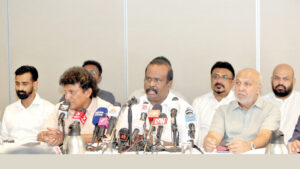
Representatives of Tamil, Muslim and Malaiyaha Tamil political parties at the launch of the new platform. Pic by Rukmal Gamage
For decades, minority politics in Sri Lanka has been shaped by a fundamental question: who speaks for communities that often feel unheard within the State? The political changes of 2024 appeared to offer a different answer, that a national political movement could move beyond traditional identity-based politics. Yet, the emergence of a new platform among Tamil, Muslim and Malaiyaha Tamil political parties suggests that the question of representation has not disappeared.
The platform has generated different reactions. Some see it as a necessary effort to rebuild minority political representation and create a common voice on unresolved issues. Others see it as a return to ethnic politics or an attempt by weakened parties to remain relevant. Even among Tamil-speaking communities, questions remain over whether this represents a genuine effort to address longstanding concerns or merely another political arrangement by leaders seeking relevance.
M.A. Sumanthiran said at the launch that cooperation among minority parties is not new. Tamil, Muslim and Malaiyaha Tamil leaders have worked together at various moments in Sri Lanka’s post-independence history on constitutional reform, representation, language rights and power-sharing. The current initiative is part of that longer tradition.
A history of cooperation and mistrust
The roots of this thinking can be traced back to the early years after Independence. The disenfranchisement of plantation Tamils through the Citizenship Acts of 1948 and 1949 was a defining moment in minority politics. For S. J. V. Chelvanayakam and other Tamil leaders demonstrated that minority communities could not depend solely on political assurances from majority Governments. They required constitutional safeguards, meaningful representation and a role in decisions affecting their future.
The Ilankai Tamil Arasu Kadchi (Federal Party), founded by Chelvanayakam in 1949, was primarily shaped by concerns relating to Tamil political rights. However, Chelvanayakam also recognised that Muslims and Malaiya Tamils had their own political identity and aspirations.
Over time, Tamil, Muslim and Malaiyaha Tamil communities developed different priorities. Northern Tamil politics was shaped by war, accountability and autonomy; Muslim politics by security and representation; and Malaiyaha Tamil politics by citizenship, land, labour rights and socio-economic exclusion. Their experiences and political choices were not identical.
Yet, they repeatedly encountered similar questions: who has access to State power, whose concerns receive attention and who gets to shape national decisions?
However, minority cooperation has never been straightforward. For many Tamil voters, the participation of leaders such as Mano Ganesan, Jeevan Thondaman, Rauff Hakeem and Rishad Bathiudeen raises difficult questions. These leaders and their parties have been part of successive Governments, including administrations that many Tamils believe failed to adequately address accountability, militarisation, land disputes and meaningful political reform.
This criticism cannot simply be dismissed. Minority parties have often had to balance community expectations with the realities of Parliamentary politics. Participation in Governments has sometimes enabled them to influence decisions and deliver benefits to their communities, but it has also created perceptions of compromise and inconsistency.
The challenge facing these parties is, therefore, twofold: they must convince the wider country that this platform is not a return to old ethnic politics, while also convincing their own communities that it represents more than another temporary political arrangement.
The importance of this platform becomes clearer when viewed against the political transformation that followed the 2024 elections. A significant number of Tamil and Muslim representatives from the North, East and Malaiyaha Tamil communities entered Parliament through the National People’s Power (NPP).
Many minority voters chose to move beyond traditional political loyalties and support a movement that promised clean governance, economic recovery and a break from the failures of the old political establishment. This was a democratic choice reflecting frustration with existing parties.
The paradox of the 2024 election is that many minority voters made a conscious decision to move beyond traditional community-based politics, yet the issues that shaped those politics did not disappear. A change in political representation does not automatically resolve questions of equality, recognition and participation. The challenge for Sri Lanka is whether a national political movement can address these concerns without requiring communities to organise separately to be heard.
Distinct voice
Historically, Tamil and Muslim political parties, despite their weaknesses and contradictions, played a role in articulating community-specific concerns within Parliament. They provided a distinct voice on issues such as devolution, land, language rights, accountability and minority representation. The 2024 elections changed that political landscape. Many voters elected representatives from a national political movement rather than community-based parties. The question now is whether representation within a larger governing party has been translated into meaningful political influence.
The concern is not that NPP representatives from minority communities do not represent their voters. They were elected through a democratic process and have a legitimate mandate. Nor is this a criticism of individual representatives or their commitment to their communities. The deeper question is whether political systems create sufficient space for representatives from diverse backgrounds to influence decisions within a large and highly centralised governing movement. This is not only a minority issue; it is a question about the quality of Parliamentary democracy itself.
A strong Parliamentary majority allows the Government to implement its program. But democracy is not only about passing laws; it also requires debate, accountability and space for different voices.
Sri Lanka’s own Constitutional history provides an important reminder. The 18th and 20th Amendments, despite their widely criticised impact on democratic institutions, were passed because Governments possessed the required two-thirds majority in Parliament. The lesson is not that the Parliamentary majority is illegitimate. The lesson is that a majority alone does not necessarily strengthen democracy.
A healthy democracy requires more than numbers in Parliament. It requires institutional restraint, meaningful debate and space for opposition voices, particularly those representing smaller communities. When certain experiences disappear within a broader national narrative, Parliamentary representation loses an essential part of its purpose.
Beyond ethnic politics
The idea that all citizens are equal Sri Lankans is an important aspiration. However, a shared identity cannot be built by ignoring different historical experiences. For many Tamils and Muslims, the issue is not whether they are equal citizens. The issue is whether equality can be achieved without recognising the structural inequalities that have shaped their relationship with the State. Sri Lanka should move beyond ethnic politics. But moving beyond ethnic politics cannot mean ignoring the reasons why identity became politically significant in the first place.
A truly inclusive national identity must recognise differences rather than assume they no longer exist. Questions relating to constitutional reform, language rights, unresolved land issues and economic inequality remain important not because they belong only to one community, but because they reflect unfinished questions about the relationship between citizens and the State. Minority representation is, therefore, not necessarily a rejection of national unity; it can also be a demand for a more inclusive form of it.
The NPP came to power promising more than a change of Government. It promised a transformation of political culture. Its appeal across communities was based on the idea that it represented a national project rather than a Sinhala, Tamil or Muslim political project.
A national political movement can demonstrate that recognising minority concerns does not weaken national unity; it strengthens democracy. The NPP’s own manifesto recognised the importance of constitutional reform and meaningful power-sharing arrangements. For many communities, the concern is that these questions may disappear within a broader national reform agenda.
At the same time, the responsibility of the minority platform is equally significant. Its success cannot be measured simply by the fact that these parties have come together. They must prove that this is more than another political arrangement that raises expectations but delivers little. The greatest danger facing the platform is not criticism from outside; it is the possibility that it becomes another elite political arrangement disconnected from the everyday concerns of ordinary citizens.
They must be transparent about their objectives, accountable for their decisions and responsive to the communities they represent. They must engage constructively with the Government while holding it accountable and remain connected to the people they claim to represent. Minority representation cannot mean speaking on behalf of communities without listening to them. The significance of this platform is not simply that minority parties have come together, but what their cooperation reveals about Sri Lanka’s current political moment.
Sri Lanka does not face a choice between national unity and recognising diversity. A stable democracy requires both. Economic recovery and good governance are essential, but they cannot replace the need for meaningful representation, inclusion and political dialogue.
The real test of this platform, and of the Government that holds power today, is whether Sri Lanka can build a political system where communities do not have to choose between being equal citizens and having their own voices heard. That remains the unfinished business of Sri Lankan democracy.
The writer is a lawyer and governance practitioner writing on democracy, rights and political change in Sri Lanka.