Life and Learning with Six Muses
by Sachi Sri Kantha, March 13, 2026
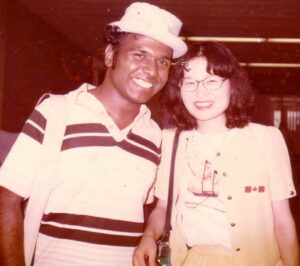
Sachi meeting his first muse at Chicago O’Hare airport (1983)
In the previous installment (Part 9), I wrote about the influence of two of my teachers (the link is https://sangam.org/notes-on-reaching-70-not-out-part-9/
But my creativity story will be incomplete, if I fail to acknowledge the sparks thrown by my six muses. Not to be omitted are seven elders, whom I consider as my mentors. In this part, I describe a little about my collaboration with six muses, on how they came to influence my writing.
The dictionary provides following three definitions to a muse, in its usage as a noun.
- Greek mythology – any of the nine daughters of Mnemosyne and Zeus, each of whom presided over a different art or science. (2) [a] muse – a guiding spirit. [b] a source of inspiration. (3) muse – a poet. I refer to the 2nd definition for this essay.
In 1940, Bertrand Russell published an essay entitled ‘The functions of a Teacher’ (Harper’s Magazine, June 1940). A sentence in this essay, ‘Any man who has the genuine impulse of the teacher will be more anxious to survive in his books than in the flesh.’ had remained as my life motto.
First Three Muses – Family members
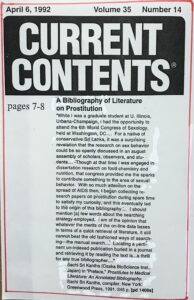
‘Prostitutes in Medical Literature’ book notice in ‘Current Contents’ (1992) – Press Digest
While three of my muses offered creative spur for my books, three other muses enabled me in writing publishable papers in biomedicine. My first book published in USA was PROSTITUTES IN MEDICAL LITERATURE: AN ANNOTATED BIBLIOGRAPHY, 1991, 245pp, Greenwood Press, Westport, Connecticut.
First muse: Saki Endo, was my Japanese pen friend, while I was at the University of Illinois, from Aug 1981. After graduating from Nihon University with a chemical engineering degree, she was then working as a chemical analyst of batteries at the Sony-Eveready plant in Koriyama. We met for about 20 minutes at the Chicago O’Hare airport in the summer of 1983. I was 30, and she was 29. I arrived at Tokyo in January 1986 for the first postdoctoral research at the University of Tokyo, with only 900 US dollars ($800 in travelers check plus $100 in cash), with a guarantee that I’ll be a Monbusho (Japan’s Ministry of Education) fellow for three years. What I had brought from Illinois was only 174,192 Japanese yen, at the then currency exchange rate of S1= 193 yen. For me to settle down in a single room apartment near the University of Tokyo, I had to pay 438,000 yen [$2,514] as advance payment. In reductive terms, my Saki offered mental and financial sustenance during that critical year of my life. I was pleased that she accepted my proposal, and we got married in January 1987. We’ve been together since then, and will tick 40 years of married life, coming January. Both being scientists, we made it certain that we cannot fail in this ‘life experiment’. It’s a fact that we were bonded by our mutual passion for books and reading.
AIDS epidemic in 1980s was the primary reason for the origin of this bibliography on prostitutes. This book established my status as a medical historian-bibliographer. I was 38 then. On submission of the typed, camera-ready book pages to the publisher, I received US$ 500, as advance payment. To reduce the type-setting and printing cost, the publisher wanted my manuscript submitted in a camera-ready format; in 1990, I didn’t even have a personal computer. Even at my work place (MCP), there was ONLY one small size desktop computer, to be shared communally by all the group members, including the professor. As this work was beyond my routine lab work, I could only type the manuscript in a NEC brand word processor I owned.
This was my first book to be published in the USA. I prepared the text, while I was a post-doctoral fellow at the then Medical College of Pennsylvania (MCP), Philadelphia, during 1989 and 1990. Subsequently, this institution changed management names by merger, as Allegheny University of the Health Sciences (1996) and then to MCP Hahnemann University (1998). Now, it is under a different name as Drexel University College of Medicine.
Proposal for this book was sent to two (small scale) American publishers and was rejected. Third time I was lucky with the Greenwood Publishers in Connecticut. Saki assisted me in preparing the indices for this bibliography. Excluded in the acknowledgment of the book was the inspiration I had gained from Sri Lankan bibliographer Henry Goonetilleke’s voluminous compilation ‘Bibliography of Ceylon’.
Reception for the Bibliography
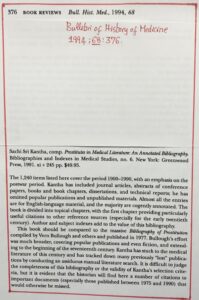
‘Prostitutes in Medical Literature’ bk review in Bull Med Hist. (1994)
A two paragraph review of this book, which appeared belatedly in the reputed Bulletin of History of Medicine [1994; 68(2): 376], stated as follows:
“The 1,240 items listed here cover the period 1900-1990, with an emphasis on the postwar period. Kantha has included journal articles, abstracts of conference papers, books and book chapters, dissertations, and technical reports; he has omitted popular publications and unpublished materials. Almost all the entries are for English-language material, and the majority are cogently annotated. The book is divided into topical chapters, with the first chapter providing particularly useful citations to other reference sources (especially for the early twentieth century). Author and subject indexes add to the value of this bibliography.
This book should be compared to the massive Bibliography of Prostitution compiled by Vern Bullough and others and published in 1977. Bullough’s effort was much broader, covering popular publications and even fiction, and extending to the beginning of the seventeenth century. Kantha has stuck to the medical literature of this century and has tracked down many previously ‘lost’ publications by conducting an assiduous manual literature search. It is difficult to judge the completeness of this bibliography or the validity of Kantha’s selection criteria, but it is evident that the historian will find here a number of citations to important documents (especially those published between 1975 and 1990) that would otherwise be missed.”
Another favorable review in two short paragraphs, by Prof. David O. Friedrichs (1944-2022), a specialist in sociology and criminal justice) also appeared in the American Reference Books Annual 1992 (vol. 23, p. 669, entry no. 1649). What I liked was his opening sentence. In this he had neatly captured my ‘originality angle’. In my bibliography, I brought together the prostitution literature that were dispersed in diverse areas – such as public health, infectious diseases, anthropology, forensic sciences, law and physiology. Friedrichs had commented on the merit of my compilation as follows:
“The focus of this bibliography may seem unusual, in so far as prostitution is not typically thought of primarily as a medical problem. Kantha has faced a challenging task in identifying relevant items for inclusion. The bibliography lists 1,446 items from 1900 onwards, with the emphasis on publications since World War II Many of the items are briefly annotated. A vast range of sources – from journals to commission reports – have been surveyed, with over 200 foreign language items included.
Following an opening section of general and historical works, succeeding sections provide items on anthropological, legislative and sexological dimensions of prostitution. There are also large sections on physical and mental health and prostitution. Currently, of course, there is intense concern with prostitution as a source for the transmission of AIDS. Accordingly, the extensive list of relevant items (all of recent vintage) will be exceptionally useful to researchers. In view of the specialized focus of this volume (and the series generally), it will be a necessary acquisition for medical libraries but more optional for other types of libraries.”
Also to be noted is a brief notice included in my mentor Eugene Garfield’s weekly publication for scientists, Current Contents of April 6, 1992 (vol. 35, no. 14, pp. 7-8). For this notice, Garfield had extracted few sentences from my preface to the book about literature searching by manual method.
Marital collaboration with my first muse, brought forth to this world two of my next two muses, in 1988 and 1992. I dedicated my Prostitutes book to the elder of the two, with the thoughts “To my two year old daughter Sachiko, with the hopes that she will continue this project in the twenty first century.” This was in 1991.
Now after 35 years, if I wish to bring out a 2nd edition of this book, title need a revision. The word ‘Prostitutes’ have gone out of fashion and become archaic. Currently accepted terminology is ‘Sex workers’, in medical lingo.
Second and Third Muses – Daughters Sachiko and Sangita
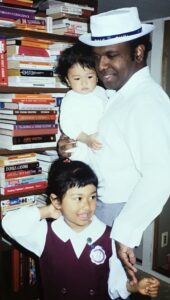
Sachi, with his two little muses (1993)
Five years later, my second book AN EINSTEIN DICTIONARY (Greenwood Press, 1996, 298 pp, Westport, Connecticut) was published. I consider this book as ‘my magnum opus’. Its origin and reception has been described in a previous chapter of this series.
[https://sangam.org/notes-on-reaching-70-not-out-part-7/] Thus I refrain from repetition here, except two details.
First, I had dedicated this dictionary to my two little muses, as follows:
“Sangita, whose birth in 1992 postponed the birth of this book by a year, and Sachiko, who tolerated her father’s robbing of her ‘play time’ with stoic patience.”
In the photo presented nearby, we could notice a few Einstein related books in the adjacent shelf, which I had studied then.
Secondly, I became aware of a biography version (oriented to high school student audience) akin to my Einstein dictionary book in the American market in 2004. It was published by educational book publisher John Wiley & Sons (Hoboken, New Jersey), and was authored by Karen C. Fox and Aries Keck. The title of this book was ‘Einstein A to Z’ (310 pages). Both authors were media journalists, and described their work as ‘A biography presented in bite-size entries’. The blurb in the back cover of this book states ‘The first accessible, handy reference to Einstein’s world.’ Well, I can only say that I do not hold a patent on Einstein’s life! Three notable differences of this book, to that of mine deserves attention. First, whereas I had compiled almost 600 entries, this 2004 book had only 114 entries. Secondly, whereas I had included many original citations to published science papers to majority of my entries, this Einstein A to Z book is devoid of any citation(s) to any of the entry. Thirdly, at the end of the book, Fox and Keck includes a list of 29 books as ‘Selected Bibliography’, and my ‘An Einstein Dictionary’ also has been included in it.
A commission from the Oxford University Press in 1994
While I was affiliated to the Osaka Bioscience Institute, then headed by Prof. Osamu Hayaishi (1920-2015), the eminent USA-born Japanese biochemist, through his courtesy, I received a commission for a translation of a biomedical reference atlas, from Japanese to English. I was a member of his research group, studying the neurochemical effects of prostaglandins and allied compounds in rats.
ATLAS OF NEUROACTIVE SUBSTANCES AND THEIR RECEPTORS IN THE RAT, edited by Masaya Tohyama and Koichi Takatsuji, 1998, 337 pp [translated from Japanese to English], Oxford University Press, London.
The memorandum of agreement was signed by me on June 30, 1994. I had to complete the task within five months, by November 30, 1994. While each chapter in the original had different authors, for the English translation, I was the sole translator and had to provide a uniform context. For this work, Saki was involved. Prof. Hayaishi knew about the science background of Saki, and though I was incapable of reading medical Japanese, he suggested that she can help me to do this translation. Saki and I accepted his suggestion, First, she prepared a tentative English translation in simple format. Secondly, I would follow up by checking the original science papers cited by each author for verification, and refined Saki’s version with appropriate neuroscience terminology. We completed this work in four months.
The remuneration received 500,000 yen (approximately US$5,000) was the maximum monetary benefit I had received in my writing career of half a century. With this remuneration, I was able to purchase my first computer – an Apple Macintosh 9500 model (launched in June 1995), for a sum of around 350,000 yen then. This remuneration was five-fold higher than the combined advances received from the Greenwood Publishers for my two books, they had published in 1991 and 1996! A review of this Atlas by Ruth McKernan did appear in Trends in Neuroscience (April 1999, vol. 22, no. 4, p. 190).
Fourth Muse – a Monkey
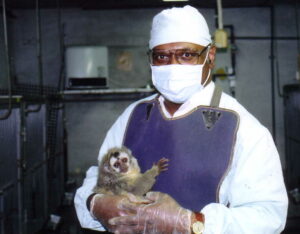
Sachi holding his 4th muse – owl monkey (2005)
I was introduced to my fourth muse – Owl monkey (Aotus sp.) when I joined the then Primate Research Institute of Kyoto University as a visiting professor in 2002. This neotropical monkey is the ONLY night-active monkey, among all the extant true monkeys. I was told that, a colony of 16 wild and captive born owl monkeys are available for study. As no other researchers were keen to study them, I found them as a god given gift to study their sleep behavior under captive conditions. It was not easy to study their behavior even in the wild, because their natural habit is tall trees (20 meters and above) in Amazon jungles and they won’t come to the ground. In collaboration with veterinarian scientist Prof Juri Suzuki, we studied the activity-sleep behavior and vocalization behavior of for nearly 12 years until 2014 and published 7 papers in International Journal of Primatology, Journal of Medical Primatology, Neotropical Primates, Acta Neurobiologiae Experimentalis, International Medical Journal and Reviews in Agricultural Sciences (see the reference list below).
The photo of me and my monkey muse presented nearby was taken by Dr. Suzuki. The monkey muse had recovered from anesthesia, and groping my chest pad. As this is a night active monkey, it shows the reverse action of groping of how we humans behave, when we enter a dark room. For comparison, check the other photo with my third muse infant Sangita; she also did similar chest groping function.
Fifth and Sixth Muses – Japanese graduate students
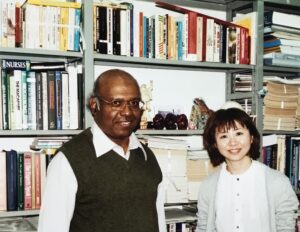
Sachi with his 5th Ayumi, on his 60th birthday (2013)
We settled in Japan, from 1991. Though continuing my day job as a biochemist, to build up my own career as a specialist in sexuality studies, I needed a theme to focus. One particular reason was I was reading Freud’s works (in English translation) for incorporating Freud’s creativity as a theoretical control to my Einstein-related papers. (See my Freud-study listing below.) Sexuality of women and Freud are blended together and one cannot be cleaved from the other. Having a family nucleus of Japanese wife and two daughters what else I had to focus, other than the discipline of women’s studies, and the status of women in Japan.
Towards this objective, I made attempts to join academia, so that I can have easy access to women students entering the universities. Due to prevailing ‘academic apartheid policies’ and other related issues of slavish mentality of Japanese decision makers for ‘white skin and Christian name’ in 1990s, it took almost a decade for me to enter a national university at the rank of term-limited Associate Professor position. I provide an excerpt from 1993 commentary by Dennis Normile to Science journal, about the recruiting policy at the Japanese universities then.
“Today, the number of non-Japanese faculty at national universities is still infinitesimal – 201 out of some 37,000 and only 17 of those hold tenured appointments equivalent to those of their Japanese colleagues. Although the Ministry of Education recently called for more openness to foreign faculty, many schools, including three of the most prestigious – Kyoto, Osaka and Tsukuba universities – still forbid grants of tenure to non-Japanese faculty members.”
It was the same with the University of Tokyo as well, barring a couple of exceptions for cosmetic purposes (such as a white American, a Chinese) for diplomatic reasons. But, I did face rejection in my few attempts to join, despite me being a PhD holder from the University of Tokyo. One of the possible reasons for my rejection could be, an academic with a Sri Lankan passport is abysmally unequal to a passport holder from USA and China.
Nevertheless, from 2000 to 2020, I was lucky to work in full time positions at the Gifu University, Kyoto University and Gifu Pharmaceutical University and also in part-time teaching positions in another three Japanese universities. I had taught cumulatively around 2,500 students at undergraduate and graduate levels in all these institutions. A small percent of them were international graduate students from Asia and Africa. Among these 2,500, I was fortunate to find two muses (5th and 6th muses), who contributed to my investigations on the sexuality of Japanese young women. Both were in the same age cohort of my two daughters.
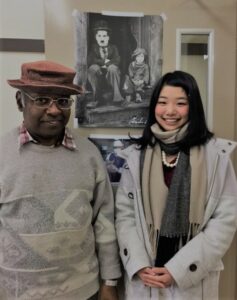
Sachi, with his 6th muse Yuri (2017)
5th muse was Ayumi Hibino and 6th muse was Yuri Matsui. Now, both have got married and their names are different. Both became muses, only towards their end phas Master’s degrees in Applied Biological Science and Engineering curricula. I met Ayumi for the first time in 2011, when she was a sophomore. I met Yuri for the first time as a freshman in 2014. At the end of a semester of teaching, I read her teacher evaluation comments submitted to the curriculum chaperons. She had written ‘After entering the university, for the first time I met a teacher who thinks about his students’ welfare.’ This appreciative thought touched my heart. For record, my co-authored papers with them on the sexuality of contemporary Japanese women (and men) are listed in the reference list.
During the decade from 2011 to 2020, one of my endeavors was to introduce sex education to undergraduates and graduate students at the universities I taught. I did this stealthily under the guise of teaching ‘scientific English’, because my ideas were offensive to the academic blockheads holding curriculum chaperon roles at the universities. They pride themselves as Victorian era prudes, even in the 21st century. My intention was to tune the young minds with the educational message of my academic idol Bertrand Russell. I chose sex-related themes of interest to students (such as sex appeal, sexual desire, sex harassment, adultery, frottage, kissing and nudity), published in journals like Nature, New England Journal of Medicine, New Scientist and Lancet and gave homework exercises. For this act, I faced inquiries, reprimand and reduction of my teaching units, even for such class-room activity. Once, I was chastised for showing a Playboy magazine semi-nude photo in the classroom (for less than 5 sec.), to explain a point for the homework exercise, related to a paper which had been published in the Lancet journal. This will be a different story to write separately, especially the Playboy magazine allergy of Japanese bureaucrats and academics. One dimwit academic warned me that I would be charged for sexual harassment of students, without him knowing the fact that he was engaged in power harassment of me simultaneously in his line of duty.
But, Ayumi and Yuri stood by me like angels providing mental sustenance for my endeavors. Twice, my digital mail and computer access privileges at the university were also blocked and delayed for more than a month, under the ruse of ‘prevention of international hacking’. When I mentioned this problem I faced with the ‘stiff necks’ to the 6th muse, without me asking for it, she willingly gave me her student digital access code, to continue my research.
Coda
What has been published now in 10 papers is a fraction of my collected data about sexuality in contemporary Japan. And each of these are in different theme. Still, much remain un-analyzed and unpublished.
REFERENCE LIST
American Heritage Dictionary of the English Language, 4th ed, Houghton Mifflin Co, Boston, 2000, p. 1158.
Normile D. Surprise! Foreigners can get jobs in Japan. Science, Sept 2, 1993 261: 1774-1775.
Freud studies
Sri Kantha S. Scientific productivity of Einstein, Freud and Landsteiner. Medical
Hypotheses, 1996; 46: 467-470.
Sri Kantha S. Sexual humor on Freud as expressed in limericks. Humor, 1999; 12:289-299.
Sri Kantha S. Nobel awards and nominations for research/activities linked to human sexuality. International Medical Journal, Apr 2021; 28(2): 262-266.
Owl Monkey studies
Sri Kantha S and Suzuki J. Sleep profile and longevity in three generations of a family of captive Bolivian Aotus. International Journal of Primatology, 2006; 27(3): 779-790.
Suzuki J and Sri Kantha S. Quantitation of sleep and spinal curvature in an unusually longevous owl monkey (Aotus azarae)). Journal of Medical Primatology, 2006; 35(6): 321-330.
Sri Kantha S, Suzuki J, Hirai Y and Hirai H. Sleep parameters in captive female owl monkey (Aotus) hybrids. Neotropical Primates, Dec. 2007; 14(3): 141-144.
Sri Kantha S, Koda H, and Suzuki J. Owl monkey vocalizations at the Primate Research Institute, Inuyama. Neotropical Primates, June 2009; 16(1): 43-46.
Sri Kantha S, Suzuki J, Hirai Y and Hirai H. Behavioral sleep in captive owl monkey (Aotus azarae) and squirrel monkey (Saimiri boliviensis). Acta Neurobiologiae Experimentalis, Dec. 2009; 69(4): 537-544.
Sri Kantha S, Kuraishi T, Hattori S, Ishida T, Kiso Y, Kai C and Suzuki J. Behavioral sleep of captive owl monkey (Aotus lemurinus) in Amami Oshima, Japan. International Medical Journal, Dec 2015; 22(6): 521-524.
Sri Kantha S and Suzuki J. Owl monkey and melatonin puzzle. Reviews in Agricultural Science, 2019; 7: 84-87 (editorial commentary).
Sexuality studies (Only co-authored papers listed)
Sri Kantha S, Hibino A and Yamamoto S. Eu-love and pseudo-love: an important split in love taxonomy. International Medical Journal, June 2016; 23(3): 204-207.
Sri Kantha S and Hibino A. Is serum testosterone/estradiol ratio, an indicator of nipple’s primary function in humans? International Medical Journal, Dec 2017; 24(6): 455-458.
Sri Kantha S and Hibino A. Polymastia, polythelia and ecotopic breasts among Asian populations: an overview. International Medical Journal, Feb 2018; 25(1): 27-31.
Sri Kantha S and Matsui Y. Medical diagnosis on Leonardo’s ‘Mona Lisa’ portrait. International Medical Journal, Dec 2019; 26(6): 446-447.
Sri Kantha S and Matsui Y. ‘Kiss is Magic Medicine’: a study on humorous definitions on kissing by Japanese university students. International Medical Journal, Aug 2020; 27(4): 454-458.
Sri Kantha S and Matsui Y. What is sexual harassment? Perceptions of Japanese university students. International Medical Journal, Feb 2021; 28(1): 86-89.
Sri Kantha S, Kobayashi A, Saito S, Sakai S and Matsui Y. Is lactic acid a primary chemosignal molecule for pair bonding in humans? International Medical Journal, Apr 2021; 28(2): 208-212.
Sri Kantha S and Matsui Y. Frotteurism in Japan and other Asian countries. International Medical Journal, Aug 2021; 28(4): 470-475.
Sri Kantha S and Matsui Y. Japanese medical and nursing students ponder on kissing: post publication impressions of a 2014 review. International Medical Journal, Dec 2021; 28(6): 671-675.
Sri Kantha S and Matsui Y. Medical issues on Marilyn Monroe’s life and death: a retrospective – part 1. International Medical Journal, Apr. 2022; 29(2): 132-136.
Sri Kantha S and Matsui Y. Medical issues on Marilyn Monroe’s life and death: a retrospective – part 2. International Medical Journal, Jun. 2022; 29(3): 216-219.
An inadvertant spellng error, related to description of my 4th muse (owl monkey) needs correction.
In the sentence which carries the words, ” natural habit is tall trees (20 meters and above)”, the specific word ‘habit’ needs revision to ‘habitat’. In biological context, both words have different meanings.
It is obvious that Dr. Sachi have lived through again the highlights of his life by writing this chapter, in particular the way he introduces his family and graduate students and his timely contribution during the start of AIDS epidemic “PROSTITUTES IN MEDICAL LITERATURE: AN ANNOTATED BIBLIOGRAPHY,” which received a befitting review “there is intense concern with prostitution as a source for the transmission of AIDS. Accordingly, the extensive list of relevant items (all of recent vintage) will be exceptionally useful to researchers. In view of the specialized focus of this volume (and the series generally), it will be a necessary acquisition for medical libraries.” It is really sad that due to prevailing ‘academic apartheid policies’ and other related issues of slavish mentality of Japanese decision makers for ‘white skin and Christian name’ in 1990s, it took almost a decade for him to enter a national university at the rank of term-limited Associate Professor position, but I am sure that his works will stand the test of time and carve out an unique position for him in the years to come.
As an after-thought, I wish to include this additional reference, of my single author paper, published in the International Medical Journal (Tokyo) in 2018. In this paper, I had provided details, related to the incident I had faced at the Gifu University during 2017, in the last sentence of the penultimate paragraph of this essay.
Sri Kantha S. A polymastia photo and pre-clinical anatomy lesson: Perceptions of freshman medical and nursing students. International Medical Journal, Oct 2018; 25(5): 318-320.
For intersted readers, complete text of this paper is available in my Research Gate profile. The link is
https://www.researchgate.net/profile/Sachi-Sri-Kantha