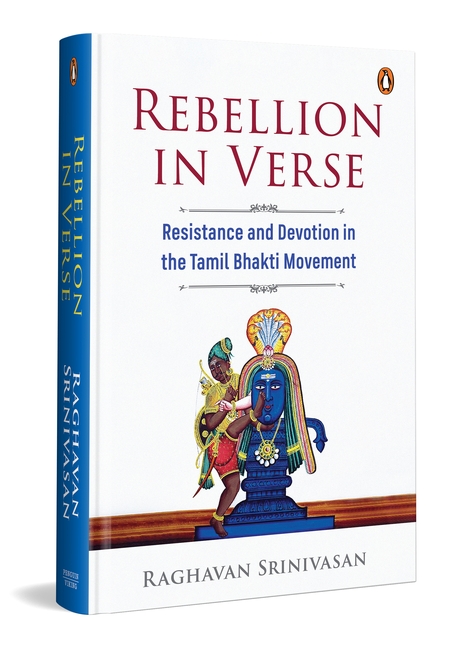
Rebellion in Verse
Resistance and Devotion in the Tamil Bhakti Movement | Indian Religious & Cultural History | Devotional Poetry, Faith and Social Change
Raghavan Srinivasan
 Why chant the Vedas, follow Vedic karma?
Why preach day by day the books of dharma?
Why learn the six Vedangas by rote?
One thing alone will to your rescue come—
thinking always of the Lord Supreme.
In the Tamil region in medieval times, a quiet revolution unfolded. It came to be known as the Bhakti movement. Appar’s hymn above exemplifies its spirit of rebellion against Vedic rigidity and ritual.
Rebellion in Verse unfolds a journey that goes back to the sixth century CE—a time when many yearned for a reprieve from the constraints of Vedic orthodoxy and caste hierarchies. The Tamil Bhakti movement emerged as their clarion call, a grassroots surge of devotion that redefined spirituality and the social fabric itself.
The saints of this movement were poets of the people, composing their hymns in Tamil and their verses, brimming with simplicity and profundity, wrestled divine wisdom from the elite grip of Sanskrit and handed it to the masses.
Change had dawned. It would soon ripple through history with the force of a tidal wave.
Imprint: India Viking
Published: Jan/2026
ISBN: 9780143474005
Length : 304 Pages
MRP : ₹999.00
“The rise of Bhakti in Tamilakam wasn’t merely a movement of devotion—it was a linguistic coup d’état, a revolution that spun the wheel of religious and cultural expression on to an entirely new axis. Imagine Sanskrit as the polished jewel of the Pallava courts—pristine, exclusive and carried in by learned Brahmanas from the north like a prized family heirloom seeking a new mantlepiece. These Brahmans, custodians of Vedic knowledge, brought not only their expertise but an air of prestige that southern kings couldn’t resist. Hosting these emissaries of Sanskrit was akin to aligning one’s kingdom with celestial coordinates, a status upgrade that came wrapped in layers of sacred rites and lofty rituals. For the Tamil kings, Sanskrit was the royal seal of legitimacy—a golden ticket to divinely sanctioned rule.
But beneath this shimmering Sanskrit veneer, Tamil flowed like an underground river, steady and unrelenting, carving its identity into the cultural bedrock of the south. Tamil wasn’t merely a language—it was the heartbeat of the land. From the lyrical symphonies of the Sangam anthologies like the Ettuthogai and Pattupattu, to the epic tales of Silappathikaram and Manimekalai, Tamil had long stood its ground, a formidable counterpoint to Sanskrit’s religious gravity. If Sanskrit dominated the royal courts, Tamil coursed through the veins of the people, whispering stories of love, valour and the indomitable human spirit.
Rebellion in Verse, Raghavan Srinivasan, Penguin India, 2026.
Then came Bhakti—a seismic shift that brought these two worlds together, not in a clash but in a symphony. Picture Sanskrit’s high philosophy and religiosity donning a Tamil cloak, shedding its aloofness to mingle with the earthy, visceral narratives of Tamil love and war. In the hands of Bhakti poets, this fusion became something extraordinary: a hybrid form of spirituality that spoke not only to scholars but to farmers, potters and weavers. It was as if the lofty philosophical musings of the Vedic tradition had been distilled into verses that could be sung while tilling a field or weaving a sari— accessible, resonant and deeply personal.
Even the late classical Tamil anthologies of the Sangam era, like Paripatal and Tirumurugattrupadai, hinted at this transformation. These works took Sanskrit myths and motifs, polished them with Tamil sensibilities and presented a captivating blend of the erotic, the heroic and the sacred. Kings and warriors gave way to gods like Murugan, whose exploits were celebrated with the same fervour that once lauded human heroes. It was as though Tamil poetry, long a stage for human drama, had extended its spotlight to the divine, preparing for the grand spectacle of Bhakti.
This shift cannot be seen as just swapping kings for gods. The tinai landscapes, those evocative metaphors for human relationships and emotions, found new life as canvases for social justice, personal duty and collective aspirations. What once depicted the tender pangs of love or the valour of warriors now painted a broader vision of equity and inclusion. Tamil poetry, with its lush imagery and emotional depth, became a medium not only for devotion but for dialogue—a way to question societal norms and dream of a fairer world.
Bhakti’s linguistic revolution, besides bringing gods closer to people, was also a call to reconnect with humanity. It stripped away rigid caste lines, sidestepped oppressive hierarchies and wielded the language of devotion like a torch, illuminating paths towards equality and compassion. Gods were no longer distant figures perched on cosmic thrones; they were intimate, relatable and, above all, champions of justice and love. In this new era of Tamil literature, Bhakti was more than a spiritual awakening—it was a collective reckoning, a poetic rebellion and a heartfelt plea for a more inclusive and humane society.
At the heart of this transformation wasn’t merely the shift from Sanskrit to Tamil—it was a full-blown democratisation of spirituality, the equivalent of throwing open the temple doors to anyone who dared to walk in. The Bhakti poets not only wrote in Tamil; they revolutionised the way devotion was expressed. They showed that the divine could be addressed in the language of lullabies and market chatter, the same Tamil that carried the concerns of farmers, weavers and merchants. This wasn’t just a linguistic pivot—it was a social earthquake that put spiritual power squarely in the hands of the people. No priests with complex rituals, no scholars with their elite codes—just you, your Tamil and your devotion.
The Bhakti poets took the gilded cage of Sanskrit rituals and gave it a hearty shake, letting the birds of devotion fly free. They flipped the script on Vedic orthodoxy, taking gods off their celestial pedestals and weaving them into the fabric of daily life. These weren’t distant, intimidating deities who demanded elaborate offerings; they were relatable, accessible and, most importantly, approachable. The divine became as familiar as a loved one—a companion who shared your joys and sorrows. For the saints, devotion wasn’t about securing divine favour; it was a quest for love, a yearning that reflected the compassion and care they envisioned for a more just society. Their message was unambiguous: the divine didn’t play favourites—it belonged to everyone, no exceptions.”
This is an excerpt from Raghavan Srinivasan’s Rebellion in Verse.
This article went live on January tenth, two thousand twenty six, at seventeen minutes past twelve at noon.