Eye Health Notes from Elite Film Stars
by Sachi Sri Kantha
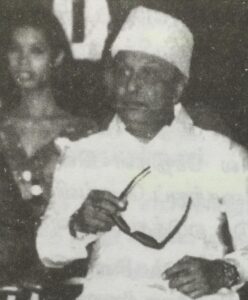
MGR, with dark glasses in his right hand (probably in 1970s)
Comments from R. Kannan
For Part 84, Kannan’s comments, received on Dec 9, 2025, were as follows:
“Except for a few, those close to MGR hold him in very high regard as a person. Countless individuals have noted his exceptional hospitality and helpful nature. Vast crowds thronged to see him, but MGR never shied away from meeting and interacting with them, unlike some actor-politicians today who cite crowds as a reason not to visit the families of the deceased and instead invite them to their place. I have seen MGR a few times in person, and every time I sighted him, I have been instantly electrified by his charisma. He always appeared like a celestial being. The heights that MGR reached can never be attained by anyone else in the state. Your Part 84 brought all these memories back to me.”
My response was:
“ I do appreciate. Yes, I do agree that MGR’s charisma is of exceptional caliber and will never be attained by other movie stars in any state of India. And this ‘charisma’ thing, is difficult to prove and measure scientifically by any methods that I know of.”
The first sentence of Kannan’s comment is apt here, especially the first four words ‘Except for a few’. In this chapter I target Prof. Mathias Samuel Sundara (M.S.S) Pandian (1958 – 2014), who belongs to this exception category mentioned by Kannan. He was a prominent MGR critic. Another one was ranking Tamil author D. Jayakanthan (1934 – 2015).
An AI generated review of the ‘MGR Remembered’ series
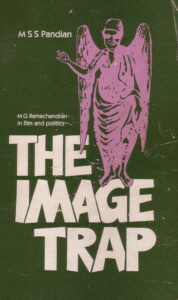
Pandian’s ‘The Image Trap’ (1992) book cover
It may be of interest to the readers of this series, to check what an AI-generated review of this series tells, at the end of 13 years and still running. If I’m permitted to brag a little, this series is akin to any of MGR’s super-hit movies of 1950s and 1960s. I present this review below. Letters in bold font, are as in the original.
“The “MGR Remembered” series is a extensive, multi-part biographical retrospective of the legendary Tamil actor and politician M.G. Ramachandran (MGR), written by Sachi Sri Kantha and published by the Ilankai Tamil Sangam (Association of Tamils of Sri Lanka in the USA) starting around 2012.
A central focus of this series is to revisit, correct, and challenge the analysis of MGR’s life and career presented by social scientist M.S.S. Pandian in his 1992 book, The Image Trap: M.G. Ramachandran in Film and Politics.
Key Aspects of the “MGR Remembered” Series
- Countering M.S.S. Pandian: Sachi Sri Kantha explicitly critiques Pandian’s work as “dyspeptic,” “sloppy,” and biased. Pandian argued that MGR’s popularity was based on a “deification” of the actor by an “illiterate Tamil mass” and that his public image was “phony”.
- Defense of MGR’s Popularity: Sri Kantha defends MGR by arguing that his connection to the masses was authentic and that Pandian failed to understand the nuances of Tamil cinema, its politics, and the audience.
- Correction of Historical Facts: The series frequently highlights errors in other biographies and academic studies of MGR, including those regarding his birthdate, marital history, and specific film production details.
- Film Analysis: The series dives deep into the sociological and political significance of MGR’s films, looking at how they promoted values like Tamil pride, self-support, and rights for the powerless.
Key Points of Dispute (Pandian vs. Sri Kantha)
| Subject | Pandian’s View (The Image Trap) | Sri Kantha’s View (MGR Remembered) |
| MGR’s Image | A manufactured, “phony” image that trapped the masses. | A genuine icon whose persona was developed through experience and audience trust. |
| Mass Popularity | Result of “deification” by illiterate voters. | Reflects a genuine connection to the non-Brahmin masses. |
| Marital Life | Cited as evidence of hypocritical behavior. | Argues Pandian ignores context, such as MGR being a widower early in life. |
| Intellect | Suggests MGR lacked intellectual depth. | Highlights MGR’s strategic thinking and understanding of his audience. |
Sachi Sri Kantha uses primary sources, including MGR’s own autobiography, to counter the ‘intellectual’ critique leveled by Pandian, aiming to provide a more empathetic and detailed portrait of the actor-turned-politician.”
Unlike a printed book, with a definite publication date and a definite number of pages within designed covers with blurbs, this ‘MGR Remembered’ series is a new experiment in biography writing, adapted to the digital era. As such, I hardly expected that this series will receive a review. But, now it has been done by AI – a digital apparition, without any clues to the identity of the reviewer.
Knowledge deficit of M.S.S. Pandian

M.S.S.Pandian (closer to the camera)
Mathias Pandian, is now hailed in the Indian academic circle, as an eminent sociologist from Tamil Nadu. He may be. But, in my evaluation, his analysis about MGR’s movie and political career has blatant bias, due to his knowledge deficit and personal political orientation. This is what I had tried to rectify in my criticism of his work. Pandian’s half-baked analysis of MGR’s contribution to the Tamil society in general (and also especially to the Tamil Nadu) shouldn’t go unchallenged. His tract‘The Image Trap’ (1992) book by Pandian had been reviewed in two academic journals, by two American academics, Robert Hardgrave and Pamela Price. Unfortunately, they were NOT well informed in Tamil language and literature. But, both had observed that Pandian’s work barely scratches the esteem and popularity of MGR’s among the Tamil masses. Prof. Hardgrave had inferred, “Pandian’s use of Gramsci’s concept of ‘common sense’ is neither illuminating nor successful in explaining how MGR produced ‘consent among the subaltern classes’, but Pandian nevertheless provides a fascinating and revealing analysis of MGR in film and ‘filmy politics’ in Tamilnadu.” Pamela Price also concurred similarly “book is unconventional in style and organization, a blend of essay-writing, political rhetoric and scholarship…The book will have less appeal than the topic warrants, however, because it does not include a general consideration of cinema as an element in political mobilization in Tamil Nadu. There are, as well, some lacunae in Pandian’s bibliography, and the result is a thinness in some of his discussions of the cultural presuppositions in common people’s common sense.”
As such, in this chapter also, I’m compelled to puncture a dubious caricature of MGR’s attire by Pandian. In a short profile on MGR, entitled ‘The MGR phenomenon’, which appeared in 1986, Pandian had opined on the adopted attire of MGR, after reaching 50. To quote Pandian, “His (MGR’s) wig and fur cap conceals his balding head, a traditional sign of ageing. His dark glasses conceal his sunken eyes.” I rebut Pandian’s comment on MGR’s ‘sunken eyes’ comment vehemently, WITH proof from the experiences recorded by ranking actors and actresses from Hollywood, on eye health. Did Pandian function as MGR’s internist or as ophthalmologist? He don’t provide any positive evidence for this. If not, Pandian had exposed his total ignorance on film acting, and the careers of actors that had lasted for over four decades.
Thoughts on eye health from Elite Film Stars
I doubt whether Pandian had read any books related to film making in general, written by actors and directors. Over decades, I had collected over 100 books on films (a 20th century art form) avidly; among my cherished collections are, Katharine Hepburn’s memoir of making The African Queen (1951) in location (focused only on one classic movie), and Charlton Heston’s 20 year diary (from 1956 to 1976) as a movie actor.
Perfectly functional, expressive eyes are most treasured as a precious armor in the competitive field of film acting. Without exception, all great actors and actresses will hardly yield to the demands and yields of photographers, journalists and fans to expose their eyes unwillingly. None other than Hollywood great Paul Newman (1925-2008), acclaimed for his beautiful ‘blue eyes’, had put it bluntly with these terse words:
“You work what you consider pretty hard at your craft and develop in a slow and painful way, and you’re getting to the point where you’re just starting to feel kind of good about yourself – and not just the way you look – and then somebody says, ‘Oh, God, take off your sunglasses so I can see your baby blue eyes!’ All the self-esteem you’ve managed to build up goes right out of the window. If I walked up to someone and said, ‘Let me see your brassiere,’ they’d be really offended.”
To disprove Pandian’s idiotic thoughts on MGR’s use of dark sunglasses, I provide below a compilation of thoughts on eye trouble and eye care from ten elite actors, culled from their autobiographies. The words in italics, are as in the originals.
Sammy Davis Jr. (in 1965/1990)
In one pathos-tinged chapter of his autobiography, Sammy Davis Jr., singer and actor, had described the mental agony of losing his left eye in an automobile accident, which happened on Nov 19, 1954. He was only 28, at that time.
His book begins with a prologue that provides a preview of this horrible accident he had to endure..
“…My forehead slammed into my steering wheel…I heard Charley [Sammy’s valet] moaning in the back. Thank God, he was alive too. I felt blood running down my face and into my eyes like it had a couple of time in the army when I’d been hit over the head. I could hardly see but I knew I’d be okay as soon as the blood cleared away…
He looked up at me and made a horrible choking sound, trying to speak. He pointed to my face, closed his eyes and moaned. I reached up. As I ran my hand over my cheek I felt my eye hanging there by a string. Frantically I tried to stuff it back in, like if I could do that it would stay there and nobody would know, it would be as though nothing happened. The ground went out from under me and I was on my knees. ‘Don’t let me go blind. Please, God, don’t take it all away…’ ”
Charlton Heston (in 1978)
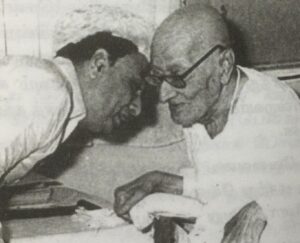
MGR with C. Rajagopalachari (Rajaji) – probably in late 1972
I consider Charlton Heston’s 20 year diary, a unique anthropological document, to study Hollywood-style movie making between 1950s and 1970s. It provides splendid vignettes from one who had experienced limelight, frustrations and failures ‘at the moment, when these were happening’. He played the hero role in ‘Ben Hur’(1959) movie and his antagonist was Irish actor Stephen Boyd who played Messala. Heston’s account describing the famous chariot race ‘takes’ (only for four specific days) in Rome are excerpted below. This was in 1958. Only the sentences related to eye strain are provided.
“June 17: We had a very bad break today. After getting all the subsidiary shots possible in the quarrel scene (the gift or the horse, the exit, etc.) we set up an intricate three-minute shot embodying the heart of the scene. We got it all rehearsed and were standing ‘like greyhounds in the slip’ when it became evident that Steve couldn’t stand the contract lenses long enough for the shot. They’re giving him a hell of a time. Never for me. If they don’t want me blue-eyed, they have to get a new boy.
June 19: Today was the toughest one yet, I think. We did the same close-up, the long scene of questioning Esther, with two or three camera lenses, till my eyes literally got tired focusing on the same spot…
July 4:….We couldn’t get Steve’s close angles because of his eyes, but we have the scene, I know that…
August 8: Another day on the plunging chariots, still without Steve, retired behind dark glasses for at least another day…”
Lauren Bacall (in 1978)
Not many had the opportunity to act with Marilyn Monroe in a movie, and also face her in same ‘takes’. But, Lauren Bacall had an opportunity, when both co-starred in ‘How to Marry a Millionaire’. What Lauren Bacall had written provides a lesson about how stressful it is for an actor, if a fellow performer fail to tango with similar timing. Though Bacall don’t mention this strain forcefully in words (maybe for diplomatic reasons), in between the lines, one can grasp her feeling.
“As Cinemascope was a new experiment for everyone, it was difficult. One had to keep the actors moving and not too close together, as the screen is long and narrow. You shot longer scenes in Cinemascope, five or six pages without a stop, and I liked that – it felt closer to the stage and better or me. Betty Grable was a funny, outgoing woman, totally professional and easy. Marilyn was frightened, insecure – trusted only her coach and was always late. During our scenes she’d look at my forehead instead of my eyes; at the end of a take, look to her coach, standing behind Jean Negulesco, for approval. If the headshake was no, she’d insist on another take. A scene often went to fifteen or more takes, which meant I’d have to be good in all of them as no one knew which one would be used. Not easy – often irritating. And yet I couldn’t dislike Marilyn. She had no meanness in her – no bitchery…”
Jean Negulesco mentioned above was the director of this particular movie.
Janet Leigh (in 1984)
Janet Leigh starred in Alfred Hitchcock’s thriller movie Psycho (1960). The most analyzed shooting sequence in film history was the ‘shower scene-murder’ that featured her glazed stare of a murdered woman when the character she plays was attacked by a knife wielding maniac was to be portrayed. This is how, Janet Leigh had described her experience.
“He [Hitchcock] was very thoughtful in regard to comfort and safety. His first impulse was to have me wear contact lenses for the close shot of the dead eye. When we went to the optometrist to select the lens and be fitted, the doctor explained he would need a few weeks with me to demonstrate the insertion procedure and accustom my organs to the foreign objects, or else my eye surface could be damaged. We didn’t have the time, and Hitch wouldn’t permit the risk, so he scrapped that idea. ‘You’ll ust have to got it alone, ole girl’. And he was adamant about the temperature of the shower water, tested it himself to insure its warmth…
The lengthy shot, starting with the eye in full frame and gradually easing back to disclose the draped body still clutching the torn curtain, the running water, the entire bathroom, was a thorny intricacy, from the technical side and from my side. I had to fix and maintain that empty glazed stare. Hitch found the spot where the camera wouldn’t pick up the blink and snapped his fingers to let me know (Mrs. Hitchcock always claimed, ‘I saw Janet blink in the film’. I didn’t see anything, but I couldn’t be positive it wasn’t there.) For sundry reasons we had to do it over and over. At long last a take was near completion without a mishap.”
Katharine Hepburn (in 1987 and 1991)
Two books of Katharine Hepburn, I refer here. The first is her charming 1987 memoir of location shooting experience for‘The African Queen’movie; it had an unusually long title. The beginning sentence itself is related to eyes. “I’ve never written a diary – well, I mean, put down dreary things like when did my eye start twitching? When did it stop? Why did it do it? – well, you know, things the doctor asks you and you’ve always forgotten them because they are really fundamentally dull.
Then, when you’ve lived as long as I have, you usually wish that you had kept one because you can’t even remember the plot of many of the movies you’ve made – or the plays ^ really not anything about them or who or why.”
Then, about her experience in shooting in Africa, Katharine Hepburn states,
“People are afraid of the African sun – bud oddly it didn’t seem to bother me, at least while playing golf. Otherwise I wore my straw Mexican sombrero. Many people say dark glasses are more important than the sun helmet. Who knows? Everyone does something different. I had a kind of stuff to protect my skin from the glare, being very freckled – and it worked. Aided by long sleeves and high necks.”
The second book was ‘Me: Stories of My Life’ (1991). In fact, one among the 31chapters, is simply titled ‘Eyes’ (chapter 26). In two pages, Katharine Hepburn had described the dialogue she exchanged at the doctor’s office. The words were arranged like how she delivers her dialogue (with her characteristic voice twang) in the movie. Just a sample below. Please note that the three dots are as in the original.
“Yes…Yes. I understand that. The skin is shrinking. Yes. It’s pulling the eye down.
“It’s not – what did you say? Senile ectropia. Yes…I see. But it is ectropia. Yes…I mean the…well, the lower lid is drooping…I mean pulling down…out…Yes, exposing the mucosa.
“No. They don’t tear. Well, they do…when I walk in the wind…or cold. Yes, tear.
“yes, they look red and they itch.
“Exposed, yes…I understand that. Yes, dry.
“Well, it does make one nervous. You know, itching is…well, yes, sir, it makes one nervous, naturally. Now, I understand that…Yes, I’ve been told that before. You would take part of the upper lid – the upper part…and use that to lengthen the skin from lower lid to the chin.”
Marlon Brando (in 1995)
Well, what Marlon Brando had noted about eyes is not directly related to eye health, unless if an ape is a fellow actor. But, he has a fascinating viewpoint which has empirical proof, and it deserves notice because it is from Marlon Brando. To quote,
“Acting, not prostitution, is the oldest profession in the world. Even apes act. If you want to invite trouble from one, lock your eyes on his and stare. It’s enough of an assault to make the animal rise, pound his chest and feign a charge he is acting, hoping that his gestures will make you avert your eyes.”
Shirley MacLaine (in 1995)
Shirley MacLaine’s Hollywood memoir contains quite many eye related notes. Here, I provide only one anecdote.
“Making pictures is like being in therapy. Every unresolved issue we’ve ever been plagued with will surface, depending, of course, on the material and the personnel involved….The day continues until at least seven, but more likely nine. In the old days, we women used to have a ‘no close-ups after six o’clock’ clause in our contracts. Today, because of spiraling costs and other economic factors, we usually shoot until the day’s allocated work is finished…
After the day’s work is finished, you don’t go home, or to your hotel if you’re on location. You go to the dailies. Dailies, or rushes, are many takes of the previous day’s work. To me, viewing them is necessary so I know how I’m doing…
I remember not being able to see many of the dailies when I was in Mexico shooting Two Mules for Sister Sara – the delay in processing back and forth from California made it difficult. I was playing a hooker posing as a nun and wore fake eyelashes. They were too overstated, but by the time I saw how awful they looked, it was too late. If I took them off, my face wouldn’t match the scenes already shot…”
Julie Andrews (in 2008)
Julie Andrews had described her struggle with strabismus in young days. She also mentions that when she is very, very tired, still she is afflicted with it.
“I remember being taken to a specialist [Julie mentions the year 1941, when she was ~6 years] for what my mother referred to as my ‘wandering eye’. A condition now known as ‘strabismus’, it was probably inherited – my daughter, and later her son, had the same problem when they were young. At that time it was thought to be due to a weak muscle and the theory was that if strengthened with exercise, the eyes would straighten up. So my mother found a woman who specialized in eye massage.
I underwent several excruciatingly painful treatments. I had to lie down and submit to the therapist sticking her thumb in my tear duct and working the muscle with enormous pressure. I could hardly bear it – the tears simply poured out – but since I was told it was necessary, I tried to comply. I don’t believe the treatments did me any good at all.
Ted Andrews [step father] bought me a new book called ‘The Art of Seeing’ by Aldous Huxley. It was the first gift he ever gave me. It contained eye exercises, such as holding a pencil and following it with one’s eye to the right or left, and wearing a bow pinned to one’s shoulder so that the offending eye could be attracted towards it. I was made to do these exercises religiously and maybe they worked, or maybe I simply outgrew the strabismus, for today I don’t seem to have it – except perhaps when I’m very, very tired.”
Michael Caine (in 2010)
Michael Caine had written about his eye disease as follows: “I was born with Blefora – a mild incurable, but noncontagious eye disease that makes the eyelids swell, I never asked Robert Mitchum if he had the same condition, but like many things that seemed like a problem initially, it turned out to be my advantage: my heavy eyelids made me look a bit sleepy on screen and of course sleepy often looks sexy.”
Paul Newman (in 2022 – a posthumous compilation)
“The dark glasses are not just because I want to hide myself – it’s far more complicated. I really have no tolerance for light, and I’ve made my eyes worse from wearing them. There’s also an accumulation of Budweiser as well as damage from my early days making movies; in those days, the slower film exposures often required an actor to keep looking straight into an arc light. We always had to put ice on our eyes and insert irritating drops to keep them bright and white for the cameras.”
A caveat: I have a premonition that movie-mad morons writing their digital blogs, students writing their term-papers and lazy zombies operating the AI will copy and paste this compilation of thoughts from elite film actors and re-cycle it as ‘their own’, without due acknowledgment. As such, I refrain from expanding further.
Eye-related thoughts from MGR
Unlike the descriptions provided above, MGR hasn’t mentioned much about his eye health in his autobiography, excluding a general statement. This was, ‘Human cannot comprehend the worth of sight, the distinctness of eye and its strength, when we can see.’ But, he had provided two inter-related anecdotes, which taught him a worthy lesson, after meeting his young, blind fans. These happened, while he was recuperating from leg injury in late 1959. One anecdote is reproduced below, in MGR’s words.
“I had offered Pongal meal to students of blind school. Central government Minister C. Subramaniam, others and me went. There were about 10-15 students, some even had to be assisted with feeding. When we entered, they greeted us by calling Minister’s name and my name. One student asked Mr. C. Subramaniam, ‘Is MGR nearby?’. Mr. C. Subramaniam responded ‘Yes’. Again the request, ‘Will you ask him to speak a little?’. Immediately, I talked, ‘I’m MGR here.’ To this, that student said – ‘No, No. You are not MGR.’
I talked firmly, with a question – ‘I’m MGR. Why should I tell a lie?’
To this, that student replied. ‘Your voice was unlike that of MGR. Your voice had changed.’
‘What’s the change you had noticed in my voice? Have you heard my voice previously? – I asked.
‘Yes, we’ve heard’ was the response.
I asked, ‘When and where?’ The response was ‘When we watched the Nadodi Mannan film. Then.’
I was surprised. Did they watch that movie? ‘Excuse me, how did you watch and appreciate the movie?’ I was forced to find an answer from them.
Devoid of any different feeling, they replied ‘We can appreciate the movie from the sound. In that movie, your voice was strong like a bell. Now, your voice is husky and lackluster.’
Then only I realized that previously for two or three days, I had addressed many meetings and also acted in stage. As such, my voice had dimmed and was husky. I didn’t realize, it was a big thing. They, who live by sensing the sound and its surroundings could distinguish my altered voice.
I told them the truth and physically left them – but couldn’t leave them from my mind.
Though devoid of their vision, they also offered me a new vision to my mind. I couldn’t offer anything for them in return, and was without strength as well. By their deed, they had taught me a truth about how humans should live. Having eye, nose, ear and mouth externally wouldn’t make a human. Few valued traits that reflects these endowments are vital too.”
Coda
Now, one can rationalize objectively why MGR wore dark glasses in public. Pandian’s interpretation that MGR wore dark glasses ‘to conceal his sunken eyes’ was utter nonsense. Among the above collections, Paul Newman specifically mentions about the damage caused by arc lights used in 1950s. Whereas Paul Newman’s first movie ‘The Silver Chalice’ was released in 1954, MGR’s hero role movie Rajakumari was released in 1947. In addition, sscd vJanet Leigh’s comment about Hitchcock that he ‘was very thoughtful in regard to comfort and safety’ had also been reiterated by MGR’s heroines, who had worked with him umpteen times.
Pandian, in the ‘Preface’ to his tract (what he called ‘essay’) stated that his objective was ‘an exercise in self-clarification. I am one among those many – both within and outside the state of Tamil Nadu – who have been puzzled and pained by MGR’s unparalleled political success.’ And asked ‘How did MGR succeed the way he did? This study is an effort to unravel the complex terrain of Tamil politics.’ Eventually, he flopped in measuring the trust bond MGR carried among the Tamils, not only in Tamil Nadu, but also in Sri Lanka. What had irked me was Pandian’s bias and illogical comparison of MGR’s popularity with Tamil masses, equating it to a cult, akin to that of fascist propaganda, while ignoring the propaganda cults established by Leftist icons Lenin, Stalin and Mao Ze Dong in the then Soviet Union and China. Literature on the cults of Lenin, Stalin and Mao were available in English for Pandian to study, prior to his demise. I provide only three references below (Nina Tumarkin, Robert Tucker and Ding Dong) to substantiate my claim.
Cited Sources
Julie Andrews: Home – A Memoir of My Early Years, Weidenfeld & Nicolson, London, 2008, p. 31.
Lauren Bacall: By Myself, Ballantine Books, New York, 1978, pp. 277-278.
Marlon Brando: Brando – Songs My Mother Taught Me (with Robert Lindsey), Arrow, London, 1995, p. 212.
Michael Caine: The Elephant to Hollywood – The Autobiography, Hodder Stoughton, London, 2010, p. 16.
Sammy Davis Jr, Jane Boyar, Burt Boyar: Yes I Can – the Story of Sammy Davis Jr., Farrar, Straus Giroux, New York, 1990, pp. 7-8, 195-198, 203-20, 213-214.
Ding Dong: Worship, reflection, empirical research: My Mao ZeDong trilogy. China Perspectives, 2012; 2(90): 55-59.
Robert Hardgrave Jr: review of ‘The Image Trap: M.G. Ramachandran in Film and Politics’ by M.S.S. Pandian. Pacific Affairs, Summer 1993 66(2): 292-293.
Katharine Hepburn: The Making of ‘The African Queen’ or How I went to Africa with Bogart, Bacall and Huston and almost lost my Mind, Alfred A Knopf, New York, 1987, 3, 25.
Katharine Hepburn: Me – Stories of My Life, Penguin Books, London, 1991, pp. 293-294.
Charlton Heston: The Actor’s Life – Journals 1956-1976, edited by Hollis Alpert, E.P. Dutton, New York, 1978, pp. 51-54.
Janet Leigh: There really was a Hollywood, Doubleday & Co, Ltd, New York, 1984, pp. 255-256.
MGR Naan Yean Piranthaen (Why I was Born?) – part 2, Kannadhasan Pathippagam, Chennai, 2014, p. 1190, 1209-1211.
Shirley MacLaine: My Lucky Stars – A Hollywood Memoir, Bantam Books, New York, 1995, p. 121-122.
Paul Newman: The Exraordinary Life of an Ordinary Man – A Memoir (edited by David Rosenthal), Penguin Random House, New York, 2022, p. 131.
M.S.S. Pandian: The MGR phenomenon. Economic and Political Weekly, Aug 23, 1986; 21(34): 1488-1489.
Pamela Price: review of ‘The Image Trap: M.G. Ramachandran in Film and Politics’ by M.S.S. Pandian. Journal of Asian Studies, May 1993 52(2) 488-489.
Robert C. Tucker: The rise of Stalin’s personality cult. American Historical Review, Apr 1979; 84(2): 347-366.
Nina Tumarkin: Religion, Bolshevism and the Origins of the Lenin cult. Russian Review, Jan 1981 40(1): 35-46.
A personal note: is in order. I apologize to the readers for a few typological errors, diffused here and there. In early days, I was careful in deleting these errors, prior to submission. Now with aging related ailments, I do realize that these typo errors serve a function, akin to the surrounding ugly thorns near the rose flower. These typo errors serve as digital markers for me to check aberrant ‘copy and paste’ criminals who are fellow travelers in the digital world.
It is pathetic that MSS Pandian stooped to the level of body shaming to criticize MGR. I am not sure about his motive to stoop that level, but Dr. Sachi have provided rebuttal to that in a wholesome manner. MGR’s interaction with blind children is very interesting as well as his take on it, “Having eye, nose, ear and mouth externally wouldn’t make a human. Few valued traits that reflects these endowments are vital too.”