A tongue-in cheek appreciation to Lalith Athulathmudali (1936-1993)
by Sachi Sri Kantha, April 2, 2026
Front Note by Sachi
Early this year, I presented my compilation of ‘Sinhalese Intelligentsia and Dimwits I admire and Resent’ [the link is https://sangam.org/sinhalese-intelligentsia-and-dimwits-i-admire-and-resent/]. One missed individual was attorney-turned politician Lalith Athulathmudali (1936-1993). I would place him in the ‘Definite intelligentsia’ category.
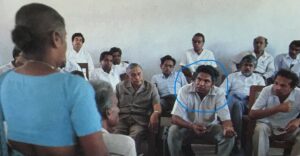
Lalith Athulathmudali (circled) meeting Tamil citiziens in Point Pedro (June 1987)
After I heard the news that Mr. Lalith Athulathmudali, UNP’s pro-Israeli politician, was assassinated on April 23, 1993, I wrote a tongue in cheek appreciation to him. It was published in the May 1993 issue of Tamil Nation (London) print edition. But, the published version disappointed me, because the then Interim editor had taken liberties with my composition without consulting me. Those were days before internet and email, and I had to use fax transmission to send my submission. At that time, Tamil Nation was facing management difficulties, following the arrest and detention of it’s founding editor S. Sivanayagam in Chennai, on a spurious charge related to the assassination of Rajiv Gandhi. Subsequently, N. Satyendra functioned as an interim editor role, and eventually he also left. Then, as a stop gap measure, another editor (I was informed the name of individual, but omit here for reasons of propriety) took over, and I believe he had revised my text to appear as the editorial. (1) How he revised my submitted text, was altering the ‘I’ to ‘We’, wherever these words appeared. (2) My name was omitted, thus totally altering the tone of my tongue-in-cheek appreciation.
Now, I wish to reclaim my original composition, and post it here to commemorate the 33rd anniversary of Athulathmudali assassination. Also to be noted is, this year marks his 90th birth anniversary, on Nov 26th. Yes, he and his nemesis Velupillai Prabhakaran (b. 1954) were born on the same day, spaced 18 years.
The original 1993 version follows:
Attorney Athulathmudali – An Appreciation
by Sachi Sri Kantha [Tamil Nation, London, May 1993, p.2]
Don’t get me wrong when I say that I love Lalith Athulathmudali in one sense. A dictionary definition for ‘attorney’ states, ‘one appointed to act for another in business or legal matters’. To Lalith Athulathmudali, this function perfectly fitted his shoes. He was the attorney of Sinhalese interests. Personally he was not only ambitious, articulate and assertive, but also arrogant and audacious in his dealings with Eelam Tamils. In an important way, I feel that attorney Athulathmudali was a God-sent guy to the Tamils to wake them from their slumber on defending the Eelam territory. So many thousands of Tamil lives and limbs would have been spared if not for the rash decisions made by this legal scholar while he held power. Thus, he, in his arrogant style, contributed to the ‘fighting spirit’ of the Eelam Tamils and activists.
Let me present some of Lalith Athulathmudali’s thoughts chronologically as recorded in 1984 and 1985. History will record that these two years (following the 1983 holocaust) were vital for Eelam campaign. He was crowned as the ‘war minister’ in March 23, 1984 and held this position for almost five years, till President Premadasa clipped Lalith’s wings of command in early 1989. There is no doubt Athulathmudali contributed to the current vigor of Eelam consciousness. Hence, my love on him. Athulathmudali was the attorney for the Sinhalese interests in the 1980s, when he delivered the following messages:
- “Sri Lanka has no quarrel with India. Its fight is against the Tamil terrorists. What is being done in the North (of Sri Lanka) is not intended to provoke India, with whom of we have had a long and traditional friendship.” (The Hindu, Apr 3, 1984).
- “This is a battle that we can win and I am more confident of that today than I was on March 23 when I took on this Ministry (of National Security).” (The Hindu, April 26, 1984)
- “Ultimately, we will have the entire population that is opposed to terrorism armed to the teeth.” (Newsweek, August 27, 1984)
- “Elements in the North (must) get out of their fear of the terrorist syndrome…They have to stand up and say: although we wanted a separate state, we now know (it) is not possible and therefore we have a compromise with honour.” (Asiaweek, August 31, 1984)
- “If you are weak in the face of terrorism, you stand no chance.” (Far Eastern Economic Review, September 20, 1984)
- [On the army massacre of more than 100 Tamil civilians in Mannar] “The Government does not condone such killings. When anyone dies it is a minus for this country. We have to investigate. We shall act to discipline them (army) if there is grave evidence that they lined up people and killed them.” (New York Times, December 8, 1984)
- “What is at stake is our independence, the unity of our country, the democratic way of life. We are faced by an enemy who does not want to talk to us, an enemy who wants to kill all of us.” (Far Eastern Economic Review, February 21, 1985)
- “We are often accused of having the most undisciplined armed forces in the world. But then we also have the most brutal terrorists in the world. Under the circumstances, the armed forces’ record was not too bad, when you consider they were formally purely a ceremonial force, and were not trained for this.” (The Times, London, April 10, 1985)
- [On the government spending of 60 million dollars for resettling 200,000 Tamils and Sinhalese in the border areas in the North] “They will dilute the ethnic mix in the North.” (Economist, April 13, 1985)
- “This is the most dangerous time Sri Lanka has ever known. These terrorists say that their ultimate goal is to take on the Sri Lankan army, face to face, in conventional infantry warfare. How I wish they would. I am ready. The Army is ready.” (Time, April 22, 1985)
- “If they (guerrillas) come out for a face-to-face fight with the security forces they can be eliminated within one month.” (Arab News, May 18, 1985)
- “I don’t like this concept of traditional homeland. The whole of Sri Lanka belongs to all of us and you cannot push a homeland thesis simply because the Tamil speaking population of Sri Lanka live in certain provinces.” (India Today, September 15, 1985)
- [On the autonomy to the North-East provinces] “The facts are simply against it.” (The Nation, New York, November 30, 1985)
Of these selected 13 quotes of attorney Athulathmudali, I really like quote number 5 for its brevity and truth. “If you are weak in the face of terrorism, you stand no chance.” He was an agent of state-sponsored terrorism and Tamils should never forget this advice of him for a long time.
Coda written in April 2026
After 33 years, the last sentence of what I had written in 1993 deserves further in-depth study. Sinhalese may disagree with the point I raise. Athulathmudali enforced Israelian-tactics of scaring the non-combatant Northern Tamils by aerial bombing strategy and burning of properties of non-combatant Tamils was the primary inducement for Prabhakaran and his advisors to counter with suicide bombing strategy in July 1987. Also, totally ignored in the anti-LTTE tracts generated by Sinhala academics (likes of Prof. Rohan Gunaratna, Dr. Susantha Goonetilake, Dr. Dayan Jayatilleka) and journalists from the stables of House of Hindu and India Today was the fact that Athulathmudali was the chief culprit, a pathological liar in the mold of current American President and initiator of eco terrorism and vandalization of Hindu temples and Christian churches in the Northern province.
In support of my view, I provide below two more items which had appeared in 1984.
Item 1: Sanjoy Hazarika’s news report from Colombo, to New York Times (Aug 29, 1984).
Item 2: a commentary by British journalist Rodney Tasker (1945-2015) in Far Eastern Economic Review (Hongkong), Sept 6, 1984.
These two items were inadvertently missed in my previous compilation of 12 news reports on Athulathmudali, posted in this site on Apr 21, 2008. [The link is https://www.sangam.org/2008/04/Scorched_Earth.php?print=true]
Tamil Party losing support to more militant in Sri Lanka
by Sanjoy Hazarika [New York Times, Aug 29, 1984, Section A, page 2]
[note by Sachi: This is one of the early reports in an international source that indicated the waning of ‘Amirthalingam wave’ among Tamils (after 1977) and acknowledged by Amirthalingam himself. Spellings of names and places, are as in the original. But, I doubt the name of the doctor identified in Valvettithurai, as Yarumuthu There might have been either a clerical error by the reporter or type-setter, or the individual might have given a twisted name, anticipating repercussions from government or military officials. Typical Tamil names prevalent in the region are Marimuthu, Nallamuthu, Thambimuthu, Vairamuthu.]
Colombo: A three day visit to Sri Lanka’s Northern province indicates that popular support is gradually moving away from the main political party representing Tamil separatism and toward militant groups committed to terrorism.
‘We cannot say that it is going out of our hands, but definitely the militants are more assertive now and in the forefront of the struggle.’, said Appapillai Amirthalingam, the secretary of the Tamil United Liberation Front, which has advocated a separate nation for the Tamil minority by nonviolent methods.
Civil rights workers, intellectuals and government employees in the northern province say reports of attacks on civilians by Government troops have deepened support for the extremists, who say they will never accept a negotiated settlement. Most of the troops are members of the country’s Sinhalese majority.
Mr Amirthalingam said many young Tamils were also upset by his party’s participation in talks with the Government of President Junius R Jayawardene on a constitutional settlement.
Loyalty Oath is Shunned
Members of the Tamil United Liberation Front have been barred from holding elective office because the Constitution requires that members of Parliament swear an oath of loyalty to the unity of the country.
‘We are being driven to the wall’, said Rajendram Yarumuthu, who identified himself as a Tamil doctor. He was speaking to a reporter at the fishing village of Velvettithurai, where residents reported that troops had burned homes and stores after a terrorist bomb killed several soldiers in August. Navy gunboats are also said to have fired upon the hamlet.
Lalith Athulathmudali, Sri Lanka’s Minister of Security Affairs, denied the charges against the troops.
The Valvettithurai incidents were said to have occurred during a major offensive by troops aimed at smashing the terrorist movement. At least 100 people are said to have died in the incidents, nearly half of them civilians. At least 600 young Tamils from the northern province have been rounded up for questioning by security forces.
Officials differ on Responsibility
The Security Minister accused the villagers at Velvettithurai of setting their own homes ablaze. In a separate interview, however, a senior Government minister acknowledged that troops were responsible for the fires and had also attacked the port town of Mannar, south of Jaffna. The minister said that 33 soldiers had been arrested for their involvement in the violence and that the Government was determined to enforce discipline.
Many Sinhalese fear that escalating violence in the north could touch off an Indian invasion. They are not assured by statements by Prime Minister Indira Gandhi of India that her country has no wish to intervene militarily.
The Tamils are viewed as having strong ethnic, cultural and religious links with India, where they dominate the southern state of Tamilnadu. They are predominantly Hindu while the Siuhalese, who are mostly Buddhist, look to Southeast Asia for cultural affinity.
Official sources say talks between various political groups on Aug 21 and 22 indicate some progress on possible constitutional changes. The negotiations are based on a Government proposal to create a second parliamentary chamber that would give Sri Lanka’s minority groups better representation.
****
The Killing Continues
by Rodney Tasker [Far Eastern Economic Review (Hongkong), Sept 6, 1984]
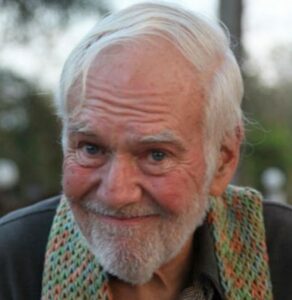
Rodney Tasker (1945-2015)
Jaffna: Evidence in mounting that army units are setting fire to Tamil dwellings in the Jaffna area. The Sri Lankan Army Major emerged through the thick smoke of a burning building and said ‘The terrorists are setting fire to houses to discredit us.’ Then, surrounded by his troops, he ordered this correspondent and three colleagues not to take pictures and said we would have to be escorted away. All evidence pointed to the fact that the army itself had put the torch to the buildings in the Tamil farming town of Achcheveli – about 15 km north of Jaffna – to retaliate against the detonation of a landmine by Tamil militants. The incident illustrated what appears to be a pattern of Tamil attacks on security forces followed by army reprisals against Tamil non-combatants in this sad, violence-torn northern peninsula of Sri Lanka. Six soldiers had been killed when their truck ran over a terrorist landmine south of Jaffna in early August. Army retaliation a few days later included the burning of more than 100 shops and houses and the killing of several Tamils in the port town of Mannar, 80 km south of Jaffna. Scores of homes had been destroyed by the army in the northern fishing town of Valvettiturai after two Sri Lankan Navy men had been shot by militants there. The government has admitted that troops went on a rampage in Mannar and said the 33 culprits would face courts martial. But any subsequent burning of houses was officially attributed to the Tamil separatists, whose hardcore numbers in the Northern Province, the government puts at 300-500. Information from the area has been sketchy, with foreign journalists relying on exaggerated Tamil reports and government denials to paint a picture of the latest in a long history of communal violence between the Tamils, who comprise a 2.5 million minority in Sri Lanka’s 15 million population, and the majority Sinhalese.
But when this correspondent, a two-man Visnews TV camera team and a correspondent from the Indian Express arrived in Achcheveli on the morning of 25 August, we surprised the Sri Lankan army in the middle of a counter-terrorist burning operation. We had been drawn to the scene by the sound of a large explosion, which later turned out to be the detonation of a large landmine on one of the town’s roads by Tamil terrorists. It had apparently been set off in haste by ‘the boys’, as the Tamils call them, on learning that the army was approaching the town after an intelligence tip. No one was hurt in the explosion, but the company of troops who arrived in eight armoured vehicles proceeded to set four shops and houses on fire. We arrived before the burning started. As we walked along a road in the heart of the now-deserted town towards the troops, a British-made Ferret sport car at an intersection swung its 50-calibre machine gun towards us, and three soldiers in full combat gear quickly crouched into the firing position.
Mindful of widespread reports from the local Tamil population of indiscriminate shooting by the feared army, we halted 25 yards from the troops as an armoured car drove into sight and trained its cannon on us. After a 10 minute standstill, one of the soldiers waved us away and we withdrew to our original position in the town square, just out of sight of the troops. Shortly afterwards, a group of soldiers made their way down the road towards us, hugging the walls in combat fashion. When they arrived, a young officer with a radio summoned our young Tamil driver and asked: ‘Are you Tamil or Sinhalese?’ The driver, evidently terrified and with his hands high above his head, replied that he was Tanil. He was then told in English to drive us up the road towards the main concentration of troops because the commanding officer, whom we later learned to be Maj P.A. Karunatilake, wanted to see us.
As we obeyed the order and drove slowly towards the intersection, the armoured car’s turret inched around to keep its cannon trained on our vehicle. When we arrived, we saw, for the first time, smoke billowing from at least one building. Karunatilake was obviously not pleased to see us, telling us that we would have to leave the town in an armoured convoy. We were taken to nearby Kankesanthurai police station where the Major took down our journalist identifications and handed us over to the police.
Secretary to the Minister of State Douglas Liyanage had confirmed, in an interview with the Jerusalem Post, that five Israeli officials were currently in Sri Lanka and that Colombo was benefiting from Israel’s expertise in anti-terrorist intelligence. The government, answering questions about the Israeli presence here, was previously vague about the relationship, the two countries having no diplomatic relations. Following Liyanage’s unauthorized interview, observers in Colombo speculated that the government’s apparent policy of reprisals in areas in which Tamil terrorists were showing themselves to be operating, including the burning of homes, may be part of a strategy suggested by the Isarelis. Israel regularly uses reprisals against non-combatants to discourage support for Palestenian insurgents. Be that as it may, only time will tell whether the tactic succeeds in stamping out what is evidently widespread support for the terrorists in the northern Tamil community, or whether it hardens further Tamil hostility.
****
Here, I also provide excerpts from a non-LTTE source: “…Worse than the ordinary aerial bombing was the use of so-called barrel bombs which were pushed out of Avro transports. These were crude devices which could not be aimed at specific targets, and consisted of a barrel of fuel padded with a rubber like inflammable substance. On hitting the ground the fuel will explode. The molten padding would fly in all directions and stick to the skin of a victim and burn itself out. A large number of these were dropped on Valvettithurai (48 according to one count). Barrel bombs were also dropped at random in several other parts of the peninsula. One falling on Sivan kovil on KKS road, Jaffna town claimed 17 victims. This seemed a sadistic extra without military purpose….” [Rajan Hoole et al., The Broken Palmyra, 1990, pp. 127-129].
All this attests to the handiwork of eco-terrorist Lalith Athulathmudali, that preceded 15 years before the publication of the citation below in the Military Medicine journal. Prabhakaran’s tactical determination to blunt the military moves of Athulathmudali gave rise to Vallipuram Vasanthan’s (aka, Captain Miller) deed of suicide attack on July 5, 1987.
Citation
Alexander GA. Ecoterrorism and nontraditional military threats. Military Medicine, 2000; 165(1): 1-5.
****