After 35 Years
by Sachi Sri Kantha, May 15, 2026
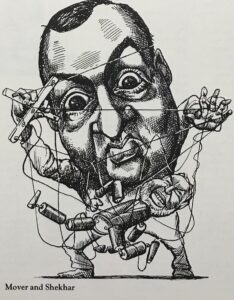
‘Rajiv Puppet Show’ Prior to Death
Rajiv’s Puppet Show cartoon
Party hopping chameleonic politician Chandra Shekhar (1927-2007) was selected to form a minority government with only 64 MPs, who split to form Janata Dal (Socialist) Party, with outside support from Indian National Congress Party, then led by Rajiv Gandhi. Chandra Shekhar became a puppet and Rajiv the puppeteer, during Chandra Shekhar’s brief tenure as the Prime Minister from Nov 10, 1990, till the latter was assassinated on May 21, 1991.
One of the accusing leads at the Rajiv Gandhi assassination trail by the prosecution was, LTTE was fearful that he was destined for his second Prime ministerial tenure in the May 1991 general election. So, they opted to stop his destiny. But, the published documents in the press (as provided below in the Economist weekly) prior to May 1991 indicate that the chances of Rajiv getting re-elected for the prime minister rank were not at all convincing.
Due to Rajiv’s tragic mode of his death at Sri Perumbudur, Tamil Nadu, and pro-Sonia Gandhi loyalists in politics as well as law enforcement and gum shoe agencies of India, Rajiv’s pre-death puppet show has receded from the memories of many; and young generations are unaware of what happened in New Delhi, prior to his death. Thus, for recording the history for digital era, it is reasonable to review the Congress Party politics during the final months of Rajiv’s life. I provide five reports from the Economist (London) magazine, as follows:
★Baltics in the South, Economist, Feb 9, 1991
★Inseparable. Economist, Feb 23, 1991
★Headless India. Economist, Mar 9, 1991
★Death of a Puppet. Economist, Mar 9, 1991
★Starting gun. Economist, March 16, 1991.
For long, I have been a critic of bias in the anonymous coverage of Asian political events by the Economist weekly. But, it has merits as well, for brevity and targeting the truthful trends occasionally. These five reports carried more plus points than demerits.
Baltics in the South
[India correspondent: Economist, Feb 9, 1991, pp. 41-42]
One reason some parts of India want to break away from the union is that they do not trust the central government to play fair. Their mistrust has been further fueled by the decision of Chandra Shekhar, India’s prime minister, to dismiss the government of the southern state of Tamil Nadu. India’s constitution allows the prime minister to impose direct rule from Delhi when law and order have broken down in a state. Successive governments have abused this power to satisfy the narrow interests of party politics and thwart the intent of the state’s voters.
So it was when Mr Shekhar pounced on the Tamil Nadu government at midnight on January 30th. The prime minister holds his job at the sufferance of Rajiv Gandhi, whose Congress Party lacks a majority in parliament but is by far the largest party there. Mr Shekhar has spent most of his life on the opposition benches berating Congress for misusing its powers; but when Mr Gandhi said jump last week, Mr Shekhar jumped.
The motive was simple: the Congress Party wants to retake power in Tamil Nadu. In the 1988 state election the easy winner was a party called the Dravida Munnetra Kazhagam (DMK), which beat both Congress and the cumbrously named All India Anna Dravida Munnetra Kazhagam (AIADMK), In India’s general election a year later, Congress and the AIADMK successfully made common cause: they won every parliamentary seat in the state. Ever since then they have schemed for a new state election.
They had no chance so long as V.P. Singh, who had won the 1989 national election and was backed by the DMK, remained in power in Delhi. But he fell last November. Congress and the AIADMK lost no time in finding a pretext for the central government to dismiss that of Tamil Nadu.
The main allegation was that the state government, headed by Muthuvel Karunanidhi, was helping the Tamil Tiger guerrillas who are fighting for a separate state in nearby Sri Lanka. Mr Karunanidhi certainly has close links with the Tigers, and their armed men have indeed been shooting up some coastal areas. But things in the state are much quieter now than they were in the early 1980s, when Congress and AIADMK first let the Tigers set up camp in Tamil Nadu and gave them arms and training. A second allegation – that Assamese terrorists were being trained in Tamil Nadu – is even flimsier: the mongoloid Assamese would vividly stick out among the black-skinned Tamils. None has been spotted in the state.
Before rule from Delhi is imposed, the governor of the state (an appointee of the central government) is supposed to certify that law and order have indeed broken down. Tamil Nadu’s governor, a Sikh from Punjab, has flatly refused. Now he himself is likely to be sacked.
Despite the riots in the state and the roundup of 23,000 people on February 5th to forestall a general strike called for the following day, Congress seems likely to secure its immediate aim of returning to power in Tamil Nadu in a fresh election. But at what price? This is now the firth Indian state under direct rule from Delhi; its imposition feeds an old suspicion.
In Punjab the Sikh political party, the Akali Dal, twice won power at the ballot box (in 1967 and 1977), only to have it taken away by remote control by the national Congress government. In Kashmir, too, Congress arbitrarily dismissed the elected government of Farooq Abdullah and then rigged the subsequent election. The rumour in Delhi is that Mr Gandhi is getting ready to pull the rug out from under Mr Shekhar. If Mr Gandhi does become prime minister again, shenanigans like the Tamil Nadu affair will do nothing to inspire trust in his government – or to hold India together.
****
Inseparable
[India correspondent: Economist, Feb 23, 1991, p. 33-34]
The puppeteer is unhappy with his puppets. Rajiv Gandhi, on whose Congress Party the minority government of Chandra Shekhar depends, appeared this week to be on the point of withdrawing his support. But the speculation died on Tuesday when Congress announced that it would support the government in a financial debate in parliament starting on February 21st.
Mr Gandhi’s manoeuvrings – which included four visits to the president, who can dissolve parliament – appear to have been designed to lure supporters from Mr Shekhar and from the previous prime minister, V.P. Singh. Join Congress, Mr Gandhi seemed to be saying, and create a party strong enough to have a clear majority. Congress and its allies are 50 short of a majority in parliament. However, it soon became clear that fewer than 30 defectors would be available and that they would demand an unacceptable political price.
So the puppets will dance on, but Mr Gandhi will withdraw even further from public sight as their master. One reason is the state of the economy. Another is that he disapproves of Mr Shekhar’s attempts to talk to terrorists in Punjab and Kashmir on terms that could threaten the unity of the country. He is upset with the prime minister for not trying harder to create a non-aligned peace formula to end the Gulf war.
Lastly, Mr Gandhi has been critical of the decision to let American aircraft refuel in India on their way to the Gulf. Indian Muslims, wooed by Congress, have been especially angered. Mr Shekhar has managed to avoid a diplomatic row with America by quietly persuading President Bush to withdraw his request for permission.
Sooner or later, however, Mr Gandhi will decide to cut the puppet’s strings and bring on another election. But when? Should he wait for a year, by which time the quarrel between Hindus and Muslims over the disputed Ayodhya mosque will have cooled down? Or will he by then be associated in the public mind with the troubles of the economy?
The annual rate of inflation is running at most 13%. India’s foreign-exchange reserves have been severely eroded by high oil prices and the loss of remittances from workers in Kuwait and Iraq. Credit from commercial banks, usually $3m-4m ayear, has dried up. India’s foreign-exchange reserves would have disappeared had it not borrowed $1.8billion from the IMF in January. Even that will be used up within a few months, when further recourse to the IMF will be inescapable. With an election to fight, the last thing Mr Gandhi wants to defend is a dose of IMF discipline.
When negotiating its first IMF loan, the government agreed to trim its deficit in 1991-92 to 6.5% of GDP, down from 8.3% this year. This will involve new taxes and a cut in subsidies, including the huge fertilizer subsidy regarded as critical in the farming areas that hold most of the voters. The alternative would be to slash public spending, a policy that few Indian politicians of any persuasion favour.
Mr Gandhi is said to be horrified by the stiff budget in prospect. The budget is due now, but it has been postponed for three months. To tide it over, the government will seek from parliament a limited spending authority. This will give Mr Gandhi a little time to consider his strategy. The IMF is likely to refuse to lend any more money until the budget is settled, but the government hopes it will just about manage, helped by lower oil prices.
Some of Mr Gandhi’s advisers doubt whether the party can win an election in the near future. They say Congress might wiser to team up with Mr Shekhar and any other small party willing to join a conventional coalition government. The prime minister clearly thinks this is an excellent idea. Mr Gandhi is far from sure.
****
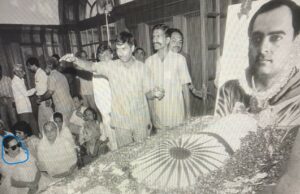
Sonia (in dark spectacle), in front of Rajiv Gandhi’s coffin, May 1991jpg.jpg
Headless India
[editorial: Economist, Mar 9, 1991, p. 20]
The only sense being talked in India’s parliament this week was uttered by the head of the Communist Party: ‘The country is going to rack and ruin. No one is discussing the economic crisis…We spend all our time on how to make and unmake governments.’ The government unmade on Wednesday, that of Chandra Shekhar, was just four months old. Whoever succeeds him will become India’s fourth prime minister in 18 months, likelier than not presiding, as Mr Shekhar did, over a precarious government whose only real concern is survival. This state of affairs is the product less of the electoral system than of politicians whose recent performance has been even more dismal than usual.
Mr. Shekhar’s fall was a farce. He controlled only a tenth of the seats in parliament, but he was backed by the largest group there, Mr Gandhi’s Congress Party. Mr Gandhi missed no opportunity to snipe at his puppet, on issues ranging from a state government in the south (which he forced Mr Shekhar to sack) to the refueling of American transport aircraft bound for the Gulf (which, Mr Gandhi bleated, was wrong). Even so, it was assumed that he did not want to risk an election by bringing Mr Shekhar down. Then it emerged that two policemen from the state of Haryana, which is run by a rogue ally of Mr Shekhar called Devi Lal, had been put on Mr Gandhi’s tail. After they were nabbed outside his house ineffectually trying to spy on it, the Congress Party walked out of parliament in protest. Next day Mr Shekhar gave up.
The only difference between this and the general run of Indian politics over the past three years is that a higher degree of ludicrousness has now been attained. The last year of Mr Gandhi’s government consisted of little more than manoeuvring for electoral position. The 11-month coalition of V.P. Singh, Mr. Shekhar’s predecessor, was plagued throughout by the scheming of ‘allies’ such as the leader of its Hindu nationalist component, the Bharatiya Janata Party, by Mr Devi Lal and by Mr Shekhar himself, all of whom though they would make a better prime minister than Mr Singh.
Nowhere in all this was a whiff of attention given to what policies the government might pursue. This is not just an insult to India’s sturdy and admirable democracy. The country faces divisive questions of caste and religion that at times in the past year have seemed capable of tearing the union apart. On top of this, two economic problems, one urgent, the other colossal, are crying out for political leadership.
The urgent difficulty is that several years of budgetary indiscipline on the government’s part have brought India’s economy to the brink. Unless policies change, a budget deficit equal to nearly 8.5% of GDP is projected for the financial year that begins in April, Inflation, which has usually been in single figures, is running at more than 12%, a doubling in a year. Before an emergency transfusion from the IMF, foreign-exchange reserves had fallen in January to a mere fortnight’s worth of imports. Persistent current-account deficits have built up a foreign debt of more than $70 billion; servicing it takes a third of export earnings.
In exchange for a commitment to reduce the projected budget deficit to around 6% of GDP, the IMF has been ready to grant a $2 billion stand-by credit; but the Shekhar government was so feeble that it had put off the budget debate from this week until May. It is a dangerous delay. Yet whoever is in office then will be forced by the imbalance of payments to take at least a step down the road to fiscal responsibility.
No one will be forced to take the more radical step of freeing India’s trussed-up economy, though 850m Indians would be forever grateful if someone did. The socialist and protectionist dogma fastened on the country in the 1950s has kept it far poorer than it should be. India sparkles with entrepreneurial and commercial verve. It generates savings (20% of GDP in the 1980s) and invests them (gross capital formation was 22% of GDP last decade) at rates that outstrip the performance of almost all other poor countries and most rich ones. Yet a thick swaddling of red tape strangles the economy. Today India’s share of world exports is a fifth of what it was 40 years ago, its share of poor-country exports less than a quarter of what it was then. China’s economy, itself held back by communism, has nonetheless grown three times as fast as India’s during the past quarter-century.
An opportunity is here that the leaders of other countries can only dream of. The thoughts of India’s leaders dwell instead on which colleagues’ backs can be most conveniently stabbed at the smallest risk of exposing their own. Until that challenges, India cannot prosper.
****
Death of a puppet
[India correspondent: Economist, Mar 9, 1991, p. 31-32]
A bizarre chapter of Indian history has come to a bizarre end. Chandra Shekhar became prime minister only last November, when he broke away with 62 defectors – just over a tenth of parliament – from Vishwanath Pratap Singh’s ruling Janata Dal. He held office at the sufferance of Rajiv Gandhi’s Congress Party (which, with its allies, had 213 of the 512 seats in parliament). It was obvious that, if Mr Gandhi’s support were withheld, Mr Shekhar would collapse. This week, it was and he did.
Far from being a deft stroke on Mr Gandhi’s part, the events seemed to reflect confusion, or even things just getting out of hand. What comes next – a general election or, instead, an attempt by Mr Gandhi to form a government – is up to the president, Ramaswamy Venkataraman. By early Thursday evening in Delhi he had still not announced his decision. Whichever way it goes, the mounting troubles that India faces, from religious violence to a fast-deteriorating economy, will take second place to the politicians’ increasingly fierce struggle for advantage.
Nothing embarrassed Mr Shekhar (and indeed everyone else) more than the manner of his going. It all began on Sunday, March 3rd, when two people were caught spying on Mr Gandhi’s home in Delhi, taking notes on all visitors. They turned out to be a policemen from the neighbouring state of Haryana. The boss of this state is Devi Lal, a wily and ambitious old warhorse who was also Mr Shekhar’s deputy prime minister and is a member of his party, Janata Dal (Socialist). The suspicion is that Mr Lal sent the policemen to Mr Gandhi’s house to keep tabs on potential defectors from Janata Dal.
Two days later the Congress Party, professing shock and outrage, boycotted parliament. No matter that an official investigation recently revealed that, when he was prime minister, Mr Gandhi himself did far worse, tapping the telephones not only of the opposition but also of his own cabinet ministers. The opposition, just as readily ignoring the hypocrisy, joined Congress in its boycott.
Mr Shekhar was humiliated when he went to parliament to make a statement on his recent visit to Nepal. He could not address the chamber: his party was unable to muster even the very modest quorum of 10% needed to do parliamentary business. Trying to end the nonsense, Mr Shekhar offered an official probe or even a parliamentary investigation of the spying incident. But Mr Gandhi insisted on the dismissal of the Haryana government.
Perhaps he was simply trying to remind the prime minister who was boss. If so, he went too far. During his 115 days in office Mr Shekhar had endured non-stop criticism and arm-twisting from his puppet-master. At Mr Gandhi’s bidding he had already, on flimsy grounds, dismissed the state governments of Assam and Tamil Nadu. There was no pretext whatever for throwing out the Haryana government and, even had there been, an attack on Mr Lal would have meant suicide for Mr Shekhar within his own party. So he quit.
Mr Gandhi’s aim in backing Mr Shekhar in the first place was to fell Mr Singh; and then, when the time was right, to get rid of Mr Shekhar too and retake the prime ministership he had lost in November 1989. For the past two months Mr Gandhi has been exploring the possibility of putting together a majority by attracting enough defectors from various centrist parties, including Mr Shekhar’s (hence the stakeout). He has been flirting with leftist parties with the same idea in mind.
Neither approach seemed to come to much, but throughout the manoeuvrng Mr Gandhi displayed a guile that reminded people more of his mother Indira than of his old innocent self. By supporting Mr Shekhar for four months, he gave time for Hindu-Muslim tempers to cool after a burst of communal violence last autumn – and then managed to appeal to Muslims on separate grounds, by taking an anti-American line on the Gulf war. He discredited Mr Shekhar’s party by showing it was packed with opportunists willing to swallow one humiliation after another. Along the way he arranged the removal of the inconvenient governments in Assam and Tamil Nadu. Lastly, having helped create so much instability, he made people long for the stability that he claims (and many voters are prone to believe) only Congress can provide.
How well will all this serve him in an election campaign? A recent private opinion poll for Mr Gandhi suggested that Congress could now win an election. From its point of view, one held before rather than after the summer monsoon is thought to make sense: India has had three good monsoons in a row, and waiting until the autumn would risk an intervening drought. However, many of the party’s old hands are unconvinced.
They are particularly worried by a historical shift. Congress has always been an umbrella party covering a large swathe of ground in the political centre. Its cynicism and corruption have from time to time driven voters into the arms of parties of the left or right, or to regional parties. But the quarrelsome coalitions put together by such parties have usually driven voters straight back into Congress’s embrace. Mr Gandhi’s behavior suggests that he is banking on this pattern now being repeated. However, it is far from certain that it will be.
For one thing, the middle ground has shrunk. The most menacing sign of this is the rising influence of the Hindu-nationalist Bharatiya Janata Party, which has won support in huge areas of northern India. In recent months it has been quiet about the Ayodhya dispute, which involves rival Hindu and Muslim claims to a site in northern India. It was this issue that caused so much violence last autumn.
The BJP is sure to bring the dispute back to the boil in any election campaign. It has already scheduled a mass rally over Ayodhya in Delhi in early April. The party also plans an agitation for all Indians to be given the right to own land in Kashmir – something that has been forbidden so far in an effort to assuage Muslim fears of being swamped by Hindus there. The BJP may win far more votes by harnessing Hindu sentiment than many people expect.
And now Congress has a formidable new competitor for the middle ground in the shape of Mr V.P. Singh’s Janata Dal. Indeed, Mr Singh’s party has been described as Congress without the Gandhi family. He has taken strong positions on religious and caste matters. These have won him the favour of Muslims and of the middling Hindu castes (for which he promises to reserve 27% of government jobs). Mr Singh has recently railroaded his party into agreeing that 60% of party posts will be filled by minorities, Muslims, untouchables, women and members of the intermediate castes, Many of these groups used to be thought to be Congress’s natural supporters.
Mr Gandhi, for his part, has the problem that he no longer seems to stand unambiguously for anything. He has waffled on Ayodhya and on the caste-based job scheme. He looks more and more like his mother, a good tactician who eventually lost sight of the bigger picture. Congress’s old methods may still bring the voters in, but it will not be an uplifting sight if they do.
****
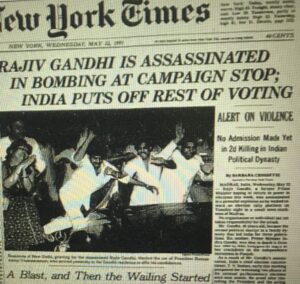
New York Times – first page May 22, 1991
Starting gun
[editorial: Economist, Mar 16, 1991, pp. 30-31]
When Chandra Sekhar resigned as India’s prime minister on March 6th and demanded a fresh election, President Ramaswamy Venkataraman said he would give his decision in 24 hours. A day is an elastic term in Indian politics, but few expected it to stretch to a full week. The delay led to desperate, and unsuccessful, horse-trading by parties eager to form another government. Parliament met briefly to pass urgent budget legislation and to extend the central government’s direct rule of Punjab and Assam. Then, on March 13th, the president dissolved parliament. An election will be held in May, probably the second half.
The manoeuvring while Mr Venkataraman was making up his mind gives an idea of just how bad things could be if the election produces another hung parliament. One idea being explored was a patch-up between Mr Shekhar (whose party has only 54 seats in a house of 512) and Rajiv Gandhi (whose Congress Party and its allies have 213). The kiss-and-make-up solution was urged most strongly by the chief ministers of the states of Uttar Pradesh and Gujarat, who feared for their own jobs if harmony was not restored.
A second idea was a formal coalition of the two parties, with Mr Gandhi as prime minister. But this would have deprived Mr Shekhar’s group of at least half the cabinet seats (it had almost all of them before). Anyway, Congress was not keen on a deal that would have given Mr Shekhar the power to break a Gandhi government at will. This consideration led Mr Gandhi to try to attract enough defectors to put together a majority of his own. That, too, failed.
So it is on to the polls. The outcome will depend largely on the alliances forged by the different parties. Congress has generally won only 40% or so of the popular vote, but has romped to victory because the remaining votes were split among several other parties. In the 1989 election the other parties managed to form a united front, and deprived Congress of its majority. Now they have fallen out. The Hindu-nationalist Bharatiya Janata Party and V.P. Singh’s Janata Dal are at daggers-drawn, as are Janata Dal and the Shekhar-led breakaway group that took over the government from its last November. Multi-cornered contests are certain in the election; Mr Gandhi hopes the old electoral pattern will reassert itself.
The BJP will combine with other Hindu parties, and is exploring the possibility of an alliance with Mr Shakhar. A second front will be formed by Mr Singh, the leftist parties and some minor regional parties. A third front will consist of Congress and its allies. In many seats the three fronts can each hope to get at least 30% of the vote. This means that even a slight swing of votes could make a huge difference in seats.
Mr Gandhi is confident of winning back many of the seats he lost in central and western India last time. However, he can only lose ground in the south, which accounts for a quarter of the seats – for the simple reason that he won virtually all of these in 1989. His party was recently thrashed in municipal elections in Kerala, largely because the Muslim vote deserted it. As a result, the Indian Muslim League has ended its alliance with Congress. Mr Singh has been received rapturously in Tamil Nadu, mainly because of his proposal to set aside a fixed share of government jobs for intermediate Hindu castes. People from these castes in the south, where they are best educated, stand to gain the most from a job quota.
Congress is unlikely to gain much ground in the east, since the Marxist Party has a tight grip on West Bengal, as does Janata Dal on Orissa. So the result will probably be decided in the northern states of Uttar Pradesh and Bihar, which account for a quarter of the total number of seats. The BJP hopes to do well in Hindu-conscious Uttar Pradesh, and Janata Dal in poor Behar.
Mr Gandhi will have to recover mightily in these two states if he is to win. His own men there are not optimistic. As the starting gun is fired, it looks as though the runners could be destined to cross the finishing-line in another tangle of limbs and cloud of dust.
****
Post – Rajiv death Shenanigans by Sonia
To be blunt, after two months and a week following the dissolution of the Indian parliament on March 13, 1991, for all his political sins, Rajiv Gandhi’s karma was sealed at Sriperumbudur, Tamil Nadu. As had been predicted by the prevailing political winds in the March 9th 1991 commentary ‘Death of a puppet’, now I tend to infer that by virtue of his pre-mature death in May 1991, Rajiv Gandhi did give a ‘new life’ to the Congress Party. Had he been living, the chances were equally balanced that either he may not have been elected again for his second tenure by the voters in preference to V.P. Singh’s Janata Dal, or he may have been elected with a slender majority with a hung parliament.
Subsequently, the Congress party’s old hands for reasons of self-preservation played the same old trick of propping the party with Nehru (Gandhi) family. Indira following her father, Rajiv following his mother, and Sonia following her husband. Though reluctant at first, Sonia was forced to play the puppet show – first with P.V. Narasimha Rao’s tenure (1991-1996). As Congress Party fortunes drifted towards unstable alternate party coalitions, Sonia entered into politics actively, by grabbing the President of Indian National Congress Party position, from 1998-2017, and again 2019-2022. Sonia’s second puppet show routine was with Manmohan Singh (1932-2024), who held the Prime Minister of India position, from May 2004 to May 2014. He was a meek-mannered, subservient Indian substitute to Sonia’s diktats.
Coda
Those interested in finding more details about Chandrasekhar’s tenure as prime minister, his resignation, Rajiv Gandhi assassination and Developments after Rajiv Gandhi’s death may benefit from Ramaswamy Venkataraman’s (1910-2009) memoir ‘My Presidential Years’ published in 1994. A smart political operator from Tamil Nadu and a Congress Party heavy weight, he served as the elected President of India, during the turbulent years from 1987 to 1992.
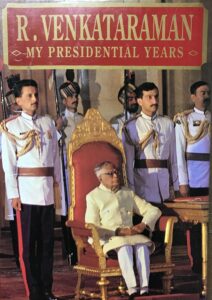
R. Venkataraman’s Memoir
To support my viewpoint, I provide two quotes, from the chapter ‘Developments after Rajiv Gandhi’s death’, Venkataraman had written,
“I had felt in 1989 that no party would get an absolute majority. Again, now in 1991, I had the same feeling that no party would come out with a significant majority.” (p. 452)
Then, a longer one after he had received P.C. Alexander on May 25, 1991.
“On May 25, Dr. P.C. Alexander came for breakfast. As Principal Secretary to both Indira Gandhi and Rajiv Gandhi he was close to the family. He told me that the Congress was irked by my call for a national government as it expected to sweep the polls and come back with a thumping majority. I was not surprised at the exaggerated optimism of each of the political parties. I had contested elections to the Lok Sabha five times, of which I lost one and won the other four. In the election which I lost I was so full of hope that I even said that the rival candidate would forfeit his election deposit for failure to poll the minimum votes. Of all gambles, horse-racing or cards, the election gamble is perhaps the most elusive and no candidate has ever felt that he would be defeated.” (pp. 455-456).
Venkataraman’s solitary loss was in the 1967 Lok Sabha election to a DMK party candidate, who was not even a ranking name then. In Thanjavur constituency, D.S. Gopalar of DMK received 225,414 votes to defeat Venkataraman (Congress Party) with a vote margin of 22, 574. Even now, hardly anyone bothers to tag Gopalar’s name with Thanjavur, akin to that of DMK and Anna DMK leader S.D. Somasundaram.
In his autobiography, DMK leader Karunanidhi had offered an alternate version for why his government was toppled by Chandra Shekar’s puppet regime in Jan 1991. His reason was, he had invited V.P. Singh to Tamil Nadu and on behalf of DMK, and felicitated him on Dec 8 and 9th, 1990. In those functions, E.M.S. Namboodhiripad (Kerala) and S.R. Bommai (Karnataka) also participated. For this, Chandra Shekhar and Rajiv Gandhi took offense and they were induced by Jayalalitha (his then political rival in Tamil Nadu) to topple his rule. The sole reason was, the law and order situation in the State had deteriorated due to the activities of Eelam Tamil militants. Towards this act, Delhi had demanded a dismissal report from the then Tamil Nadu governor Surjit Singh Barnala. But, Mr Barnala had rejected to submit such a false report. Then, they implemented their plan of dismissal via Mr Venkataraman, the then the President of India. Thus, Karunanidhi earned the dubious record of his DMK ministry dismissed twice – first by Indira Gandhi in 1976 and then by Rajiv Gandhi in 1991.
Sources
Karunanidhi: autobiography Nenjukku Neethi, vol. 3, Thirumagal Nilayam, Chennai, 1997, pp. 611-612.
S.K.S. Nathan. The DMK and politics of Tamilnad. Economic and Political Weekly, Dec 9, 1967; 2(48): 2133-2135, 2137-2140.
Venkataraman: My Presidential Years, Indus, an imprint of Harper Collins Publishers, New Delhi, 1994, pp. 387-422, 441-457.
What a nice collection of critical documents from the turbulent years of Indian history! Hats off to Dr. Sachi for collating the documents and summarizing them for the current generation. Earlier, I thought Rajiv was not politically corrupted like the current regime, but in light this detailed collection of information, I think he is as corrupt as the current regime!