The first legislation to emerge from direct negotiations with Abdullah Ocalan offers a path to ending Turkey’s war with the PKK while potentially giving President Recep Tayyip Erdogan the votes he needs to remain in power for a third term.
France24 report on dissolution of SDF, August 26, 2026: https://www.msn.com/en-us/news/other/turkey-says-dissolution-of-kurdish-led-group-crucial-for-syrian-stability/vi-AA2aYnrR?ocid=socialshare
by Amberin Zaman, Al-Monitor, Washington, DC, August 5, 2026
A draft framework law resulting from more than two years of negotiations between the Turkish state and the imprisoned leader of the Kurdistan Workers Party (PKK) was submitted to the parliament’s Justice Committee on Wednesday in what some call a historic milestone and others a humiliating capitulation by the Kurdish-led resistance movement.
Either way, it marks the first time the Turkish state has introduced legislation in parliament following direct talks with Abdullah Ocalan, a man who was long vilified as a “baby killer” and terrorist and was sentenced to death in a courtroom trial in 1999 following his capture by Turkish special forces in Nairobi earlier that year. It is also the first time any Turkish government has pursued a political solution rather than a military one to end the four-decade-long war between the Turkish army and the PKK, which has claimed more than 40,000 lives, most of them Kurdish.
The law, titled the “Bill on Strengthening National Solidarity and Social Integration,” is expected to be voted on in a plenary session as early as Friday.
It consists of 12 articles and establishes a staggered legal mechanism covering PKK rebels and others linked to the organization who qualify for full or partial amnesty under its terms. Offenses covered by the bill include membership in or leadership of the organization, as well as engaging in propaganda and raising funds on its behalf. A board — overseen by the president and consisting of Turkish diplomatic, military and intelligence officials along with representatives from the Interior and Justice ministries — will coordinate and supervise the PKK’s disarmament and dissolution. A 17-member monitoring committee will follow up with further laws in the parliament.
As of the time of publication, at least 360 lawmakers in the 600-member Turkish legislature had signed the bill.
Its passage has as much bearing on the Kurds’ decades-long struggle for political equality as it does on President Recep Tayyip Erdogan’s political future.
Under the current constitution, Erdogan cannot run for a third term when his current mandate expires in May 2028. A referendum on constitutional amendments to change the relevant article requires at least 360 votes. Wednesday’s support for the bill suggests that Erdogan could corral enough votes to secure such a referendum. Friday’s session may also show that he may not even need one if 400 lawmakers vote in favor of the bill.
Quite a bit will hinge on Ocalan and the pro-Kurdish People’s Equality and Democracy Party (DEM), which holds 56 seats in parliament. Erdogan’s ruling Justice and Development Party (AKP) and its Nationalist Movement Party (MHP) allies jointly hold 323 seats, falling 37 short of the 360 needed not only to trigger a constitutional referendum but also to call snap elections, which would likewise allow Erdogan to circumvent the presidential term limit.
In a statement shared by DEM on Monday, Ocalan signaled his support for the government. While noting that the legislation left much unaddressed, the 78-year-old rebel leader stressed that it constituted “a key” that would “crack open the door” to further reforms such as constitutionally enshrined language rights.
“This law won’t fix the Kurdish question in and of itself, but it’s a start,” Ceylan Akca Cupolo, a DEM lawmaker for Diyarbakir, the Kurds’ informal capital in southeastern Turkey, told Al-Monitor. “It’s a good start to lay the groundwork for future dialogue and the legal amendments needed to resolve the century-long Kurdish problem,” Cupolo said.
Another wild card is Ozgur Ozel, the ousted leader of the Republican People’s Party (CHP) who broke away to form his own New Party. The New Party, with 91 lawmakers, is now the main opposition grouping and could yet expand. Ozel is expected to vote in favor of the bill, in a bid to woo Kurdish voters and sustain bridges with DEM.
Ocalan and his top lieutenants, with the latter based in the Qandil Mountains and elsewhere along the Iraq-Turkey border, do not fall within the bill’s scope. Moreover, it remains unclear whether Selahattin Demirtas — Turkey’s most popular Kurdish politician, who led DEM’s forerunner, the People’s Democratic Party, and who has been jailed since 2016 on a panoply of thinly evidenced terrorism charges — will benefit, in line with repeated calls by the European Court of Human Rights, whose rulings are binding on Turkey.
Secret talks between Ocalan and the Turkish government began in April 2024, as first reported by Al-Monitor, with two aims. One was to enlist Ocalan’s support to end his armed campaign and to use his influence over the Kurdish-led Syrian Democratic Forces to have them integrate with Damascus. The other was to get DEM to back Erdogan’s plans to remain in power.
The talks were made public in October that year, when the MHP leader, Devlet Bahceli, invited Ocalan to order his fighters to end their armed campaign before the Turkish parliament and suggested that he too might benefit from a potential amnesty.
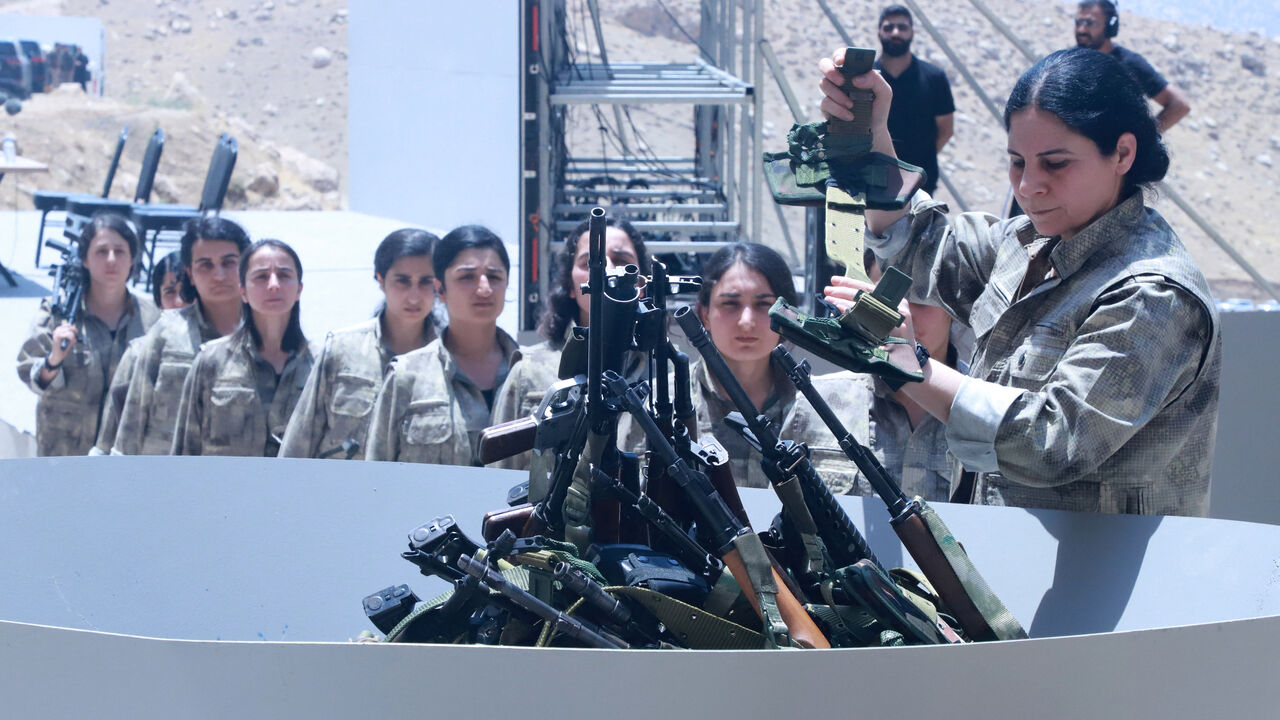
Ocalan duly obliged from his prison cell in February 2025 and has since called on the Kurds to “integrate” with the Turkish state. On May 12, 2025, the PKK announced that it was ending its armed campaign for Kurdish autonomy within Turkey and dissolving the organization in line with Ocalan’s call. On July 11 of that same year, a group of rebels held a symbolic weapons-burning ceremony in the mountains near Sulaimaniyah, in Iraq’s Kurdistan Region, an area controlled by the Patriotic Union of Kurdistan (PUK).
Several members of that group are expected to return to Turkey, along with exiled Kurdish politicians and other PKK-linked individuals, after the law is passed. How the first batch of returnees is handled will be a key test of the government’s sincerity and help determine the future of the process, according to rebel sources speaking on background to Al-Monitor.
Ocalan “continues to fight for equal rights for the Kurds in a democratic Turkey. When he speaks of Kurdish integration with the state, it can only be on that basis,” one of the sources said. Others concede that it is all a big gamble and that much will depend on Erdogan, whose overriding instinct is self-preservation.
The AKP’s earlier attempts to forge a lasting peace agreement with the PKK — in 2008 and again in 2012 — failed amid mutual recriminations, and on each occasion the conflict resumed with even greater ferocity. The anti-Islamic State alliance forged in 2014 between the Pentagon and the PKK’s Syrian branch, which later expanded to include Arab fighters, heightened Turkish paranoia about Western plans to establish an independent Kurdish state.
However, the dramatic geopolitical changes following Hamas’ 2023 attack on Israel propelled Ankara to reach out to the PKK at a time when it believed it had already established military superiority through its much-vaunted drone capabilities. With Iran driven out of Syria, Islamist ally Ahmed al-Sharaa installed in Damascus and the United States embracing him — effectively at the Kurds’ expense — Turkey now appears far more confident about reaching a deal with the PKK, one whose terms it is, for the time being, largely setting and imposing.
However, the conflict with Iran could yet upend Turkey’s calculations despite President Donald Trump’s decision not to support the armed Iranian Kurdish opposition. He is widely believed to have made that decision at Erdogan’s behest. But the famously unpredictable US president could yet change his mind. Moreover, the PKK’s Iranian affiliate, the Free Life Party of Kurdistan, says that Ocalan did not include them when calling on the rebels to disarm and disband.
Here’s How One Country May Have Solved a Violent Uprising
by

For nearly half a century, the P.K.K. has fought the Turkish state to push for Kurdish rights and autonomy in a conflict that has spilled across Turkey’s borders into Iraq, Syria and Iran. The new law creates a path for thousands of fighters and supporters in prison or exile to return to civilian life.
The Turkish government will not call this an amnesty. The word remains politically toxic in a country scarred by decades of violence from fighting between the military and P.K.K. forces. Nor is this a sweeping democratization package.
But it is the closest Turkey has come in years to some form of national reconciliation. After a year of negotiations, the P.K.K. leadership appears to have accepted that it can no longer advance Kurdish rights through armed struggle. Turkey, in turn, has implicitly conceded that the Kurdish question cannot be solved by military means alone and that a movement with roots among ordinary Kurds needs a way for their political aspirations to be met.
This weapons-for-politics bargain offers lessons that could be applied to other intractable conflicts with militant groups, namely in Gaza with Hamas and in Lebanon with Hezbollah, the Shiite-based political party and militant force.
The cases have their differences. But the underlying principle — that rooted armed insurgencies cannot be bombed out of existence — is similar. Disarmament must be phased and conditional and have reciprocal steps by the opposing sides and a political endgame in sight. In the Turkish case, it took more than a year of negotiations.
Armed movements rarely give up their weapons simply because their enemies demand it. Many do so when they conclude that armed struggle can no longer deliver their political objectives and they are offered another route through which their constituencies can pursue those objectives.
What is distinct about the Turkish process is its incrementalism and the involvement of the country’s institutions. The P.K.K. first agreed to dissolve last year and staged a symbolic ceremony in northern Iraq to burn its weapons.
Turkey has now fulfilled its side of the bargain, creating legal protections that could allow thousands of P.K.K. members to return home. The benefits are conditional on Turkish authorities’ verifying that the group has disarmed, and the law distinguishes between ordinary members and those responsible for the most serious crimes.
Rank-and-file fighters, jailed politicians and political exiles can return and reintegrate into civilian life, while proceedings against many will be suspended for five to 10 years before ultimately being dropped if the individuals stay out of armed activity. The delay gives former fighters, even if they have convictions, a path back to civilian life while giving Turkey’s security establishment insurance against a return to violence.
Senior P.K.K. commanders are largely excluded for now, though Turkish and Kurdish officials told me that the expectation is that their fate will be addressed gradually. A parliamentary commission will oversee the process while larger questions of Kurdish rights are left to political debate.
Another matter has made the ground fertile for such agreements: the power of armed nonstate actors seems to be waning. Guerrilla warfare traditionally depended on concealment and the ability to outlast a stronger adversary. But no longer. Drones, surveillance technology and A.I.-driven precision weapons have eroded that advantage. Turkey used these technologies to constrain the P.K.K. in Syria and Iraq, while Israel has done so against Hamas and Hezbollah, though at enormous cost in destruction and civilian lives in Gaza and Lebanon.
Abdullah Ocalan, the imprisoned founder and chief negotiator of the P.K.K., acknowledged the new reality when he said the armed struggle had “run its course.” More tellingly, he argued that disarmament required “the recognition of democratic politics and a legal framework.”
This doesn’t mean nonstate actors everywhere will disappear. The Houthis in Yemen, backed by Iran, show that armed groups can still inflict enormous disruption.
For Hezbollah to relinquish its weapons, Lebanon’s Shiite population would need confidence that doing so would not mean surrendering political influence or security. The Lebanese state would need to become strong enough to replace Hezbollah’s parallel military structure, while the group’s constituency would need security and a way to channel its demands through politics.
Hamas’s disarmament similarly would require Israel to accept that getting rid of the guns will not eliminate Palestinian political aspirations. Hamas cannot have an army in Gaza. But any durable arrangement would have to provide Palestinians with a credible political path for self-governance — and give those who abandon armed struggle a reason to believe politics can deliver something that weapons cannot.
I know how difficult this is to imagine. As a journalist in the past, I covered Turkey’s Kurdish conflict from Diyarbakir in the southeast to the capital, Ankara, to the mountains of northern Iraq. I saw enough grief and interviewed enough Turkish leaders and Kurdish activists who were convinced that they would eventually prevail — only to be trapped in a decades-long war.
For years, governments across the Middle East have treated disarmament primarily as a security question: How do you destroy a militia or kill its leaders? That meant open-ended counterinsurgency. Turkey seems to be trying something different. It is testing whether an armed movement can be transformed into a purely political one.