Goliard columns in the Tamil Nation print edition (1991- 1993)
by Sachi Sri Kantha, Sept. 21, 2026
Front Note
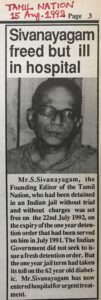
Sivanayagam freed from Indian detention, after 12 months – ‘Tamil Nation’, Aug 1992
From June 1991 to Dec 1993, I contributed 28 columns to the Tamil Nation (London) print edition. The column caption was ‘Goggles’, and I used the handle name C.P. Goliard, for a reason. As 35 years had passed, it’s time that I claim authorship, while I’m alive. There is a reason, why I chose this handle name. The first two columns appeared when S. Sivanayagam was in charge as the founder editor of Tamil Nation print edition. As I was contributing more than one item (book review, essay, commentary-letters) under my given name regularly, I opted for C.P. Goliard to write this ‘Goggles’ column. And Sivanayagam agreed to my handle name. In the aftermath of Rajiv Gandhi assassination on May 21, 1991, Sivanayagam then living in Madras was held in detention behind the bars for over a year, under spurious suspicion by the Indian law enforcement officials.
In his memoirs, ‘Sri Lanka – Witness to History – A Journalist’s Memoirs (1930-2004), Sivanayagam had covered the short life span of Tamil Nation print edition, from 1990 to 1993, in a chapter. He had written, ‘The Tamil Nation was the brain child of a few London-based professionals – four doctors, two engineers, a teacher, an accountant and a well-known lawyer – all highly committed men who felt the need for a vibrant journal in English to espouse the Tamil cause.’ It was published by Tamil Forum Limited (Croydon, Surrey, UK), a company registered in the United Kingdom. After Sivanayagam’s detention behind bars from July 19, 1991 (that lasted until July 22, 1992), Nadesan Satyendra took over the laborious job as an Interim editor. Tamil Nation print edition eventually folded in Dec 1993.
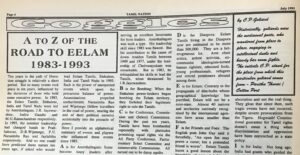
Among the 28 columns, the 24th column which appeared in July 1993, had the caption ‘A to Z of the Road to Eelam, 1983 – 1993’. In it, I had identified 26 items which contributed to the Eelam story, as of 1993. For digital record, first, I post this column in its entirety. Secondly, at the end I had assembled the titles of the 28 Goliard columns published from June 1991 to Dec 1993. The specific themes have mostly formed the nucleus of my writing interests. Since 2001, I had expanded few of the column themes in my other lengthy features, such as ‘Prabhakaran Phenomenon’, ‘Onomastics of Tamil personal names’, and ‘MGR Remembered series’, posted in this site.
‘A to Z of the Road to Eelam, 1983 – 1993’ [first published in July 1993]
Ten years in the path of liberation struggle is relatively a short period. But so many events took place in ten years, influenced by the decisions of those who held some executive power. In 1983, the Eelam Tamils, Sinhalese, India and Tamil Nadu were led by Amirthalingam, J.R. Jayewardene, Indira Gandhi and M.G. Ramachandran respectively. In 1993, the nominal leadership had changed hands to Prabhakaran, D.B. Wijetunge, P.U. Narasimha Rao and Jayalalitha respectively. And no one could have predicted these names ten years ago, if asked who would lead Eelam Tamils, Sinhalese, India and Tamil Nadu in 1993. Such is the power of unexpected events which upset the precarious balance of power. Assassinations propelled uncharismatic Narasimha Rao and Wijetunge (fellow travelers in the road of power, nearing the end of their political careers) accidentally into the pinnacle of power.
Here I provide an alphabetical summary of events and players who influenced these events since 1983.
A is for Amirthalingam: Some become lousy leaders after serving as excellent lieutenants for born leaders. Amirthalingam was such a type. His leadership skill since 1983 was flawed. But his contribution to the cause of downtrodden Tamils between 1949 and 1977, under the leadership of Chelvanayakam was remarkable. But in 1983, he relinguished his skills to lead the Tamils, when threatened by J.R. Jayewardene.
B is for Bombing. When the Sinhalese power brokers began bombing the Eelam territory, they forfeited their legitimate right to rule the Tamils.
C is for Conference, Commission and (Select) Committees. During the past ten years, Tamils have been bombarded repeatedly with platitudes promising equal rights via the All Party Conference, Parliamentary Select Committee and innumerable Commisions. All turned out to be damp squibs.
D is for Diaspora. Eelam Tamils living in the Diaspora now are estimated to be more than 500,000. They are a heterogeneous lot. Arm chair critics, ardent activists, ex-Communist ideologists turned human rightists, educated fools, young professionals, refugees and retired pensioners abound among them.
E is for Eelam. Contrary to the propaganda of dim-bulbs whose geographical knowledge has putrified, Eelam will not be a mini state. Almost 40 nations and territories currently recognized by the International Agencies have areas smaller than Eelam.
F is for Friends and Foes. The English poet John Gay said it forcefully, &An open foe may prove a curse; but a pretended friend is worse&. Eelam Tails learnt a good lesson about the friendship of pretended friends. Rajiv Gandhi, the Research and Analysis Wing (RAW), the Hindu news establishment in Madras etc. in 1987 and after.
G is for Gandhis – Indira and Rajiv. Such a contrast in the attitude towards the Tamils between the mother and her son! Eelam people rejoiced on the actions taken by Indira in 1983 and 1984. Her successor Rajiv was a disappointment. Only he could have plundered his good reputation of being ‘Mr Clean’ in 1984 to ‘Bofors Boy’ in 1989.
H is for Holocaust. The Tamil holocaust of 1983 ignited the war for liberation of Eelam. The Sinhala propagandists now play the tune that the 1983 planned aggression was an aberration and not the real thing. They gloat that since then, such tragic events have not recurred, despite severe provocations from the Tigers. Hogwash! Constitutional guarantee for Tamil rights doesn’t mean a thing when discrimination and oppression have been entrenched as a state policy.
I is for India. Not long ago, India had giants who guided the subcontinent. Mahatma Gandhi, Jawahar Nehru, Subash Chandra Bose and Rajaji instilled confidence among the downtrodden masses all over the world. Independence movements and struggle for equal rights in Asia and Africa were ignited by their actions. Now, one needs to look for a giant in India with a magnifying glass. Politicians during the past five years who made crackles about Eelam seem so Lilliputian, spineless, timid and vainglorious. Folks like V.P. Singh, Chandrasekhar, Narasimha Rao, Subramania Swamy and Jayalalitha, have given a new interpretation to the Gandhian principles of endurance, self-sacrifice and silence.
J is for Jayewardene. The founding editor of Tamil Nation, S. Sivanayagam, has aptly summarized the legacy of J.R. Jayewardene in 1987. To excerpt, ‘When the history of the post-independence period of Sri Lanka comes to be written…his years in power will emerge in dark contrat against the rest of the period – a blood-soaked chapter in the life of a country which had for long earned the happy reputation of being a Paradise Isle; a debilitating phase in the life of the majority of Sinhalese people, who despite occasional bouts of mob violence against the minority Tamils, had been known for their spontaneity, warmth, hospitality and friendliness; and of course a period of unmitigated tragedy for the Tamils, who, oppressed by the very State to which they were expected to owe allegiance, decided either to fight back or flee the country.’
K is for Karunanidhi. Amirthalingam’s contemporary and counterpart in Tamil Nadu history. He was an excellent lieutenant to Anna for 20 years, from 1949 to 1969. But, with all the goodwill of people and organizing talents, he could only become a lousy leader. What an anti-climax to the expectations of Eelam Tamils? Even after Karunanidhi dismissed for the second time as the Chief Minister in 1991, he might have retained the respect of Eelam Tamils, had he continued to show his support. His opportunism got the better of his judgement and Karunanidhi stood exposed.
L is for Land. It has been recorded that the Scottish historian Thomas Carlyle told an American almost 120 years ago, ‘You may boast of your democracy, or any other ‘cracy or kind of political rubbish; but the reason why your laboring folk are so happy is that you have a vast deal of land for a very few people.’ Regarding Eelam, the liberation struggle of Tamils is also preserving the land we own by heritage. All the Tamil lives sacrificed for the past decade will be in vain if the cherished land is lost. To repeat Carlyle, ‘democracy, or any other ‘cracy, or any kind of political rubbish’ is secondary to the cherished land.
M is for Money. Even to fight a liberation war, one needs money. This has remained as the main limitation for the successful execution of the Eelam plan. In Sri Lanka and India, the PLO and its chief Yasser Arafat is held in high esteem and I don’t grudge that. But they should also know the amount of money Arafat receives from his allies for his fight against Zionist interests. The annual budget of PLO, before the recent Gulf War was 199 million dollars, with reserves of 7 billion dollars. Saudi Arabia, Kuwait, Libya, Iraq, UAE, Algeria and Qatar contributed abundantly to the coffers of PLO. Since 1991, this annual budget has been trimmed to 100-120 million dollars, with reserves fallen to 2.5 billion dollars (U.S. News & World Report cover story, April 26, 1993). Is Prabhakaran’s equivalent financial support during the past 10 years similar to that of Arafat? Only MGR openly came forward and gave his financial support to the Eelam campaign in 1987.
N is for News media. The international news media had covered the Eelam campaign for the past 10 years with varied accuracy, focus and distortions. The two cliché sentences which do appear in almost every news agency dispatch have been, ‘The rebels from the minority Tamil community are fighting for an independent homeland. Tamils make up 18% of Sri Lanka’s 17 million people. They say, the Sinhalese, who make up 75% of the population and control the government and military, discriminate against them.’ For a relatively un-biased record of commentaries, I would choose the New York Times and the Asiaweek (Hongkong) as the best sources.
O is for Over-confidence. In his interview with the Time magazine (Apr 9, 1990) was asked, ‘What in your judgment were the LTTE’s own strengths and weaknesses?’ The question was related to LTTE’s war with the Indian army. Prabhakaran replied, ‘Our strength and our weakness was our over-confidence. Sometimes our cadres took impossible risks, like ambushing an Indian patrol at a point where there were no escape routes. This cost us casualties. But also because of our over-confidence, our boys carried out some amazingly brave attacks.’
P is for Prabhakaran. So much has been said about Prabhakaran. One of the best which I remember appeared in the Newsweek magazine (Nov 9, 1987), at the height of the Indo-LTTE war. Angus Deming wrote, ‘Velupillai Prabhakaran may not be a household name elsewhere, but in Sri Lanka he has become the stuff of legend. He is the wily guerrilla leader whose outnumbered Liberation Tigers of Tamil Eelam (LTTE) bloodied the Indian army in Jaffna, then slipped away to fight again another day…Prabhakaran is a man obsessed by a dream; to carve out an independent Tamil state in Sri Lanka…He sometimes mouths Marxist jargon, and admires Fidel Castro and Che Guevara. But at heart he is a freedom fighter – not a revolutionary…’
Q is for Quislings. One need not waste much space for the quislings, who have contributed much to the misery of the Eelam citizens.
R is for Ramachandran (known to Tamils and others in India and Sri Lanka as MGR). India is full of politicians whose words and deeds do not match. MGR was an exception, as far as his relationship with Eelam Tamils were concerned. After the 1983 holocaust, MGR identified himself with the LTTE and pledged that ‘Tamil Nadu will protect Liberation Tigers (The Hindu, Nov 7, 1983) and did just that till his death on Dec 24, 1987. When Jayewardene and Athulathmudali tried to throttle the Eelam Tamils during their Vadamarachchi offensive in May 1987, MGR came to the rescue of Tamils and announced a grant of 3.3 million dollars for food, clothes, medicine and ‘other help’ (Time, May 11, 1987). When Jayewardene accused the LTTE as the ‘private army of Mr M.G. Ramachandran, the present chief minister of Madras’, MGR swiftly retorted ‘Tamil groups are spearheading the war against the dictatorial and fascist actions of the Jayewardene regime, and they should be congratulated and helped.’ (Time, May 11, 1987).
S is for Scholarly writing. Tamils have been notorious for not writing their past history. It is gratifying to note that to rectify this lapse, quite a few scholarly books have appeared during the last 10 years authored by Tamil academics. These include, Satchi Ponnambalam’s ‘Sri Lanka: The National Question and the Tamil Liberation Struggle of Democracy’ (1986), and S.J. Tambiah’s ‘Buddhism Betrayed? Religion, Politics and Violence in Sri Lanka’ (1992) and A. Jeyaratnam Wilson’s ‘The Break-up of Sri Lanka’ (1988).
T is for Tigers. Tracing the origins of the Tigers, Marguerite Johnson wrote for the cover story in the Time magazine (June 9, 1986), ‘In 1972 a Tamil teenager named Vilupillai Prabhakaran started a rebel group that became the Liberation Tigers of Tamil Eelam. By mid 1983, Prabhakaran’s Tigers had only 30 full time members, with far less than one gun apiece.’ From such insignificant beginnings, the Tigers have developed into such a power in ten years, that the Sri Lankan government had to increase its military budget by more than ten-fold in a decade. (see the next entry).
U is for United National Party (UNP). The two titans (Jayewardene and Premadasa) who controlled the UNP during the past ten years had naively believed that by increasing the annual military budget, they could silence the Eelam campaign. But they were proved wrong by the tenacity and valor of the LTTE army. In 1980, 1981 and 1982, the annual defence allocation were 458, 479 and 486 million rupees. In 1983, it climbed to 979 milion rupees. In 1991 (the latest figure I have), the military operations consumed 6,844 million rupees. Will the news UNP boss be shrewd enough to learn from the mistakes of his two predecessors?
V is for Vadamarachchi and Valvettithurai. Almost every region and town in Eelam experienced loss of life and bombing damage during the past ten years. However, Vadamarachchi and Valvettithurai in particular had to bear the brunt of enemy attack repeatedly, for the only reason that it happens to be the soil which gave birth to Prabhakaran.
W is for Wars. Every war produce heroes and villains. The road to Eelam has witnessed three wars during the past decade. Eelam War I (1983-1987), Indo-LTTE war (1987-89), and Eelam War II (1990 – ongoing). The real heroes, apart from those who fought valiantly in the battle fronts, are the Eelam civilians who stayed in the Eelam territory despite bombing, intimidation, starvation and death, to give support to the fighters. The mental toughness shown by these patriotic citizens to ride out the difficulties of war can never be matched by those who have settled in non-Eelam territories of Sri Lanka or elsewhere.
X is for X-brained Indian pundits. The 24th letter of English alphabet is conventionally used to indicate incorrect response as well as for signature by a person unable to write his name. So much negative coverage had appeared in the Indian press since mid-1987 about the LTTE and Prabhakaran, one can only laugh at the stupidity of these X-brained opinion making. I cite two items published in 1989 and 1992. In July 1989, the pundits of the Madras Hindu found Prabhakaran ‘killed in a shoot out’. The July 31, 1992 issue of India Today trumpeted that ‘for once, the masters of guerrilla warfare (LTTE) have been cornered’. One caption gloating, ‘Tigers exposed as men of straw’, also carried the photo and wishful predictions of Major General Denzil Kobbekaduwa, the Commander of the Northern Operations. The only glitch in that wishful thinking was that, Kobbekaduwa and his top buddies could not manage to live for ten days, from the date line of that report.
Y is for Youth. The last ten years belonged to the Tamil youth. Their actions have been criticized by many who play the role of arm chair critics. But as Nehru wrote in his book, ‘Glimpses of World History’, ‘the parents of many of these children may have behaved as cowards or slaves in the past. But who dare doubt that the children of our generation will tolerate no slavery or cowardice?’
Z is for Zeitgeist. Zeitgeist [derived from the German words – zeit (time) and geist (spirit)] is described in the dictionary as the ‘spirit of the times: trend of thought and feeling in a period’. The zeitgeist for the past ten years is nothing but Eelam.
****
Below I had assembled the titles of the 28 Goliard columns published from June 1991 to Dec 1993. Also, Sivanayagam’s chapter on his jail experience in Madras during his detention from July1991 to July 1992, deserve digital record, and I’ll do this at the earliest in this ‘From Sachi’s Files’ series.
Sachi’s 28 columns published in the ‘Tamil Nation’ from June 1991 to Dec 1993.
1991
Mahatma Gandhi and Tamils. Vol. 1, Jun 1, p. 5.
Albert Einstein and Tamils.Vol. 1, Jul 1-15, p. 5.
Bernard Shaw and Tamils. Sept, vol.2, no.1, p.
Remembering Kavi Arasu Kannadasan. Oct, vol. 2, no.2, p. 6.
Elephant Pass – Revolution – Nehru. Nov 15, vol.2, no.3, p.6.
The rebel of rebels [Jesus Christ]. Dec 15, vol.2, no.4, p. 4.
1992
The man from Maruthur and Malainadu [MGR]. Jan 15, vol.2, no.5, p. 4.
The dilemma of democracy. Feb 15, vol.2, no.6, p.4.
The assassinations of John F Kennedy and Rajiv Gandhi, Mar 15, vol.2, no.7, p.4.
The Madras Hindu and the Brahmin establishment. Apr 15, vol.2, no. 8, p. 4.
Goliardic giggles – N.S.K. and Sirkazhi Govindarajan song, May 15, vol.2, no.9, p.4.
The Tiger ban. Jun 15, vol.2, no.10, p. 13.
15 years after the verdict. Jul 15, vol.2, no.11, p.4.
Tamil names. Aug 15, vol.2, no.12, p.4.
Desk top dreamers! [Major Gen. Denzil Kobbekaduwa], Sep 15, vol.3, no.1, p.4.
Eelam in the year 2000. Oct 15, vol.3, no.2, p.4.
The status of the Tamil Language -Past. Present and Future, Nov 15, vol.3, no.3, p. 4.
Tenali Raman and Premadasa, Dec.1992/Jan.1993, vol.3, no.4, p.4.
1993
40 years after kaa…kaa…kaa…. [on M. Karunanidhi],Feb, vol.3, no. 5, p.4.
Take up arms in the war of words. Mar, vol. 3, no.6, p. 4.
Unrepresented Nations and People’s Organization (UNPO). Apr, vol. 3, no.7, p. 4.
The fall of a Czar (President Premadasa). May, vol.3, no. 8, p.4.
Eelam Tamil refugees in the diaspora. June, vol.3, no.9, p.4.
A to Z of the Road to Eelam 1983-1993. July, vol.3, no.10, pp. 4-5.
The Prime Misfit of India (P.U. Narasimha Rao). Aug-Sept, vol. 3, no. 11, p. 4.
The Tamil Writers of Eelam. Oct, vol.3, no.12, p.4.
The Unforgettable Tamil writers of Eelam. Nov, vol.4, no.1, p.4.
The Battle of Poonagari, Dec, vol. 4, no.2, p.4.