by Sachi Sri Kantha, September 12, 2026
Introduction
To mark the 120th birth anniversary (Sept. 17th) and 30th death anniversary (Nov.1st) of J.R. Jayewardene (1906-1996), two interviews given by Jayewardene and A. Amirthalingam, to Indian journalist S. Venkat Narayan, for the India Today (Sept 1, 1981) magazine are reproduced below. At that time, Venkat Narayan was serving as the Senior Editor of this magazine. Having read the published items of Venkat Narayan subsequently, my impression was that he is nothing but a ‘lap dog’ journalist. He also had been serving as the India correspondent to The Island (Colombo), a prominent anti-Tamil newspaper. To make your own impression about the journalism of Venkat Narayan, feel free to check this report by Devirupa Mitra, dated June 12,2023, [https://thewire.in/media/foreign-correspondents-club-members-resign-after-president-visits-myanmar-meets-junta-ministers].
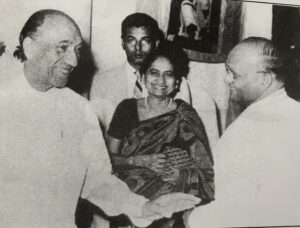
J.R.Jayawardene (lt) andA. Amirhtalingam (rt) in 1980. In the center is Mrs. Elina Jayawardene
Nevertheless, I provide the complete texts of these two 1981 interviews, after 45 years. This introduction offers some context to the early days of Eelam war, when India’s English literate coolies (i.e. journalists in the ranks of N. Ram, M.R. Narayan Swamy, Shekhar Gupta, Anita Pratap who also simultaneously played a conduit role to the India’s intelligence operatives) took interest in interviewing Eelam Tamil politicians and Tamil militants. Earlier generation of Tamil politicians such as C. Suntheralingam, S.J.V. Chelvanayakam and G.G. Ponnambalam Sr.) were hardly interviewed, while they were living, by any Indian journalists.
What comes out from the interview details of Jayawardene and Amirthalingam presented here, is metaphorically a ‘fox’ and a ‘chicken’ game, played by Jayewardene and the then TULF leader Amirthalingam (1927-1989) between 1977 and 1981. Jayewardene was ‘the fox’ and Amirthalingam was ‘the chicken’. Being a senior to Amirthalingam by over 20 years, Jayewardene showed nothing but condescension to Amirthalingam’s leadership. Comparatively it may be said, for S.J.V. Chelvanayakam and G.G. Ponnambalam who were seniors to him, Jayewardene at least had a grudging respect. Jayawardene also showed similar condescension to Indira Gandhi as well, because he had felt he was on par with Indira’s father Jawaharlal Nehru. But, Indira was able to tackle this sort of arrogance by her apt guile. Sadly, this type of political game was not in Amirthalingam’s armory, other than wailing to journalists and ‘diplomats’ that he is being mugged by Jayawardene. Only after Prabhakaran’s entry prominently in 1985, ‘the fox and the chicken’ political game morphed into ferrocious ‘the fox and the tiger’ game in the battlefields.
What seems interesting to me, is that the answers (one may categorize them as arrogant, self-serving, mischievous with pro-Sinhalese slant) given by Jayewardene to the Indian journalist had been totally obliterated in the Prof. K.M. Silva’s authorized biography of Jayawardene (vol. 2, 1994, Leo Cooper/ Pen & Sword Books, London). Thus, these answers deserve posthumous digital exposure. Jayawardene (1) showed no remorse to the army goons’ arson of 1981 Jaffna public library instigated by his Cabinet ministers causing loss of 97,000 books, (2) showed no sympathy for the plight of, V. Yogeswaran (the then TULF MP for Jaffna) whose house was also set on fire by the army goons and that he narrowly escaped being killed with his wife, (3) insisted that the Tamil plantation laborers who had lived in the island for five generations, ‘have to go back (to India)’, (4) also insisted, unlike USA where if a child born on American territory, its mother too gets that country’s citizenship, “that may be so, but we have different citizenship laws here”.
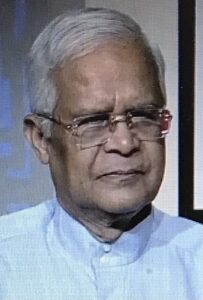
S. Venkat Narayan (in 2018)
I would also note that Venkat Narayan forgot to do his homework, in not preparing himself to study the past political career of Jayawardene from 1943 to 1977. About Jayawardene’s prominent pro-Sinhalese stances such as (1) moving a motion in 1944 that Sinhala alone should replace English as the official language of the island, and (2) Kandy march to protest the Solomon Bandaranaike – Chelvanayakam Pact of 1957 were not at all questioned by the interviewer.
And TULF leader Amirthalingam’s weakness deserves to be noted as well. Why I had portrayed him as a ‘chicken’ (after he gained the leadership role, following the demise of his mentor Chelvanayakam), is he wished to ‘please all’, without being firm on his conviction of leading the fight for a separate state for Eelam Tamils. He had wished to please the Sinhalese parliamentarians (Jayawardene, Sirimavo Bandaranaike and Premadasa), Tamil militants, and (later) India’s mandarins (including journalists, RAW operatives and Karunanidhi). Eventually, he ended pleasing none and became a sacrificial pawn in the Rajiv Gandhi – Premadasa tug of war, abetted by RAW operatives in July 1989. Please check Amirthalingam’s ‘chameleonic’ answer to the question ‘What would you accept short of Eealam?’ Rather than being firm in his conviction for a separate state, he had meandered that the ruling party should decide what ‘they are willing to offer to Tamils.’ This was the major difference in conviction between Amirthalingam and Prabhakaran.
Furthermore, Amirthalingam had a leaky mouth! Few of his answers to Venkat Narayan’s questions in 1981 were childish or at best amateurish! Two examples I cite here.
“Q: Have you ever discussed your problems with Mrs Gandhi?
Amirthalingam: I met Mrs Gandhi two or three times and placed the problems faced by the Sri Lanka Tamils before her.”
Why he was NOT specific, how many times he met Mrs. Gandhi – ‘two or three times’!
Then, the next question was
“Q: What did she say?”
Amirthalingam should have tactfully answered with few words. ‘That’s not for you or India Today to know.’ Instead of this, his answer was ridiculously 102 words long! (check below) Indira Gandhi would have leveled Amirthalingam’s intelligence was a shallow one.
When did Amirthalingam began to stray from his conviction and leadership role for the Eelam separate state? It was not after the enactment of the 6th Amendment to the Sri Lankan constitution on Aug 8, 1983 that criminalized the advocacy, promotion or support for a separate state within Sri Lanka. Quite a few books on Amirthalingam in my shelf do not provide a clear date. But the answer appears in vol.2 of Jayawardene’s biography. According to de Silva and Wriggins,
“On 10 December (1981) the TULF, in a bold statement, condemned the attempts being made by a group of London-based Sri Lankan Tamil expatriates to issue a Unilateral Declaration of Independence (UDI) for the Northern and Eastern Provinces. JR and the government had been warned about this latter possibility for some time and were deeply concerned about its political consequences within Sri Lanka. They were not too certain about the TULF’s own stand, especially about its youth wing should such a declaration be made. When the TULF’s statement condemning the London-based Tamils for arrogating to themselves the right to decide on the political future of the Sri Lankan Tamil community was published, JR was delighted. He attributed it to the rapid improvement in relations between the UNP government and the TULF after the latter’s decisive polls victory at the District Development Councils election in Jaffna, and the practice he had initiated of informal meetings between some of his cabinet ministers and the TULF leadership…”
Both interviews by Jayewardene and Amirthalingam appeared in the same issue of India Today, for its cover story ‘Sri Lanka – a Tamil Nightmare’. While Jayawardene had answered 28 questions, Amirthalingam had answered 12 questions. Sentences and phrases in bold fonts and italics are as in the original.
J.R. Jayawardene – ‘The TULF began it All” [India Today, Sept 1, 1981, pp. 18-19]
Following his stunning electoral triumph four years ago and the overwhelming parliamentary majority that his United National Party (UNP) commands, Junius Richard Jayawardene, 75, had earned the enviable reputation of being one of the most stable heads of state in the volatile Indian Ocean region. By last fortnight, however, the austere, Sri Lankan President’s political fortunes had taken a dramatic downswing in the wake of the recent orgy of violence that has convulsed the central part of the idyllic island. While the spark that ignited the violence was confined to the so-called ‘Tamil problem’, a long-festering thorn in the Government’s side, opposition to the UNP government has been steadily snowballing in the wake of Jayewardene’s efforts to arm himself with extra-constitutional powers in order to muzzle the powerful labour unions and bring the Tamil problem under control.
Despite the widespread feeling that he is currently riding an unpredictable tiger, Jayawardene was surprisingly relaxed and cheerful when he met INDIA TODAY’s senior editor S. Venkat Narayan for an hour-long exclusive interview last week in his elegant official residence in Colombo. Dressed in his traditional spotless white cotton sarong and shirt, Jayawardene spoke frankly and at length on the factors and forces responsible for the current instability in Sri Lanka. Excerpts:
Q: Your Excellency, the recent arson and looting in Ratnapura and other areas where plantation workers of Indian origin live has caused much damage to their lives and properties. What steps are you taking to instil confidence in the affected people?
Jayawardene: These disturbances arose as a result of the murder of over 20 police officials in Jaffna district. They were largely Sinhalese and some Tamils. This is the work of those whom we call terrorists. These terrorists have long been associated with the activities of the Tamil United Liberation Front (TULF). Some of them are members of the TULF. I personally do not think that the TULF leadership has anything to do with them now. But it takes a long time to erase the original idea from the minds of the public. The TULF, though they may not be associated with the terrorists, doesn’t condemn or oppose these murderous activities in Parliament and in their utterances. If the TULF people openly say that they are against terrorism, and associate themselves with the Government in nabbing the terrorists, this feeling of insecurity in the minds of the non-Jaffna people, people living south of Jaffna, will disappear. They will then believe that though the TULF is asking for separation, they will resort to only constitutional means and not to violence. Because there’s this anti-TULF feeling and the TULF is associated with Tamil people – good and bad – certain elements, maybe criminals, maybe politicians, use that existing anti-Tamil feeling to create tension. We are doing our best to control the situation. Those who need our special protection are those in the plantations- citizens, non-citizens or the stateless. They are the most harmless people. They are members of unions which are supporting our government. That’s why I cannot understand why anybody supporting the Government should try to harm people who are themselves supporting the Government. I think there is some anti-government movement behind this.
Q: This has caused anxiety in India where there was a heated discussion in Parliament last week.
Jayawardene: I can understand the anxiety of India, but that anxiety should be for people wherever they attacked, not only in Sri Lanka. Just as much as we are anxious when people in India are subjected to communal violence, whether they be Muslims, Buddhists. But I feel the Indian Government should not show undue anxiety. In Sri Lanka it can be misunderstood. We do not like interference in our affairs and I feel our government is liberal, democratic and as humane as the Indian Government or any government in the world. There’s nothing they can teach us or anybody can teach us about how to govern a country.
Q: There has been some talk about the involvement of a foreign hand by some of your ministers. Do you believe that too?
Jayawardene: I can’t say I believe or don’t believe it. Terrorism is always international. We are investigating it.
Q: You don’t suspect the Indians by any chance?
Jayawardene: I am not suspecting anybody, least of all the Indians.
Q: During the past week I have travelled in the affected areas and spoke with the people, Sinhalese as well as plantation workers. Some statements made by some of your ministers in Parliament appear to have contributed a great deal to the building up of tension in the affected areas. Do you approve of the racial tone of such statements by your ministers?
Jayawardene: Maybe they could have contributed but much less than what the TULF has contributed. The TULF people began it all by making provocative statements. If there wasn’t that debate where a lot of steam was let off, it is possible the Sinhalese might have erupted more. They were saying: What is the Government doing? What are the MPs doing?
Q: One gets the impression that the ‘Ceylon’ Tamils as well as those of Indian origin suffer from a tremendous sense of insecurity. This is why they are agitated and are talking about a separate state.
Jayawardene: They have a sense of insecurity because they are talking about a separate state. If they give it up, all this will disappear.
Q: They say that Tamils don’t get jobs if they can’t speak Sinhalese. They have problems getting admission to colleges. They say there’s discrimination. So they are fed up and are very agitated. They say, ‘we have been living here as long as the Sinhalese have been living. If we can’t live in non-Tamil areas happily, let them give us autonomy so that we can live in our areas like Jaffna with happiness and without any discrimination’.
Jayawardene: The development councils will be implementing all this. You can’t change things overnight by legislation. But a section of the TULF, which believes in terrorism, is opposed to the development councils. They murdered our chief candidate. They don’t cooperate. Nobody tells us who did it. Why doesn’t the TULF come forward and say they are for development councils? Their main grouse is that we are not implementing some of our decisions. Implementation takes time. We need TULF’s cooperation. I can’t go beyond the development councils. As long as there is terrorism, I don’t think both sides can get together. Anytime we sign any agreement they go and shoot the Sinhala police.
Q: So you are saying that it’s terrorism that is coming in the way of a settlement?
Jayawardene: I have done everything they want. Their complaint is non-implementation of what we have agreed to. But why don’t they get together with us to implement things?
Q: Whenever there’s serious communal trouble in India, either the prime minister or one of her senior colleagues rushes to the spot to console the victims and to reassure them. Nothing of the kind seems to be happening here. Are you planning a visit to Ratnapura or Jaffna?
Jayawardene: I am thinking of doing that. I am trying to go there before leaving for Saudi Arabia next month.
Q: In Jaffna people are very upset. The policemen set fire to the 50 year old library and burnt 97,000 valuable books. They also set fire to a TULF MP’s house.
Jayawardene: That’s because they think he is in touch with the terrorists.
Q: It seems they were trying to catch him so they could kill him.
Jayawardene: Terrorists do that too.
Q: So its tit for tat? This kind of situation is causing a lot of alienation. Therefore, if you go there and assure them of your concern for their safety, they may feel relieved. It may go a long way to ease the tension.
Jayawardene: I want to do that but I must find time. I don’t want to go with so much security. If something happens, it will be worse.
Q: I don’t think the Ealam Tigers will try to get at you! Mahatma Gandhi whenever he visited areas of Hindu-Muslim riots, used to completely transform the atmosphere there. Your image is such that such visits will certainly help a great deal.
Jayawardene: I am trying to work it out.
Q: The 15 year Indo-Sri Lanka agreement about repatriation of Tamil plantation labourers will expire in October this year. There are still over half a million stateless people here. What do you propose to do about them?
Jayawardene: We are discussing it at the official level.
Q: Are you going to have another agreement?
Jayawardene: Yes, we have to have something like that.
Q: How to you propose to run the plantations which entirely depend on Tamil labour if the plantation workers leave the area to go either to Jaffna or to India due to fear and insecurity?
Jayawardene: Those who are non-citizens can go back.
Q: But after living here for five generations?
Jayawardene: Yes, they have to go back.
Q: In the US, if a child is born on American territory, its mother too gets that country’s citizenship.
Jayawardene: That may be so, but we have different citizenship laws here.
Q: Mr Amirthalingam, the Leader of the Opposition, says the TULF has a mandate to fight for separation. He says it is up to your government to come up with proposals so that they can consider what to do.
Jayawardene: All the proposals are now being implemented.
Q: Are you planning to ban the TULF?
Jayawardene: Not the TULF, but the Ealam group that is now in Tamil Nadu.
Q: But the talk of Ealam is already illegal, isn’t it?
Jayawardene: I think it is, under the Constitution, but we have not really taken it all that seriously.
Q: Now you want to ban it or banish the people who talk about Ealam?
Jayawardene: I have not thought about it. I want to develop their consciousness. It has just started.
Q: Has Mrs Gandhi been in touch with you about the recent troubles here?
Jayawardene: No. I don’t write to her when there’s communal trouble in India. It happens more often in India.
Q: Do you think she has any clout with the Tamils here? Can she perhaps help mediate here?
Jayawardene: I don’t think so.
Q: You don’t think she has a role to play?
Jayawardene: Nobody other than Sri Lankans have a role to play. But what help can she give?
Q: Maybe, she can ask the TULF leadership not to push you hard on separation but to sit down and talk to settle their problems with you in a peaceful way.
Jayawardene: Oh, yes. Certainly it will be helpful. But I have not asked her for it.
Q: If she offered to help on her own you won’t consider it interference or something?
Jayawardene: I don’t think they’ll listen to her.
Q: At Mrs Gandhi’s level if she does something to help sort this out and asks her ally, the DMK leader Karunanidhi, not to encourage the talk of Ealam but to see how best the Tamil problem can be solved in a peaceful way, I am sure…
Jayawardene: Yes, yes. That will be a great help.
*****
Amirthalingam – “Survival at Stake” [India Today, Sept 1, 1981, pp. 22-23]
The leader of the Opposition in Sri Lanka’s Parliament, Appapillai Amirthalingam, 54, represents the Vaddukoddai constituency in the Jaffna area. Bold and articulate, the lawyer-turned-politician is one of the most prominent leaders of the Tamil United Liberation Front (TULF) which is demanding Ealam – a separate state for the island’s Tamils who number 2.7 million and comprise 20 percent of the population. Last fortnight, S. VENAKAT NARAYAN met him his native village Moolai, near Jaffna. Excerpts.
[Error corrected by Sachi: Amirthalingam did represent Vaddukoddai constituency from 1956 to 1970. But, in 1977, he was elected from Kankesanthurai constituency.]
Q: You have said that the Tamils are worse off under President Jayawardene than they were under Mrs Bandaranaike. How do you substantiate this claim?
Amirthalingam: Under the new constitution he has given more language rights and other things than Mrs Bandaranaike, no doubt about that. But those rights have not been implemented. In the matter of employment in the public and semi-public sectors there has been gross discrimination against Tamils under Jayawardene’s Government. During the four years, he has been in power, not even 2 percent of jobs in this sector have been given to Tamils. The President admitted this. You can see how grave the situation is. Violence against Tamils all over the country has become almost a regular feature now, particularly since 1977. In Mrs Bandaranaike’s time there was no communal violence against Tamils in the south. She ruled with emergency and violence of all types was kept under control. Since 1977, there has been communal violence four times. Every year it has been happening. In August 1977, we had widespread violence all over the country. Nearly 300 people were killed, about 10,000 Tamils were injured, about 50,000 came to the north and east as refugees, and over 200 Tamil women were raped. Property belonging to Tamils worth about a thousand million rupees or more was destroyed or looted. It happened again in 1978, 1979 and once again this time. It spread all over and I think in Ratnapura district alone about 10,000 workers have been affected. The damage to property and the attack on people this time has been more systematically planned. It was ruthlessly executed.
Q: What do you think of the charge that some hawks in the Cabinet were actively involved in inciting the people by their communal speeches?
Amirthalingam: I entirely agree. I am definitely of the view that the climate for all this violence was created by members of the Government. In fact the people who were driven out of the Ratnapura area say that it all started with speeches made by a woman minister and a Buddhist priest in that area a few days ago. They were hundred percent certain that all the fellows who attacked were UNP people. The Sri Lanka Freedom Party (SLFP) men did not interfere, according to them.
Q: Have you come to accept the extremist view that Ealam is the only solution to this problem?
Amirthalingam: For 25 years we put forward a federal solution but there was no response from the other side. Actually, it was police and army violence against our people at the World Tamil Research Conference in Jaffna in 1974 that was the turning point which altered the thinking of the Tamil people, that they cannot live with the Sinhalese any longer. And the idea grew in 1975. Ultimately in 1976, at a party convention, we took the decision that that was the only way we could survive as a separate entity. Apart from our rights, our very survival is at stake. The systematically planned colonization of our areas with Sinhalese people has been carried out over the last 30 years to such an extent that we run the risk of being made a minority in our own areas, and if we become a minority we know what fate awaits us. If we are a minority here in Jaffna then we will have to jump into the sea, we will have no other place. That is our fate.
Q: The President said in his manifesto that he would organize a round-table meet to discuss the Tamil problem. But he has not done so. Do you think, hawks like Industry Minister Cyril Mathew are coming in the way?
Amirthalingam: I think it is partly because of resistance to the President’s plans within his own Cabinet, and in his own party. They are not allowing him to do what he wants to do. But at the same time, as a politician he also has been making certain speeches which were calculated to rouse the Sinhalese. Jayawardene wants to satisfy both sections of his party. I think he has an eye on the next elections. So he must carry all sections with him. I think today Cyril Mathew and his group are very powerful in the Cabinet and in the country, so he will not like to go violently against them. Yet, I am hoping that we may be able to at least get over some of the harsher effects of the situation through him. He is the only person who can do something.
Q: What would you accept short of Eealam?
Amirthalingam: During the elections of 1977 we asked for a mandate from our people to work for the freedom of the Tamils by establishing their own state. We are not free to put forward any alternative to Ealam. But it is up to the Government to put forward alternatives. Whatever the Government is prepared to put forward, we are willing to consider and submit to our people. We are only two familiar with governments asking us for the minimum and it becomes the maximum. And then they beat down from that point, and we get nowhere. We get played out in the end. Though for 25 years we asked for a federal form of government, it was never seriously considered. This has at least made them sit up and realise that they must find a solution to this problem.
Q: How do you propose to achieve this through parliamentary means? The Tamils are concentrated in a few areas. How do you propose to persuade the 80 percent Sinhalese to look at things your way?
Amirthalingam: Not merely by agitation in Parliament, but by non-violent struggle outside. We will make it impossible for them to govern us in the way which they are seeking to do. After all they are not a mighty empire which can keep us down.
Q: Have you ever discussed your problems with Mrs Gandhi?
Amirthalingam: I met Mrs Gandhi two or three times and placed the problems faced by the Sri Lanka Tamils before her.
Q: What did she say?
Amirthalingam: She understands our problems. Of course, I can’t expect her as the head of a neighbouring country to interfere in Sri Lanka’s internal affairs. I said to her that India should understand and sympathise with us. If things go beyond our endurance, if we are repressed to an extent that our very right to live as human beings is in danger, India is the only country which can raise its voice on our behalf. Because, we are tied to India by ties of language, religion; emotionally we have much in common with India. All our thinking is conditioned by thinking in India.
Q: What do you think India should and can do to help you without giving the impression that she is intervening in the internal affairs of another sovereign country?
Amirthalingam: Lately, India has begun, through diplomatic channels, to bring pressure on the Sri Lanka Government with regard to our problem. This was not there in the past. If they keep up what they are doing now, things ought to be better.
Q: Do you think India’s offer to mediate with the Sri Lanka Government and suggest to it to be more sympathetic to the Tamils could be misinterpreted as intervention here?
Amirthalingam: Many countries take up the cause of the Palestinians or of the blacks in South Africa; they apply sanctions for the rights of the blacks in South Africa. If one looks at it narrowly, it is an internal problem in South Africa. The problem of the blacks in Zimbabwe was an internal problem but the world didn’t close its eyes to that. They felt that where human rights are denied it is a matter for the world to interfere and to see that human rights are granted. As our neighbour, India has a moral obligation to see that human rights are granted, particularly when a substantial section of the people denied human rights are people of recent Indian origin.
Q: Are you suggesting that the plight of Tamils in Sri Lanka is similar to that of the blacks in South Africa and the Palestinians who are fighting for a homeland of their own?
Amirthalingam: Yes, very much so. We had dour own homeland in this country, our own government, our own kingdom; for the first time the British unified the entire country. Now, in the name of independence and democracy, power has gone into the hands of the Sinhalese and they are using that power to deny all our rights.
****