by Sachi Sri Kantha, September 27, 2026
Introduction
Lingam (phallus) worship has been a sustained Hindu tradition for millennia, and this is reflected in the Tamil personal names. Provided nearby is a screen grab from the 1954 Kannada film ‘Bedara Kannappa’. Kannada actor Rajkumar (1929-2006) in his debut performance portrayed the hunter devotee Kannappa. The clipped scene appears in the song sequence ‘Sivappa kaya thonde’, elegantly sung by Chidambaram S. Jayaraman, in kannada. [The link is, https://www.youtube.com/watch?v=_OslH9DyKcY]. The dubbed Tamil version, had the name Vedan Kannappan. The particular song ‘Ennappan antro enthan’, was delivered by Jayaraman’s junior contemporary T.M. Soundararajan [The link is https://www.youtube.com/watch?v=Dm2QeRoAJWk]. The music director for both movies was R. Sudharsanam.
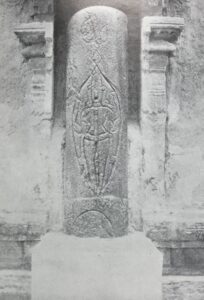
Carved lingam at Munneswaram temple, near Chilaw
Rev. James Cartman had described about lingam worship among Hindu Tamils in Ceylon, in his 1957 book. This book also includes a photo of carved lingam at Munnesvaram temple (presented nearby). Rev. Cartman’s description was as follows:
“In the Munnesvaram temple near Chilaw there is a linga erected upon a stone altar facing the western entrance. On the linga are several carvings. At the top, there is a swan, and at the base, the figure of a boar, whilst between the two figures, separating them, is a flame of fire in the midst of which is the god Siva. This linga thus reminds Saivas of the story, related in the Linga puranam, of a dispute between Brahma and Vishnu, each claiming to be the supreme deity…”
Cartman also has a paragraph on phallic worship in Ceylon, which had prevailed prior to the introduction of Buddhism in the island. In this, Cartman’s source was none other than Dr. Senarath Paranavitana! (In this regard, I’m currently preparing, a re-formatted version of Paranavitana study, that appeared in the Journal of Royal Asiatic Society – Ceylon branch in 1929, with my commentary.)
Previously, I have passingly mentioned about ‘lingam’ names in Part 3 of this series and Prof. Ratnajeevan Hoole’s erroneous thoughts, whose ancestors were Hindus, less than three centuries ago. That was in 2018. [The link, https://sangam.org/onomastics-of-tamil-personal-names-part-3/]. In this part, I expand on the continued prevalence and popularity of ‘lingam’ (literally, phallus) names among Tamils in India and Sri Lanka. Mostly, ‘lingam’ appears as suffix in male names, but it may also appear as a prefix in male (such as Linganathan, Lingarajah and Lingasamy) and female personal names.
A popular lingam name in 20th century Ceylon was Suntharalingam, represented by the mathematician turned politician/polemicist (1895-1985). Though his father’s name was Chellappah, all of Suntharalingam’s siblings carried the lingam suffix – Nagalingam, Thiyagalingam, Amirthalingam. Suntharalingam in turn, named two his male children with lingam suffix (Gnanalingam and Sathyalingam) and four of his female children with lingam prefix (Lingambikai, Lingaathy, Lingamani and Lingeshwari). Please see the obituary note of physicist Dr. S. Gnanalingam.
Lingam etymology and symbolism
I present below, what appears in Hobson-Jobson – a Glossary of Colloquial Anglo-Indian Words and Phrases (1969 revision), for the word LINGAM.
“This is taken from the S. Indian form of the word, which in N. India is SKT. And Hind. linga, ‘a token, badge’ & thence, the symbol of Siva which is so extensively an object of worship among the Hindus, in the form of a cylinder of stone. The great idol of Somnath, destroyed by Mahmud of Ghazni, and the object of so much romantic narrative, was a colossal symbol of this kind.”
First use of this word is recorded in 1311. Subsequent uses checked in 1616 by Diogo de Couto, 1726 by Valentijn and William Hodges in 1781. Derivatives from the word ‘lingam’ such as lingait, lingayet, linguist, lingavant, lingadhari and lingua are also explained in the same page.
Multiple entries in Jack Tresidder’s ‘Dictionary of Symbols’ (1998) do offer short descriptions about lingam and its variants (cross, head, omphalos, pillar, rod) in other cultures. What Tresidder had described about lingam is given below:
“The male generative force in nature, symbolized in Hindu art and architecture by a stylized phallus representing the god Shiva as divine procreator. In the cave of Elephanta at Bombay, the lingam – a thick, smooth cone of black stone – was the focus of circumambulation rituals, indicating its role as an axial symbol as well as a phallic one, somewhat like the classical omphalos. In one myth, Shiva’s lingam appears as a pillar of light, the upper and lower limits of which cannot be found by Brahma as a wild goose or Vishnu as a boar – proof of Shiva’s power. Although essentially a virility symbol, the lingam sometimes appears with a stone circle at its base representing the yoni (vulva) as a symbol of the sacred marriage of male and female. The Chinese keui, a jade oblong with a triangular end, has similar meaning. The lingam entwined by a snake refers to the yogic kundalini, the serpentine flow of vital energy.”
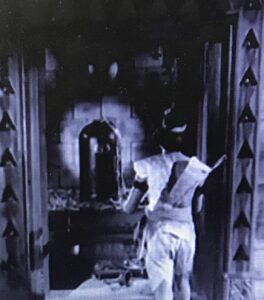
Prayer to Sivalingam (screen grab from ‘Bedara Kannappa’ – Kannada movie, 1954)
Hindu myth about Sivalinga
An excerpt, from the entry on ‘Shiva, India’ in the Dictionary of World Myth (1995) is given below:
“Shiva is worshipped in the form of a linga or sacred phallus. According to one myth, Vishnu and Brahma were disputing who was the greatest when Shiva appeared in the form of a fiery column, the linga. Brahma took the form of a goose and flew to find the top, while Vishnu became a boar and sought the bottom. Both failed and were forced to concede to Shiva’s authority.
Both ascetic and erotic aspects are found in a myth that relates how Shiva smeared himself in ashes and visited a forest where many sages lived a life of asceticism. The sages feared he would seduce their wives and cursed the god to lose his penis. Shiva was castrated, but with his own complicity. The world then grew dark and cold and the sages lost their virility until they had placated Shiva by erecting a linga.”
Prof. Hoole’s fetish with the ‘lingam’
Prior to exposing the ignorance of Prof Hoole, and rebutting his anti-Hindu drivel, I quote his thoughts from a paragraph that appeared in a deceptive sub-titled work ‘The Exile Returned: A Self-portrait of the Tamil Vellahlahs of Jaffna, Sri Lanka’ (1997). Why I assert that the subtitle of this book is deceptive? In coherence with the main title ‘The Exile Returned’, the subtitle should have used the phrase ‘Christian fundamentalist Tamil of Jaffna’, instead of ‘Tamil Vellahlahs of Jaffna’. Portrayed ‘returned exile’ of the book was Prof. Hoole himself. Words in italics in the citation, are as in the original.
“The name Amirthalingam harked back to the thirteenth and fourteenth centuries when the Tamils came under the influence of the Tengalai bhakti movement looking upon Pillai Lokacarya (b. 1213) as its founder. He had authored 18 esoteric treatises, the Rahasyas, with their influential expositor Manavala Mahamuni (b. circa 1370). The bhakti cult, especially of Radha, tended to degenerate into erotic excesses.419 This was particularly true to the followers of Vallabhacarya (1479-531), a Telugu Brahmin and founder of a system called suddhadvaita which exalted bhakti above knowledge. The acaryas of the sect were known as Maharajahs and lived luxurious lives, very much like the white Maharishis of America who seemed to emulate the life style of these Maharajahs. The highest ambition of Vallabhacarya’s followers was to become gopis (cow-herdresses) and sport eternally with Krishna in his Heaven, an ideal which in practice degenerated into gross eroticism. A part of this period saw the phallic symbol of Siva, his phallus or penis, being exalted. Names like Amirthalingam (the Phallus giving Ambrosia), Varnalingam (the Coloured Phallus), Mahalingam (the Big Phallus), Sundaralingam (the Beautiful Phallus), Gnanalingam (the Wise Phallus), and Panchalingam (5 Phalluses) became common among the devotees. It was the period when female devotees inserted phallic symbols of stone, the penis of God, into themselves as an act of devotion to Siva. The Suchindram Temple in South Travancore was a place where a dagger was used as a symbol of Siva’s penis and Devadasys were married to it.420 It was the same period that undergirded the dance forms of Vijayanagar where the dancer yearned for God as her lover and invited copulation at the high point of the dance. The name Amirthalingam could also be interpreted as the Phallus tasting of Ambrosia as in oral sexual intercourse, and perhaps as a left over from the days of sexual orgy referred to by the historian Sastri…”
Two specific superscripts 419 and 420 refers to published books of K.A. Nilakanta Sastri ‘A History of South India: From Prehistoric Times to the Fall of Vijayanagar’ 2nd ed. 1958, and Massey, Reginald and Jamila ‘The Music of India’, 1976.
Criticism on Prof. Ratnajeevan Hoole
A stinging review of this 1997 book by Hoole appeared in the Oru Paper (London, Apr 7, 2006). Though without a by-line, it’s my guess that it was contributed by S. Sivanayagam. It said,
“Grant it to the man, he had done a lot of painstaking research during his life in America into Aryan Brahmanical agamas and Vedas. Why did he do it Because he thought that is the only way he could scrape enough evidence to discredit the Hindu faith.
This man has a streak of eccentricity. But that is his problem. He is a Christian fundamentalist, but that too is his privilege. He has a lot of sex thoughts in his head, but even that is his problem. The mistake he makes is in making various sex allusions in a book he says is ‘dedicated to the little children of Jaffna’…Sex, sex habits, sex behaviour, are all universal traits not discovered by Professor Hoole through his research, nor are they peculiar to Tamil Hindus only, but what is nauseating is the pleasure the man derives from talking about them with the Hindus always in mind. His real viciousness shows when he ridicules the Hindu faith…”
In the reference sources provided below, I cite published literature (from ranking thinkers – Iwan Bloch, Bertrand Russell and R.K. Narayan among others) to support this editorialist’s viewpoint that sex habits and sex behavior are universal traits and not specific to Hinduism.
My criticism of Hoole’s ignorance is this. While he had taken pain (or pleasure!) to read Hindu scriptures with jaundiced eyes, he had conveniently ignored the writings of Christian religious practices. Bertrand Russell was definitely NOT in his reading list and not cited in his 1997 book. I suggest, Prof. Hoole should read Russell’s classic ‘Why I am not a Christian’ (1957), especially the chapter ‘Our sexual ethics’. Another Russell classic was ‘Marriage and Morals’ (1929). While Prof. Hoole debunks the devadasi culture among the Hindus in his diatribe, does he know that Catholic nuns like Mother Teresa are the equivalents of devadasis in Christianity? This is what Russell had written in ‘Marriage and Morals’. “Up to our own day in the Catholic Church, nuns are regarded as the brides of Christ. And this is certainly one of the reasons why, it is thought wicked for them to have intercourse with mortals.”
In addition to Bertrand Russell, to name a few other sources in English, Prof. Ratnajeevan Hoole may benefit much from glancing the books of Roger Goodland (A Bibliography of Sex Rites and Customs, 1931) and George Ryley Scott (Phallic worship – A History of Sex and Sex rites in relation to the religions of all races from antiquity to the present day, 1941). Scott had included a chapter ‘Phallicism in the Bible’. In it, he provides the following interpretation on the use of ‘euphemisms or harmless terms’ for penis in the English translation of the Bible. To quote,
“The persistent practice of the Bible translators of disguising sexual references and phallic indications by the employment of euphemisms or harmless terms is again illustrated in the deliberate use of the word ‘thigh’ for the penis. It was the universal custom for anyone making a vow to place his hand upon either his own sexual member or upon that of the other person concerned than the penis, the representative of Yahweh, no higher testimony could be given or asked…”
Apart from this particular chapter, Scott also have specific chapters for phallicism (1) in ancient Greece and Rome, (2) phallicism in Egypt, Persia, Assyria, (3) phallic Gods of India, (4) phallicism in China and Japan, (5) phallic worship in Great Britain, France and other parts of Europe, (6) phallicism in relation to Christianity, etc.
Popular lingam names
Now, to popular lingam names among Tamil Hindus in the 20th and 21st centuries. For convenience, I separate the locations – Tamil Nadu and Sri Lanka, and identify the men in politics and cultural areas (literary and music-films) who have carried the lingam name. Names are arranged tentatively in the descending year of birth.
Tamil Nadu
Namakkal V. Ramalingam pillai (1888-1972) – poet and novelist. His novel ‘Malaikallan’ was the source of 1954 block buster MGR movie with the same name. [Check this link https://sangam.org/malai-kallan-mountain-dacoit-movie-and-its-five-variants/]
Pudukottai K. Nagalingam (1894 –1943), became popular with his stage name Raja Sandow – actor in silent movies produced in Bombay from 1922 to 1931, and actor/director of Tamil talkies for the first ten years, from 1932 to 1942. According to spotty biographical records, he was a gymnast, weight lifter and physical culturist, who came into contact with silent films when he visited Bombay to teach wrestling. MGR had written in his autobiography Naan Yaen Piranthaen (1970-72), that Raja Sandow was an inspiration for his cinema career, and incorporated a real life incident that happened in Sandow’s career at Bombay, in one of his popular movies ‘Enga Veetu Pillai’ (1965). After he became the Chief Minister of Tamil Nadu, MGR also established ‘Raja Sandow Award’ State award to recognize senior artists who had contributed to the cinema industry.
Tenkasi Sangaralingam Chockalingam (1899 – 1966) – journalist and first editor of Dinamani newspaper in 1930s. He was also a pre-Independence Congress party politician who got elected in 1937 to the Legislative assembly of Madras Presidency.
Tiruppur Subrahmanya Avinashilingam chettiar (1903-1991) – pre-Independent era Congress party politician, who also served as the Minister of Education, in Madras Presidency during 1946-1949.
Anbil P. Dharmalingam (1919 – 1993) – One of the founder members of DMK party. He had been an elected MP, and MLA representing this party, and served as a Cabinet Minister.
Kasilingam – well recognized editor and director of Tamil movies starring MGR and Sivaji Ganesan from 1942 to early 1960s.
Sangaralinga Bhagavathar – actor in few Tamil movies – Naveena Satharam (1935), Kusela (1936), Bhaktha Arunagiri (1937).
S.S. Sangaralingam – a lyricist for the 1935 Tamil movie Athiroopa Amaravathi.
P.S. Sivaramalingam Pillai – an actor in 1935 Tamil movie Bhaktha Duruvan, and a lyricist in the 1940 Tamil movie ‘Shylock’.
Sokkalinga Bhagavathar – an actor in few Tamil movies Thukaram (1938), Thanasoorakarna (1940), Thilotthamai (1940).
Pollachi Nachimuthu Mahalingam (1923 – 2014) – recognized Indian industrialist and politician. A Congress Party MLA representing Pollachi constituency from 1952 to 1967, by winning three consecutive general elections. He died, aged 91, while delivering a spirituality lecture at the stage.
Thenkarai Ramakrishna (T.R.) Mahalingam (1924-1978) – one of the popular singing actors in Tamil movies, active for decades from 1939 to 1973.
Trividaimarudur Ramaswamy (T.R.) Mahalingam (1926 – 1986) – most popular Karnatic music flutist of the 20th century.
Ramaiah Mahalingam aka Saalai Ilanthiraiyan (1930 – 1998) – renowned Tamil professor (essayist, poet) and Dravidian brand activist, who held an academic rank at the University of Delhi, from 1959 to 1985. Among all the Tamil literati in Tamil Nadu, it was only with Saalai, I had a letter correspondence in late 1970s.
C.P. Jambulingam – an editor and director of Tamil movies. Had worked in MGR movies in both capacities (Rani Samyuktha, Mannathi Mannan, Enga Veetu Pillai, En Annan).
Subbiah Muthulingam (b. 1942) – poet and lyricist. Received recognition due to patronage in MGR’s final few movies in 1970s and also as the poet laureate of Tamil Nadu.
Seshampatti T. Sivalingam – Karnatic musician (nadaswaram expert), of distinction.
Sri Lanka
I provide a list of recognized lingam names in politics, professions and cultural areas. Names are tentatively arranged in the descending year of birth.
Elected legislators
Chellappah Suntharalingam (1895-1985) – elected from Vavuniya constituency five times in 1947, 1952 and 1956 general elections, and two by-elections on Oct 31, 1951 and Feb 13, 1956, all as an Independent candidate. Prof. Alfred J. Wilson had aptly portrayed the character of Suntharalingam as ‘a man of integrity who acted according to his convictions, he was best described as a Ceylon Tamil who would neither lead nor follow.’ in his 1988 book, ‘The Breakup of Sri Lanka – The Sinhalese-Tamil Conflict.’. For my thoughts on Suntharalingam’s standing among Eelam Tamils, please check these two links posted in this site: https://sangam.org/happened-65-years/ in 2012, and https://sangam.org/from-sachis-file-chapter-24/ in 2024.
Sidambarampillai V. Vytilingam (1903 – ? ) – elected twice; for State Council 1931 and 1936 elections, from Talawakelle constituency, as an Independent candidate of recent Indian origin. He was a tea estate director of Kirimetiya Estates Ltd, in 1950s.
Thamodarampillai Ramalingam (1904 – ?) – an attorney, elected twice; won at Point Pedro constituency in 1947 and 1952 general election on Tamil Congress Party ticket.
Kalimuthu Rajalingam (1905 – 1985) – elected as a representative of Ceylon Indian Congress, from Nawalapitiya constituency, to the first parliament of Ceylon. Subsquently, he morphed into a trade union leader.
Viswanathan Dharmalingam (1918-1985) – elected five times; won in Uduvil constituency in March 1960, July 1960, 1965, 1970 general elections on Federal Party ticket and Manipay constituency in 1977 general election on TULF ticket.
Appapillai Amirthalingam (1927-1989) – an attorney, elected five times; won in Vadukkodai constituency in 1956, March 1960, July 1960, 1965 general elections on Federal Party ticket and in Kankesanthurai constituency in 1977 general election on TULF ticket. Amirthalingam had three younger siblings, all having ‘lingam’ suffix – Sokkalingam, Vasudevalingam and Thihambaralingam.
Poopalapillai Ganesalingam (1932-1986) – one time MP, won at Padiruppu constituency in 1977 general election. Prior to his entry into politics, he worked as an officer in the Excise Department. He also worked as the organizer of SLFP for Padiruppu constituency until 1974.
Thambipillai Rasalingam (1933 – 1990) – one time MP, won at Udupiddy constituency in 1977 general election. Prior to his entry into politics, he served as an education officer.
Mahalingam Kanagalingam Sivajilingam – elected as MP in 2001 and 2004 general elections as a Tamil National Alliance (TNA) candidate.
Professionals
Chellappa Nagalingam (1893-1958) – elder sibling of C. Suntharalingam, and a name-recognized attorney. He became a Supreme Court Justice of Ceylon.
Chellappa Thiagalingam QC (1900-1982) – younger sibling of C. Suntharalingam and a name-recognized attorney. He had five sons and four daughters with his wife Maheswary. All five sons had ‘lingam’ suffix names – Parathalingam, Jeyalingam, Nirmalalingam, Jothilingam and Vijayalingam.
Ponnambalam Nagalingam (~1905 – 1980) – an attorney and became an elected member of the Senate of Ceylon in 1951. He held this rank until 1957. His recognition derives from being the loser to S.J.V. Chelvanayakam (then Tamil Congress party) in the 1947 general election, as a Trotskyist (LSSP), but placed above Subbiah Natesan (1895-1965, a founder member of UNP, and son in law of Sir. Pon Ramanathan). Subsequently, he lost three times to V. Dharmalingam at the Uduvil constituency in Mar 1960, July 1960 and 1965 general elections.
Ambalavanar Vaidialingam (1915-1988) – a school teacher and one of the founder members of Ceylon Communist Party. To enter the parliament, he was a constant rival of A. Amirthalingam at the Vaddukoddai constituency, in four consecutive general elections 1952, 1956, Mar 1960 and July 1960. In the 1952 general election, among the six candidates, Vaidialingam was placed last, while Amirthalingam was placed 3rd. Then, in the subsequent three general elections, Amirthalingam beat Vaidialingam repeatedly.
Prof. V. Sivalingam – physician and first professor of parasitology, University of Ceylon, from 1956 to 1963.
Prof. Selvadurai Mahalingam (1926 – 2015) – from Alaveddy. Renowned mechanical engineer and renowned professor in the Faculty of Engineering, University of Peradeniya. Newton Wickramasuriya, a Past President of Institution of Engineers Sri Lanka, in his appreciation to Prof Mahalingam contributed the following:
“ He was a witty person too. Once in our final year, just outside the lecture room, somebody raised the engine of his two-stroke motor cycle, sans the silencer. With his characteristic staccato voice, he asked ‘who made that spectacular display of his horsepower?’ He was not without critics. There were many who found fault with him for not initiating post graduate studies in his field of specialization. His answer to that was, he did not believe in half-baked products. He bemoaned the fact that the University did not have sufficient funds to get down text books and journals of repute. ‘How can I produce postgraduates under such circumstances’, he asked.” [Official Newsletter of Institution of Engineers Sri Lanka, Dec 2015].
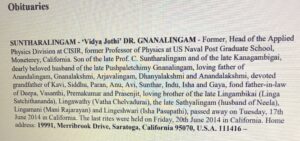
Physicist Dr Sundaralingam Gnanalingam’s obituary notice in 2014
Prof. Sivalingam Mahalingam (? – 2010)– Veterinarian scientist, and son of Prof. V. Sivalingam (mentioned above). Possessed a jovial talent for conversation, he was a senior acquaintance of mine during my Peradeniya period (1977-81).
Suntharalingam Gnanalingam (1924 – 2014) – physicist son of mathematician-politician Chellapah Suntharalingam. He was also an elderly acquaintance of mine, at the University of Illinois for a year in 1985. Then, he moved to U.S. Naval Postgraduate School in Monterey, California. When his father Suntharalingam died in Vavuniya, Dr Gnanalingam left for Sri Lanka to attend the funeral, and after returning to Illinois, described to me the travails experienced to conduct that funeral, though he did receive a formal condolence message from J.R. Jayewardene, the then President. Suntharalingam was a senior Cabinet colleague of Jayewardene for a year between 1947 and 1948.
Suntharalingam Sathyalingam (1930 – 2011) – received recognition as a musician, after graduating with a degree in Music at University of Madras, and alsostudying at Kalakshetra school. Subsequently, moved to Singapore in 1974 and established Apsaras Arts, a music school in 1977, in collaboration with his wife Neila.
Ramachandra Sundaralingam (1930 – 2018) – police officer, who raised to the rank of Senior Deputy Inspector General of Police. He was a son of Hindu philosopher Kathiresu Ramachandra (1895-1976). As I had written previously, his son Radhakrishnan was a student of mine at the University of Peradeniya. [please check the link https://sangam.org/nobel-peace-prize-nominees-and-wannabes-from-sri-lanka/] After July 1983 riots, he wisely chose to leave the island and landed in Interpol headquarters in France and worked for 18 odd years. Eventually, settled in Chennai and died there.
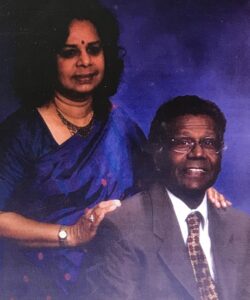
Prof Muttiah Sundaralingam and his wife Indrani
Muttaiya Sundaralingam (1931 – 2004) – Ranking professor in biochemistry, at the University of Madison, Wisconsin, recognized for his trend setting studies in crystallography of nucleic acids. Along with his wife Indrani, Prof Sundaralingam died at Trincomalee on Dec 26, 2004, a victim of major tsunami, which followed the major earthquake off the coast of Sumatra. An obituary by Eric Westhof in the journal Structure provides information of his achievements. While I was at the University of Illinois, after the July 1983 anti-Tamil riots, and reading one of my commentaries that appeared in the Tamil Times (London) magazine, I was surprised to receive a phone call from Prof Sundaralingam, commending my piece. Though I yearned to become a postdoc researcher in his laboratory, due to my deficiencies in crystallography research, he politely suggested to look for more appropriate labs that fitted my graduate training.
V.K. Ganesalingam (1935 – 2018) – Professor in Zoology, University of Jaffna. A specialist in Entomology. Prior to moving to Jaffna, he was a lecturer at the University of Peradeniya.
Nagalingam Shanmugalingam – An academic, after joining the University of Jaffna in 1981 as an assistant lecturer, he became the Vice Chancellor position of University of Jaffna (from Dec 26, 2007 to Mar.31, 2011), during the tenure of Mahinda Rajapaksa presidency.
Kanakarathnam Maruthalingam (nom de guerre, Maruthan) – one of LTTE fighters, from Vaddakachchi, Kilinochchi. Born on Feb 2, 1971. Heroic death Dec 22, 2000, during attack on Kaithadi/Kopay military camp.
Subramaniam Selvalingam (nom de guerre, Major Kumanan) – one of LTTE’s suicide battalion, from Mannar. Born on June 6, 1973, he donated his life on Nov 12, 1994, at the age of 21.
Business and Cultural Notables
Rev Fr. Swami Gnanapragasar (1875 – 1947) – prominent Catholic priest and linguistic scholar. His birth name was Vaithilingam. Parents being R. Swaminathapillai and Thangamuthu. He was ordained into Catholic priesthood in 1901, and assumed the name Rev Gnanapragasar.
Nagamuthu Vaithilingam (1878-1955) – businessman with origin in Navaly; proprietor of Vaithilingam and Co, hardware merchants in Colombo.
‘Kalaiarasu’ Kanagaratnam Chornalingam (1899 – 1982) – famed Tamil stage actor, and during his era, he was popularly known for his ‘Shylock’ character role, in Shakespeare’s play ‘The Merchant of Venice’. ‘Kalaiarasu’ (King of Arts) was a title awarded to recognize his talents.
Ramalingam (1908 – 1976) – a respected Tamil folklorist from Vaddukoddai.
Dr. S.A. Tharmalingam (1908 – ?) – a popular physician and social activist, from Jaffna.
Vaithiyalingam (1911-1991) – Tamil fiction writer.
Se. Ganesalingan (1928 – 2021) – Tamil fiction writer, born in Urumpirai – a novelist of note with Marxist inclination. He moved to Chennai, after July 1983 riots and died in Chennai.
Shanmugam Sivalingam aka Stephen Master (1936 – 2012) – born in Pandiruppu, Eastern Province, was a school teacher and Tamil poet.
Appadurai Muttulingam (b. 1937) – Tamil short story writer born in Kokuvil, with a chartered accountant qualification. After leaving Sri Lanka in 1972, and working in many countries, is living in Toronto, Canada now.
Kandiah Sokkalingam aka Sokkan (1943 – 2026) – a Tamil writer born in Elalai west, with some recognition. He died in Negombo.
Conclusion
I should also include the names of three young heroic women fighters, who belonged to LTTE’s suicide battalion. Their family names are ‘lingam’ too.
Shyamala Mutulingam (aka Capt. Aruljothi), from Chundikuli – born on May 11, 1976. died on Sept 10, 1995, aged 19.
Rajakumari Shanmugalingam (aka Capt. Sivagami), from Nagarkovil – born on Jan 1, 1975. died on Oct 17, 1995, aged 20.
Rajamalar Rajalingam (aka Capt. Ilaiyaval), from Kannakipuram, Trincomalee – born on Oct 31, 1974. died on Mar 30, 1996, aged 21.
I have provided only the names of well recognized individuals above. But I acknowledge this list is not exhaustive. A fancy name identified among my kin is Sugirthalingam. The adjectival prefix ‘sugirtham’ in Sanskrit means coitus. Thus, the literal meaning of this name is either ‘erect penis’ or ‘coitus-prompt penis’. Another fancy name, Thigambaralingam (mentioned above as a sibling of Tamil politician A. Amirthalingam) relates to naked penis. The adjectival prefix ‘digambaram’ in Sanskrit means ‘sky clad’ or naked. It is my assertion, whether erect or naked, only the illiterate prigs will laugh at these Hindu names. The religious meanings of other adjectival prefixes to ‘lingam’ names deserve a separate treatment.
Reference Sources
‘Film News’ Anandan. Sadhanaigal padaitha Thamizh Thiraipada Varalaru, Sivagami Publications, Chennai, 2004.
Anon – Sooriya Puthalvargal 2003. Publication division, Thamil Eela Viduthalai Puligal, International office.
Anon – Sooriya Puthalvargal 2005. Publication division, Thamil Eela Viduthalai Puligal, International office.
Peter Bently (ed). The Dictionary of World Myth, Facts on File, New York, 1995, pp. 191-192.
Iwan Bloch. Das Sexualleben unserer Zeit in Seinen Beziehungen zur modernen Kultur, 1906 [translated to English, by Keene Wallis, Anthropological studies in the strange sexual practices of all races in all ages, Anthropological Press, New York, 1933].
Rev James Cartman. Hinduism in Ceylon, M.D. Gunasena & Co, Colombo, 1957.
William Crooke (ed). Hobson-Jobson – a Glossary of Colloquial Anglo-Indian Words and Phrases, and of kindred terms, etymological, historical, geographical and discursive, by Henry Yule and A.C. Burnell, Routledge & Kegan Paul, London, 1969 (originally published in 1886), p. 517.
G.P.S. Harischandra de Silva. A Statistical Survey of Elections to the Legislatures of Sri Lanka 1911-1977, Marga Institute, Colombo, 1979.
Roger Goodland. A Bibliography of Sex Rites and Customs, Routledge & Sons, London, 1931, 752 pp.
Ratnajeevan H Hoole. The Exile Returned: A self portrait of the Tamil Vellahlahs of Jaffna, Sri Lanka, Aruvi Publishers, Dehiwala, 1997, pp. 254-255.
Hargrave Jennings. Phallic Miscellanies Facts and Phases of Ancient and Modern Sex Worship, privately printed, 1891.
Herbert S Joseph. Volsa Pattr: A literary remnant of a phallic cult. Folklore, autumn 1972; 83(3): 25-252.
R.K. Narayan. My Days – A Memoir, Penguin Books, 1989 (originally published by Chatto &Windus Ltd, London, 1975), p. 145.
Ashish Rajadyhyaksha and Paul Willemen. Encyclopedia of Indian Cinema, Oxford University Press, New Delhi, revised edition 1999.
Bertrand Russell. Marriage and Morals, Unwin Paperbacks, London, 1985 (originally published in 1929), ch. 4 – phallic worship, asceticism and sin, pp. 28-34.
Bertrand Russell. Why I am not a Christian, Simon & Schuster, New York (originally published by Allen & Unwin Ltd, London, 1957), ch. – Our Sexual Ethics, pp. 168-178.
George Ryley Scott. Phallic worship – A history of sex and sex rites in relation to the religions of all races from antiquity to the present day, T. Werner Laurie Ltd, London, 1941, 299 pp.
K.S. Sivakumaran. Contemporary Tamil Writing in Sri Lanka, Colombo, 1976.
Lee Alexander Stone. The Story of Phallicism, Pascal Covici publisher, Chicago, 1927.
Jack Tresidder. Dictionary of Symbols, Chronicle Books, San Francisco, 1998, pp. 123, 148-149, 157, 159-160, 171.
Eric Westhof. Muttaiya Sundaralingam (1931-2004): a pioneering stereochemist and crystallographer of nucleic acids. Structure, Mar 2005; 13: 343-345,
Hodder M. Westropp. On Phallic worship. Journal of Anthropological Society of London, 1870-1871; 8: 136-146.