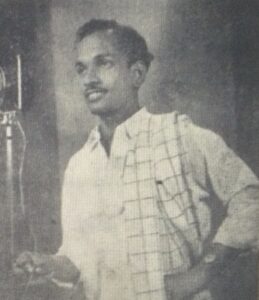
C. Rajadurai on a stage (Sutanthiran, April 8, 1956)
by Sachi Sri Kantha, March 7, 2026
In Part 1, I presented the post-Independence electoral details of Batticaloa constituency, from 1947 to 1989. To provide context to the Tamil and Muslim ethnic distribution, what has been recorded about the Batticaloa region by pre-Independence scholars deserves notice as well. Then, I provide details about Rajadurai’s first plunge into 1956 electoral politics. 70 years had lapsed since April 1956 is recognized as the landmark of political change, with the elevation of Bandaranaike’s Sri Lanka Freedom Party among the Sinhalese and Chelvanayakam’s Federal Party among island Tamils. .
Batticaloa district in pre-Independent Ceylon
Simon Casie Chitty mudaliar (1807-1860), in his Ceylon Gazetteer (1834) compilation reported a population of 27,564 for the Batticaloa district, spread among ‘Manmooone, Porative, Eruwil, Karrewahoo, Sammantorre, Nadukadoo, Akkarapattoo, Panaha, Eraoor and Korelepattoo. Among the population, 8,833 were employed in agriculture, 351 in manufactures and 4,927 in commerce.’ Please note that the English spelling of the locations are archaic to the 19th century British colonial period and varies from the current usage. Though nominally recognized as a Tamil scholar, he also had erroneously attributed the native ‘name of ‘Mattakalappoo’, to mada muddy, and kalappoo a lake’ to Sinhala origin. In reality, the origin is from Tamil, with two words having variant meanings in Tamil. Mattam = level plain, and kalappoo = mixing. In the following page, Casie Chitty also mentions, “The inhabitants are chiefly Malabars, and for the most part heathens.” In translation, this means Tamils and majority Hindus. Being an Anglican Christian by birth, Casie Chitty’s usage of the word ‘heathens’ to Hindus was derogatory and reek with colonial condescension. Also, if Sinhalese were NOT living there in 1834, how the location derived its name from Sinhala language itself seems contradictory to logic. One may also accomodate the fact that being a native of the North-west region of the island, Casie Chitty’s knowledge of the East region was marginal, at best.
The description provided by Sir James Emerson Tennent (1804-1869), about Batticaloa in his two volume ‘Ceylon’ (1859) account is noticeable for lack of details on the ethnic population inhabiting the Batticaloa region. He had served as the 5th Colonial Secretary of Ceylon to British imperialists from 1846 to 1850. Between the lines, Tennent had inserted a couple of sentences such as,
“Far less frequented by Singhalese and Europeans than any other portion of Ceylon, the Eastern province has retained many ancient habits, and presents more frequent instances of curious social peculiarities than are to be noticed in the rest of the island.”
“In the fifteenth century, Batticaloa (which was formerly called by the Tamils, Maticaloa, from Mada-kalappoo, the ‘muddy lake’) was a fief of the kingdom of Kandy, held by one of the chiefs of the Wanny and on a branch of the Natoor river there are still to be seen the remains of a stone bridge which led to a palace of the ‘Vanichee’, or queen of the district.”
S.O. Canagaratnam’s Monograph of the Batticaloa district of the Eastern Province (1921) provides the following the numbers for the ethnic distribution, based on the island-wise 1911 census.
“The great majority of the inhabitants are Tamils, representing 55 percent of the total population according to the last Census. Of the total population of 153, 943, 39 percent are Moors, 2 1/4percent Burghers and half-caste Portuguese, and 3 3/4 percent Sinhalese, who are mostly fishermen and boutique-keepers.” .
The religious split: “according to the Census of 1911, there were 79,908 Hindus, 7,466 Christians, 60,740 Muhammadans, and 5,829 Buddhists.”
Rajadurai’s candidacy for Parliament in 1956 from the pages of ‘Sutantiran’
Sutantiran newspaper was owned and managed by S.J.V. Chelvanayagam (1898-1977), prominent civil law attorney turned politician in 1944. It’s first issue was released on June 1, 1947, in anticipation of the 1st parliamentary election to be held in Ceylon, scheduled between August 23 and September 20, 1947, prior to independence. Initially Sutantiran was a daily, published from Colombo. Kothandarama (K) Natesa Iyer (1887-1947), labor union leader, journalist, and an elected representative of 1936 State Council, was nominated as its first chief editor. Sadly, after five months, Natesa Iyer died on Nov 7, 1947. Though Sutantiran was started when Chelvanayagam was affiliated to the Tamil Congress party led by G.G. Ponnambalam Sr. (1902-1977), after he quit this party in 1949, Sutantiran became the mouthpiece of Chelvanayagam’s Federal Party. According to Chelvanayakam’s son-in-law and biographer Prof. A.J. Wilson, Mrs. Emily Chelvanayagam managed the interests of the journal, on behalf of her husband. When journalist S.D. Sivanayagam became the editor of Sutantiran in 1952, Rajadurai (after leaving school), served as its sub-editor for six years.
The March 11, 1956 issue of Sutantiran indicated the list of Federal Party candidates for the April general election. The names and the constituencies in which 14 candidates would compete were,
S..J.V. Chelvanayagam – Kankesanthurai
N.R. Rajavarothayam – Trincomalee
Vanniasingham – Kopay
Dr. E.M.V. Naganathan – Jaffna
V.A. Kandiah – Kayts
S.M. Rasamanickam – Padiruppu
Amirthalingam – Vaddukoddai
Rajadurai – Batticaloa
Manickavasagar – Kalkuda
V.N. Navaratnam – Chavakachcheri
Gate Mudaliyar M.S. Kariapper – Kalmunai
M.M. Mustapha – Pottuvil
V.A. Alagecone – Mannar
Thurairatnam – Point Pedro
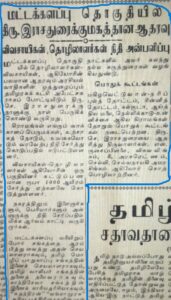
Rajadurai’s popularity, (Sutanthiran, Mar 25, 1956)
Among these, Vanniasingham and Rajavarothayam were sitting MPs, who won on FP ticket at the 1952 election. Rasamanickam was also a sitting MP, who had won on UNP ticket.
The March 25, 1956 issue of Sutantiran had a news item with the caption ‘Mr. Rajadurai receives popular support at Batticaloa constituency – Farmers and laborers donate funds’. It stated that a section of farmers and laborers had collected 1,000 rupees for Rajadurai, as the deposit fund for his candidacy. His credits included as the founder member/secretary of Batticaloa tax payers sangam, Vice President of the Tamil youth sangam, Joint secretary of Gandhi Seva sangam, ex sub editor of ‘Sutantiran’ paper and ex primary editor of ‘Lanka Murasu’ magazine, and currently the editor of ‘Thamizhagam’ magazine.
Another newsitem in Sutantiran, dated April 1, 1956, had the caption ‘Growing support for Rajadurai’. Its content was: ‘Day by day, we learn that, Mr. C. Rajadurai’s support is increasing in trend. Mr. Rajadurai is the only candidate to hold meetings in all the sections of the constituency and explaining the policies of his party to the public. Other candidates are not to be seen and many doubt whether they are really in the contest. The public meetings held in support of Rajadurai are funded by the public and they also collect finances. In a meeting held at 6th ward, 149.05 rupees were collected.’
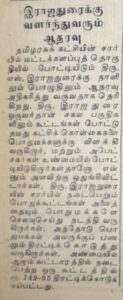
Rajadurai’s popularity (Sutanthiran, Apr 1, 1956)
The election day was April 10th 1956. Two days ahead, the Sutantiran of April 8th carried a write up on Rajadurai with the caption ‘Uthaya tharakai [Rising star]’, with a photo in front of stage microphone. It stated, ‘This is the heroic youth Mr Rajadurai, though young in age, he is matured in oratory and political knowledge. Even those who oppose him are bounded by his sweet Tamil oratorical skills embellished with alliteration. His popularity is blooming to an extent that one of his rival had retreated without putting up a fight. Mr Rajadurai has scored heavily among the Muslim voters in Batticaloa, Kathankudi, Kangeyan oodai, Palamunai villages. In addition to overt support, Rajadurai also had picked up covert support as well. Muslim youth and Muslim women in Kathankudi had already convinced themselves that ‘whoever claims anything, this time our vote is for Rajadurai’. Batticaloa voters had already decided that Rajadurai will be the rising star in Batticaloa politics of future. This conviction will be proved on April 10th, and welcomed by Tamil speaking folks all over Ceylon.’
Rajadurai became one of the 10 MPs (8 Tamils and 2 Muslims) elected in the Federal Party ticket, from North and East. Other 9 MPs were, S.J.V Chelvanayakam (Kankesanthurai), C. Vanniasingham (Kopay), V.A. Kandiah (Kayts), A. Amirthalingam (Vaddukoddai), V.N. Navaratnam (Chavakachcheri), V.A. Alegacone (Mannar), N.R. Rajavarothayam (Trincomalee), M.S. Kariapper (Kalmunai) and M.M. Mustapha (Pottuvil). Four Federal Party candidates lost – two in Northern Province (Dr. E.M.V. Naganathan in Jaffna and K. Thurairatnam in Point Pedro), and two in Eastern Province (S.M. Rasamanickam in Padiruppu and P. Manickavasagar in Kalkuda).
Compared to these days, life of folks in Batticaloa was relatively simple 70 years ago. The main media for news was radio and newspapers. Even sports were not so prominent. Annual festivals of Hindu temples and activities related to such events like firewalking were the primary entertainment. Television was absent. Other popular past times were watching movies at theaters and folk dramas called ‘koothu’. General election campaigns of candidates lasting for a minimum of 3 to 4 weeks also offered some entertainment for folks. Those candidates who could speak humorously in folksy Tamil with impromptu delivery could sway the voters, in comparison to stiff-lipped, fumbling speakers. Rajadurai was able to score well among all age groups. As one who had listened to Rajadurai’s oratorical excellence, while as a school boy in my early teens during 1960s, I could vouch that he had that blessing in even attracting young non-voters. During 1950s, oratory in alliterative Tamil promoted by DMK leaders (Anna, Nedunchezhian, Karunanidhi and poet Kannadasan) political stages and movies was in ascendancy. Rajadurai was a willing importer/contributor to such tradition. Being a newspaper journalist, he also invited Nedunchezhian and Kannadasan to Batticaloa during 1954 and 1955 respectively.
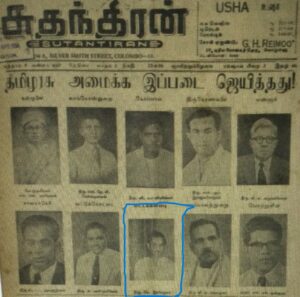
Federal Party’s 10 winners in 1956 (Sutanthiran, April 15, 1956) Rajadurai is indicated in blue square
During the election period in April 1956, the Tamil movie which was running in the theaters of Ceylon was MGR- Bhanumathi starrer ‘Alibaba and Forty Thieves’ – a popular hit in Tamil Nadu as well as in Ceylon. I provide a scan of the advertisement that appeared in the Sutantiran, for a reason. This movie was released all over Ceylon, in 9 theaters, namely Kingsley (Colombo), Plaza (Colombo), Mylan (Colombo), Vijaya (Batticaloa), Wellington (Jaffna), Manohara (Jaffna), Wembley (Kandy), Modern (Badulla), and Tivoli (Nuwara eliya). After 70 years, if I’m not wrong, all these theaters had vanished now. I heard that the Plaza theater in Wellawatta, Colombo was destroyed during the 1983 anti-Tamil riots.
A Critical Appraisal in Es. Po’s Autobiography
Sanmugam Ponnuthurai (aka Es Po, 1932-2014), by popular recognition, was the eminent literatus among Eelam Tamils in the 20th century. In the absence of an authentic version of overall political and cultural history of Tamils in Sri Lanka (Ceylon) during the post independent period, I recognize Es.Po’s two volume autobiography of 1,924 pages (in Tamil) as a reliable source, until 2003. What Es Po had written about the 1956 general election events in Batticaloa is interesting indeed. He was 5 years younger to Rajadurai.
“1956 general election was nearing. Communist Party was keen to nominate responsible candidates against the UNP.
During this phase, I was able to interact closely with C. Rajadurai. He had gained recognition as a rationalist and as a superb orator. Being an official representative of Rice sangam [Es.Po uses the word ‘nellu’for rice], he had finance circulation. Nevertheless, he had simple habits of using bicycle for travel. He was kind to me as well. He was also the secretary of Batticaloa tax payers sangam…
Krishna Kutty [a Kerala native, then living in Batticaloa, was the organizer for the Communist Party] had announced that Rajadurai, Kariapper and Mustapha were Communist Party sympathisers and may contest in the forthcoming election. Comrades Stephen, Kathirgamathamby, Kandiah, Thavarajah strongly claimed that Rajadurai was a Communist Party enthusiast. ‘He may contest under CP label. But Kariapper and his son in law Mustapha may use us, but will not support us’, was the prevailing opinion…
Rajadurai began his election propaganda meetings at Batticaloa. He announced that he was contesting on behalf of Batticaloa’s poor tax payers and as a supporter of Socialist parties. His first propaganda meeting was held at the empty land, north of Batticaloa Government College. Comrade Kathirgamathamby presided that meeting. I also spoke. That was my first election propaganda meeting in Batticaloa soil. It was at this meeting Rajadurai announced for the first time that he will be contesting at the parliamentary election…
Tamil speaking politicians of Eastern Province who had quit the UNP were searching for new political labels. This sort of searches were comical as well as humorous too… S.J.V. Chelvanayagam decided to offer his party’s candidacy to Kariapper at Kalmunai constituency and Mustapha at Pottuvil constituency. This was convenient for them to collect the Tamil votes. Manickavasagam was chosen for Kalkuda constituency and Rasamanicakam who had quit the UNP then was chosen for Paddiruppu constituency. He rejected Kadramer to contest Batticaloa constituency. In the previous [1952] election, Kadramer contested with the support of Federal Party, and [after winning] then released a statement that he had joined UNP, due to the mirage offered by Sir John Kotelawala]. Due to this act, he had lost considerable support. Rajadurai used this advantage to promote himself as the Federal Party candidate.
[S.D.] Sivanayagam, the then editor of Sutantiran paper was also promoting Rajadurai candidacy via Sutantiran. But, Chelvanayakam was reluctant in giving a ticket to Rajadurai due a previous incident. Previously, Rajadurai was an employee at Sutantiran paper. During that time, Federal Party made use of Rajadurai’s oratory. When Chelvanayakam made a trip to India, both Sivanayagam and Rajadurai jointly embezzled property belonging to the paper and Chelvanayakam was upset with such breech of trust. During investigation, all sins were directed to Rajadurai. That’s why he had to quit the paper. This was the reason for Chelvanayakam’s reluctance.
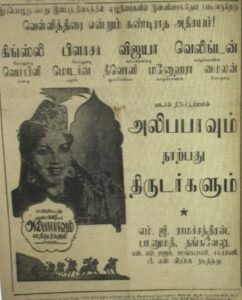
MGR-Bhanumathi movie ‘Alibaba and 40 Thieves’ advertisement (Sutanthiran, Apr 15, 1956)
In addition, Chelvanayakam had felt that Batticaloa constituency being a the lead constituency in the Eastern Province, preferred a learned candidate (one who is a specialist in law field). Chelva wished to have retired judge Ulagasekaram as a candidate, but Ulagasekaram was not inclined to enter politics. This Ulagasekaram was a cousin of Dr. E.M.V. Naganathan. Chelvanayagam met Thambimuttu, the post master of Koddaimunai post office, who also had authored a research book on Dravidas. I was also present at that meeting. At that time, Thambimuttu’s son Sam was a law college student. Thambimuttu [senior] had suggested that Sam’s education should have first preference, prior to entering politics. Because of this, Chelva returned to Colombo without deciding on a candidate for Batticaloa constituency. Subsequently, Rajadurai pulled in the support of some party workers in quite many ways and forced his path to nomination. He scared the leadership, if his claims were ignored he may contest as an Independent on behalf of Tax Payers sangam. The historical fact was, Rajadurai forced himself as the Federal Party candidate, by a cleverly calculated move, arguing that suppose the Federal Party nominate another Tamil, chances of a Muslim winning the seat become increased, when Tamil votes are split between two Tamils.
On the recommendation of Krishna Kutty, Batticaloa Communists took a decision to support the Federal Party. I feared that this sort of support to Federal Party may hinder the growth of Marxist parties in the region. Though quite a few did accept my viewpoint, they rebutted sentimentally, by stating fundamentally Rajadurai was not well endowed in funds, and he was indeed a member of working class.”
In later pages (p. 870), Es Po revealed the truth behind the property embezzlement that happened at Sutantiran paper, around 1952. This was the year, when S.D. Sivanayagam (1921?-2000) was hired as Sutantiran’s editor. According to Es. Po, “S.D. Sivanayagam who had stolen the expensive camera and the advertisement collection funds of the paper, passed all the blame on Rajadurai [then, working as an assistant editor there] and escaped. Subseuently, Rajadurai wrote a pro-note for 850 rupees and with the assistance of Sudeshi Mart proprietor Thirunavukarasu paid the bond, and joined the Rice sangam. It is at this Rice sangam, Rajadurai swiped thousands of rupees to become rich. I had known this history and with supporting evidences had brought this to limelight in Batticaloa platforms.”
I did check Rajadurai’s tenure at Sutantiran, from his felicitation volume, I was offered, in my quest of ‘Rajadurai papers project’. Published year of this volume is missing; but based on the congratulatory message offered by M. Karunanidhi, the then Chief Minister of Tamilnadu, dated Dec 12, 1997, I guess it might have been published in 1998. It is mentioned that Rajadurai worked at Sutanthiran for 6 years. As he had been elected as a MP in April 1956, this works out that Rajadurai was an employee of Chelvanayakam either from 1950-55 or 1951-56.
As an aside, it need to be recorded that Es.Po’s inference of the character and career of journalist S.D. Sivanayagam is worse than that of Rajadurai. Nothing much is available now in the digital media about this S.D. Sivanayagam, a character who made it a habit of working against the interest of Tamils, for selfish reasons. One should not confuse him with his namesake S. Sivanayagam (1930-2010), a pillar for Tamil nationalism and junior to S.D. Sivanayagam by a decade. S.D. Sivanayagam’s career was a contrast to that of S.Sivanayagam, like day and night. I have heard an inside story from M.K. Eelavanthan (1932-2024) which needs recording. This S.D. Sivanayagam was angling for a ‘Senate ‘nomination from the Eastern Province as a representative of Federal Party in early 1960s. This Senate, consisting of 30 members, was abolished in 1971. But, Chelvanayagam wouldn’t budge, due to lack of trust he had on Sivanayagam’s capabilities. ‘He was my employee, and how can I nominate him to the Senate?’ was Chelvanayagam’s rejection point. Hurt this rejection, S.D. Sivanayagam quit, offered his services to Sinhalese businessman (M.D. Gunasena Ltd.) and spent the rest of his journalism career by cussing Federal Party, Chelvanayagam and Amirthalingam, as well as propagating with glee, the North-East divide among the Tamils.
Es.Po’s mention of ‘post master Tambimuttu and his son Sam’ deserve a note as well. There have been quite a few Tambimuttus. The author of ‘Dravida (A History of the Tamils) from pre-historic times to AD 1800), published in 1945 was E.L. Tambimuttu. It was a small book of 74 pages. He was the father of attorney Samuel (Sam) Tambimuttu (1932-1990), who was affiliated with the Federal Party in 1970s, and later to become elected as a MP representing EPRLF in the tainted 1989 General Elections.
Rajadurai’s Version
In his 2008 memoir (52 years after the event), Rajadurai provided the following detail: “ When I contested the 1956 election, anti-Jaffna sentiments were dominating. Leaflets with the slogan ‘a traitor Eddappan who sacrifice Batticaloa to Jaffna folks’ were distriuted, and in public stages I was cussed.
In front hall of my residence, I had hung photos of Periyar E.V. R(amasamy Naicker), Anna (DMK leader),Karl Marx, Lenin and Stalin. My supporters demanded that I should take these out; if not, I’ll be tagged as an atheist and Communist affiliate.’ But, I had refused, because these photos have been here for long. I was warned that at the final propaganda meeting to be held at Batticaloa pavilion, there will be bombs.
On the final day, thousands of booklets against me were distributed. My supporters were shaken. My opponents had re-published a booklet in which I had claimed ‘God is a fiction’, and they had published a bill asking ‘Do you wish to send to parliament an atheist like him’ I picked up that booklet in my hand, and addressed the public.
‘Of course, I do not deny that I was the author of this rationalist tract. It focused on social reform, opening of temples for all folks in the society, elimination of ignorant beliefs etc. But now, I’m standing as a candidate for Federal Party, and not as a rationalist. What we demand now, is equal rights and status for Tamil speaking people. Please support me with your vote.’ The gathered folks responded in strong voice – ‘Our votes are for you.’ They danced in their enthusiasm. I was able to defeat two former MPs who represented Batticaloa and made one Justice of Peace to lose his deposit. Eventually, false propaganda lost to the truth.”
Also, Rajadurai asserts that, based on his conviction and recommendation that Chelvanayakam accommodated S.M. Rasamanickam and P. Manickavasagar to contest in Federal Party ticket. Though both Rasamanickam and S.U. Ethirmannasingham (ex-MPs) were approached by him to join the party, Rasamanickam was first to accept the party’s offer and he was nominated for Padiruppu constituency. As for accomodating P. Manickavasagar, leader Chelvanayagam was reluctant at first. But, Rajadurai had recommended Manickavasagar strongly, insisting that he could be trusted and was also a kin of K.W. Devanayagam (later to be elected as a MP for Kalkuda constituency in 1965 and 1970s, to become a Cabinet Minister).
Rajadurai article in 1974 Federal Party Silver Jubilee issue
To the Silver Jubilee issue of the Federal Party (prepared in 1974, BUT released silently in 1980, if I’m not wrong), Rajadurai had contributed an article about his valiant attempts to promote the party in the East. For record, I provide a pdf scan of this short article in Tamil. I have heard from M.K. Eelaventhan, why there was a delay in the release of this Silver Jubilee issue. It was because of the formation of Tamil United Front (TUF) in 1972, in which Federal Party was the major player. Then, TUF morphed into Tamil United Liberation Front (TULF) in 1976. Though the party had merged into TULF, the prepared issues of Silver Jubilee issue had to be sold, to cover the printing costs. Around that time, TULF also earned a pejorative moniker; it stood for Tamil United Lawyer’s Front! Only a couple of MPs like Rajadurai and Pundit K.P. Ratnam were exceptions.
Despite writer Es.Po’s critical appraisal of Rajadurai’s Jekyll and Hyde personality, eventually Chelvanayakam did settle on Rajadurai for Batticaloa constituency. I guess, Chelva’s decision was partially based on the recommendation of two of his senior MPs, Mr. N.R. Rajavarothayam (1908-1963) and Mr. C. Vanniasingham (1911-1959), as well as identifying Rajadurai’s capabilities and contributions as a party organizer, in reaching beyond the literary circle of attorneys and educators. While Rajadurai showed his vote-attracting capabilities by getting elected in the 1956 election, both Rasamanickam and Manickavasagar recommended by him as party’s candidates lost that election. At the Batticaloa constituency, with 61.6% polling, 9,300 votes received by Rajadurai was higher than cumulated 8,568 votes polled by three of his competing rivals.
Claiming MP status
At the age of 28 years and 9 months, Rajadurai had arrived in the Parliament, from the East. Amirthalingam, one month younger from Rajadurai, also had arrived in the Parliament, from the North. As young rising stars in the Federal Party, in addition to V.N. Navaratnam, elected from Chavakachcheri constituency, they maintained collegiality until the death of Chelvanayagam in April 1977. From 1956 onwards, using his parliamentary status as the MP with literary, art and music interests, Rajadurai would score over Amirthalingam, in establishing contacts with Tamil Nadu personalities, including MGR and other prominent figures in Tamil cinema and journalism. In this aspect, Rajadurai scored over Amirthalingam in continuing the bond of Tamil Nadu- Eelam links, promoted by Tamil-Hinduism scholars Arumuga Navalar (1822-1879) and Swami Vipulananda (1892-1947). Amirthalingam’s interest with Tamil Nadu personalities was kindled, only after he gained stature as the successor of Chelvanayakam’s mantle, around 1972. Between 1956 and 1977, Amirthalingam would slip in his seniority status as a MP, by losing one election in 1970, but Rajadurai would never lose in Batticaloa, either in 1970 or in 1977. Subsequent split of Amirthalingam and Rajadurai in July 1977 would become a tale to be told in the next part.
Sources
O. Canagaratnam: Monograph of the Batticaloa District of the Eastern Province, Ceylon, H.R.Cottle, Govt Printer, Colombo, 1921, p. 35, 39.
Simon Casie Chitty mudaliar: The Ceylon Gazetteer: containing an accurate account of the Districts, Provinces, Cities, Town, Principal Villages, Harbours, Rivers, Lakes, of the Island of Ceylon, Cotta Church Mission Press, Colombo, 184, pp. 19-21.
G.P.S. Harischandra de Silva: A Statistical Survey of Elections to the Legislatures of Sri Lanka, 1911-1977, Marga Publications, Colombo, 1979.
News item: [Mr. Rajadurai receives popular support at Batticaloa constituency – Farmers and laborers donate funds]. Sutantiran, Mar 25, 1956, p. 12.
News item:: [Growing support for Rajadurai] Sutantiran, Apr 1, 1956, p. 5.
News item: [Rising Star]. Sutantiran, Apr 8, 1956, p. 9.
Es Po: Varallatril Vaazhtal [Living through History], vol. 1, Mithra Arts Creations Pvt Ltd, Chennai, 2003, pp. 609-612. 615-616. (in Tamil)
Rajadurai Felicitation Volume, Manimekalai Pirasuram, Chennai, not dated (probably 1998?)
Chelliah Rajadurai: Suvadukal [Footprints], Poomagal Pathippagam, Batticaloa, 2008, p. 31-33, 97, 123-126, 130-131. (in Tamil)
Sivasubramaniam: Mattakkalappu Nattarial, Batticaloa, 2004 (in Tamil).
James Emerson Tennent: Ceylon, An account of the island Physical, Historical, and Topographical with notices of its natural history, antiquities and production, vol. 2,, Longman, Green, Longman and Roberts, London, 1859, p. 458, 465.
Valuable News We Lost Our Beloved Political Legend,