by Sachi Sri Kantha
Prelude
In 2023, I was engaged in a double-handed correspondence duel (debate) in the ‘Tuppahi’s blog site, maintained by Prof. Michael Roberts. My two opponents were Sinhalese – namely Prof. Chandre Dharmawardena and Mr. Edward T. Upali. Their premise was ‘Mahavamsa is a reliable historical document’. I was opposed to this sort of fabrication. I maintained that the author of Mahavamsa had engaged in fiction writing. Outcome of this debate was: I shouldn’t brag much. But, to borrow the colorful lingo of my idol ,champ Muhammad Ali ‘I whupped them with a straight to the jaw.’ Would you guess? I had in my corner, Mahanama thero, the Mahavamsa author himself. Those interested in this episode can verify the details, in Prof. Michael Roberts’ blog. The link is, https://thuppahis.com/2023/07/30/canadian-double-standards-both-at-home-in-lanka/#comments
Now, I re-visit this episode, to summarize my debate and expand my readings about the Mahavamsa chronicle and its 19th and 20th century commentators (European scholars as well as indigenous academics), in multiple parts. This exercise, I consider is a vital one for Tamil history, because in the digital world, quite many illiterate jerks express their stupid opinions on everything under the Sun, and they deserve censure. Among the two of my opponents in this debate, one was a professor in physics who interprets historical events with prominent ‘Sinhalese bias’ and the other one was less endowed in logic.
A Debate: Mahavamsa as a historical document is reliable
Proponents: Prof. Chandre Dharmawardana and Edward T. Upali
Opponent: Sachi Sri Kantha
There were altogether 5 correspondences relating to the validity of Mahawamsa chronicle, as a historical document. Prof Roberts kindly allowed me three times to respond. I’m thankful for this offer. Mr. Prof. Chandre Dharmawardena and Mr Upali responded only once. For convenience, I provide these 5 items, in the order of their posting, without editing even a word.
Item 1 – Sachi Sri Kantha [July 31, 2023]
I know Prof. Chandre is a physicist of some recognition. Does he believe that Mahavamsa chronicle is a historical document of worth, instead of being a religious tract propagating Buddhism of Mahavira sect.
I’m sure that Prof Chandre will agree with me that controlled air flight was experimented by many air travel enthusiasts and experimenters in the 19th century and perfected by Wright Brothers, only 120 years ago. If we believe that Mahavamsa is a historical document, air flight by humans (Buddhist priests, nonpareil!) was demonstrated in Ceylon – during King Devanampia Tissa’s period (= 250 – 210 BC)!! Will Prof. Chandre explain to me the logic in the following verses in Mahavamsa, as it appears in Wilhelm Geiger translation of 1912?
“The (king) then asked: ‘By what way are you come?’ And since the answer was: ‘Neither by land nor by water are we come,’ he understood that they had come through the air.” (chapter 14, verse 15)
“ ‘We will not mount into the wagon; go them, we will follow thee.’ Saying this they, full of holy desires, sent the driver away; and they rose into the air and by their miraculous power they descended to the east of the city in the place where the first tupa (afterwards stood)” (chapter 14, verses 43-44)
This demonstrates to me, that the celebrated author of Mahavamsa was a great fiction writer, with fantastic imagination of air travel.
Item 2 – Chandre Dharma-wardana [Aug 1, 2023]
Is the Mahawamsa, with its recording of miraculous events, a reliable text?
The Mahawamsa and all texts of that era state as ‘matters of fact’ events that seem to modern readers as miracles based on mere fantasy. However, they also contain very accurate reporting of certain matters as explained below. Historians who deal with ancient texts spend a lot of time on sorting out the good from the bad, and are expert at it. So we should follow them rather than the views of political commentators.
An avowed purpose explicitly stated by the Mahawamsa author is clear from every chapter. Every chapter ends by stating that it is written for the ‘serene joy of the pious’. So, the belief system of the pious, hell and heaven, miraculous powers to deities and holy men and so forth all hold.
Furthermore, accuracy was felt to be important in regard to one crucial issue to satisfy the serene joy of the pious. For instance, everyone who had the means maintained a chronicle of their meritorious acts (Pin Potha) that was to be recited on their death bed. In fact, I think this was how the tradition of writing chronicles developed in early Buddhist societies.
Reading the ‘Pin Potha’ was also supposed to increase the piety of the reader and the listener. So, even the Mahawamsa author tried to give an accurate chronology of the meritorious deeds of the rulers of Lanka – that was a duty imposed on chronicle writers. This is why the Mahawamsa turned out to be so valuable to Indian historians who at first could not sort out their early royal dynasties.
Given that the Mahawamsa records events already several centuries old when the Mahawamsa was chronicled, the early records are inaccurate. But the chronology from about the time of Emperor Asoka has turned out to be unusually accurate for that age in regard to clarifying Indian dynasties and their chronology by relating them to what is in the Pali Chronicles.
The accuracy is said to be better than what is found in comparison with other ancient histories (e.g., Hebrew texts, Indian or Greek texts).
Historians of different mindsets have supported the value of the Pali chronicles. For instance, both Karthigesu Indrapala in his relatively recent book on Ethnic Identities, and Wilhelm Geiger in the 1930s have commented on this reliability of the Mahawamsa.
https://buddhism.lib.ntu.edu.tw/FULLTEXT/JR-ENG/gei.htm
The chronicles have also been of importance from a linguistic historic point of view. See: Hinuber, Oskar von. 1983. The oldest literary language of Buddhism. Saeculum 34.1-9. Also published in Selected papers on Pali studies, 177-194, Oxford: The Pali Text Soceity, 2005.10.7788/saeculum.1983.34.1.1
Sachi Sri Kantha (SSK), well known in Tamil Nationalist circles, quotes a stanza from the Mahawamsa and claims that the celebrated author of Mahawamsa was a great fiction writer, with fantastic imagination of air travel…
Contrary to SSK’s conclusion, the Mahawamsa author, like almost everyone in those times, did not have to fictionalize anything. They actually believed in the possibility of levitation; they believed that ‘arahants’ and holy men used this miraculous power. In addition, there were legends of flying machines used by the likes of Ravana in Lanka.
The ‘Pushpaka Vimana’ of Ravana (who took it from Kubera; Rama returned it to Kubera) is the most well-known example of a Vimana or flying machine. Vimanas are also mentioned in Jain texts. On top of almost every Hindu temple or pyramid, one can find a Vimana structure, and often they are rounded, saucer-like objects; Shiva is said to fly on a bird, Garuda.
SSK who writes about Tamil culture cannot be ignorant of all these. Even today, Mr. Narendra Modi and many millions upholding Hindhuthva orthodoxies believe that ‘holy men’ do have such ‘special powers’. In fact, under Modi, the Indian Association for the Advnacement of Science has been asked to investigate into such powers, and funds have been allocated for such research. This shows why India will stagnate forever with its Gods and its Manu Dharma and all that, while Sri Kantha and his ilk perhaps want to uphold all that while laughing at a fifth century writer who held similar beliefs? Certainly, Mr. Wigneswaran seems to want all that back.
So, the Mahawamsa author is reporting exactly what his readers expected him so say, in re-counting the legends that were already well-accepted in his day and already found in the even older Dipawamsa.
If the Mahawamsa author gave a new twist to the stories, he remained within the chronology without erring as far as possible in recounting the meritorious deeds of rulers who built temples, stupes, constructed water reservoirs etc. and also included the legends that went with them.
This does NOT mean that he invented the legends and produced fiction. He was an excellent anthropologist in holding onto legends and reporting them for posterity. We would be poorer without those legends.
Mahawansa writer was true to the ‘known facts’ as accepted during that epoch. He differed in emphasis from, say, the Dipawamsa when he made the Elara-Gemunu battle the center stage of his story and wrote the greatest epic poem in the Pali language. His Pali text, easily memorisable as it was in verse, was also a ‘best seller’ of his age and went East and West along the Silk route.
Item 3 – Sachi Sri Kantha [Aug 2, 2023]
I do appreciate the response of Prof. Chandre, defending the Mahawamsa author. Let us stick to the essential issues raised in my query, rather than diverting to extraneous thoughts on Narendra Modi’s as well as Mr. Vigneswaran’s political campaigns.
Apart from his comment about me (‘well known in Tamil nationalist circle), I wish to inform Prof. Chandre that I’m also a zoologist (entomologist) by education and training, and I have been interested in the theme of flying, for the past half a century.
Prof. Chandre shouldn’t confuse issues by equating ‘flight’ to ‘levitation’. Flying is DIFFERENT from levitation. Here are the dictionary definitions.
Levitate: ‘rise and hover in the air, esp. by means of supernatural or magical power’ (The New Oxford American Dictionary, 2001, p. 980).
Fly: ‘(of a bird or other winged creature) move through air under control. (same source, p. 655).
Whereas, flying is achieved by controlled directions to move from point A to B, levitation is simply hovering in the air for few minutes at most, WITHOUT directed movement from point A to B.
Prof. Chandre also uses the word ‘legend’, which is defined in the dictionary as ‘a traditional story sometimes popularly regarded as historical but unauthenticated (p. 973). The last two words in this definition are important.
The quoted passages in my previous communication refers to movement in air using controlled directions, and not simply the exhibited power of levitation. As I’m clueless in Pali language, maybe Prof Chandre could tell me the exact word used by Mahavamsa’s author in Pali, for this sort of movement. I had simply relied on Wilhelm Geiger’s translation from Pali to German to English.
Item 4 – Edward T. Upali [Aug 4, 2023]
- This is in reply to both Dr. Dharmawardene and Sachi Sri Kantha. Inspite of what some naysayers say, it is very evident that Mahavansa is a book that documents both historical facts as well as some religious beliefs that prevailed at the time of its writing. However, it has enabled modern historians to establish, with some degree of certainty, that those events actually took place and to corroborate them by checking with existing archeological ruins, writings on stone etc.
- Although I am not a Physicist (Dharmawardene) or an Entomologist (Sri Kantha), I would say the process that has been followed to establish the veracity of events described in the Mahavansa is definitely more complicated, perhaps than studies in Physics or Entomology. As Mr. Sri Kantha has done or Mr. Vigneswaran often does (shame on members of the Supreme Court), one cannot quote one paragraph from the book and say, therefore the book is garbage. Until someone with more integrity, intellectual honesty and knowledge of history proves otherwise, Mahavansa will be considered a great historical chronicle.
- In regard to the Wright Brothers flying, as referred to as the first instance of flying, by Sri Kantha, is incorrect. Wright Brothers were the first to fly heavier than air aircraft. The first instance of flying lighter than air, aircraft was much earlier. The first fully controllable airship, the French Army’s La France, made a series of successful flights in 1884, over 100 years before the Wright Brothers. By the end of the 19th century, Count Ferdinand von Zeppelin built the first rigid airship, which had an internal aluminum structure and invidual gas cells filled with hydrogen to provide lift. Both these flights were earlier than the Wright Brothers’ flight.
- In regard to Mr. Sri Kantha’s comments on flying, I can only say that those of us who live in Sri Lanka have seen birds, bees and butterflies travel long distances in air, at some speed. So maybe some humans could, but the practice has died out due to the availability of ‘modern comfortable flying’!!
- Most of us still believe that in some ‘geographical gods’ such as the ones in Kataragama or Saman in Sri Pada, have supernatural powers. Such beliefs did not and do not require a great stretch of imagination. Similarly, we have believed that ancient Arahants could fly or appear very quickly at some location; viz Buddha appearing in Nagadeepa, Kelaniya or Sri Pada.
- Similarly those of us, who grew up in Jaffna, believed in gods having six heads or having snakes round their heads, or heads of elephants. We also believed as described in the Ramayanaya and Rama flying to Sri Lanka to rescue Sita. We believed in the historical tale of Rama even though, Ramayanaya epis has not been verified by archeological research. These stories might have been folklore. But lot of us still believe in the Mahabharata and Ramayanya. However in contrast to Mahabharatha or Ramayanya, most of Mahavansa has been verified by authoritative historians & archeologists.
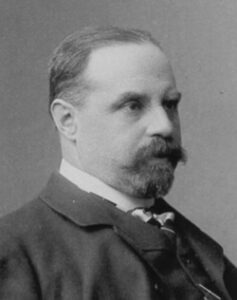
Prof Hermann Oldenberg,1854-1920
Item 5- Sachi Sri Kantha [Aug 4, 2023]
Here is my brief response to the comment by Edward T. Upali.
First, despite his reverence and admiration to the Mahavamsa chronicle, it appears to me that Mr. Upali has NOT even read a page of Mahavamsa, either in the original Pali or in Sinhalese or English translation. To quote him, “one cannot quote one paragraph from the book and say, therefore the book is garbage.” Please note, that I had never mentioned that Mahavamsa chronicle is ‘garbage’. What I stated was that ‘celebrated author of Mahavamsa was a great fiction writer, with fantastic imagination of air travel.’
In fact, the central issue of Mahavamsa’s proposition – that is the introduction of Buddhism to ancient Lanka – was IN THAT one verse or sloka (not paragraph, as mentioned by Mr Upali). As Geiger had written in his introduction (p. xiv), “Mahinda arrives in Ceylon in marvelous fashion, flying through the air.” I do not deny the fact that Mahinda arrived in Lanka, during Devanampiya Tissa’s time, as Asoka’s emissary to spread Buddhism doctrine. This is ascertained in more than one sources. But, how feasible it is for Mahinda to ‘fly through the air’ and land in Lanka? This is why, I asserted that ‘author of Mahavamsa was a great fiction writer, with fantastic imagination of air travel.’, about an event which happened nearly 800 years before his time. Mahanama could have easily described that Mahinda traveled by boat (in crossing the sea) or either on horse back or walking (while traveling in the land). But, he attributed ‘miracle powers’ to Mahinda (the human) to fly. There is NO supporting evidence for Mahinda’s flight into Lanka. This is my brief here.
Secondly, Mr Upali’s assertion that ‘may be some humans could, but the practice has died out due to the availability of ‘modern comfortable flying’ is totally unsupported by zoological evidence. It is simply gibberish!
****
My chief focus in this part is – how valid is Mahavamsa as a historical text? Akin to the Holy Bible, Mahavamsa has its share of defenders and debunkers. In the above exchange, Mr. Edward Upali had ignorantly claimed that “Until someone with more integrity, intellectual honesty and knowledge of history proves otherwise, Mahavamsa will be considered a great historical chronicle.” For want of space in that correspondent section in Tuppahi’s blog, I couldn’t provide details to support my claim.
A debunking view of Prof Hermann Oldenberg in 1879 on the worth of Mahavamsa as a historical source, focusing on missionary Mahinda’s origin is one the likes of Mr Upali would wish to suppress. Prof. Oldenberg was an authority on Pali scriptures and he was the one who translated Dipavamsa (the precursor of Mahavamsa text) into German. Prior to Prof Oldenberg’s text, for proper context, I provide pertinent historical dates, culled from the Oxford History of India. The years mentioned are before Christ. (BC). A map is presented nearby that shows the reach of Emperor Asoka’s reign and indicates the locations mentioned by Oldenberg.
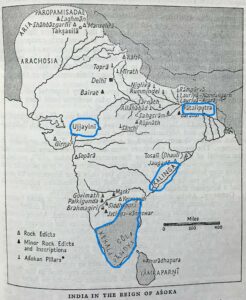
India map during Emperor Asoka’s Period
298 – Bindusara Amitraghata accession.
273 – son Asoka [-vardhana], chosen as heir apparent by Bindusara, accession, following the death of Bindusara.
269 – Consecration or coronation (abhisheka) of Asoka.
261 – the Kalinga war of Asoka
259 – Asoka abolished the imperial hunt, and dispatched missionaries.
257-256 – The Fourteen Rock edicts, the Kalinga edicts and appointment of censors.
251 – (Deva nampiya) Tissa, King of Ceylon, accession.
c.251-250 – Mahendra (Mahinda) mission arrival in Ceylon.
249 – Asoka’s pilgrimage to the holy places.
232 -. death of Emperor Asoka. His grandson Dasaratha accession in eastern provinces; and probably Samprati, another grandson accession in western provinces.
211 – Tissa, king of Ceylon, died.
204 – missionary Mahendra (Mahinda) died in Ceylon.
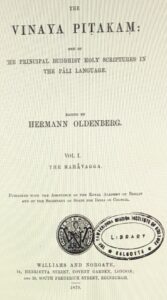
Hermann Oldenberg’s translation ‘Vinaya Pitakam (1879)
Text of Prof. Hermann Oldenberg (1879)
In the passage I present below, I had emphasized in bold fonts the inferences of Oldenberg which (1) debunks Mahavamsa fiction, and (2) presents a case that Buddhism entered Ceylon via ‘Kalinga country’ (current Odisha state) and the adjacent kingdoms of south India (currently from Andhra Pradesh and the northern Tamil Nadu region), and NOT from the Magatha kingdom during Lord Buddha’s era (current Bihar state).
“The tradition of the Sinhalese, we know, connects the conversion of the island to the Buddhist belief with name of Mahinda (Mahendra), the son of King Asoka. The Mahavamsa gives some details concerning the descent and the birth of Mahinda. When Asoka, as a young prince left Ujjeni, in order, at his father’s command, to undertake the regency of the country of Avanti, he, on his way thither, and in the city of Cetiya – also called Vidisa – married the daughter of a Setthi, and in Ujjeni she gave birth to Mahinda. Asoka resided in Ujjeni for ten years after the birth of Mahinda, but upon his father’s death he removed to Pataliputta, and undertook the government of the whole kingdom. It is probable – as probable as the whole account itself that young Mahinda lived in Ujjeni with this father till the latter became king.
On these data, Westergaard and with him E. Kuhn, have assumed that Mahinda, when he spread the Buddhist doctrines to Ceylon, made use of the language of his native country, and that consequently the Pali was the dialect of Ujjeni.
This hypothesis seems to me to possess but little possibility. For even though we credit the statements of the historical books of the Sinhalese regarding the life of Mahinda, it is little in keeping with these to assume that the Prince made use of the Ujjeni dialect for his religious work. Mahinda joined the Buddhist Sangha in his twentieth year, six years after his father’s being anointed, ten years after the beginning of his father’s reign. It is hardly conceivable that the should have studied the literature of Buddhism in the language of his childhood, at a time when he had evidently for long lived at the royal court in Paliputta, and that he should not rather have become acquainted with the works oin the language of the court, it being, moreover, the language in which Buddha himself originally had taught his people.
Another difficulty presents itself. We are not yet acquainted, by inscriptions, with the Ujjeni dialect itself. But we have a safe support in the inscriptions of Bhilsa, which is identical with Vidisa, the home of Mahinda’s mother. A lively intercourse was carried on between the town of Vidisa and the not very distinct city of Ujjeni, as we learn from the numerous inscriptions found at Vidisa relating to citizens of Ujjeni. The dialect of the inscriptions of Bhilsa, however, differs in two many essential points from the Pali for us to regard it as in any way likely that the Pali language originated in this part of India.
Thus there are difficulties that cannot be overcome as long as we consider the traditions of the Pali Tipitaka as connected with the person of Mahinda; it is impossible both to identify the Pali with the language of Mahinda’s youth and with the court language of his paternal home.
A fundamental mistake in the investigation seems to me to lie in the fact of their making Mahinda play so decisive a part. In fact, it cannot by any means, with the requisite strictness, be considered as sufficiently attested, that Mahinda brought the sacred texts to Ceylon.
Asoka’s own inscriptions tell us that in the reign of this monarch steps were taken to propagate his beneficent maxims in a number of other countries, and also in Ceylon; considering Asoka’s well known position towards Buddhism, it is also very likely that the missionaries who, at his instigation, went to Ceylon, were Buddhists. And hence, in all probability, the stories of the Sinhalese concerning Mahinda may contain some germ of historical truth. This germ, however, has become surrounded by a coating of inventions which render it impossible to place any faith in the traditions of Mahinda. Prince Mahinda himself, as the founder of the Ceylonese Bhikku Samgha, the Princess Samghamitta his sister, as the foundress of the Bhikkunisamgha, the stories about bringing over the relics and the Bodhi branch: – all this looks like a tissue of a little truth and a great deal of fiction, invented for the purpose of possessing a history of the origin of the Buddhist institutions in the island, and to connect it with the most distinguished person conceivable – the great Asoka. The historical legend is fond of poetically exalting ordinary occurrences into great and brilliant actions; we may assume that, in reality, many things wee accomplished in a more gradual and less striking manner than such legends make them appear. Whatever we may choose to think about the Buddhist impulses that are said to have reached Ceylon from the court of Asoka, in my opinion, the naturalization of the whole great Buddhist literature in the island of Ceylon does not look as if it had been brought about the sudden appearance of missionaries from the Magadha kingdom, but as if it were the fruit of period of long and continued intercourse between India and the adjacent parts of India. It is self-evident that, at all times, there must have been a greater amount of intercourse between Ceylon and the peninsula of the Deccan – more particularly the countries along the shore – than between Ceylon and the Hindostan. Those acquainted with the ancient records relating to Ceylon will know of numerous proofs with regard to the relations in which Ceylon stood to the kingdom of Kalinga, and in such a case we should scarcely require any express proofs at all. The Kalinga country, or one of the adjacent kingdoms of Southern India, seems to me to have the most claim to have been the medium for transplanting the Buddhist literature into Ceylon…”
****
Cited Sources
Hermann Oldenberg (ed): Vinaya Pitakam: One of the principal Buddhist holy scriptures in the Pali Language, Williams and Norgate, London, 1879, Introduction, pp. L-LII.
Percival Spear (ed): The Oxford History of India by the late Vincent A. Smith, Clarendon Press, Oxford, 1964 reprint (originally published 1958), pp. 117-163,