by Sachi Sri Kantha, May 21, 2026
David Jeyaraj was born on May 21, 1954 in Colombo. After completing his primary and secondary schooling at St. Thomas Preparatory school, Colombo and Jaffna College, Vaddukoddai respectively, Jeyaraj failed to enter any of the then four universities in Sri Lanka. He was first an apprentice journalist at Virakesari (Colombo) Tamil daily in 1977. Then, he became the token Tamil hire at the newly established The Island (Colombo) in 1981, where he sharpened his skills in English writing about political events in the North and East provinces of the island. Subsequently, he also contributed to Saturday Review (Jaffna) and to the House of Hindu (Chennai) newspapers, prior to leaving the island. After being chosen for International Nieman Fellowship for journalists (Nieman Foundation at the Harvard University, USA), Jeyaraj left Sri Lanka on Sept 14, 1988. It was a competitive program lasting 9 months for working journalists ‘with at least five years of full time media experience’ but without age limits or academic prerequisites. Jeyaraj was one among the 23 Fellows in the class of 1989. Eventually, Jeyaraj settled in Toronto, Canada. From Toronto, Jeyaraj continued to cover Sri Lankan events for Sunday Leader, Daily Mirror and the House of Hindu organizations. He gained Canadian citizenship status in 2004.
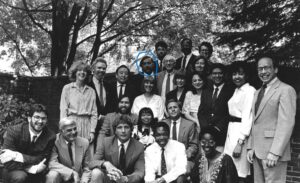
Harvard University Neiman Fellow batch 1989 (Jeyaraj circled)
Jeyaraj was a good wordsmith, spinning stories from what he had heard from his informants; but NOT an academic researcher, for the solitary reason, he neither published a single research paper in any of the peer reviewed scholarly journals nor authored a single book on any theme of his specialty. Nevertheless, for Sinhalese political scientists and historians who are illiterate in Tamil, Jeyaraj became a ‘citable source’ because he specialized in criticizing/nit picking LTTE’s campaign for Eelam state, while conveniently turning a blind eye on the activities of plumbing agencies of Sri Lanka and India.
Quite a few elegies have appearedon the web for Jeyaraj’s demise on May 17th, mainly from Indian journalists (like M.R. Narayan Swamy), as one who stood up to LTTE. Of course, they are bound to do it, if their neck is pulled with a leash by the Indian plumbers [Please feel free to check this link, containing hyperbolic sentiment,
https://www.jaffnamonitor.com/d-b-s-jeyaraj-fearless-chronicler-of-sri-lankas-war-dies-in-exile/].
My evaluation of Jeyaraj’s journalism will be different. A year older to him, I have been a reader of David Jeyaraj’s journalism since late 1970s. Please mark my words: I’m not an ‘admirer’ of his brand of journalism. I do not deny that he had talent in spinning stories to his audience. He also had talent in writing puff pieces and yarns on inconsequential Tamil/ Muslim politicians using hyperbole adjectives, such as ‘legendary’, ‘great statesman’, ‘brightest star’, phenomenon’ and ‘foremost intellectual’ that hardly matched the real life performances of those whom he praised. His beneficiaries were politicians of second or third degree like V. Anandasangaree, Lakshman Kadirgamar, Neelan Tiruchelvam, Douglas Devananda , Mohammad H.M. Ashraff, and M.A. Sumanthiran. Akin to the talents of a good carnival barker, Jeyaraj was an expert in making a mole hill appear as a mountain.
Serving as a Lap dog to Lakshman Kadirgamar
Jeyaraj served as the protective lap dog to Lakshman Kadirgamar (1932-2005), ex-Foreign Minister of Sri Lanka, from 1994 to 2005, praising him as ‘Sri Lanka’s finest foreign minister’ [link https://dbsjeyaraj.com/dbsj/?p=82475]. While Kadirgamar bad mouthed LTTE in his international jaunts for practicing child terrorism, and simultaneously closed his eyes on (1) the troubles of raging child prostitution and pedophilia in the Sinhalese regions of the island, and (2) the serious issue of sexual abuse of Tamil youth in detention highlighted in academic journals, did Jeyaraj criticize Kadirgamar for his hypocrisy? Not that I know of. I’ll be pleased, if anyone among Jeyaraj fans provides documentary support for my claim, that Jeyaraj himself was also a hypocrite. Below, I provide specific citations for these two issues.
Pigs are flying in Batticaloa in 2005
I have been a critic of Jeyaraj’s coverage on LTTE and Prabhakaran, and his subservience as a conduit/message carrier of India’s intelligence agency skunks. In 2004, when LTTE took action against turn-coat Col. Karuna. I titled my criticism on Jeyaraj’s Karuna promotion as ’Pigs are Flying in Batticaloa!’. Excerpts follow:
“No-No, I’m not asserting a new discovery which would contradict a well certified zoological fact. The title of my commentary relates to the opinion piece of D.B.S. Jeyaraj, Sunday Leader (Colombo)’s token Tamil pontificator, which appeared on July 24, 2005. In the fictious imagination of Jeyaraj, pigs are indeed flying in Batticaloa, and he had seen it from Canada – of all the locations. That’s how one has to infer the cockamamie-yarn Jeyaraj had provided under the caption, ‘Tigers get a taste of their own bitter medicine.’
For those who have missed reading Jeyaraj’s yarn, I reproduce the initial segment consisting of 214 words.
“For the first time in many years the Tigers feel threatened and beleaguered. The organisation that revels in terrorising others particularly those of the Sri Lankan Tamil community through violence finds itself at the receiving end.
In a remarkable reversal of roles a motley group of various anti-Tiger Tamil elements aided and abetted by the security and intelligence networks of the state is providing the LTTE a taste of its own bitter medicine. Naturally the Tigers are not relishing it.
The Karuna factor dismissed derisively by the Tigers and their sycophants is looming large on the eastern horizon. Karuna himself shuttles between Sri Lanka and a southeastern country where his family resides. He left Sri Lanka last on May 6. Some say he has now returned.
In any case, as this column stated earlier, Karuna is now a brand name. A large number of Tiger cadres loyal to him are now in the Eastern Province and Polonnaruwa District. They are kept in different units in different locations. They are functionally autonomous but are helped and to some extent logistically supported by the security network.
Sri Lankan military intelligence provides some guidance and direction. It also exercises some amount of control and restraint. The espionage agency of at least one country has provided financial aid….”
Jeyaraj is a master of ‘hide and seek’ and learnt his journalism from Madras Hindu school of camouflage, that he would neither identify his “sources” nor mention any names. He has not a single ‘Deep Throat’ but dozens of ‘Deep Throats’ to protect. Check again his last sentence quoted above. “The espionage agency of at least one country has provided financial aid…”
This is presented by Jeyaraj as a big finding, while every Tamil child in Jaffna, Batticaloa, Trincomalee and Vavuniya would name names. That espionage agency has an acronym RAW and its headquarters are in New Delhi.”
I found his opening paragraph so offensive, and wondered whether he had lost his marbles. Or was he massaging the ego of his paymasters in Sri Lanka and India? As opposed to the view of Indian journalist M.R. Narayan Swamy, my late pal Dr. Rajan Sriskandarajah (1943-2023) called Jeyaraj a journalist ‘who chest thumps for wages’. It’s a direct translation of a pejorative idiom in Tamil ‘koolikku maar adippavan’. The word ‘maar’ is a clipped version of ‘masrpu’ (chest). Figurative meaning of a chest thumper is a ‘sin eater’. In many cultures, a ‘sin eater’ is a individual who is hired at funerals, to do chest/breast thumping and wail loudly, for a nominal pay. Robert Hendrickson (2004) offers the following description for a ‘sin eater’: ‘old, poor people called sin-eaters were hired at funerals in ancient times to eat beside the corpse and thus take on all the sins of the dead person, who was then thought to be freed from purgatory. Usually, all they got for taking on these often myriad sins was a small coin, a crust of bread, and a bowl of ale – small payment, though a living, for what amounted to a pawned soul.’
On M.K. Eelaventhan losing his MP status at the Sri Lankan parliament
About this particular issue on M.K. Eelaventhan (1932-2024) losing his MP status at the Sri Lankan parliament in 2007, I previously rebutted Jeyaraj’s ‘cockamamie yarn’ in my appreciation to Eelaventhan. As such, I refrain from repeating it here. Those interested can check the following link, https://sangam.org/m-k-eelventhan-appreciation-part-2/
Protecting Sonia Gandhi from LTTE in 1999
The “LTTE threat to Sonia” first made its public round in May 1999. It was immediately after the Supreme Court verdict on the Rajiv Gandhi assassination case. The Hindu (Chennai) daily of May 25, 1999, datelined ‘New Delhi, May 24’ reported,
“The Government is fine-tuning the security arrangements with an aim to plug the possible loopholes in the security cover provided to the Congress (I) president, Mrs. Sonia Gandhi, following a heightened threat to her life.
Although the Government confirmed that it had received intelligence reports recently, ‘concerning the threat to Mrs. Sonia Gandhi’s person’ and refused to disclose specific details, highly placed sources said the needle of suspicion pointed towards the LTTE. The top brass of the Home Ministry as well as other security agencies are meeting on Wednesday to have yet another round of discussions on the security measures for Mrs. Gandhi.
The sources disclosed that the Government had sent a communication to all the Directors-General of Police (DGPs) on May 11 informing them of a meeting of LTTE that had taken place in Durban, South Africa in April where it was reportedly discussed that an attempt on Mrs. Gandhi’s life could be made by using a ‘car bomb’. The meeting also reportedly came up with a suggestion that attempt on her life should be made in some Northern states so that needle of suspicion did not indicate involvement of any South Indian groups and LTTE. It has also come to light that LTTE had managed to have a dry run of their ‘plot’ in the capital of a Northern Indian state…”
This cockamamie yarn of concocting a LTTE meeting in Durban and its topping with a ‘dry run of the plot’ conducted in a North Indian state capital could be nothing but a Goebbelsian delusion of the pea-brained pundits representing the India’s plumbing agency.
Then, our ‘all-knowing, all-listening, all-watching’ reporter-shaman Jeyaraj, gobbled this “LTTE threat to Sonia” story, and vomited it in his commentary, “Sonia and the Tigers” (Frontline, July 3, 1999). In a ‘neither here-nor-there’ standing typical of his weather-vane style of reporting, Jeyaraj whined, “It may also be that the intelligence reports about the assassination attempt are totally incorrect and the entire matter constituted a false alarm. However, this is no cause for relief because the potential danger to Sonia Gandhi from the LTTE is always there. That threat is something that cannot be disregarded as improbable. Therefore, it would be prudent for the authorities to provide maximum security to Sonia Gandhi and also exercise a constant vigil in this respect.”
Isn’t it funny, that since 1999, Prabhakaran, Pottu Amman, Bahukutumbi Raman (RAW spymaster) and Jeyaraj have now gone to meet their Maker, but Sonia is still limping on, following a serious bout of cervical cancer treatment in 2011?
Coda
I never met Jeyaraj even once, face to face, or corresponded with him either by postal mail or email, though we had two or three mutual friends. I consider that his chutzpa pretense for ‘neutrality in news coverage of Tamils’ is nothing but a sham or in mild euphemistic terms ‘a mask’. In this sort of chutzpa pretense, Jeyaraj’s journalism suffered from the same affliction of his senior contemporary P. Rajanayagam (1936-2022), the editor of Tamil Times (London). Both haven’t read Bertrand Russell’s thoughts on non-fiction writing! I also hated Jeyaraj’s posturing of showing to the readers that he knew more, had left quite a chunk in talks with ‘politicians’, because they are ‘off the record’. He adopted this dirty ruse, in his coverage of Amirthalingam, Anura Bandaranaike, etc. If the discussed topic was ‘off the record’, then what is the need to write about it, other than mere posturing?
Though Jeyaraj and I were in the opposite ends of political flag-waving (he an anti-LTTEer, and me a pro-LTTEer), when it comes to interests in (old) Tamil movies, we were aligned together. I did enjoy reading his write ups on movie stars and singers.
Cited Sources
Amarasinghe SW. Sri Lanka – The Commercial Sexual Exploitation of Children: a rapid assessment, ILO, Geneva, 2002, 100 pp.
Cordingley P. Gee AD. The lost children (cover story). Asiaweek (Hongkong), Feb 7, 1997, pp. 36-41.
Flowers RB. The sex trade industry’s worldwide exploitation of children. Annals of American Academy of Political and Social Science, 2001; 575: 147-157.
Hendrickson R. The Facts on File Encyclopedia of Words and Phrase Origins, 3rd ed, Checkmark Books, New York, 2004, p. 662.
Harendra de Silva DG. Children needing protection: experience from South Asia. Archives of Diseases of Childhood, 2007; 92: 931-934.
Miles GM. ‘Children don’t do sex with adults for pleasure’: Sri Lankan children’s views on sex and sexual exploitation. Child Abuse & Neglect, 2000; 24(7): 995-1003.
Peel M, Mahtani A, Hinshelwood G, Forrest D. The sexual abuse of men in detention in Sri Lanka. Lancet, June 10, 2000; 355: 2069-2070.
Razdan U. Child paedophilia and international travel and tourism: an unholy nexus. Journal of Indian Law Institute, 2006; 48(4): 540-561.
I regret a typographical error. The Tamil word for chest is ‘maarpu’, and not ‘masrpu’. This error is frequent, because alphabets ‘a’ and ‘s’ are adjacently placed in the English keyboard.
A fitting tribute for a Kodali Kambu indeed! I completely agree with Dr. Sachi’s views indeed even though in Tamil culture we do not talk ill about those who left us, I think DBS deserves this writeup for all the venom he spewed on Maaveerers. I myself remember that in one of his pieces he referred Maaveerar Dinam as a fetish and I was terribly offended.