Health status – A Decisive Factor
by Sachi Sri Kantha, November 22, 2025
Comments from R. Kannan
After nearly 12 years of email correspondence, Kannan and I met face to face on Oct 17, 2025 in Tokyo. It was a pleasurable meeting for us, and to our spouses. Kannan’s son, residing in Tokyo, was the primary stimulus for this meeting. The photo taken on this occasion is presented nearby. Individuals in the photo, clockwise from left are: Sachi, Sachi’s wife Saki, Kannan’s wife Usha, Kannan’s son Iniyan, Mr. Anil C (a pal of Kannan) and Kannan.
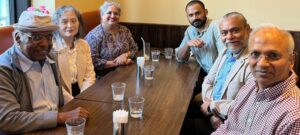
Sachi meets Kannan in Tokyo, Oct 17, 2025
Prior to this meeting I had received Kannan’s view of Part 83, by mail of Sept 15th. It was as follows:
“Thank you, Sachi. I had missed the Kannadasan essay on his meeting MGR prior to the elections and the latter’s expectations of 135 seats. The election statistics and the analysis that follows make this part invaluable. II wasn’t aware Ugamchand and Ramasamy were rebel candidates that MGR swiftly accommodated. I expected you to also touch on MGR’s campaign. It was an election that MGR fought with no major ally and yet polled the most. ”
My response to Kannan’s observation, sent by mail the following day was this.
“Your thoughts on the contents of Part 83 are well accepted. Unfortunately, I don’t have any materials related to the May 1980 election campaign itself, with me now. My Sri Lankan period collections of that period had vanished! I managed to write the chapter, with the material I have now. And also, I make sure that what I write, will have to be complementary to what you had provided in your book. As for Ugamchand selection in Maduranthakam constituency, I had read that he was a North Indian! When I came up with this name first time, I noticed that it was not a Tamil name. MGR shrewdly picked him with his ‘inner third eye’. Ramasamy’s case had been reported in Economic and Political Weekly report.”
During the May 1980 Legislative Assembly Election Campaign
Though I had responded to Kannan that ‘I don’t have any materials related to the May 1980 election campaign’, on Kannan’s suggestion, I dug into materials available in my shelf, to provide some more missed details. The reason: This was the final election in which MGR actively participated.
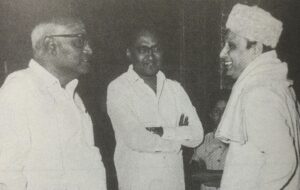
MGR in conversation with director P. Neelakantan (lt) and Kanagasabai chettiar (middle) – circa 1969
An eventually abandoned plan to respond with a movie
According to Ravindar’s (MGR’s writing assistant) published memoirs in Bhommai film magazine (serialized during 1992-1995), MGR had wanted to respond to his dismissal with a movie. He had requested Ravindar to spin a story. Ravindar was able to write one within a week, based on the events that happened then in two schools. One was based on a event in which Ravindar’s friend (one Muhaideen) who was serving as the principal was dismissed by the school’s management. The second one was a strike in a woman’s school, demanding better facilities for the school. MGR was pleased with the plot and wanted to finish the movie within a month. He had commanded his favorite directors P. Neelakantan and K. Sankar to work in two separate units. Lyricist Vaali completed 7 songs, and M.S. Viswanathan had tuned them and these were recorded as well.
Movie’s title was aptly named ‘Itho En Pathil’ (Here is My Response). The date for election was announced. MGR had wished to complete the shooting within 20 days. But, with election campaign schedules for visiting all the constituencies, shooting was abandoned; however the recorded songs were used in the elected platforms. Though the movie plan had to be dropped eventually, MGR did pay the sum to those who were contracted to participate in the production.
Campaign routine
Another snippet from Ravindar’s memoirs. “In each village, MGR traveled there may not be a stage for speaking. MGR would stand in a stool inside his campaign vehicle, with open hood. With this sort of arrangement, folks could at least view, MGR’s upper half. People would listen, and garlands and clothes would cover the campaign vehicle in full.
In an incident that happened around Madurai, at 11:00 am, MGR requested his driver Ramasamy to stop the vehicle. The van stopped near a ‘campaign arch’. Folks had gathered immediately. MGR asked ‘what’s this?’ We also noticed it. The slogan was ‘Welcome Welcome Bharat’s Prime Minister’. People responded, ‘ Day before yesterday Indira amma was here. And this arch was set up for her.’
MGR responded: ‘Please take it away.’ People replied: ‘Why bother with it? You can proceed.’
MGR replied: ‘Opposition party folks may wag their tongue stating, MGR now wishes to be the Indian prime minister, and he had set up this campaign arch. I don’t have such a wish. If you remove it, I will enter your village. If not, I’ll return.’ People removed that arch instantly. Then, MGR thanked them for acceding to his request, and continued his journey.
He campaigned day and night, without regular meals and regular sleep He would sleep at 3:00 am, and get up at 5:00 am. People who were waiting for his arrival couldn’t be counted. Even though it may be announced at he will arrive at 2:00 am, people would gather by 9:00 pm.
After dismissal, all the security detail for MGR were removed. Many suggested to him that he should arrange for private security for protection. MGR’s response was:
‘Why? Who will do anything? I’ll remain without protection. If people want, let them kill me. If they wish, let them select me. Last time, when they choose me, I accepted it with reluctance. If they want me [again], I’ll accept it gladly, because people had chosen me, despite being removed without a cause. If Delhi removes a government chosen by the people, it means dictatorship rules and democracy had been crushed.’
A Life Threating Incident faced by MGR
I did pick up on a life threatening incident faced by MGR during that campaign. I’m thankful to him, for prodding me on this.
The authenticity of this incident cannot be doubted, because it appears in the 2007 memoirs of K.P. Ramakrishnan (1930-2021), who served as MGR’s ‘body- double’ (during his film career) and subsequently was a member of his security detail. Ramakrishnan had provided two anecdotes about the 1980 election campaign. One relates to a sad incident which happened when fellow actor Sivaji Ganesan was campaigning for Congress Party, at a village called Vaadipaddi, near Madurai. MGR’s party also happened to be at the same place on that particular day. I omit details of this incident here. But, the second one that happened inside a train compartment was more personal to MGR and his security team. I provide a translation of what Ramakrishnan had described,.in four pages.
“The incident which I describe now also happened during 1980 election propaganda. Even when we think about it now, we feel wretchedly unpleased.
MGR had wished for a train travel, as an alternative to traveling by van. J. Panku Raj (JPR), Singh, driver Govindan and me were in the first class. In the adjacent first class berth with air conditioned (AC) facility, MGR traveled. Once the journey began, MGR called me to be with him in the AC facility. I responded, ‘I cannot tolerate cold breeze. I’m sorry Anne’. Then, he replied ‘OK. Take a good rest. Don’t bother to disturb me.’
By night 1 am, train stopped at Virudhachalam station. After it started, there was a signal stop for some time. Like now, there was no ‘automatic signal’ switching then. Someone had tampered with the signal, so that the train had to ‘stop’.
MGR had been sleeping while resting his leg towards the car ‘window’, with head on opposite side. A gang had attempted to break the window using a chisel. As the AC compartment had double-barreled glass, a piece of broken glass had fallen on MGR ‘s leg, and this made him to wake up. Instinctly, he had moved towards the berth’s door to escape an attack. The gang had entered MGR’s assigned berth with torch and long stick to attack him.
I was shocked to hear the broken glass sounds near MGR’s berth, and all four of us entered. [What we saw was] MGR was kicking two guys who were attempting to enter the berth. JPR, Singh and I challenged the six guys and hurt them badly. Singh also got hurt on his back scalp. I had bleeding in my neck.
In the meantime, train had started. driver Govindan had pulled the emergency stop chain. As a result, the train guard and the engine driver rushed to our berth and was shocked to hear what had happened. Once certifying that MGR was unhurt, then the train continued the journey.
Usually while traveling, MGR carries a ‘dress box’, which contains first aid medicines and items related to that. His personal doctor B.R. Subramaniam also accompanied him. As we were traveling by night train, MGR had arranged for the doctor to move to Madurai, the following morning. From the first aid box, MGR used cotton to wipe my neck wound and administered tincture. He did the same for Singh as well.
Though he had realized that six guys had came to attack him, MGR wasn’t flustered. What he told was, “Some one had planned to ‘close’ me. We should be very careful at this election.’ Though we pleaded to be with him, he wouldn’t let us, and said ‘Don’t mind it. You better take rest.’
When the train reached Madurai in the morning, at the railway station, Kalimuthu, K.K.S.R. Ramchandran, M.P.Ambhazhagan, attorney Patturajan and other numerous fans were there to receive MGR. The van which MGR was using for election propaganda had also arrived from Chennai, and was ready.
In the afternoon, we left at 3:00 pm to attend the meeting at Thiruparamkunram, and was about to leave for Theni at 5:00 pm. A party official brought a copy of ‘Malai Murasu’ newspaper, that carried this MGR item. What was published in that paper was, ‘Nothing unusual happened at Virudhachalam train station. Many MGR fans were visiting to see him.’ It had the imprimatur of the release of Highest ranking police officer of Tamil Nadu.
MGR had prevented us from making a complaint about the railway station incident. ‘ We don’t know the identity of who came to attack us. We also don’t know, to which group (party) they had affiliation. This being the case, what to tell to the police? Who can they find out?
He also told us, after reading the Malai Murasu news item, ‘Why this D.G.P. [Director General of Police] talks like this? What did happen was one thing? And what he tells is different? Why this need for twisting?’…
Once MGR assumed the chief minister position, within few days, V.R. Lakshminarayanan was appointed as the new administrative officer of Tamil Nadu police. The official who was holding that position previously was transferred to another rank.”
It was this Lakshminarayanan (1928-2019), who was assigned the duty to arrest Indira Gandhi, during Morarji Desai’s tenure, in 1977.
An analysis on this ‘Less noticed Life Threatening Incident’ of MGR
To the best of my knowledge, none of the previously published books on MGR (which I had checked) by those who were close to him professionally, had omitted this Virudhachalam station incident, during the 1980 election campaign. Kondath Mohandas (who served as MGR’s bogeyman in law enforcement), Vidwan Lakshmanan (who was MGR’s ghost-writer for his autobiography) and Ravindar (another writer, employed by MGR for his stage dramas and movies) do not mention this incident, in their books.
Nevertheless, the facts remain: (1) This incident was brought to public notice by Ramakrishnan, 20 years after MGR’s death. (2) Ramakrishnan didn’t mention about any injury suffered by MGR when he was defending the attack from six-member gang who had entered his First class AC train car. (3) From Ramakrishnan’s description, that he and Singh (another member of MGR’s security team) did suffer some injury during such wrangling suggest that the attackers were of ‘professional grade’. (4) That why MGR opted not to file a complaint to the police, could be explained that he personally didn’t suffer any noticeable injury to his body. (5) Suppose if MGR had suffered such an injury, the train guard and the engine driver who were at the scene, would have noticed promptly and reported to the law enforcement team.
One can also infer that what Ramakrishnan had described in 2007 could not be a fake story due to the fact that it had received coverage in the following day’s Malai Murasu paper, with a phony twist offered by the highest ranking police official of Tamil Nadu state then.
One can attribute MGR’s escape from injury on that night (at the age of 63!), to his fine-tuned vigilance skills based on decades of professional training as an action movie star, endowed with martial art skills. Though MGR could handle such life threatning attempts by humans, his hectic pace of political life with its inbuilt stresses might have warned him that the Grim Reaper was angling him with a focused view. I have no doubt that MGR himself could have felt such ‘minor tweaks’ in his body.
Another health-related incident in MGR’s Life
In his 2007 memoir, Ramakrishnan has also mentioned another health-related incident in MGR’s life, which deserve mention. This had happened during 1977 election campaign, before MGR’s election to the Chief Minister rank. A translation of what Ramakrishnan had recorded, follows:
“Year 1977. Near Sivaganga, an election meeting at 7:00 pm. Attorney Billappan had organized it. MGR officiated a wedding event to a couple. Madurai mayor Muthu joined Anna DMK party in front of MGR.
Occasionally MGR suffers from one sided migraine. It takes time to stop. He had to vomit to be relieved from migraine. On that day, at the meeting he suffered such a situation. Nearby there was a government guest house (only one room!).
A woman doctor ‘Kamala’ (real name is hidden) working at the Chennai Royapettah government hospital was staying there then. I asked her ‘MGR had to use the bathroom for 10 minutes. Will you allow?’ She agreed. MGR went inside to vomit. Then, Dharmalingam and I massaged his back.
That lady doctor then called me ‘Will you please come?’ [she said] ‘My husband had returned. We have to eat. Please tell MGR to come out.’ After hearing this, MGR immediately came out, and apologized ‘Sorry madam, for the inconvenience caused.’and left. I was sickened by the rudeness, and felt sorry ‘Treating MGR, like this, with disrespect!’
In the 1977 election, Anna DMK was elected for ruling the state and MGR became the chief minister. I was irritated by that lady doctor’s behavior towards MGR and suggested that ‘she should be transferred’. He asked me to ‘write the details about it.’ Aftet two weeks, when I went to Royapettah General Hospital, I saw that doctor was still there. Then, I told MGR about the discomfort I felt on that doctor’s behavior. He retorted, ‘We should avoid taking revenge on others. Will dog barking at the Sun cause any effect?’
An incomplete listing of MGR’s health-related issues
In chapter 41 of this series [link https://sangam.org/mgr-remembered-part-41/] posted on Dec 19, 2017, I had covered medical details of 1967 shooting incident that MGR overcame. Now, I have tabulated MGR’s major health-related issues, between 1929 and 1984. This is provided in a pdf file nearby, specially prepared for this chapter: cholera infection, scorpion bite, an unusual hanging accident in the shooting sequence of ‘Rajakumari’ (1947) movie, broken left leg at a stage play in 1959, assassination attempt by actor M.R. Radha in 1967, failing eye sight due to strong strobe lights, an attempt on life during election campaign in 1980. Then, four years into his second term as the Chief Minister of Tamil Nadu, facing the serious health setback of cerebral thrombosis, stroke and paralysis leading to kidney transplant surgery in 1984.
Major Health Related Issues faced by MGR
However, I present two details as observed by two Indian doctors – Dr. Muthu Krishna (M.K.) Mani and Dr. Sunil K. Pandya – in 1989 and 1990, here. These relates to side aspects relating to 1984 treatment MGR had received at the Apollo Hospitals in Chennai. Dr Mani was the chief nephrologist then, at the Apollo Hospital and he published his autobiography in 1989. Dr Pandya reviewed this autobiography in the British Medical Journal in 1990.
Dr Mani’s two specific notes about treating MGR in October 1984 were as follows:
“Patients with chronic renal failure have, over the years received small concessions, usually some notable fell ill …When the Janata Party came into power, they made an effort to provide dialysis facilities at many hospitals. When the Chief Minister of Tamil Nadu [i.e., MGR] had a renal transplant [in New York], azothiprine, an expensive drug needed to prevent rejection of the kidney, was made available free at Government Hospitals. Thus does the common man benefit from the misfotrunes of the great.”
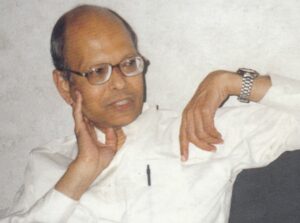
Dr M.K. Mani (nephrologist)
Another related comment Dr Mani had made was,
“The reader expecting the story of the VIP patients I treated at Apollo will be disappointed. I have not been authorized to speak about them.”
In his review of Dr Mani’s book, Dr Sunil Pandya had observed the following;
“Fifty odd pages are devoted to an account of Dr Mani’s most famous patient, the late Jayaprakash Narayan. Compulsory reading for anyone interested in modern Indian history, this section was written at the express request of the illustrious statesman. Those seeking a similar account of the late chief minister of Tamil Nadu, M.G. Ramachandran, will be disappointed. Neither he nor his heirs have authorized Dr Mani to narrate that tale, marred as it is by several sordid aspects over which Dr Mani had no control.”
Though MGR’s refusal to Dr Mani appears to project him in a negative light, in reality, this was not so. About the ‘sordid aspects over which Dr Mani had no control’ in the last sentence of Dr Pandya, the angle MGR had taken was NOT to embarrass Apollo medical team who had treated him in an emergency situation prior to his New York transfer in November 1984. These events will be covered in much detail, in a forthcoming chapter.
A noticeable item in a photo (circa 1969) presented nearby showing MGR in conversation with director P. Neelakantan (lt) and Kanagasabai chettiar (middle) – is that while MGR was wearing his trade mark white fur cap, he was without spectacles. But, after reaching 50, for eye care, he had begun wearing dark spectacles in public. Only while relaxing among close friends and family members, he could be seen without spectacles.
Coda
What is unique in MGR’s political career from 1977 until his death in 1987, he was consecutively elected as Chief Minister of Tamil Nadu three times. This record still stands, even after 38 years. But, he couldn’t complete the nominal five year term, in any of his three tenures. MGR first tenure was shortened due to abrupt dismissal by Indira Gandhi, after 2 years and 232 days. His second tenure, which began on June 9, 1980 fell short by months, due to his debilitating illness Oct 1984. His third tenure, which began on Feb 10, 1985 came to a close with his death, after 2 years and 10 months in Dec 1987.
Nevertheless, despite all the negative predictions about his flip flops in policy decisions and instinct-based decision making, MGR’s chosen deeds did influence future events tremendously in Tamil Nadu as well as Sri Lanka (Eelam) affairs. Fellow politicians (prominently Karunanidhi), academics (like M.S. Pandian, Prof. K.M. de Silva), journalists (like N. Ram and journalists from the India Today stable) and critics like Cho Ramaswamy (a guy who figuratively wore multiple hats) did ridicule MGR’s flip flops in politics but they could hardly comprehend his decision-making strategy. His decisions were based on instinct from personal experience, akin to that of Mahatma Gandhi, and not derived from ‘balancing books and consulting experts’. But, as pointed out by Dr. M. K. Mani above, who can complain if an expensive drug was made freely available to public at the government hospitals in Tamil Nad?
Though ill health issues dogged him in his final seven years, MGR was not one to wilt under health debacles. He proved himself to be a ‘fighter’. He would promote and administer the Noon Meals Scheme for school children in 1982, for which he is still admired by Tamil Nadu public. The prime instinct for this scheme was his personal experience of childhood poverty in 1920s. MGR’s rendevouz with Sri Lankan affairs would begin from January 1981 at the 5th International Tamil Research Conference, which he sponsored at Madurai and continue till his death in December 1987.
About MGR’s active participation on Sri Lankan affairs in mid 1980s, I present a letter which I sent to Lanka Guardian magazine on May 14, 1993. The editor Mervyn de Silva did not publish it, probably for a reason, I was rebutting an influential Sinhalese historian. My letter was in response to a two part essay that appeared in the Lanka Guardian of April 1, 1993 and May 1, 1993. It was entitled, ‘The Prelude to the Indo-Sri Lanka Accord of 1987’. Now, after 32 years, I present my criticism of Prof K.M. de Silva’s take on MGR. The complete text of my 1993 letter appears below.
“K.M. de Silva believes that the role of former chief minister of Tamil Nadu, M.G. Ramachandran was inconsequential because ‘his [MGR’s] health broke down to the point where he could hardly speak and his hangers on, male and female, interpreted his wishes through lip reading, movements of his eyes and hands.’ There is no question that MGR was debilitated in October 1984 and he was away in New York from November 1984 to January 1985. But, this debilitation did not force the charismatic MGR to step aside from his role as an important player in the Indian political field, after his return to Madras.
For the role played by MGR between Feb 1985 and Dec 1987, information not appearing elsewhere has been presented in the book of Kondath Mohandas [MGR: Man and Myth, Panther Publishers, Bangalore, 1992, pp. 111-124 and 134-164].He served as the Director General of Police during MGR’s rule in Tamil Nadu and was in a privileged position to see how the move star turned politician functioned even while under the weather. Though K. M. de Silva may not be aware of it, Tamils (Karunanidhi, Amirthalingam and the Eelam militants) as well as the prime ministers of India (Indira Gandhi and Rajiv Gandhi) knew well that, being a seasoned movie star he was, no one could steal a scene from MGR.
Despite the bickering within his party ranks for succession, MGR did influence Rajiv Gandhi and LTTE in no uncertain manner between 1985 and 1987. Regarding the scene in Tamil Nadu, Mohandas has noted,
“The Sri Lankan Tamil problem was one of the top priorities of the new MGR government…MGR was gradually getting in touch with the militant groups – particularly the LTTE, through sources other than the CID. His idea seemed to be to impress on the Central Government his hold over the militant groups and use it as a card to be used if and when the need arose. This was a dangerous game, but as MGR once told me, ‘Life is not worth it without risks’
MGR’s action of confiscating the arms of all Tamil militant groups prior to the SAARC summit in Bangalore (Nov. 1986) and then returning the confiscated items to the LTTE also attest to the fact that MGR played his card according to his way, without minding the Delhi wags, who did not bother to know the ground realities in Tamil Nadu.”
What made me to write this unpublished letter in 1993 was Prof K.M. de Silva’s naivete that a ‘speaking politician is a good politician’, and ignorance that MGR couldn’t communicate meaningly in other ways with hand gestures, with eye and also by silence. The simple fact that MGR was a professional grade actor for decades was lost on the learned Professor. For comparison, we now have an American President Donald Trump who speaks and writes gibberish on a daily basis, thinking that he is communicating wisdom. But all what he projects to his audience was his ignorance, and limited vocabulary replete with middle school level spelling errors.
Cited Sources
Vidwan V. Lakshmanan: Makkal Thilagam MGR, 4th ed, Vanathi Pathippakam, Chennai, 2002, pp. 81-82, 101-102, 106-111, 196-197, 210-214.
Dr M.K. Mani: Yamaraja’s Brother – The Autobiography, Bharatiya Vidya Bhavan, Bombay, 1989, pp. 252, 266.
Sunil K. Pandya: The autobiography of an unusual Indian [review of Dr. Mani’s autobiography]. British Medical Journal, Mar 24, 1990; 300: 801-802.
K.P. Ramakrishnan and S. Rajath: MGR – Oru Sagaaptham, 8th ed., Vikatan Pirasuram 155, Chennai, 2013 (originally published 2007), pp. 42-47, 172.
Ravindar: Pon Mana Chemmal MGR, Vijaya Publications, Chennai, 2009, pp. 145-147.
A revision has to be noted. In the section ‘A Life Threating Incident faced by MGR’, the second sentence begins with ‘I’m thankful to him….’. Here, I refer to Kannan, for his suggestion.
As usual Dr. Sachi amazes the readers with so many new details, example, MGR’s plan to respond to his dismissal with a movie and even though the idea did not materialize, paying everyone involved in the project, a hall mark of a man of his stature, natural comparison comes about American President who filed for bankruptcy to avoid paying workers who built his casino.
As I read on, again comparison comes with campaign of Actor Vijay wherein more than 50 people died, even though much huge crowds came for MGR, his party workers ensured nothing like that happened, it is really amazing. His demand for removal of banner as prime minister is also typical of him, such a statesmanship! His courage is reflected by moving around without security, even actors who acted a few movies nowadays have ‘bouncers’ around them! The essay gets more interesting while reading about attack on him during rail journey and his magnanimity on forgiving the doctor who treated him rudely!
It is heartwarming to know that MGR made costly medicines available free to public, a signature move typical of him indeed!
I thoroughly enjoyed Dr. Sachi’s rebuttal of K.M. de Silva’s portrayal of MGR and his comparison with American President who is a joker on world stage!”