Fifth International Tamil Research Conference, Madurai – Jan 1981
by Sachi Sri Kantha, June 17, 2026
Prelude:
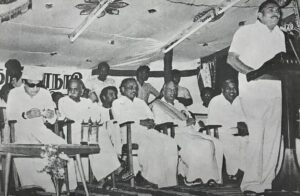
Madurai 1981 Conference – at a podium. Seated from Lt to Rt were MGR, Ma Po Si (with his trademark mustache), C. Rajadurai and K. Rajaram
Since 1981, I have written my experiences as a Sri Lankan delegate to this Fifth International Tamil Research Conference held at Madurai between Jan 4 and 10, 1981 in print and digital media. Cited sources section below, provides these details. As such, I refrain from regurgitating my personal observations again here, excluding the first day events on January 4, 1981 Sunday, recorded in my diary.
Quite a number of conference delegates from ‘not so affluent countries’ were put up at the Madurai Kamaraj University’s Men hostel. I was also one of them. First, we were taken to a location tagged as ‘Mu.Varadarajan (Mu.Va) Arangu’. Mu. Va (1912-1974), a Tamil scholar, essayist and novelist, is a name well recognized by literate Tamils. He had served as the Vice Chancellor of Madurai University in 1970s, prior to death). After we registered ourselves to receive the conference registration card, handouts. souvenirs and other associated trinkets, we were directed to have a lavish lunch.
“Around 1:30 pm, MGR came to Mu Va Arangu to open the lunch for assembled delegates. He was accompanied with his security protocol guys, and print journalists. As is well known to Tamilians, in ‘MGR-brand hospitality’ offering meals to the guests were the first priority. Timing was perfect for us. He was dressed in clean white veshti, long sleeve white shirts and his attire of white cap and dark glasses. He was two weeks shy of reaching 64 (on Jan 17, 1981). I was 27 then. We had to squeeze in and greet MGR with a handshake. I experienced a once in a life time opportunity of a less than 4 second experience in shaking MGR’s right hand with my right hand, and introducing myself. ‘I’m Sri Kantha, coming from Kandy, Ilankai’. He smiled and exchanged with me only one word –‘Vanakkanga’ (greetings) in Tamil.
In the evening, around 5 pm, we were picked in delegates’ buses and brought to the Race Course grounds. The Opening session began around 6:00 pm, and we were seated in the Delegates’ section. By the time MGR began his speech, it was around 10:30 pm. We didn’t have dinner properly, and reached our residence hall by 12:00 am.”
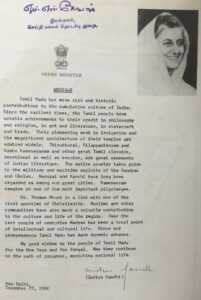
Indira Gandhi’s message to the 1981 Madurai Conference, dated Dec 27, 1980
Forty five years have lapsed now. Two generations later, only those who are in the 65+ age group can reminisce now clearly on what happened during that particular one week in January 1981. Thus, in addition to the essential statistical details about the research papers presented at the Conference, I’ll analyze the appreciative views of Prof. Norman Cutler (University of Chicago’s Tamil scholar who was an American delegate to the Conference, negative views of MGR’s political rival M. Karunanidhi, Eelam’s author-memoirist S. Ponnuthurai (Es Po) and the insensitive rascality demonstrated by a few Sri Lankan delegates (including that of Prof. K. Sivathamby) as well as non-registrants in three chapters consequently. Of the five names I’ve mentioned now, MGR died in 1987, aged 70. Prof. Cutler died in 2002, aged 52. Prof. Sivathamby died in 2011, aged 79. Es. Po died in 2014, aged 82. Karunanidhi died in 2018, aged 94. And last year, we lost Chelliah Rajadurai (another prominent guy, who was also a featured presence at the Madurai conference). He was 98. MGR, Karunanidhi and Rajadurai interacted in personal terms; and Prof. Sivathamby’s submitted paper on MGR-Karunanidhi influence on Tamil films was eventually not presented at the Conference also created a stir. Unlike previous biographers of MGR, personally I consider this Conference as one of MGR’s ‘unique successes’ during his chief minister tenure in how he negotiated the ‘political currents’ to make it happen and achieved a success, despite gripes from his opponents.
The Second International Tamil Research Conference was held in Jan 1968 at Madras (Chennai) during C.N. Annadurai’s tenure as the chief minister. I point out two specifics which differentiated the 1968 Madras Conference to that of 1981 Madurai Conference. First, Indira Gandhi was the prime minister of India in 1968 and 1981. But, she did not participate in 1968 conference. It was opened by Dr. Zakir Hussain, the then President of India. But in January 1981, despite the political differences he had with Indira Gandhi, MGR somehow managed to bring Indira Gandhi on the closing day of the Fifth International Tamil Research Conference.
Have a look at the Kalki cartoon of Jan 11, 1981, presented nearby. MGR and Karunanidhi had competed with each other to show the Tamils, on whose side Indira Gandhi will be. Being an electoral loser in the May 1980 Tamil Nadu legislative assembly elections, while having Indira as an alliance partner, Karunanidhi virtually had no political cards to play against MGR. In contrast, MGR was more than willing to have Indira showing up for his twice-postponed ‘Tamil festival’. And unlike in 1968, Indira also had matured politically. As the cartoon depicted, MGR (dressed in his role as a Tamil king regalia, with a horse drawn chariot behind him) was receiving Indira with the words ‘Suppose You have told that you will arrive early Next year, it’s fine. Until that day, we’d have extended World Tamil Conference.’ Indira’s perplexed face hides her inner feeling. She raises only her left hand, while MGR welcomes her with both hands. The vehicles drawn behind Indira (car) and MGR (horse-drawn chariot) also conveys the message of old vs. modern.
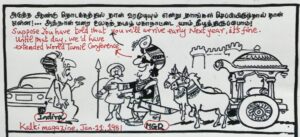
Cartoon of MGR (dressed in regalia) receiving Indira Gandhi (Kalki magazine, Jan 11, 1981)
Quite a few inferences may be made here. First, Indira Gandhi during her first tenure was politically immature enough to comprehend the political realities in Tamil Nadu in 1968, probably because she had delegated the state’s politics to senior Congress Party leaders like K. Kamaraj, C. Subramaniam and R. Venkataraman. Secondly, MGR’s standing among the Tamil Nadu populace would have made a politically mature Indira to decide that snubbing MGR would be detrimental to her own political interests in the State. Thirdly, though UNP was in power during 1968 and 1981, the Sri Lankan Tamil issue was NOT a political factor in 1968, but it was gaining traction in 1981. The UNP leadership had changed from that of Dudley Senanayake (in 1968) to Junius R. Jayawardene in 1981, who had rubbed Indira on the wrong side when she was defeated in 1977.
Nevertheless, there were two influential individuals who had participated actively in organizing of the both the 1968 Madras and 1981 Madurai conferences. One was MGR himself. For the 1968 Conference, he had the official designation as ‘Chairman of the Souvenir Production Committee’ and unofficially he was involved in numerous other functions, especially hospitality to the visiting researchers and foreign delegates. The other one was V.R. Nedunchezhian the ranking Cabinet minister (always No. 2 to Anna in 1960s, Karunanidhi in the first half of 1970s, MGR in 1980s and even to Jayalalitha in 1990s). Both in 1968 and 1981, Nedunchezhiyan was the Vice-Chairman of the Steering Committee. In 1981, Nedunchezhiyan was one of the four Vice Presidents of the Steering Committee. Other three were MGR’s Cabinet ministers R.M. Veerappan, C. Aranganayagam and K. Kalimuttu.
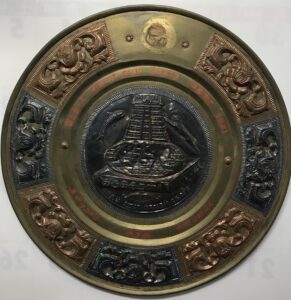
Conference Felicitation Plaque given to the Delegates. Emblem is sculpted in the Center.Nedunchezhiyan’s Introduction of the scheduled events in Madurai between Jan 4 and Jan 10, 1981
To a special publication [Spotlight on Tamil Nadu] released in honor of the 5th International Conference to be held in Madurai, prime minister Indira Gandhi released a brief ‘good wishes’ message, dated Dec 27, 1980. This is presented nearby. MGR, as the Chief Minister also presented his ‘vision’ for the State, as follows: “Prosperity with peace is the aim of my Government. In the name of my leader Anna, I dedicate myself to the service of the people of Tamil Nadu. My Government will spare no efforts to mobilise all the resources and the abilities at our service. We shall endeavor to build a prosperous Tamil Nadu…”
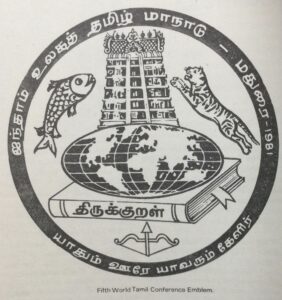
Emblem of the 5th International Conference-Seminar for Tamil Studies, Madurai, Jan 1981
V.R. Nedunchezhian, had offered a glimpse of what was planned during the one week felicitation of ‘mother Tamil’ at the scheduled 5th World Tamil Conference.
(a) Academic seminar at the Madurai Kamaraj University in which the scholars from all over the world will present research papers and discus on them
(b) Public Conference where in Pattimanram (debate), Kavi Arangam (Poets forum) and Special lectures by popular Tamil scholars will be conducted at the specially erected pandal called ‘Moovendhar Arangam’.
(c) Cultural exhibition depicting ancient Tamil culture, literary scenes and the grant of Tamil civilization over the ages.
(d) A colourful pageantry depicting ancient Tamil culture, both the civilization and the literary scenes.
(e) Cultural programmes on all the seven days of Conference in which famous artists, dancers, and instrumentalists will perform to the foreign delegates as well as the people at home. Besides, this, folk arts will also be an important item.
(f) A colourful souvenir containing over one hundred research papers and paintings.
(g) Cultural tour: All the foreign delegates attending the Conference will be taken to tour to the places of cultural importance in Tamil Nadu.
Thirteen individuals who had contributed to the progress of Tamil language and literature in varied forms will be honored with statues in Madurai city. These were, Tiruvalluvar, Tholkappiar, Robert de Nobili, Pandithurai Thevar, Desika Vinayagampillai, U.V. Saminatha Iyer, Arumuga Navalar, Somasundara Bharathi, Mayuram Vedhanayakam pillai, Thaninayagam adikal, Veerama munivar, Thirumalai naicker, V. Kalyanasundaranar. Among these 13, two (Arumuga navalar and Thaninayagam adikal) were from Eelam.
Among the 7 vistas offered to the Conference delegates (a) to (g) mentioned above, I totally missed out on vistas (b), (c) and (g). Missing the post-Conference cultural tour arranged for the foreign delegates was a deep regret to me, as I had to be back in Colombo, to attend another International Conference related to my then research, and receiving Prof. John Erdman Jr. who had offered me a position to join his group, at the University of Illinois later that year. In the next chapter, I provide descriptions of Es. Po about this post-Conference tour for foreign delegates.
Steering Committee’s lead Members for the Madurai Conference-Seminar 1981
I provide this detail for a reason, to counter Karunanidhi’s assertion (see below). The lead members of the Steering committee who handled the Conference-Seminar affairs were,
President – M.G. Ramachandran (Chief Minister of TN government)
Vice Presidents (4) – V.R. Nedunchezhiyan (Minister of Finance)
R.M.Veerappan (Minister of Hinduism and Cultural endowments)
- Aranganayagam (Minister of Education)
K Kalimuttu (Minister of Agriculture)
Chairman – Justice S. Maharajan
Co-ordinator K. Diraviyam (2nd secretary to TN government)
Vice-chairman (3) Dr. V.Sp. Maickam (Vice Chancellor, Madurai Kamaraj Univ.)
- Ramdas (Secretary to TN government- Education department)
K.M. Shetty (Secretary to TN government – Finance department)
Secretary & Treasurer R. Muttukumaraswamy (Librarian, Maraimalai adigal Library)
Secretary (Madurai unit) B. Murugan (Registrar, Madurai Kamaraj Univ.)
Convenor A. Subbiah
In addition, there were chosen 28 members (academics and specialists in their chosen themes of expertise) involved in the selection of research papers. Among these 28 members, 5 were non-Indians: Dr. Brenda Beck (Canada), Dr Albertin Gaur (UK), Dr. S. Singaravelu (Malaysia), and Prof S.Vidyananthan (Sri Lanka). Dr. Francois E. Gross was a French academic, then stationed at Pondicherry.
Officially, there were 759 delegates were registered. 293 were Indians. Among the 466 registered foreign delegates, Sri Lanka had the highest 194 delegates, followed by Malaysia/Singapore with 138 delegates. Then, in decreasing order of delegates, other countries were represented as follows: USA (30), Indonesia (23), UK (15), Japan (10), Mauritius (9), Fiji/South Africa (8), West Germany (7), Australia (6), China (3), Italy (3), Senegal (3), Sweden (3), USSR (3), Canada (2), Czechoslovakia (2), Ghana (1), Libya (1) and Nigeria (1). Quite a number of registrants in USA, UK, Australia, Africa and European countries were Tamil ethnics who had settled or in short term stay from either India or Sri Lanka. This delegate number differ marginally from the 1983 eyewitness account provided by Norman Cutler (see below). This number is recorded in the Official Proceedings of the Conference-Seminar (vol.1), published in 1981. The highest number of Sri Lankan delegates was related to the spouses and family members of ‘notable names’ who also registered separately. For example, in the registrants’ list of Sri Lankan delegates, I could identify the following, and have indicated 8 of the then TULF MPs in italics:
Amirthalingam, and Mrs. Amirthalingam
Dr. K. Indrapala and Mrs Indrapala
Dr. K Kailasapathy and Mrs S. Kailasapathy
Kathiravelupillai and Mrs Kathiravelupillai
Kumar Ponnambalam, Mrs. Kumar Ponnambalam
Murugaiyan and Mrs Murugaiyan
V.N. Navaratnam and Mrs Navaratnam
K.P. Ratnam and Mrs K.P. Ratnam
X.M. Sellathambu and Mrs Sellathambu
Sivasithamparam, Mrs Sivasithamparam, Miss Sivasithamparam.
Sivathamby and Mrs Sivathamby
V.S.Thurairajah and Mrs Thurairajah
Thurairatnam and Mrs Thurairatnam
Yogeswaran and Mrs Yogeswaran.
Apart from these, there were also two Minister MPs representing the Sri Lankan government – S. Thondaman, C. Rajadurai and the Muslim Speaker of the Parliament M.A. Bakeer Marker. These three names do not appear in the Sri Lankan delegates listing.
Some of the notable personalities who had registered themselves as Indian delegates include the following: P. Akilan (novelist). P.N. Appuswamy (science writer in Tamil), Dr. Dagmar Hellman (ethnologist), K.V. Jagannathan (journalist and Tamil scholar), P. Neelakantan (stage script writer and film director), Dr Padma Subramaniam (bharathanatyam dancer), Naa Parthasarathy (journalist and novelist), Poornam Viswanathan (stage and film actor), Mrs. Shyamala Balakrishnan (vocalist and musicologist), Dr. M.S. Udhayamurthy (motivational writer in Tamil) and Vaijyanthimala Bali (film actress, dancer, and later Congress Party MP).
Submitted and Selected Research Papers for Oral Presentation
Muthukumarasamy’s (Secretary of the Steering Committee) synopsis about the specific details on the research papers submitted and selected was “232 out of a total 321 papers received were presented at the Plenary Sessions and Group Sessions. Subject-wise break-up of the chosen papers is as follows:
Session 1: linguistics and grammar – 34
Session 2: archaeology – 4
Session 3: arts and architecture – 4
Session 4: dance and music – 10
Session 5: drama – 6
Session 6: history – 13
Session 7 a) ancient literature (until AD 600) – 37
- b) and c) early/late medieval literature (AD 600-1800) – 19
- d) modern literature – 8
- e) education and literature – 4
Session 8: comparative literature – 11
Session 9: children’s literature – 2
Session 10: folk lore and folk literature – 11
Session 11: overseas Tamil – 15
Session 12: philosophy and religion – 20
Session 13 a) science and technology – 8
- b) siddha medicine – 2
Session 14: sociology – 8
Session 15: translation and lexicography – 9
Session 16: miscellaneous – 2
Session 17: administration and Tamil – 5
TOTAL = 232
However, in the Conference program schedule, I could count only 221 papers. I guess 9 selected papers were dropped eventually, for various reasons. One happens to be Prof. K. Sivathamby’s paper. (This issue will be presented later). Plenary sessions in the morning had 18 scheduled presentations for 6 days. Among these 15 were in English and 3 were in Tamil. The time allotted for the plenary session presentation was 60 min. Afternoon seminar sessions had a total of 203 presented for five days. Among these, 144 were in English and 59 were in Tamil. The time allotted for each seminar presentation was 30 min.
My seminar presentation was one of 203 and it was held on the first day (Jan 5, 1981 Mon). It was my first oral presentation at an International Conference. The title of my paper was ‘Arunagirinathar, the Adiguru of Carnatic Music’. It was also one of the 10 papers chosen under the subject ‘Music and Dance’. This session was presided by musician/musicologist Dr. S. Ramanathan. Among the 194 Sri Lankan delegates, I was lucky to be in the select sub-group of one of 27, who could present their research study at this Conference-Seminar. Maybe, it was a coincidence, at that date point, I was also 27. At the end of the session, Dr. Ramanathan offered encouraging words, that he was impressed with my research – an unusual angle on saint Arunagirinathar – a 15th century composer of repute.
I present an appreciative review (from Prof Norman Cutler), a critical view (by Karunanidhi) in this chapter. Essence of two neutral reviews (by Es. Po and Mi. Pa. Somasundaram) on the Conference-Seminar will be provided in the next chapter. It should be noted that Prof. Cutler, Es. Po and Mi. Pa. Somasundaram were registered delegates and were present in Madurai. But, Karunanidhi boycotted the Conference, for a petulant reason that he was not properly invited, for his ‘stature’..
Prof. Norman Cutler’s ‘Eyewitness account’
When Cutler (1949-2002) attended the Madurai Tamil Conference, he was only 32. Following his PhD, he had joined the University of Chicago, as an Assistant Professor. His paper contained 44 long and short paragraphs, with only 9 foot notes, but NO citations. As such, his ‘paper’ was like a journalist’s report of a ‘spectacle’ that was personally observed. Selectively, I provide below 10 paragraphs verbatim, which had distilled the essence of one week activity (from Jan 4 to 10, 1981).
“The city of Madurai (1981 population: 817,562) is situated about 260 miles southwest of Madras, or about two-thirds of the way to Cape Comorin, the tip of the Indian subcontinent, where the Indian Ocean, the Bay of Bengal and the Arabian Sea are said to comingle under the watchful eye of the virgin goddess, Kanya Kumari. From January 4 to January 10, 1981, Madurai made a bold gesture to reclaim its glorious past as the capital of Tamil culture by hosting the Fifth International Conference-Seminar of Tamil Studies.
Many of the event’s detractors (‘conference’ does not do justice to the happenings of those seven days) expressed mild surprise that the organizers had at last managed to transform a plan, long on the drawing boards, into reality. The conference was twice announced and twice preempted by the higher callings of Indian democracy. The original date in January 1980 coincided with the Indian Parliamentary election in which Indira Gandhi and her followers reclaimed control of the Indian government. With resignation the organizers rescheduled the conference for June 1980, and once again their plans were foiled, this time by state assembly elections. But, ever determined, the organizers pressed on with a third attempt. Ultimately fortune, and M.G. Ramachandran, movie star and chief minister of Tamilnadu, the Indian state in which Madurai is located and where Tamil is the official language, were on their side….
The widespread use of English at the Tamil conference was intended, at least in part, to put foreign participants at ease but one could not fail to note the irony. English was not confined to casual conversation; quite to the contrary, at the ‘scholarly’ portion of the conference, conducted at the Madurai Kamaraj University, English was actually the dominant medium of communication. Of the 197 papers delivered, 141 were delivered in English. While almost 40 percent of the over 800 delegates were technically classified as foreign delegates, in fact the majority of these were Tamils from Malaysia and Sri Lanka. The number of non-Tamil foreigners participating in the conference, mostly scholars from the United States, Europe and Japan, probably came to no more than thirty or forty at the most…
The patron who supported and guided the efforts of the conference organizers was the state government of Tamilnadu, led by Chief Minister M.G. Ramachandran. Like the Nayak rulers of Madurai’s past, MGR (as the popular chief minister is known to the public) and his party allies fully intended the public should realize that their representatives liberally support Tamil culture….
The inaugural ceremony – an entire evening’s program in itself – capped by the lengthy speech delivered by MGR. It was by no means the only time the chief minister took the podium in the course of the conference week. There was not quite so much of this sort of thing at the university, but the scholarly conference also had its honorary speech makers – some scholars, some public figures….
MGR deserves credit for playing his cards well. Indira Gandhi was not eager to show too much enthusiasm for the Tamil conference, especially since in the parliamentary and state elections held during the preceding year her Congress (I) party was allied with Mr Karunanidhi, MGR’s political foe. (Karunanidhi and his party, the DMK, boycotted the conference). But Mrs Gandhi also knew that she could not ignore the conference altogether without provoking ire of the Tamil populace. She therefore was compelled to give in at least a little to MGR’s stratagem and show herself to the Madurai crowd. She arrived in Madurai on the morning of the final conference day, rode in state from the airport to the city, addressed a meeting of Congress Party workers, viewed the grand procession of floats in the afternoon, addressed the crowd, and left Madurai that same evening.
The presence of Mrs. Gandhi and of Subbulakshmi, an artist who ‘belongs to the nation’, elevated the conference, at least in the minds of many participants, from the status of a regional event to an event of national importance. Mrs Gandhi’s participation assured news coverage throughout the nation, even if it was only to report the prime minister’s speech before the Madurai crowd. In her speech, a gem of center-state diplomacy, Mrs Gandhi was careful to praise the achievements of Tamil culture even as she subtly but pointedly attacked those who would see in the Tamil conference an opportunity to fan the flames of regional divisiveness. The theme of her speech could be summarized as ‘national unity in cultural diversity’. Subbulakshmi’s participation in the events of the final day was no less significant than the prime minister’s. Herself a Tamil residing in Madras, Subbulakshmi is an artist of national, indeed international reputation…” [Note by Sachi: Dr. Cutler had missed the point that Mrs Subbulakshmi was a native of Madurai. Her initials M.S. stands for Madurai Shanmugavadivu; her mother’s name is Shanmugavadivu.]
When all was said and done, many probably asked themselves if the extravaganza was worth the expense. Some felt sure that it was not, even before things got off the ground. Many gasped when the newspapers announced that the state government’s expenditure on the conference and related activities came to 120 million rupees…
But perhaps it is not fair to look at the conference in this light. How many westerners have sadly shaken their heads at the fabulous displays which are inseparable from the festivals observed by Hindu temples? Do the thousands upon thousands of devotees who gather to see Siva and his bride parade through the streets of Madurai on their wedding day shake their heads and grumble over wasteful expenditure?”
I do agree with the positive sentiments expressed by Prof. Cutler. But, I couldn’t meet him face to face at Madurai, during the Conference days. He had presented a seminar paper on an esoteric topic entitled ‘Study of 2 South Indian vratas when the Sun enters Capricorn’, on Jan. 8, 1981.
Karunanidhi’s criticism
Chapter 56 in the vol. 3 of Karunanidhi’s autobiography (1997), provides Karunanidhi’s angle on the 5th International Tamil Conference, organized by his political rival MGR. In it, he had cited selections from an article that appeared in the Indian Express newspaper of Jan 3, 1981, that favored his angle. But, he had neither identified who wrote that article, nor whether that individual was a DMK partisan. An English translation of Karunanidhi’s gripe is given below.
“In 1981, an international Tamil conference was held during Anna DMK tenure at the expense of 100 million rupees. That was held between January 4 and January 10th, 1981. In that conference, me or Professor [i.e., K. Anbhazhagan] or anyone on behalf of DMK did not participate.
They didn’t invite me or Professor with proper formalities and courtesy. They had included both our names in the list of over 20 Vice Presidents; without individually soliciting our consent, they informed by a letter. Furthermore, it was announced on behalf of the Anna DMK regime that the two statues for horse jockeys placed in Chennai near Anna over bridge to commemorate the abolishment of horse racing during DMK’s tenure will be uprooted and located in Madurai during the International Tamil Conference. Considering these ‘insults’, DMK decided not to participate in the said Conference…
On behalf of the Tamil Nadu government, Prime Minister was invited to the Madurai International Tamil Conference. The Chief Minister (i.e, MGR) also personally met with the prime minister and invited her. Those who had gained patronage via the Anna DMK government, and those who wished to re-link the bonds between Anna DMK and Indira Congress also worked hard to invite the prime minister to the Conference. What message they had passed to the prime minister was this. Please do not consider this as an invitation of Anna DMK government. One should view this as a felicitation function of Tamils, and if prime minister attended, she will be popular among all the Tamil diaspora. Also the Congress Party among Tamils will be rejuvenated. By such sweet posturing, they confirmed the attendance of the prime minister.
When prime minister Indira Gandhi landed at the Chennai Meenampakkam airport, I received her and handed a letter to her describing the anti-people activities in the State machinery and administrative malfunctions of Anna DMK…While I was on my way to meet the prime minister, few belonging to the ruling party blocked my car and attempted to attack me. Due to expert driving by R.D. Seethapathi, DMK’s secretary of Chennai district, we were not touched…Then, even at the airport, when I went to welcome the prime minister Indira Gandhi, a police officer pulled my hands and twisted. Despite such obstacles, I proceeded to meet Indira Gandhi, and she did receive my petition letter. She conveyed to me that her visit to Madurai was not based on political reasons, and it was solely for expressing her thanks to the Tamil delegates who attend the Conference… (Note by Sachi: bold fonts are my insertions to emphasize an essential issue, which was talked about at the conference venue.)
It should be noted that Panneerselvan, Karunanidhi’s biographer in English (2021), had omitted mentioning the 1981 Madurai Conference in his work, other than a five sentence paragraph. It was this: “MGR now wanted to project himself as a great contributor to Tamil and as the true heir to Annadurai. If Annadurai’s hosting of the second IATR conference in Chennai brought him adulation from scholars across the world, MGR felt a similar effort would win him the hearts of academia. The third and the fourth conferences were held in Paris (1970) and Jaffna (1974). MGR invited IATR to hold the next conference in Madurai. The Tamil Nadu government bore the entire expenditure for the conference.” IATR stands for International Association for Tamil Research.
Panneerselvan also had missed the fact that Karunanidhi did attend the Third conference held in Paris (from July 15 to July 18, 1970), on his capacity as the Chief Minister of Tamil Nadu, and delivered an address on the opening day in Tamil. I provide a translation on essential points of this address here.
“I welcome this Conference in the spirit that I do respect Tamil language more than my eyes. I’m pleased for the opportunity given to me, to participate in this Conference…There are 18 delegates from Tamil Nadu here, and they represent the 40 million Tamils (from India). Tamil language had spread. Tamils are living all over the world. But, Tamil language – for example in Mauritius is disappearing. There is a danger that Tamil diaspora is forgetting their mother tongue… Tamil specialists and researchers shouldn’t think that their contribution is over at that point. This Conference should concentrate on three specific issues. First, there should be student exchange between Tamil Nadu and other countries. Secondly, for Tamil to advance further, an English-Tamil dictionary need to be prepared. Thirdly, steps need to be taken to promote Tamil in countries all over the world. Our Tamil Nadu government which follows the foot steps of late Anna, will offer all the help towards realizing these objectives.” (Note by Sachi: The last sentence in italics, is my emphasis.)
Coda
I noted a factual discrepancy in what Karunanidhi had mentioned about the ‘number of Vice Presidents’ in the Steering Committee of the Madurai Conference. He had stated that the invitation he received had over 20 Vice Presidents. But, as indicated above, the number of Vice Presidents in the Steering Committee was only 4.
Also, as I had emphasized in bold font above, it’s a pity that Karunanidhi couldn’t grasp the essential issue which Indira Gandhi could recognize. Indira was not a Tamil, and she was not even a Tamil scholar. But, Karunanidhi is a Tamil, and he had promoted himself as a Tamil scholar. What I heard from a few Madurai natives at the conference venue, I summarize below. ‘This Karunanidhi fellow shouts from the roof top that he is willing to sacrifice his life for ‘mother Tamil’. We see, so many non-Tamils who had travelled long distances to honor our ‘mother Tamil’ with their scholarship. Why then, this Karunanidhi fellow who lives in Chennai couldn’t come to Madurai for a week of felicitation of ‘mother Tamil’? Isn’t he nothing but a selfish politician?’ This talk about ‘invitation not properly given to him’ is nonsense. He was indeed invited. If he bothers to honor mother Tamil, one wouldn’t bother whether you were ‘properly’ invited or ‘invited as an unwanted guest’. The second postponement of the Conference from June 1980, was mainly due to this Karunanidhi fellow’s political manoeuvers in toppling MGR regime.’
In his 1970 Paris address at the 3rd International Tamil Conference, Karunanidhi (then in his second year as the Chief Minister of Tamilnadu) offered three specific goals to be achieved for rejuvenation of Tamil language. But, in his virulent criticism of the 1981 Madurai Conference, he hardly mentioned specifically how much funds were allocated to complete the three specific goals during his tenure as the chief minister from 1969 to 1976, and whether these three goals were achieved successfully.
Cited Sources
Arunachalam (Ed): Proceedings of the Fifth International Conference – Seminar of Tamil Studies, vol.1, International Association of Tamil Research, Madras, 1981 [86 papers read at the Seminar, in English]
Associated Journals Ltd. – Spotlight on Tamil Nadu, a special publication released on the occasion of the 5th World Tamil Conference, Madurai, January 1981. 139 pp.
Norman Cutler The Fish-eyed Goddess meets the movie star An eyewitness account of the Fifth International Tamil Conference. Pacific Affairs, summer 1983 56(2): 270-287.
Karunanidhi: autobiography Nenjukku Neethi, vol. 3, ch. 56, Thirumagal Nilayam, Chennai, 1997, pp. 427-431. (in Tamil)
A.S. Panneerselvan: Karunanidhi – A Life, Penguin Random House India Pvt, Gurgaon, Haryana, 2021, p. 269.
Sachi Sri Kantha: Puthiyathoru paarvaiyile Madurai Mahanaatu anupavankal [Experiences of Madurai Conference in a new angle], Suthantiran (Jaffna), in 3 parts, Feb 15, Feb 22 and Mar 4, 1981. (in Tamil).
Sachi Sri Kantha: Observations on the Madurai Tamil Conference. Lanka Guardian (Colombo), Mar 1, 1981 3(20): 15.
Sachi Sri Kantha: Memories of MGR’s Madurai Thamil Thiruvizah, 1981. Tamil Nation website, https://tamilnation.org/forum/sachisrikantha/mgrbirthanniversary, (accessed, June 15, 2026).
Sachi Sri Kantha. From Sachi’s Files, ch. 17 – My Participation at the Madurai Tamil Research Conference (January 3-11, 1981) https://sangam.org/from-sachis-files-chapter-17/ – May 4, 2021. (accessed, June 15, 2026).
X.S. Thani Nayagam and Francois Gros (ed). Address – M. Karunanidhi, Chief Minister, Tamil Nadu. Proceedings of the Third International Conference Seminar, Paris 1970, Institut Francais D’Indologie, Pondichery, 1973, pp. 13-14.
In the list of Sri Lankan delegates indicated, inadvertently, I had missed indicating Mr. S. Kathiravelupillai (then TULF MP for Kopay), with an italics. Unfortunately, he passed away two monhs later in Madras. If memory serves, I do remember seeing him, in the company of Mr. K. Thurairatnam (MP for Point Pedro), Mr. V. Yogeswaran (MP for Jaffna) and M.K. Eelaventhan, when for a few minutes I had a courteous talk with Mr. Thurairatnam on Jan 4, 1981.
Have been regularly reading your extensively researched “MGR Remebered” Series for more than 4 years now, and I eagerly look forward to your updates in this series. I thank you for covering the life of the most respected MGR Annan in detail. Your coverage of 1981 Madurai Conference in this article includes finer details like the remarks of then-PM, and hence is most appreciated.
In light of latest developments in Tamil Nadu, I would also request you to compare the rise of MGR Annan with present-CM Vijay as both have some similarities and a few differences.
I reply to correspondent Wingong. Thanks for your thoughts and being a reader of this series.
As for recent developments in the TN political scene, I cover a different period, when there were giants in films and politics. Maybe, I’m biased now, currently we have NO giants – but actors promoting themselves as ‘giants’, but they are pygmies in their relative standing. These upstarts need to prove themselves first, in their chosen objectives.
What a lovely and detailed description of the World Tamil Conference by Dr. Sachi, I was 17 years old then and worked as a volunteer in crowd control aspect expect for the final day when we were permitted to attend the grand finale wherein Indira Gandhi was the chief guest and we could clearly see that MGR have patched up with her, and it was proved by the fact that till his death, ADMK was aligned with congress.
I read this article multiple times since it is written from a delegate perspective and we were not privy to that grand experience of MGR’s hospitality and organizing skills. Whenever I visit Madurai still the structures and statues installed for the conference take me back those wonderful days, in particular the three entry roads to the city have arches constructed to commemorate the conference (Pandian Thoranavayil, Cheran Thoranavayil, and Chozhan Thoranavayil).