by Sachi Sri Kantha, February 2, 2026
In the past 125 years of its existence, unlike other countries, Sri Lanka (or it’s previous incarnation, Ceylon, until 1971) was never represented in any of the original five Nobel Prizes. But, according to the Nobel Prize nomination archives, only the Nobel Peace Prize and the Nobel Physiology/Medicine prize had received nominations.
The Nobel Medicine prize nominations were for Aldo Castellani (1874-1971), a specialist in Tropical Medicine, who was serving the colonial British government in Ceylon, from 1903 to 1915. Born in Florence, Italy, he was a bacteriologist, until he had received a total of 61 nominations for this prize between 1905 and 1953. As such, 5 nominations received for the Nobel Medicine prize by Castellani for years 1905 (two nominations), 1907, 1908 and 1910, is tallied under ‘Ceylon’.
Now, let me provide details for the Nobel Peace Prize nominations. Nomination archives provide information, available from 1901 to 1975. There is a ‘50 year lock’ for release of nomination details. As such, we need to wait to find out who were nominated for the Nobel Peace Prize, especially for the civil war years in Sri Lanka (from 1985 to 2010). I mention this, because chances are that I may not be here, when 2035 roll in to find out whether my prediction on Nobel Peace Prize wannabes listed below were included in the list of Nobel Peace Prize nominees. But I feel certain that the list of ‘wannabes’ (from their deeds, as recorded in the mass media), I provide did make attempts to get themselves nominated for the Peace Prize.
Nobel Peace Prize Nominees (between 1901 and 1975)
Only two Sri Lanka born individuals are identified as nominees. They were,
Mr. Kathiresu Ramachandra (1895-1976), tagged as a ‘religious philosopher’, and Dr F. Hudson Silva (1929-1999), an eye surgeon. Mr. Ramachandra had received Nobel Peace Prize nominations for years 1966, 1968, 1969, 1970 and 1971. Dr Hudson Silva had received only a solitary nomination for the year 1974.
What is interesting for me is that, all nominators for Ramachandra and Hudson Silva were politicians, and none from other respected members of the society. One had to admire the tenacity of Ramachandra’s efforts to earn this prize. Here are the details.
Kathiresu Ramachandra’s Nominations. Total 8.
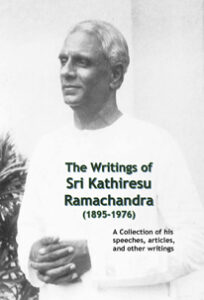
Year 1966 – nominator Alick Aluwihare (1926-2009), MP. Cited motivation: ‘for his dedication to the Mission of Peace in the World.’
Year 1968 – nominator G.G. Ponnambalam (1901-1977), MP. Cited motivation: ‘for furthering intercommunal, inter-racial and inter-religious harmony and international understanding and peace.’
Year 1969 – nominator S.C. Shirley Corea (1906-1979), MP. Cited motivation: ‘for his substantial contribution to the advancement of world peace by the propagation of his ideas’. In fact, two separate nominations were recorded for this year, by Corea, in the Nobel nomination archives log, and counted separately.’
Year 1969 – nominator M.D.H. Jayaeardena (1915-1986), MP. Cited motivation: ‘for his selfless and devoted work towards the idea of racial harmony and national unity, and his quest for peace on a global dimension.’
Year 1969 – nominator A.P. Jayasuriya (1901-1980), MP. Cited motivation: ‘for having dedicated his life to the cause of peace. His peace mission promotes inter-communal, inter-racial harmony on the local levels, inter-religious harmony and international understanding of peace.’
Year 1970 – nominator S.C. Shirley Corea (1906-1979), MP. Cited motivation: same as above.
Year 1971 – nominator C.X. Martyn (1908-1991), MP. Cited motivation: ‘for faithfully serving the cause of world peace.’
Dr. Hudson Silva’s Nomination, Total 1
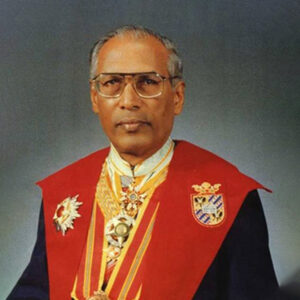
Dr. Hudson Silva (1929-1999)
Year 1974 – nominator P.B.G. Kalugalle (1920-2007), MP. No specific motivation cited. Probably, the contribution of Dr, Hudson Silva, as the founder President of the International Eye Bank, and donating corneas to other needed countries, to restore eyesight of the blind individuals.
My inference on these two nominations from Sri Lanka is that, while Dr Hudson Silva’s service to the society is meritorious and deserving a nod, that of Mr. Ramachandra as a ‘propagator of peace’ is rather dubious. As far as I know, Ramachandra edited a magazine ‘Religious Digest’ in English. The name of the magazine itself was a take from the internationally popular American magazine ‘Readers Digest’. He had promoted ‘his version of peace’, only via this vehicle! From the list of his nominators for the Nobel Peace Prize, belonging to major Sri Lankan parties of his period, Alick Aluwihare (UNP), Shirley Corea (UNP), M.D.H. Jayawardena (UNP), A.P. Jayasuriya (UNP, then SLFP), G.G. Ponnambalam (TC) and C.X. Martyn (FP), one may guess Ramachandra might have possessed the contact reach of parliament, but NOT the institutions of learning and masses. Without malice I can assert that he was of paper weight rank as a Hindu philosopher, if Sarvepalli Radhakrishnan (1888-1975) of India was a heavyweight. And Nobel Peace Prize Committees had snubbed Radhakrishnan 11 times in 1950, 1953, 1956, 1957, 1958, 1959, 1960, 1961, 1963 and 1966.
It is some sort of coincidence that one of Ramachandra’s grandson was named Radhakrishnan; and this Radhakrishnan was a student of mine at the University of Peradeniya.in late 1970s. He followed dentist curriculum. I didn’t ask him then, whether he was named after India’s philosopher. Unfortunately, I lost touch with him, after I left Sri Lanka. This Radhakrishnan’s father was a well-recognized name in Sri Lanka’s police circle – R. Sundaralingam (a son of Ramachandra), ex-Deputy Inspector General.
Nobel Peace Prize Wannabes
The slang word ‘wannabe’ is an abbreviation of three words ‘want to be’, and is considered as a deprecating term for a slob who wishes to be recognized as one possessing the merits of an individual recognized for a specific skill or talent. Though President Donald Trump is lambasted for this posturing, quite a few Sri Lankans had beaten him, ahead of his Presidential tenure, which began in 2016. Here is my list of Sri Lankan Nobel Peace Prize Wannabes, for 15 years from 1994 to 2009. They played the role of Sri Lanka’s version of ‘witch doctors’, entertaining the gullible international audience with their symbolic ballet with lamentations of lack of peace among diverse ethnics and bad-mouthing LTTE. Their stages were, predominantly, Chennai, New Delhi, Tokyo, London and Washington DC, not to mention with an eye on Oslo.
Ex-President Chandrika Kumaratunga (b. 1945): I had briefly analyzed her wannabe claim in 2000, citing her own words recorded in the Asiaweek (Hongkong) magazine of Feb 26, 1999, “We should be given the Nobel Prize for trying to be democratic in a situation that was most undemocratic”. This was made in reference to the reason for her pursuing war with the LTTE.
Ahangamage Tudor Ariyaratne (1931-2024): This individual, whom I can tag as ‘nominally non-political politician’ had been a perennial campaigner for the Nobel Peace Prize, by posturing himself as a Gandhian follower. He did receive quite a few international awards, including Ramon Magsaysay Award for community leadership in 1969, Niwano Peace Prize in 1992 and International Gandhi Peace Prize in 1996.
Radhika Coomaraswamy (b. 1953): This individual, with educational credentials and pedigree, did serve as an Under Secretary General and Special Representative for Children and Armed Conflict from 2006 to 2012. Her Wikipedia profile notes that she was appointed to this position by UN Secretary General Kofi Annan (1938-2018), for this position. Mr. Annan himself was a Nobel Peace Prize laureate in 2001. Thus, probably Ms Coomaraswamy could have aimed for the coveted prize, as a protégé of Kofi Annan. She did present herself as a valiant campaigner of peace and violence against women, in local and international podia. As per her Wikipedia profile, she did receive Bruno Kreisky Prize for Human Rights in 2000, Leo Ettinger Human Rights Prize (year not specifically stated) of the University of Oslo.
University Teachers for Human Rights (Jaffna) duo: A group consisting of four individuals (one of whom was assassinated in 1989), but primarily led by mathematicians duo Dr Rajan Hoole and Kopalasingham Sritharan were active during the periods 1990 to 2009. They cloaked themselves as ‘human rights investigators’ and their dubious investigations/activities and their adopted methodology in collecting data were strongly criticized by quite a number of fellow Tamils in Sri Lanka. But to their advantage, they had international reach from various multi-media sources and spooky networks which were against the ideals of Liberation Tigers of Tamil Eelam (LTTE). They received Martin Ennals Award in 2007, from the Martin Ennals Foundation established in 1992 Martin Ennals (1927-1991) was a British guy, who served as the Secretary General of Amnesty International from 1968 to 1980..
About this particular ‘Martin Ennals Award’, when I checked its Wikipedia entry (accessed Feb 2, 2026), I found something unusual. None of the recipients of this award had any international level name recognition. There are these adulatory sentences. “The Martin Ennals Award is considered the award of the whole human rights movement. It is known as “the Nobel prize for human rights”. The Annual Ceremony organised with the City of Geneva is an event with world Internet and TV coverage.” It was first awarded in 1994, and had come to a standstill in 2016! Between these years, all except the 2007 award had ONLY one recipient. But the 20007 award was split among three – Hoole and Sritharan had to share their award with a Burundi activist named Pierre Claver Mbonimpa.
For whatever reason (probably their funding sources dropped them like hot potatoes), the activity of UTHR (J) duo became muted after 2009.
A Nobel Peace Prize pretender
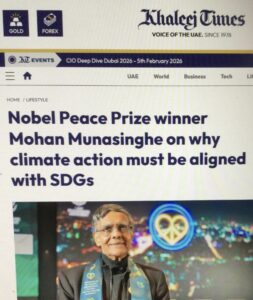
Prof. Mohan Munasinghe, as headlined in Khaleej Times, Sept 25. 2025
Sri Lanka also has a Nobel Peace Prize pretender. In 2007, Nobel Peace Prize was awarded jointly to Intergovernmental Panel on Climate Change (IPCC) and Albert Gore Jr., ‘for their efforts to build up and disseminate greater knowledge about man-made climate change, and to lay the foundations for measures that are needed to counteract such change.’ The IPCC was founded in 1988, and at the time of the award Prof. Mohan Munasinghe (b. 1945) was one of the three Vice Chairs of this Panel. The Nobel Prize lecture was delivered by Rajendra K. Pachauri (1940-2020) of India, the Chairman of IPCC on Dec 10, 2007. Though NOT named specifically like Albert Gore Jr, and not even delivering the Nobel Prize lecture, this Munasinghe had promoted himself as the Nobel Peace Prize recipient. The Nobel diploma does NOT mention Munasinghe, by name. But, he is blessed with Sri Lankan-grade chutzpah, at that!
Post-Nobel award career of Rajendra Pachauri was also blighted. He had to face allegations of conflict of interest and financial anomalies as well as sexual harassment charges in India.
My radical view on the Nobel Peace Prize
I have been studying the Nobel Prizes in sciences and literature since 1988, when my first commentary on Sir C.V. Raman’s 1930 Nobel Physics Prize was published in the European Spectroscopy News. Since then, 23 of my original papers, reviews, commentaries and letters had appeared in peer-reviewed science journals (including Nature) for the past 37 years. Please check the Appendix below. But, I couldn’t publish my radical views on the Nobel Peace Prize, because it’s rather controversial, for the editors to touch with a barge pole. I consider the Nobel Peace Prize, during the Cold War period (tentatively, 1950 – 1989) had morphed into a sort of crypto-CIA prize, hijacked by Uncle Sam’s plumbers. This is rather unfortunate. There may be a historical reason for this. Norway folks were compensating for the sins of Nazi collaborator Vidkun Quisling (1887-1945), by bending over backwards to the diktats of Uncle Sam.
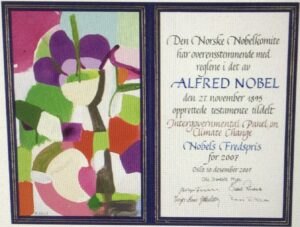
Nobel Peace Prize diploma (2007) given to IPCC
One can study the pro-CIA influence, from the anointed Nobel Peace Prize laureates since 1950. It is simple. Please make three columns – (1) pro-CIA, (2) unclear, and (3) anti-CIA. The number of names listed in the pro-CIA column is longer, than the number of names listed in the anti-CIA column. Here is the proof.
Pro-CIA column: Four Nobel Peace Prize laureates [Kissinger (1973), Carter (2002), Gore Jr (2007) and Obama (2009)] had direct links to CIA by virtue of their elected or selected executive positions. Then, count backwards from last year’s Nobel Peace Prize laureate (Maria Corina Machado), Nihon Hidankyo (2024), Narges Mohammadi (2023), Ales Bialiatski (2022), Maria Ressa and Dimitry Muratov (2021), Abiy Ahmed Ali (2019), Nadia Murad Basee Taha (2018), Malala Yousafzai (2014), EU (2012), Ellen Johnson Sirleaf, Leymah Gbowee and Tawakkol Karman (2011), Liu Xiaobo (2010), Shirin Ebadi (2003), Kim Dae Jung (2000), Shimon Peres and Yitzhak Rabin (1994), Fred de Klerk (1993), Aung San Suu Kyi (1991), Mikhail Gorbachev (1990), 14th Dalai Lama (1989), Lech Walesa (1983), Menachem Begin (1978), Andrei Sakharov (1975), Eisaku Sato (1974) and the list goes on.
Anti-CIA column: I could count only four individuals – Mandela (1993), Mother Teresa (1978), Martin Luther King Jr (1964) and Linus Pauling (1962).
Coda
As of now, Sri Lanka’s neighboring countries, India (Mother Teresa and Kailash Satyarthi), Pakistan (Malala Yousafzai), Bangladesh (Muhammad Yunus), Myanmar (Aung San Suu Kyi) and even Tibet region of China (14th Dalai Lama) already have Nobel Peace Prize laureates, but not Sri Lanka. When will it be, is anybody’s guess.
Cited Source
Sri Kantha S. CBK’s Nobel intentions? Hot Spring (London), Mar 2000, p. 13.
Appendix (Sachi’s score as a Nobel Prize historian)
I do recognize this is a case of blowing one’s own trumpet. But, I did accumulate 24 publications as a Nobel Prize historian; all except three, were sole authored. Among the three co-authored papers, two were with my research collaborators and one was with my ex-graduate student. Here is my score, for my critics.
Sri Kantha S. The discovery of Raman Effect and its impact in biological sciences. European Spectroscopy News, 1988; no. 80: 20-26.
Sri Kantha S. A review of Nobel prizes in medicine or physiology, 1901-1987. Keio Journal of Medicine (Japan), 1989; 38: 1-12.
Sri Kantha S. Avery’s non-recognition in Nobel awards. BioEssays, 1989; 10: 131.
Sri Kantha S. Raman’s prize. Nature, 1989; 340: 672.
Sri Kantha S. Women winners of Nobel Prize. Nature, 1990; 344: 582.
Sri Kantha S. The question of nepotism in the award of Nobel prizes; a critique of the view of Hans Krebs. Medical Hypotheses, 1991; 34: 28-32,
Sri Kantha S. A centennial review: the 1890 tetanus antitoxin paper of von Behring and Kitasato and the related developments. Keio Journal of Medicine (Japan), 1991; 40: 35-39.
Sri Kantha S. Productivity drive. Nature, 1992; 356: 738.
Sri Kantha S. The legacy of von Behring and Kitasato. Immunology Today, 1992; 13: 374.
Sri Kantha S. Clues to prolific productivity among prominent scientists. Medical Hypotheses, 1992; 39: 159-163.
Sri Kantha S. The blood revolution initiated by the famous foot-note of Karl Landsteiner’s 1900 paper. Ceylon Medical Journal, 1995; 40: 123-125.
Sri Kantha S. Is Karl Landsteiner, the Einstein of the biomedical sciences? Medical Hypotheses, 1995; 44: 254-256.
Sri Kantha S. One Nobel prize winner left out. Food Technology, 1995; 49(10): 57.
Sri Kantha S. Literature Nobel prize winners as palliative for scientific English. Croatian Medical Journal, 2003; 44(1): 20-23.
Sri Kantha S. Bertrand Russell (1872-1970): calibrating the scientific productivity of a polymath. Current Science (Bangalore), 2011; 100(2): 262-263.
Sri Kantha S. Why Wright Brothers failed to receive Nobel prize recognition? Current Science (Bangalore), 2012; 103(4): 435-437.
Sri Kantha S. Cartoon humour on Nobel Prizes. Current Science (Bangalore), 2013; 105(8): 1175-1177.
Sri Kantha S. A history of Karl Landsteiner’s stature in Nobel Prizes. Current Science (Bangalore), 2013; 105(12): 1754-1757.
Sri Kantha S and Suzuki J. Primatological studies by medicine Nobel laureates. Current Science (Bangalore), 2015; 109(4): 810-813.
Natsuki H and Sri Kantha S. Nobel prizes for research in plant science: Past, Present and Future. Reviews in Agricultural Science (Japan), 2017; 5: 83-99.
Sri Kantha S. Nobel prizes for medicine or physiology, 1988-2017; a retrospective. International Medical Journal (Tokyo), 2018; 25(6): 353-356.
Pai SA and Sri Kantha S. CIA, MoSSAD, NKGB and Surete in medical research – the RAW truth. National Medical Journal of India, 2019; 32(5): 311-312,
Sri Kantha S. Cancer research recognized (and ignored) by the Nobel prizes. Indian Journal of Cancer, 2020; 57(4): 376-377.
Sri Kantha S. Nobel awards and nominations for research activities linked to human sexuality. International Medical Journal (Tokyo), 2021; 28(2): 262-266.