Book review
Suppiah Ratneswaren and Malavarayan Vijayapalan (editors) – Satyagraha – The Freedom Movement of Tamils in Ceylon, 2nd ed., Agaram Publishers, Carshalton, UK, 2026, 546 pp. ISBN 978-1-3999-6676-4.
by Sachi Sri Kantha, June4, 2026
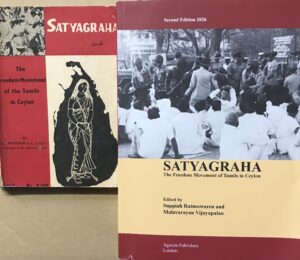
Satyagraha book by S. Ponniah (lt – 1st ed, 1963, rt – updated 2nd ed. 2026)
Among the books I have read in the past 60 years or so in Tamil and English, Jawaharlal Nehru’s The Discovery of India (1946) will be included in my top 10 list. As this year marks the 80th anniversary of its publication, first I cite an important fact Nehru had mentioned in this book.
“Unlike the Greeks, and unlike the Chinese and the Arabs, Indians in the past were not historians. This was very unfortunate and it has made it difficult for us now to fix dates or make up an accurate chronology. Events run into each other, overlap and produce an enormous confusion.”
The same applies to Ceylon history as well. An important book ‘Satyagraha and the Freedom Movement of the Tamils in Ceylon’, authored by attorney Sinnathamby Ponniah (1921-2004) that provided details about the 1961 Satyagraha campaign initiated by the Federal Party was published in 1963. This work had now been expanded and refined with additional primary materials and published recently in London by Agaram Publishers. This refined version had been ably edited by Dr. Suppiah Ratneswaren and late Mr Malavarayan Vijayapalan. Whereas Ponniah’s original version was only 198 pages, this refined version had expanded to 546 pages (please check the photo, nearby).
In 2011, to mark the 50th anniversary of the 1961 Satyagraha campaign of Federal Party, I had written about this Ponniah’s book in this site. For those interested, the link is,
[https://www.sangam.org/2011/03/Satyagraha_1961.php]. Thus, I refrain from repeating myself. At that time, I was clueless about the biographical details of attorney Ponniah. As such, the years of birth and death of Ponniah noted by me in 2011 were erroneous. The correct facts are, Ponniah was born in 1921 at Valveddithurai, and died in 2004, aged 82. Thanks to the time consuming detective work and tracking the progeny of Ponniah by Dr. Ratneswaren, quite much history behind the publication of this book in 1963 had been recovered. He let me know that even Ponniah’s progeny were unaware about the ‘existence’ of this book. Then, there was a side story of Dr. Baheerathan Amirthalingam (the second son of Federal Party leader A. Amirthalingam), confronting Dr Ratneswaren, by falsely claiming copyright status for this book! The only detail I know then about Ponniah was that, he was featured in a photo book of Amirthalingam (2002), published by the Amirthalingam Memorial Foundation. That one photo was captioned Law College Tamil Society 1950-51 (presented nearby). Ponniah was seated at left extreme. To his left was V. Dharmalingam (later, Federal Party MP for Uduvil from 1960). Amirthalingam was seated 3rd from left. Now I know that Amirthalingam (b. 1927) was 6 years junior to Ponniah.
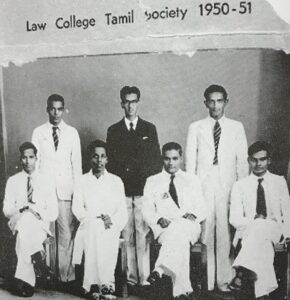
Seated from Lt to Rt – S. Ponnaiah, V. Dharmalingam, A. Amirthalingam (circa 1951)
Editors of this 2nd edition had retained the original text of Ponniah’s 24 chapters and photos, while supplementing it with numerous archival photos of lead politicians of 1950s and 1960s. I salute the editors for the labor they endured in negotiating with the copyright holders of the vintage photos to include these in this book. Thus, first 270 pages of the current version is accounted for. Then, this 2nd edition begins with a post script contributed by Dr Ameer Ali, in 2023. The plus point of this compilation is that Ponniah’s original text is enhanced by 36 Annexures, that totals cumulatively 219 pages, plus supporting ‘Notes’ for the 24 chapters of Ponniah’s 1963 version. An index, as well as a two page biographical synopsis of Ponniah completes the refined version.
36+ Annexures included in the book is listed below for a reason. Among the Sri Lankan history books I have read (recording the events of a narrow span, from 1926 to 1961), this sort of documentation assembled from varied public/private sources is rare. Among these 36+ Annexures, I would consider that young Solomon Bandaranaike’s 1926 speech in Jaffna (Annexure 36) and the two speeches by Senator Somasundaram Nadesan at the floor of the Senate, in May 1961 (Annexure 31) were historical relevant documents.
A1 – Synopsis of political events from the Introduction of Sinhala Only Act (1956) to Satyagraha (1961). Omissions in this synopsis include the natural death of Federal Party leader C. Vanniasingham and assassination of the Prime Minister Solomon Bandaranaike.
B1 – S. Ponniah’s letter of Sept 1, 1944, to Mr. Oliver Stanley Moore, the British Secretary of State for the Colonies.
B2 – Subramaniam Sivasubramaniam’s (Joint Secretary of All Ceylon Tamil Congress) letter of Jan 15, 1946, to Mr Clement Attlee, the British Prime Minister.
B3 – Prime Minister Sir John Kotelawala’s pledge for equal status of Sinhalese and Tamils, in 1954.
B4 – LSSP leader Dr Colvin R de Silva’s statement in the Parliament, during the Sinhala Only Bill debate during 1956.
B5 – Police Officer F.N.D. Jilla’s eye-witness account during the June 5, 1956 in Galle Face, Colombo.
B6 – Police Officer F.N.D. Jilla’s eye-witness account of the violence in Amparai, June 1956.
B7 – Prime Minister Solomon Bandaranaike’s speech during the debate on Official Languages Bill, June 6, 1956.
B8 – A letter from Prime Minister Solomon Bandaranaike read by the Speaker of the Parliament Mr Ismail, to the House.
B9.1 – Ceylon Daily News report of Apr 17, 1958 providing Prime Minister Solomon Bandaranaike’s message to the Nation, in negating the agreement he had with the Federal Party.
B9.2 – Ceylon Daily News report of Apr 17, 1958 on the Abrogation of Bandaranaike-Chelvanayakam Pact.
B10 – Excerpts from Tarzie Vittachi’s ‘Emergency ’58 – The Story of Ceylon Race Riot’ book, on the abrogation of Bandaranaike-Chelvanayakam Pact.
B11 – S.M. Rasamanickam MP’s Presidential address at the 7th National Convention of the Federal Party, Jan 21, 1961.
B12 – Times of Ceylon report Jan 23, 1961 on the Resolutions adopted by the Federal Party on Jan 22, 1961 in Jaffna.
B13.1 – Times of Ceylon report Feb 22, 1961 on police violence to the Satyagrahi volunteers.
B13.2 – Times of Ceylon report Dec 3, 1961 on police violence.
B14 – Kattumuluwa Jinaratne Thero’s statement to the press, following his visit with the Satyagrahi volunteers, in Times of Ceylon, Mar 1, 1961.
B15 – Excerpts from the memoirs of Neville Jayaweera (2014), on the events of 1961 in Jaffna, and the contribution of Mr. Neil Quintus Dias, the then Permanent Secretary of Defence, who held a Rasputin-like influence on Mrs Sirima Bandaranaike, the then Prime Minister.
B16 – Script of Mrs Sirima Bandaranaike’s radio broadcast, published in Ceylon Observer, Mar 4 1961.
B17 – The Hindu (Madras) editorial entitled ‘Crisis in Ceylon’, Mar 5, 1961.
B18 – Joint letter from 5 University of Peradeniya academics (all Sinhalese), Ceylon Daily News, Mar 18, 1961.
B19 – The Straits Times (Singapore) news report Mar 6, 1961, captioned ‘Black flags for Ceylon Premier’, when she arrived in London to attend the Commonwealth Prime Ministers Conference.
B20 – The Hindu (Madras) editorial entitled ‘Whither Ceylon’, Mar 18, 1961.
B21 – The Guardian (London) editorial entitled ‘Language in Ceylon’, Mar 22, 1961.
B22 – Prime Minister Sirima Bandaranaike’s speech script, after his return to the island from London. The Ceylon Observer, Mar 25, 1961.
B23 – The Glasgow Herald editorial entitled ‘An island divided’, Apr 3, 1961.
B24 – The Times (London) editorial entitled ‘Struggling for words’, Apr 1, 1961.
B25 – The Hindu (Madras) editorial entitled ‘Ceylon Tamils’ demands’, Mar 31, 1961.
B26 – Names of Tamil and Muslim individuals arrested and detained at the Homagama Army camp, and districts from Jaffna, Vavuniya, Mannar, Trincomalee and Batticaloa, between Apr 18 and Jul 2, 1961.
B27 – Speaker R.S. Pelpola reporting a statement from Prime Minister Sirima Bandaranaike at the Parliament, on Apr 20, 1961.
B28 – a record in Annual Register of World Events 1961 (Longman, 1962) with a caption ‘The language issue, arrests and banning of the Federal Party’.
B29 – Timeline of Arrests and Detentions, from 1956 to 1961.
B30 – The Daily Telegraph (London) editorial entitled ‘Damocles in Ceylon’, Oct 27, 1961.
B31.1 – Senator S. Nadesan QC speech on the state of emergency. Senate House of Ceylon Parliament, May 2, 1961.
B31.2 – Senator S. Nadesan QC speech on the state of emergency. Senate House of Ceylon Parliament, May 9, 1961.
B32- Communique from Felix R Dias Bandaranaike, Permanent Scretary of Defence about strike by estate workers. The Ceylon Times, Apr 25, 1961.
B33 – Peter Robins report entitled ‘Terror in the Petticoat Kingdom’, Daily Mail (London), May 3, 1961.
B34 – a Nov.1938 letter from Mr. Leonard Woolf (1880-1969), on the demands for reform of Ceylon Constitution, for Labour Party Advisory Committee on Imperial Questions. (Leonard Woolf had served as the British administrator of Colonial Ceylon in the first two decades of the 20th century.)
B35 – Swarajya (Chennai) editorial entitled ‘The Ceylon struggle’, Apr 29, 1961.
B36 – Jaffna correspondent – Solomon Bandaranaike’s speech in Jaffna, on a federal system for Ceylon. Ceylon Morning Leader, Jul 17, 1926.
Among the Tamils and Muslims included in Annexure 26, a Keralite (K.V. Krishnakuddi, a Communist Party activist) who had settled in Batticaloa was also included. Subsequently, he was released on mistaken identity. Factual slips in Annexure B29 deserve note. Federal Party’s front rank members Dr E.M.V. Naganathan and V. Navaratnam were not MPs on June 4, 1958. Both were elected to the parliament subsequently in 1960 general election and in 1962 by-election respectively. A factual addition is also needed here. 14 Tamil MPs were arrested and held in military detention during the 1961 protest. But, two were held under house arrest; S.J.V. Chelvanayagam, the leader of the Federal Party (probably due to his health condition) and M.C. Ahamed, the MP for Kalmunai, who was elected on Federal Party ticket in the July 1960 election. But, he quit the party and joined SLFP on July 13, 1961.
Professors Jayadeva Uyangoda and Sivasubramaniam Pathmanathan had contributed the foreword and introduction respectively for this 2nd edition. Prof Uyangoda had observed in his foreword, “As the account of the Satyagraha in this book clearly shows, the protest action was not confined to Tamils alone. Muslim and Sinhalese citizens in the Northern and Eastern Provinces joined and supported it…The government managed to break up the Satyagraha after three months by arresting and placing in military detention all the political leaders who were elected members of parliament. After breaking up the Satyagraha by using the coercive power of the state, the SLFP government triumphantly went ahead with the implementation of the Official Languages Act in the Tamil majority provinces, with no concession granted to the aggrieved Tamil citizens.”
Prof. Pathmanathan’s lengthy foreword (of 16 pages) provides a synopsis of what happened between 1961 and 2005, describing the political transformation of Federal Party’s non-violent protest to violent agitation by the Liberation Tigers of Tamil Eelam (LTTE). He attributed three major issues which had a ‘catalytic effect in worsening ethnic relations’. These were,
- Language medium-based standardization in admissions to universities
- Forcible eviction of workers in many plantations during the process of nationalization of estates, and
- Discriminatory provisions in the 1972 Constitution that transformed a majoritarian democracy into an ethnocracy.
Compilation of a good index for a non-fiction book is a laborious task. That this book has a good index deserves recognition. However, I noted quite a number of names which were in the text, had been inadvertently missed in the index. The activities of few Buddhist priests and unnatural deaths of Tamil commoners during 1957-58 deserve notice for posterity. In alphabetical order,
Arumairatnam – stabbed to death by rioters at Dehiwala, during May 1958 riots.
Baddegama Wimalawansa Mahanayake thero – who opposed the Bandaranaike-Chelvanayakam Pact of 1958.
Francis Anthony – who was shot and killed by police during an agitation on Mar 30, 1958.
Iyavoo Muthu – who was shot and killed by police during an agitation on Mar 30, 1958.
Kattumuluwa Jinaratne thero – who pleaded for status equality of Tamil speaking population.
Mirisse Chandrajothi thero – who opposed the Bandaranaike-Chelvanayakam Pact of 1958.
Nadarajan – from Trincomalee, who was shot and killed by police on Feb 4, 1957.
Sundararaja kurukkal P – Hindu priest of Panadura Kandasamy temple, killed by mob on May 26, 1958.
Thambyah Sam – clubbed to death by rioters at Ratmalana, during 1958 riots.
Viswalingam – crushed to death by hooligans at Kalutara, during May 1958 riots.
This book has multiple merits. I list only three of them. First, it provides some forgotten details about the activities of first generation of Federal Party leaders, other than Chelvanayagam (1898-1977) and Amirthalingam (1927-1989). Names of V.A. Kandiah (1891-1963), V.A. Alegacone (1903-1973), N.R. Rajavarothiam (1908-1963), V. Navaratnam (1910-2006), C. Vanniasingham (1911-1959) and S.M. Rasamanickam (1913-1974), have been obliterated with passage of time. Secondly, standard references such as Prof. K.M. de Silva’s ‘A History of Sri Lanka’ (1981), also by-pass the 1961 Satyagraha campaign of indigenous Tamils casually with only one sentence. This sentence was, “Once more there was the familiar pattern of a civil disobedience campaign in the north and east of the island in March-April 1961, the government responding with the imposition of a state of emergency in the Northern and Eastern provinces.” This sentence completely hides the atrocities committed by the Ceylon army to the commoners. Thirdly, inclusion of two speeches of Senator S. Nadesan (1904-1986) in the then Senate of Ceylon as Annexure B31 counters the nasty propaganda presented by the Sri Lankan army’s website, in its history section (please check this link https://alt.army.lk/slavf/history, accessed June 5, 2026). What is significant is that Senator Nadesan had used the ‘terrorism’ word specifically to the atrocities of the Ceylon army. This was 65 years ago, even before the JVP insurrection of 1971. And, Nadesan was not affiliated to the Federal Party.
Dr Ratneswaren was indeed a dedicated contributor to the welfare of Eelam Tamils, even after he settled in UK decades ago. I do know his dedication to serve the Tamil ethnics, because he was a senior to me during the University of Colombo days in the first half of 1970s. He held the position of the President of Colombo Campus Tamil Society prior to me, during 1973-74.
Despite a few careless blemishes, this refined compilation of Mr Ponniah’s classic work will remain as an authentic source of Eelam Tamil history during 1950s and the first half of 1960s. I’ll give a ‘double thumps up’ for this reference book on Eelam Tamils.
The book is available for purchase at Amazon.com vendor. The link is,
[https://www.amazon.co.uk/Satyagraha-Freedom-Movement-Tamils-Ceylon/dp/1399966766]
*****