by Sam Darymple on X @SamDalrymple123, November 17, 2026
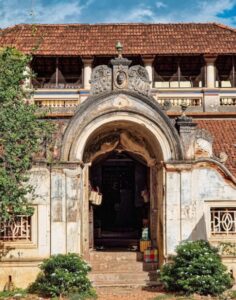 Tucked away in a small corner of Tamil Nadu lies one of the greatest clusters of palatial mansions in all of India. The Chettinad region is the heartland of the Nattukottai Chettiars, one of the most influential mercantile communities in South and Southeast Asia. Today, their grand homes have been transformed into one of Tamil Nadu’s biggest tourist attractions.
For a hundred years, the Tamil Chettiar community were the single most important financiers in the whole of South East Asia, essentially setting the foundations of microfinance in the region
As their wealth grew, mansions began to spring up across the Chettinad countryside, set around vast columns of Burmese teak. Each pillar had to be individually shipped from Rangoon to Madras.
The expansion of the Malayan rice trade and the growth of Singapore’s middle class are both directly linked to the activities of the Chettiars. Indeed, Chettiar influence is one of the reasons that Tamil is one of the national languages of Singapore today! By 1920, Chettiar loans underwrote 80% of Burma’s agrarian and trading economy.
The Chettiar financial system was built around a simple concept: if you fail to repay your loans, we seize your property. But in the 1920s, crisis struck. The Great Depression meant that millions of people defaulted on their debts at once. Between 1931-8, this tiny community of Tamils suddenly found themselves in possession of a quarter of all Burmese land.
This incited a massive backlash in Burma. Over the next 30 years, pogroms gradually forced the Chettiars – and other indians – out of the country. The exodus from Burma was the largest refugee crisis India had ever seen until the partition. “Chetti” and “Kala” became slurs in Burma, and it is tragically telling that today, the Burmese government still uses it to denigrate the Rohingya minority.
By the end of WW2, many Chettiars had become bankrupt. Hundreds of Chettinad mansions were thus pulled down, their parts sold off to antique markets.
Recently, however, there hbeen a move to convert them into hotels. Slowly its reviving the memory of one of Indias most important and forgotten communities.
Recent Substack by Darymple on Sufis of Chettinad.
More on Chettiars: Nagarathar Chettiar: Social Group of Tamil Nadu – Notebook of Rick Rejeleene

Bankers of the East
How a Tamil business community dominated 19th-century South-East Asian commerce before colonialism and World Wars cemented its decline.
by Amol Agrawal, Frontline, Chennai, Aug 05, 2025

A portrait of Chettiars in their traditional attire of veshti and thundu in the 1920s. | Photo Credit: Wikimedia Commons
Penguin India’s multi-volume series on “The Stories of Indian Business” has covered a wide range of topics in history, from the ancient wisdom of Arthashastra to the strategies of the East India Company, from commercial law in medieval India to managing agency, from the railways to the monsoon economy. This series, which has previously featured four of India’s business communities—Marwaris, Kachchis, Khatris, and Sindhis—now adds a fifth: the Nattukottai Chettiars. In his foreword to Raman Mahadevan’s Fortune Seekers: A Business History of Nattukottai Chettiars, Gurcharan Das summarises the key business practice of all these business communities: buy low and sell high.
It is only from the 19th century onwards that the Chettiar community finds mention in official records as major purveyors of credit in South and South-East Asia. In 1896, the population of Chettiars was recorded at 10,000. The history of Chettiars (also called Chettys) is a fascinating tale of how a business community rose from humble origins to capture the heights across South Asia, only to decline thereafter. Historical records suggest that up to 2897 BCE, the Chettiars were inhabitants of Santhiyapuri in Naganadu, a region north of Kancheepuram in Tamil Nadu.
Fortune Seekers A Business History of Nattukottai Chettiars Raman Mahadevan Penguin Business Pages: xxv+235 Price: Rs 599
Owing to high taxes, the community migrated in 789 BCE to Kaveripoompattinam (present-day Poompuhar), a coastal town with a flourishing seaport, from where they learnt trading. After living there for nearly 15 centuries, they migrated again (owing to persecution by Chola kings), this time to the Chettinadu region.
Chettiars earned their fame by excelling in banking in the South Asian region. How did they get into banking? After colonisation, the British made changes in the land revenue system. They first started the zamindari system and then introduced the ryotwari system in the south. Under the zamindari system, the appointed zamindar had to pay land revenue in time to the British authorities.
Due to the high assessment of the land revenue, the zamindars were constantly under financial pressure and often resorted to borrowing from creditors. The Chettiars saw an opportunity and decided to enter the field of moneylending and banking. In order to borrow money from the Chettiars, the zamindars often leased them land. The Chettiars ended up acquiring large tracts of land when the zamindars could not repay these loans.
The Chettiar community opened bank branches via their joint family network, or valavu. Unlike the north Indian joint family system where members lived under a common roof and shared a kitchen, the valavus had their own designated quarters and kitchen. The valavu families also ran their own expenses and accounts, fostering a spirit of enterprise. The businesses were run by the proprietor of the firm known as mudalali, who appointed agents, or melals, who spread to different parts of South Asia and South-East Asia and set up branches. The agent was recruited from the Chettiar community and trained in banking practices. Often, younger family members were sent to these branches for training and exposure.
Wealthier Chettiars, or adathis, operated banking on a much larger scale and played a crucial role in the provision of capital. The Chettiar bankers also fixed the current, or nadappu, rate of interest in secrecy after factoring in the demand and supply of credit. The reference interest rate was used for all the transactions for the month. The process for fixing nadappu is quite similar to today’s benchmark interest rates, except that the latter are made public.
Chettiar enterprise was not limited to Indian shores but spread its wings outside India. There were two major reasons for this. First, the other banking communities, such as Marwaris and Multanis, had entered southern markets. Second, the opening of the Suez Canal transformed the world of ocean commerce, leading to the opening of new commodity markets in South and South-East Asia. The Chettiars, who were already present in these regions due to trading, were perfectly placed to exploit these new opportunities with their banking network.
Chettiar enterprise was not limited to Indian shores but spread its wings outside India.
In Ceylon, the Chettiars acted as financiers of the trade commodities such as cotton, coffee, tea, and rubber. In Malaya, they financed tin and rubber. They even developed a new financial instrument called the Chetty Insurance and Mortgage Bond, which not only provided loans to shipowners, who were mostly Chinese, but also insured them against repayment if the ship sank. They also gained access to other areas from Malaya such as Sumatra Island, Hong Kong, and Siam. In Burma, the Chettiars financed rice and timber. Of the three regions, Burma was the biggest catch, and their investments in Burma outstripped the investment in other regions.
Despite these overseas operations, the Chettiars always maintained head offices in the Tamil region. They started two major banks in the region: Indian Bank in 1907 and Indian Overseas Bank (IOB) in 1937. In fact, IOB was started expressly to channelise funds from Chettiars’ overseas operations. Over time, the Chettiars ploughed their capital into industry as well, especially textiles, sugar, and rice mills. They got into industry mainly by acquiring units of industrialists who found themselves in financial trouble.
To represent the common interests and causes of the business community, Chettiars also established Chambers of Commerce in Madras and in their overseas offices. The elite Chettiars established a close rapport with the British and were conferred titles such as Sir and Bahadur, although there were frictions, too, with the authorities over the taxation structure.
The drying up of global opportunities
While the Great Depression in the late 1920s significantly affected the Chettiars, they could not recover from the ongoing resentments against them in overseas regions. The rise of nationalism after the First World War made Chettiars—who were portrayed as exploitative land-grabbers—an easy target. The peasants in foreign countries blamed the Chettiar moneylenders for their misfortunes. The Chettiars did not help their cause either as they kept to their own communities abroad and did not integrate with the locals or build hospitals and schools as they did in India.
These changing sentiments abroad brought Chettiars back to India albeit reluctantly. Fortune Seekers documents how some the Chettiar business groups continued to channelise capital into known sectors of banking and insurance. The new banks that were established during the period included Bank of Chettinad, M.Ct Bank, and Chettinad Pioneer Bank. Some of them also diversified into new sectors such as textiles, sugar, transport, and even film production and distribution.
The Second World War and its fallout created further crises for the Chettiars. The Japanese occupation of most of South-East Asia, including Burma, was a rude shock. The Japanese introduced their own currency, which was printed in large quantities and led to high inflation in the region. The Chettiars, who were hoping to make profits from war operations, had to make a sudden exit and ended up with huge losses. In 2007, a group of Chettiars, yet to come to terms with losses suffered in Burma, formed the Burma Investor Group to work with the Burmese government to identify issues related to their properties and investments in Burma, and to seek compensation for land and other assets.
The drying up of global opportunities meant the Chettiars had to move even more aggressively in India. They tried to repatriate capital to India but faced tax discrimination by the colonial government. Post-Independence, the Indian business environment changed significantly with a new government and the adoption of central planning. Unlike the Indian business community that was present in India, the Chettiars struggled as they had had stronger business interests outside India.
Also Read | Roots of capital
That said, Fortune Seekers does profile a few large Chettiar business groups—such as those of Annamalai Chettiar, M.Ct, A.M.M. Chettiar (Murugappa Group)—that managed to repatriate capital well before the Japanese occupation. Not surprisingly, they also went on to grow and cement their place in Indian business history. There were also others, such as Karumuthu Thiagaraja Chettiar and A. Nagappa Chettiar, who had weaker business ties but still managed to establish major businesses.
The book laments that the subsequent generation of Chettiars did not really catch up with their counterparts in other business communities. The younger generation opted out of banking and business and chose to take up white-collar professions. Many of them studied at educational institutions established by Chettiar families, such as Annamalai University, Chidambaram, and Thiagarajar College, Madurai; they work in the IT and financial sector and are based in the UK, the US, and Singapore. While conferences have been held to rekindle interest in entrepreneurship among the younger generation, it remains to be seen whether the business zeal can be revived. The book ends on a poignant note, with its observation that the common man today associates Chettiars with their cuisine and not their entrepreneurial ventures.
Overall, Fortune Seekers is an excellent primer on the history of the Chettiar community and their businesses. Mahadevan has taken considerable pains to stitch together various pieces of historical evidence using the limited evidence at his disposal to help us understand this saga of the rise and fall of a business community.
Amol Agarwal is the author of History of Private Banking in South Canara District (1906-69).