Drawing parallels
by Balan Kugabalan, May 13, 2026
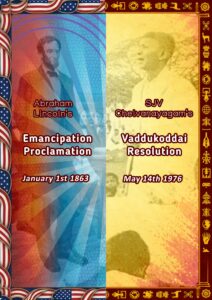 On January 1, 1863, President Abraham Lincoln signed Presidential Proclamation 95, later known as the “Emancipation Proclamation,” freeing 3.5 million enslaved African Americans in the Confederate States. More than a century later, on May 14, 1976, in Sri Lanka, S. J. V. Chelvanayagam led the adoption of the Vaddukoddai Resolution, a historic political declaration calling for the liberation and self-determination of 13.5 million oppressed Tamils in Sri Lanka.
Though born in vastly different historical and geopolitical contexts, both the Emancipation Proclamation and the Vaddukoddai Resolution were grounded in a universal principle: that all human beings are created equal and entitled to dignity, equality, freedom, and justice regardless of race, religion, or ethnic identity.
Both measures faced significant legal, political, and practical obstacles. Lincoln and the Emancipation Proclamation confronted constitutional uncertainty and fierce opposition during the American Civil War. The Vaddukoddai Resolution emerged in the aftermath of the 1972 Constitution of Sri Lanka, which reinforced the unitary character of the state and deepened Tamil concerns regarding political autonomy, representation, equality, and security.
The international response to the two struggles differed sharply. The Emancipation Proclamation strengthened the moral position of the United States and discouraged European powers from openly supporting the Confederacy due to widespread opposition to slavery. In contrast, the calls from the Tamil minority for freedom, equality, and self-determination received limited international attention despite decades of discrimination, violence, and political marginalization in Sri Lanka.
Both the Proclamation and the Resolution faced determined resistance from the governing powers they challenged. Yet both were embraced by the communities whose aspirations they represented: enslaved African Americans in the United States and the Tamil people in Sri Lanka seeking freedom, dignity, and political recognition.
History, however, took two very different paths.
President Lincoln was assassinated only two years after signing the Emancipation Proclamation. S.J.V. Chelvanayagam passed away just one year after the adoption of the Vaddukoddai Resolution. In the aftermath of their passing, the trajectories of the two movements diverged profoundly.
The United States, founded upon ideals of liberty and equality, moved—despite setbacks and a long struggle toward civil rights—toward the abolition of slavery through the ratification of the 13th Amendment in 1865, formally ending slavery throughout the nation. In Sri Lanka, however, Tamil political aspirations encountered increasing suppression and hostility. The Sixth Amendment to the Constitution, enacted in 1983, effectively criminalized advocacy for a separate Tamil state, only seven years after the Vaddukoddai Resolution was passed.
The decades that followed witnessed civil war, widespread displacement, disappearances, and immense suffering among the Tamil people. In the final stages of the armed conflict in 2009, an estimated 140,000 Tamil men, women, and children had lost their lives within a short period of time amid unrestrained military operations carried out by the Sri Lankan Armed Forces.
Thus, the parallels became contrasts: two minorities, in two different parts of the world, experiencing profoundly different historical outcomes. While African Americans in the United States continued a long—though unfinished—journey toward greater civil rights, representation, and opportunity, the Tamil people endured decades of violence, insecurity, and unresolved political grievances.
As the Tamil diaspora across the globe, together with Tamils in Sri Lanka, commemorates the 50th anniversary of the Vaddukoddai Resolution, we recall the words of President Lincoln from the Gettysburg Address in honouring the courage, aspirations, and sacrifices of those who shaped that historic moment in Pannakam, Sri Lanka:
“The world will little note, nor long remember what we say here, but it can never forget what they did here.”
About the author: Balan Kugapalan is President @theUSTAG (US Tamil Political Action Group)