by Sachi Sri Kantha, May 3, 2026
A Trend setter
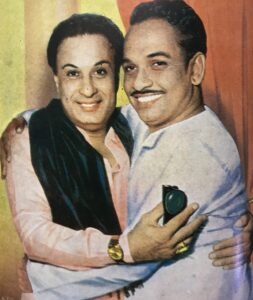
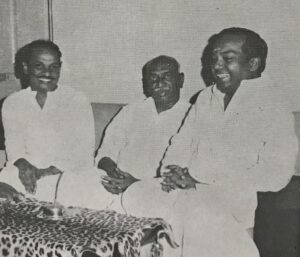
MGR with Rajadurai (1965). MGR is holding his glasses in right hand
In comparison to his Federal Party colleagues of 1960s (excluding Pundit K.P. Ratnam), Rajadurai was blessed with Tamil literary mind. Majority of his Federal Party colleagues were advocates and lawyers, with E.M.V. Naganathan being the solitary medical doctor. Even those who began their career as school grade teacher (like K. Thurairatnam, ex-MP for Point Pedro) subsequently chose the path of becoming an attorney. But being politicians, all had to capture voters with their Tamil oratory. None could top Rajadurai. I should add, his rivals in north were A. Amirthalingam and M. Sivasithamparam. But, there is a subtle difference. The oratory of Amirthalingam and M. Sivathamparam were of ‘home-grown’ grade, and they were also equally adept in English oratory due to their legal skills. Rajadurai’s oratory was attuned to the DMK school of Anna, Nedunchezhiyan, Karunanidhi and Kannadasan with references extolling the ancient Tamil culture, plus local flavor of Eastern Tamil. This was the success for Rajadurai’s political career. And I think, Chelvanayakam – the leader of Federal Party was also aware of this unique blessing Rajadurai possessed.
Rajadurai actively cultivated Tamilnadu (DMK) links, even before he became a parliamentarian. He had invited Nedunchezhiyan and Kannadasan to Ceylon in 1953 and 1955 sequentially. None of the Federal Party activists from the Northern Province, (barring Pundit K.P. Ratnam, who was primarily involved in Tamil language circles) trained their eyes towards this angle. This maybe because the senior founder leaders of the Federal Party (S.J.V. Chelvanayakam, Dr. E.M.V. Naganathan, V.A. Kandiah) were based in Colombo. Even, young A. Amirthalingam was a law student in Colombo. I’d tend to infer that Rajadurai was a step ahead of Amirthalingam in cultivating Tamil Nadu politicians in the second half of 1950s and 1960s. And when DMK captured the power in 1967, this would serve better for Rajadurai’s overt and covert contacts. He had the foresight to cultivate MGR and invite him to Ceylon in 1965.
Even among Tamil Nadu political scientists/journalists, an angle which had been ignored until now, was the personal friendship Rajadurai had with MGR. After being pushed out from Federal Party in 1979, Rajadurai became a Cabinet minister in J.R. Jayewardene government. It is my conjecture that MGR’s decisions on Eelam Tamil issue during 1983-1987 period, can be understood to an extent, if we consider a fact that he had Rajadurai (as ‘a sort of silent spy-consultant’) within Jayewardene’s Cabinet. Its understandable that more than one Sinhalese Cabinet ministers were rather suspicious about this link. Please check Part 1 of this series. The link is [https://sangam.org/chelliah-rajadurai-the-rajah-of-batticaloa-part-1/]
Also, it is a fact that prior to Rajadurai becoming a ‘parliamentary pal’ of Jayewardene in 1960, after he had become friendly with MGR (see below). During the 1956 general election, J.R. Jayewardene was out of parliament, suffering defeat in his Kelaniya constituency.
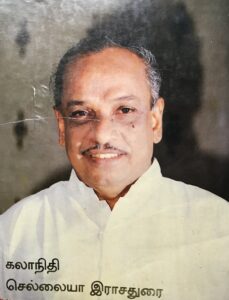
Rajadurai Felicitation Volume, 1998
Rajadurai Felicitation Volume (1998?)
In my quest for Rajadurai papers, through the courtesy of my Batticaloa school mate Siva, I received a handful of items 22 years ago. I consider Rajadurai felicitation volume of 262 pages (published with much delay in late 1990s – probably 1998), an important document. It should be noted that, this was released when Rajadurai had completed his active political career and was around 71. Also, as he had quit Federal Party/TULF in 1979, and joined UNP. Among the 79 photos in which Rajadurai had posed with politicians, and religious dignitaries in Sri Lanka, India, and other south Asian and southeast Asian countries, as well as folks in Tamil Nadu journalism and movies, not a single photo about his association with fellow Federal Party members is represented. There is not even a photo with his Federal Party mentors S.J.V. Chelvanayakam and C. Vanniasingham, or even his party colleagues from the Eastern province. I provide nearby 4 photos of Rajadurai, which appear in this felicitation volume – probably all were taken in 1960s. I’m certain the one with MGR was taken in 1965, when he visited Ceylon. Others with Anna, Karunanidhi and Kamaraj with Kannadasan were taken in Tamil Nadu, because they never visited Ceylon in 1960s.
One contribution by K. Jeyapandian (editor of ‘Thina Ithal’) in the felicitation volume attracted my attention. It was vaguely titled ‘The Love of Father’, and tells the story of how Rajadurai came to meet M.G. Ramachandran (MGR), the movie star. Exact date of this meeting was not specifically mentioned in the article. Excerpts translated below:
“After being elected as a MP, for the first time Rajadurai visited Chennai. It was the first time, I got introduced. Then, I was working as the cinema section editor of Malai Murasu daily. He asked me, whether I can arrange a meeting with MGR for him. I thought, if these two meet, I can get some story, and responded ‘I’ll arrange immediately’. Very next day, Rajadurai met MGR in the morning and had meals together. At the end, he invited MGR to visit Ceylon. Until then, MGR had not visited any foreign country. I thought I could make this a big story. But, MGR had firmly rejected my thoughts. He said, ‘Thamby, I treat you as my sibling and like you. Suppose if you are a journalist, I wouldn’t have allowed you to bring Mr. Rajadurai here. [When time comes], I’ll give the news. Please wait until then.
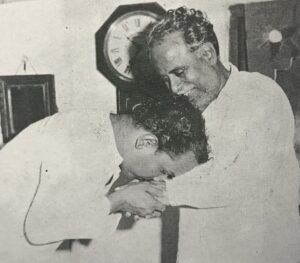
Rajadurai with C.N. Annadurai (circa 1960s)
After one year, Rajadurai visited again and we met MGR at Ramawaram garden house. Then, the Ceylon visit was confirmed. First, MGR received permission from [his mentor] Anna, and following that MGR released the news. With MGR, his heroine of those days Saroja Devi and her mother went to Ceylon.
After that the relationship between Mr Rajadurai and MGR blossomed to an extent of regular telephoning family friends…”
I do note some discrepancy in the dates mentioned by Jayapandian. MGR and Sarojadevi did visit Ceylon, only in Oct 1965. But, Rajadurai was first elected as MP in 1956. Such a long delay may be explained: after the original meeting between MGR and Rajadurai in late 1950s, MGR would have been busy with his cinema – political activities, in addition to personal debacles (leg injury in 1959, death of second wife in 1962 and inner party conflicts of resigning the Member of Legislative Council position). It’s not reasonable to assume a 7-8 years delay in accepting Rajadurai’s invitation. In addition, visa problems enforced by the Sirimavo Bandaranaike government, for prominent DMK activists, between 1960 and 1964, was a reality too. During that period, I do remember, Karunanidhi was black marked, due to his agitation politics then. Second tier DMK leaders like C.P. Chittarasu were allowed, as well as then aging and ‘toothless firebrand’ M.P. Sivagnanam (Ma Po Si), the leader of Thamil Arasu Party. But front rank DMK leaders were not given visa. DMK party’s then front ranking actors MGR and S.S. Rajendran (SSR), popular playback singer and music director Chidambaram S. Jayaraman (brother in law of Karunanidhi), and the then DMK student leader R. Janarthanam were given visa, only during UNP regime after March 1965. This was enabled because Federal Party was a constituent member of the ‘National Government’ of Dudley Senanayake until Nov 1968.
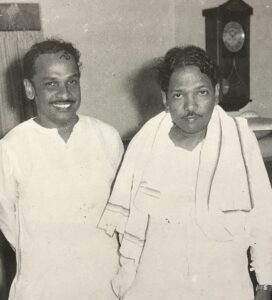
Rajadurai with M. Karunanidhi (circa 1960s)
To compensate for the lack of photos about the Federal Party activities in the Felicitation volume, quite a few written contributions do extol Rajadurai’s career in promoting the Federal Party during 1950s. Few of these deserve highlight here, for the reason that historical details on Rajadurai’s sacrifice and contributions to the Party and Tamil culture should not be forgotten. In fact, the Silver Jubilee souvenir of the Federal Party (1974) does contain one short contribution by Rajadurai, but quite many details have been omitted there, by design or accident. Furthermore, a short biography on Chelvanayagam in English (1994) authored by his son in law Prof. Jeyaratnam Wilson, fail to mention the name of Rajadurai even once in the text and index, though two Federal Party MPs from the East, N.R. Rajavarothiam (1908-1963) and S.M. Rasamanickam (1913-1974) are included! This as a lapse in Prof Wilson’s scholarship because Rajadurai had served as Federal Party/TULF MP consecutively for 23 years (six wins), in comparison to and Rajavarothiam’s 11 years (four wins) and Rasamanickam’s 10 years (3 wins).
As I had noted in part 2 (via Es.Po’s criticism), with the rise of Rajadurai’s fame, influence and subsequently ‘Amirthalingam wave’ of mid and late 1970s, he had been pummeled from many quarters, especially upstart Tamil politicians of next generation, like M.K. Shivajilingam (b. 1957, currently, Chairman of Valvettiturai Urban Council). A related link is here [https://www.tamilnet.com/art.html?artid=35120&catid=13]
But, truth has multiple montages. I provide excerpts from three articles here. I had mentioned that, Rajadurai’s nomination for Federal Party ticket in 1956 would have happened due to the then senior leader C. Vanniasingham’s recommendation. One article in this felicitation volume, contributed by K.M. Sha (a Muslim), attest to my guess. Translation of two paragraphs from this article is given below:
“In late 1949, Mr. Chelvanayakam, Mr. Vanniasingham and Dr. Naganathan visited Batticaloa. There weren’t anyone to receive them. On behalf of Batticaloa folks, only three youth in addition to ‘Rasu’ met them. With those, they went to meet the city’s ‘big names’. Nothing of benefit resulted. Then, they went to Kalmunai. There also, they met similar treatment. Then, ‘Rasu’ got involved for party activity. Youths surrounded him. They held small meetings, in each region, published pamphlets. He wrote party promoting reports in ‘Sutantiran’. Due to this, he was asked to join as the sub-editor. He moved to Colombo. Nevertheless, party activity continued here (at Batticaloa) as well. After one and a half years later, he returned to Batticaloa, and became active in party building. During these days, he brought folks like ‘Arapor’ Ariyanayagam, Aaraiyur Amaran, Kasi Ananthan, Kala Manickam to the stages and made them propaganda speakers. Party grew from Thambiluvil in the south to Vahari in the north. There wouldn’t be Federal Party, if Rajadurai was absent or vice versa. He promoted arts, literature and politics simultaneously.
During the 1956 election, the party leaders wanted a suitable candidate for Batticaloa. Rasu and party activists approached a ‘big name’. But, it was unsuccessful. Then, the leaders was invited here. Even the attempt of the leaders failed. No one came forward to contest the election under Federal Party flag. Then, Mr. Vanniasingham told Rasu and the party activists, ‘You choose someone who is interested and send me the name. We will follow up.’ At that time, one of the party activist raised a voice, ‘Why not we nominate Annan Rajadurai?’ Instantly, there was approval from the gathered audience, with encouragement ‘Long live Annan; Long live Rajadurai annan’. Leaders were happy. Mr. Vanniasingham retorted, ‘Why we are wandering places for ghee while holding butter in the hand?’ Then, the unanimous decision to nominate [him] was made.”
Rajadurai with K. Kamaraj (center) and poet Kannadasan (rt)
Poet Kannadasan’s visit to Batticaloa in 1955
About poet Kannadasan’s 1955 visit to Batticaloa, there appears a contribution from artist Kumar, in the Felicitation volume. It was entitled, ‘Who is this Rajadurai?’ Excerpts from this second article are given below:
“To participate in the Batticaloa Muthamizh Manram festival, poet Kannadasan visited Ceylon in 1955.Mr. Rajadurai received him at the Jaffna Palaly airport and brought him to Batticaloa. Rajadurai’s wish was for Kannadasan to stay at his house. It was 5 pm, when they reached Batticaloa. The message Kannadasan had arrived spread and there assembled many literary fans. All were served with short eats and tea. Kannadasan had requested Rajadurai to reserve a hotel for him to stay. Rajadurai responded, ‘We don’t have good hotels nearby. For today, please stay here, and tomorrow I’ll arrange for a better location.’ Kannadasan was allowed to stay in a room of Rajadurai’s house, filled with many shelves of books. After entering the room, Kannadasan had told ‘I’ll better stay here (for all days).’ Will you think about Rajadurai’s book collections in 1955, for a while? After returning to India, Kannadasan had written about this episode in his ‘Thenral’ magazine.”
About Kannadadan’s visit to Batticaloa, and interactions with him, writer Es.Po also had passingly mentioned his 2003 autobiography. Relevant passages are translated below for record. Both Kannadasan and Es Po engaged themselves on the relevancy of poetic usage of words for alliteration – about potato, pumpkin and nelli (Indian gooseberry).
“I remember well, visiting Rajadurai’s house to invite Kannadasan for a meeting, with a pal-clerk Vadivel. Kannadasan was staying at Rajadurai’s house. During that time, he was editing ‘Thenral’ magazine. It had popularity among Batticaloa youths. A discussion between Kannadasan and me deserves recording here. It’s my habit to openly critic without fear at any time. This incident had been recorded in the Jan 1965 issue of Ilampirai magazine published in Colombo, as follows.
Es.Po: Those belonging to DMK use meaningless alliteration simply for sound effects. I believe that literature cannot be fertilized by this.
Kannadasan: Sir, that’s not so. Our Anna, Arignar Anna, had used alliterative Tamil effectively to produce elegant Tamil literature.
Es Po: For stage oratory, alliteration may be of help. But, in your Thenral magazine, you had used the phrase ‘ullankai urulaikizhangu’ (potato inside the palm). Conventionally we have a term ‘ankai nelli kani’ (nelli fruit inside the palm). You had used ‘u’ simply for alliteration. By this switch, will literature be endowed?
Kannadasan: You’ve misunderstood. In English they say hyperbole. Poets use it. Isn’t potato bigger than nelli? [Note by Sachi: nelli is Indian gooseberry, with dimensions equaling to grape]
Es. Po: If it’s so, why not use pumpkin? You could write, ‘pumpkin inside the palm’.
Kannadasan: Pumpkin is too big, and couldn’t be held inside the palm.
Es Po: May be, you haven’t seen big size potato what couldn’t fit inside the palm.
Kannadasan: Sir, this is ‘this size’ potato.
Es Po: Suppose you had written ‘this size’ potato inside the palm, there wouldn’t be an issue. Furthermore, there are other kizhangus (tubers) that fit Tamil tradition well.
While we were at it, C. Rajadurai watched time and hurried us. ‘Ponnu! It’s time for the meeting. He will be visiting your school tomorrow. Why not continue this discussion then?’ Then, he told Kannadasan, ‘Many will be waiting for us. Sir, let’s go to the meeting now.’
Then, accepting our invitation, Kannadasan came to the school and delivered a splendid one hour talk…
After many years, when Kannadasan had reached the zenith of his fame in the movie world, with my wife and friend Rahman I met him at Kavitha hotel… When informed that we will be returning [to Sri Lanka] within two days, he postponed his lyric composing activities, and enjoyed chatting with us in reminiscing his visit to Batticaloa. He also invited us for a meal the next day. After learning that we were staying at Kodampakkam, he sent us back, in his own car. I had strongly criticized his poetry in Eelam magazines. This, he was aware of. Nevertheless, his hospitality and treating a friendly rival in literature was exemplary. I was so attracted by his courtesy and human interaction. I wished to continue interacting with him. But, due to my travels and his death, my wishes were not fulfilled.”
Assassination attempts on Rajadurai
Events that followed after Rajadurai’s election as MP in 1956 receives mention in another feature (3rd article) contributed by R. Pathmanaban (considered as a ‘right arm’ of Rajadurai) to the Rajadurai Felicitation volume. He was in charge of Rajadurai’s office in Batticaloa, as the administrative sccretary. Excerpts follow:
“I worked at Ilanko printing (his office). In front of Ilanko press was Ajantha Photo, a sort of gathering joint for those interested in art activities. Dr. M.P. Kumar, Mr Balu Mahendra (currently a leading movie director), poet Kasi Ananthan, and recently deceased Mr. Eelathu Rathinam, all these folks were moulded as (Rajadurai) Anna’s siblings, in these two places – Ilanko Printing and Ajantha Studio.
Many were delighted to see Mr. Rajadurai’s growth as a leader. At the same time, it also induced jealousy among some. Rajadurai wrote a stage play of King Sankiliyan, the last king of Jaffna kingdom, [and acted as the hero]. I was involved as a director. When this play was staged at Batticaloa city council stage, a serious accident was averted. All the needed materials had been brought from Mr. Rajadurai’s house to the stage.In the final scene, King Sangiliyan had to be shot by the white guy. But the delivery of the gun was delayed. Before the gun was handed to the actor who played the role of white man, casually I took it and checked and I was shocked. When [we checked] at house, the gun was not loaded. But, when it was delivered [to us] at the stage, NG bullet had been loaded in the gun. Who was involved in this nasty job had remained a mystery until now. I kept silent then, and only after the play ended I brought the fact to participants. There were invitations to stage the play in other places like Colombo, Mannar, Trincomalee, and Kandy, but we folded the play due to this bullet incident.
Another reason was the May 1958 anti-Tamil riots and an attempt on the life of Rajadurai. After May, we had a comedy play called ‘Soodu sambalaachu Podiyare’ staged in many locations of Eastern province and at the Federal Party meetings. This one act play opened at Batticaloa pavilion on May 1st meeting of Federal Party. Folks were attracted to this play, because it mixed politics and humor. In some days, both the meetings and the play were staged in two villages. At the end, in two cars we (Mr. Rajadurai and Mr. R.W.V. Ariyanayagam) move to the house of Mr. P. Manickavasagar, later to be the MP for Kalkudah. While enjoying the tasty ginger-coffee prepared by Mrs Manickavasagar we converse in the front room. Mr Rajadurai would be relaxing in the easy chair inside. That particular day, we heard a loud sound in the back, around 11:00 pm, and there was dense smoke from a thrown bomb. Once the smoke had dispersed, we found that outside the window next to the easy chair, where Mr. Rajadurai usually rests, had a big hole. And the wall nearby was damaged. Beyond the wall, in the road, we found dynamite wicks and box of matches. Fortunately, on that day, Mr. Rajadurai had left for Colombo by train. The three suspects who had set the bomb were identified entering the Rajah theatre, half a mile distance from the house, and was handed to the Police at Eravur. We could clarify that the purported assassins had spied on the timing and place where Rajadurai would rest and had set the bomb to kill him. After this attempt on his life, the May 1958 riots began. Due to this, Mr. Rajadurai couldn’t attend the Federal Party convention held in Vavuniya at the end of the month.”
Coda
It is a fact that many talented Tamil youth from Eastern province were potential beneficiaries of Rajadurai’s links with Tamil Nadu personalities in 1950s and 1960s. These include, villu pattu (bow song) artist and story teller Master Sivalingam (1933-2022), poet Kasi Ananthan (b. 1938), famed cinematographer-director Balu Mahendra (1939-2014), Eelathu Rathinam (aka, Ratnasingham), artist Kumar, R. Pathmanaban, and Muzhakkam Murugappa.
Sources
Murugesan: Sollin Selvarum Unarchi Kavignarum, 20 page pamphlet, Batticaloa, not dated (certainly in 1977). (in Tamil)
Es Po: Varallatril Vaazhtal [Living through History], vol. 1, Mithra Arts Creations Pvt Ltd, Chennai, 2003, pp. 546-549. (in Tamil)
Rajadurai Felicitation Volume, Manimekalai Pirasuram, Chennai, not dated (probably 1998?), pp. 174-177, 193-198, 219-222.
A, Jeyaratnam Wilson: S.J.V. Chelvanayakam and the Crisis of Sri Lankan Tamil Nationalism, 1947-1977 – a political biography, Hurst & Co, London, 1994.
Thanks to Dr. Sachi for introducing this unique leader to me and his connection to Tamil Nadu politicians. As usual MGR stands out by fulfilling his promise given to Mr. Rajasdurai to visit Ceylon. Also, the friendship between writer Es. Po. and Poet Kannadasan is interesting in spite of literary rivalry. Kannadasan opting to stay in Rajasurai’s home after seeing his book collection tells a lot about intellectual nature of both of them.
Hi I just saw your reference to Malai Murasu and K. Jeyapandian (editor of ‘Thina Ithal). Where did you find these archives of Mr. k. jeyapandian?
K. Jeyapandian (editor of ‘Thina Ithal) Where did find the archives?
Answer to Ram:
Jeyapandian’s article about Rajadurai, appears in Rajadurai’s Feliciation Volume, that I had cited in the ‘Sources’. That’s the only information I have, about K. Jeyapandian.