Fifth International Tamil Research Conference, Madurai – Jan 1981
by Sachi Sri Kantha, July 24, 2026
Kannan’s comment
Comment about the contents of Part 87 from R. Kannan, fellow MGR biographer, was received on June 20. It was,
“Your latest chapter, as usual, meticulously documents the Fifth World Tamil conference and will serve as a useful record of the conference, its antecedents and the politics surrounding it. I was 18 then and had gone to attend it with my aunt and uncle. Some of the events from that time remain etched in my mind, such as a pattimandram chaired by Kundrakudi Adigal.
I heard that Indira Gandhi finally showed up after the [then Spiritual head of] Kanchi Mutt [Hindu monastic institution] intervened on MGR’s behalf. This is most likely true. If she hadn’t come, the conference would have sought the President of India’s presence. It was another attempt by MGR to mend ties which had been impaired by his Thanjavur [by-election] turnabout. Panruti Ramachandran [then one of MGR’s confidants, and Cabinet minister, still alive] told me how desperate MGR was to rebuild his relationship with Indira Gandhi and the lengths he went to in order to bring her back to his side.”
The words within parenthesis, were my additions for clarification. The then head of Kanchi Mutt referred to was the respected Hinduism scholar Chandrashekarendra Saraswathi VIII (1894-1994).
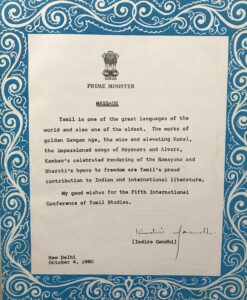
Indira Gandhi’s greeting to the 5th International Tamil Conference, dated Oct 4, 1980
Indira Gandhi’s greetings to the Conference
The Felicitation book celebrating the 5th International Tamil Conference carried a formulaic greeting message of Indira Gandhi in English, dated Oct 4, 1980, sent in the
PRIME MINISTER letter head. (an image is presented nearby). It consisted of only three sentences, as follows:
“Tamil is one of the great languages of the world and also one of the oldest. The works of golden Sangam Age, the wise and elevating Kural, the impassioned songs of Nayanars and Alvars, Kamban’s celebrated rendering of the Ramayana and Bharati’s hymns to freedom are Tamil’s proud contribution to Indian and international literature.
My good wishes for the Fifth International Conference.
signature of Indira Gandhi in English.
(Indira Gandhi)
New Delhi
October 4, 1980”
Though formulaic, the consent message offered by Indira Gandhi for the Conference received three months ahead of the commencement of the Conference was a green signal that she was leaning towards MGR, despite political protests and agitations against the Conference by MGR’s political rivals.
A commentary (with an euphemistic by-line ‘Southern Bureau’) on the relationship between Indira Gandhi and MGR appeared at the end of the Conference, in India Today monthly. Excerpts:
“Mrs. Gandhi’s acceptance of MGR’s invitation to participate in the World Tamil Conference in Madurai is an indication of the thaw in the ties between the two parties. Not only Mrs Gandhi but Chief Ministers Anjiah and Gundu Rao participated in the Conference much to the consternation of the DMK president, M. Karunanidhi, their political ally in Tamil Nadu. MGR went to the extent of withdrawing one of the 28 tableaux got ready for the procession during the Conference, depicting two kings Kanga and Vijayam, carrying a huge boulder from the North to Tamil Nadu as a punishment for insulting a Tamil poet when he visited them, lest it hurt Hindi sensibilities. Mrs Gandhi was quite aware of the boycott of the Conference by the DMK. As a sop to DMK sentiments, she kept MGR on tenterhooks for days before giving her consent.”
MGR’s objectives in organizing this Conference
Not much analysis is available on, why MGR badly wanted to hold this International Conference, which was postponed twice in 1980, other than that (1) he wished to emulate his mentor Anna’s achievement in holding the 2nd International Tamil Conference in Madras during January 1968, (2) he also wished to score over Karunanidhi, who had failed to bring the Tamil Conference, during his chief minister tenure from 1969 to 1976. For MGR’s version, a document in Tamil, with MGR’s by-line in the Felicitation volume of the 5th International Tamil Conference is available. For record, a pdf of this MGR’s article is placed nearby. It’s entitled ‘Amuthat Tamil Valarpoom’ [A literal translation is, ‘Let’s grow sweet Tamil’].
MGR byline in the Preface to the 1981 Madurai Conference Felicitation volume
Though devoid of sub-titles, quite many themes were covered in this MGR by-lined article, with numerous citations to the names of Tamil and non-Tamil contributors to Tamil studies, from ancient, medieval and contemporary periods. These include, (1) research studies in Tamil, (2) purity in Tamil language, (3) science literature in Tamil, (4) multi-religious endowment for Tamil, (5) Tamil culture in comparative global reach, (6) defining the grammar for love in Tamil, (7) deficiencies in contemporary Tamil research, (8) critical art form in Tamil research, (9) drama Tamil, (10) Tamil alphabet reform movement, (11) translations. I provide translations of couple of excerpts below.
“It cannot be denied that English language is distributed all over the globe. Thus, it had gained prominence as a ruler’s language, and wherever it traveled, it picked up native tongues within its compendium. Even [our word] ‘milagu thanneer’ [pepper broth] had received acceptance in English dictionary.” [Note by Sachi: Mulligatawny was the referred word. It entered English lexicon in 1784, in a song ballad.]
In contrast, Tamil language resisted incorporation of foreign tongues, to retain its purity. Among the Indian languages, only a few had promoted such language purity in recent times. We note that other Dravidian tongues, Kannada, Telugu and Malayalam had accepted Sanskrit words willingly. This has been accepted by Surananth Kunjan Pillai, who compiled the Malayalam dictionary…”
“The letter (alphabet) reform movement undertaken by our administration offers me trust. Even though Bernard Shaw had campaigned for alphabet reform in English but couldn’t succeed, due to Thantai Periyar’s [E.V. Ramasamy Naicker] valiant approval that it is happening in Tamil gives pleasure. Since the production of quadruple Tamil lexicon (in 1732) by Veera Ma Munivar [aka, Fr Constanzo Beschi, 1680-1747; Italy born missionary of Catholic church], to memorialize the life of Thantai Periyar, Tamil Nadu government is active now in promoting Tamil alphabet reform. Due to encouragement of the government, law books are being translated into Tamil…Steps are taken to establish Tamil University now. Learning the language is one thing. But, learning in the language is a separate thing. Steps are being taken to study science in mother tongue. I have listed only a few plans which had been outlined in Arignar Anna here. But, I have not forgotten that exists thousands of meaningful paths to promote Tamil…”
“I have always believed that this Conference will glitter to offer the memory of Anna. To convince all of us that we will work to promote the glory of elegant Tamil, I invite all with open hands in humility to welcome this Conference.”
While studying this article, a few questions may be posed. (1) Word for word, was it really written by MGR? (2) Was MGR literate enough to choose the appropriate and specific citations of poets and scholars included in the article? (3) If it was ghost-written, who was (were) the ‘ghost(s)’?
My impressions and inferences are as follows: (1) The article appears to be ghost-written, while sprinkling with MGR’s thoughts on Tamil language and his oratorical tag phrases in the final four paragraphs, emphasizing Tamil alphabet reform movement and administrative efforts undertaken for translations from Tamil to English and vice versa. (2) But, MGR was not an illiterate in Tamil literature and culture. Having been a lead professional stage and film actor for decades and having the experience in tackling historical themes and interactions with 20th century giants in Tamil literature in both poetry and prose in his movies, MGR not an ignoramu about promoting Tamil tradition. It’s on record that, MGR could even distinguish correctly the lyric usage of whether it was written by Kannadasan or by Vaali. (3) I couldn’t identify the ‘ghost writer’. It could have been a montage of multiple hands.
In this chapter, I provide additional impressions of few other participating delegates of the Conference, which were missing in Prof. Norman Cutler’s version, presented in Part 87.
Prof. Ronald Eaton Asher’s appreciation of Madurai
Among all the many addresses delivered on the Opening day of the Conference, the one that brought tremendous applause and delight to the gathered Tamil folks, was the one delivered by British linguist from University of Edinburgh, Prof. Ronald E. Asher (1926-2022). A white, non-Tamil scholar of Tamil used the old idiomatic couplet in Tamil praising the ancient cultural tradition of Madurai, with the lines, from Alli Arasani malai – a 16th century Tamil ballad in verse, praising a legendary Tamil queen Alli rani, of the Sangam period.
The couplet Prof. Asher delivered in effusive Tamil was –
‘Maadu katti poor adithal maaLaathu sen nel enru
Aanai kaddi pooradikkum azhahana then Madurai’
In English translation, it reads as,
‘As a bull isn’t worth to thresh a super breed of paddy
An elephant is used in elegant south Madurai’.
I mention this episode, as an example of public sentiment who felt, why Karunanidhi was a sourpuss to reject the invitation from MGR government, if white skinned scholars had come to Madurai, to honor ‘mother Tamil’. Being an eyewitness, I record that Prof Asher delivered his address in flawless Tamil (of course, with an English accent!), for a full 15 minutes on Jan 4, 1981. This was considered as an achievement by commoners, when the official Sri Lankan invitee – Mr. M.A. Bakeer Markar (the then Speaker of the Sri Lankan parliament, a Muslim with native skin color) delivered his address in unappreciative, inelegant, smattering Tamil. I did mention this comparison, in my brief commentary, published in the Lanka Guardian of Mar 1, 1981.Prof. Asher died on Dec 26, 2022, aged 96.
A critical appraisal by Prof. Noboru Karashima (Japan) and Dr. Leonid Alayev (Soviet Union)
The Hindu newspaper (Jan 10, 1981) carried two critical appraisals of the Conference. Verbatim excerpts follow:
Date line Jan 9: “ ‘I am disappointed. It has turned out to be a political festival’, says Dr. Noboru Karashima of the Tokyo University, commenting on the World Tamil Conference which is drawing to a close tomorrow.
‘The management and arrangement of the research seminar should have been left to competent and sincere academics’ feels Dr. Karashima, who has attended all but one of the four World Tamil Conferences, that have gone by.
The Japanese historian is not at all against popular celebrations to mark the event. ‘I fully understand and appreciate the feelings of the Tamils and their desire to arrange festivities to highlight the glory of Tamil language and culture’ he asserts. But these should not be ‘confused and combined’ with the academic part of the Conference…
‘Somehow, I feel out of place here. The people around look upon me as a sort of nonsense’ the Soviet delegate, Dr. Leonid B. Alayev, says though good humouredly. Even in the academic group discussions Tamil is used liberally and as a result, participants like him, who have gained only a little knowledge of Tamil, find it difficult to follow the goings on, Dr. Alayev feels.
A senior research scholar from the Institute of Oriental Studies, the USSR Academy of Sciences, Dr. Alayev says people like him can have absolutely no objection if they organize a conference for Tamils, by Tamils and of Tamils. But this is supposed to be for researchers like him too.”
As a ‘non-Japanese Japanese’ living in Japan for nearly four decades, I can comprehend the thoughts of Prof. Noboru Karashima (1933-2015). I do not deny the fact that he was a recognized Tamil scholar of merit. But, there seems to be a touch of professional jealousy in his criticism. Though he was indeed a veteran researcher, at this 1981 Conference, the recognition was preferentially given to another Japanese linguist, Prof. Susumu Ohno (1919-2008), who was featured in the Plenary session on day 1. This is because Prof. Ono’s research ‘Phonological correspondence between Tamil and Japanese’ was more captivating and of popular interest, rather than Prof. Karashima’s ‘The new agrarian order appearing in the lower Cauvery valley towards the close of Chola rule’ which sounded archaic.
Eelam writer Es. Po’s impressions and criticism of Eelam delegates
These impressions of S. Ponnuthurai (Es. Po) were culled from his autobiography in Tamil, published in 2003. I have omitted some personal episodes from S. Ponnuthurai’s (aka Es. Po, 1932-2014) recording, which are somewhat out of focus to the Conference events. These omissions are indicated by dots. But, he was indeed correct on the obnoxious behavior of some ‘registered Sri Lankan Tamil delegates’, whose main focus of Madurai trip was not on their interest in Tamil studies, but mostly on ‘shopping and bartering’ business activities. Few of these notorious delegates were also accused of hijacking the free vehicle transport allowed for the registered delegates for travel between the event locations, to be used as chauffer –driven cars for personal trips to shopping excursions. Now to Es Po’s thoughts:
“At one time, there was a daily ship service from Talaimannar and Thanushkodi. Then, Thanushkodi pier got demolished in the cyclone [Note by Sachi: This was in Dec 1964]. Indian government was not keen in renovating the pier. A reason could be , passengers by ship were quantitatively lower in comparison to air travel, that had picked up. Nevertheless, there was a sea service between Talaimannar and Rameswaram, depending on the seasons. During December and January, such a sea service route is closed. But to facilitate Sri Lankan delegates arriving for the Tamil research conference, there were news items that Tamil Nadu chief minister MGR was keen to open the service. We were also keen to take this sea route….
From Batticaloa, we moved to Talaimannar pier, and entered the ship. Majority of the travelers were involved with the Tamil research conference – those who were presenting research papers, delegates, observers. Quite a few MPs from Tamil United Liberation Front also were with us. A notable individual was Pundit K.P. Ratnam…
Once we landed at Rameswaram train station, we were told that a special train had been arranged for Sri Lankan delegates, to travel in comfort. Simultaneously, some of the conference observers (especially women) spread the ‘Ceylon items’ they had brought with them and were engaged in selling such items to Rameswaram natives. The anti-social dealings of such individuals were instantly stopped by a screaming Tamil activist Maravanpulavu Sachithananthan, who had worked in FAO as a fisheries research consultant.
At that time, Rameswaram island was not linked to the Indian land mass, which prevented bus transport. Thus the need for a special train arrangement. Then, in specially arranged buses, we were taken to (Madurai) Kamaraj University site…
At the Madurai Conference, there were many fumbles in smooth organization of seminar locations for scholars and the public appreciation Quite a number of intensive papers were not presented. This was due to administrative mishaps. But MGR was highly successful in organizing the event as a function for felicitating Tamil language. He suffocated the participating delegates with his grand hospitality.
The plenary sessions which were held at the Kamaraj University facility appeared to be insipid display of usual Tamil scholars. Special attention was paid for meals to the Conference delegates: mutton, chicken, fish, egg – all varieties of non-vegetatian items filled the plate in excess. I realized the complete meaning of Tamil proverb ‘Alavukku minchinaal amirthamum nanju’ [In excess, even ambrosia is poison.] only during that brand of hospitality. One night, dinner was given to the delegates at the Pandian Hotel lawn. MGR did appear and joined the meal with delegates. With patience, he posed with many Eelam Tamils on that occasion for memento photos. MGR was indeed a ‘show man’ appearing at different locations unannounced at the convention. His active participation and fortitude in mingling with the public did attract me very much.
I did participate in a seminar session related to fiction/creativity category. Writer Akilan presided. Neela Pathmanathan ‘spoke’ without presenting his research. Less than 50 were gathered on that room. Only F.X.C. Nadarajah, me and my wife were there at that session from Sri Lanka. While this session was progressing, those who bragged themselves as the critics of Eelam fiction such as Prof Kailasapathy and writer Dominic Jeeva were absent. They were enjoying shopping indulgence in the street of Madurai. What a disappointment! [Note by Sachi: I would have attended this session, held in room no. 5. Unfortunately, on January 5, 1981 afternoon, my research presentation was scheduled at the same time slot, in room no.8. So, I had to miss this seminar session.]
MGR considered that Indian Prime Minister Indira Gandhi’s consent and attendance on the Final day was a great political victory for him. All the streets leading to Madurai Thamukkam pavilion were full of human flood. All the buses that carried the delegates to Thamukkam Pavilion couldn’t advance towards the destination. I was in one of such delegate buses which commenced in a later schedule. These buses were re-routed to a building, and we were told to proceed to ‘this’ building. It was announced that prior to her address at the Thamukkam pavilion, prime minister wished to address the delegates at this building. We were told that both Indira Gandhi and MGR would speak. As this was announced impromptu, scheduling of the delegate speakers representing each country was unplanned, and who was to be seated at the podium was also undecided. Many of the Sri Lankan delegates wished me to be the Sri Lankan representative speaker, and the ‘Thanks’ address had to be in English. I looked around for a more appropriate representative. Prof. A Sathasivam was seated in the front row. Though I had been a critic on the activities of Tamil departments of the Sri Lankan universities, I was of the opinion that for formal occasions, higher institutions deserve such recognition. I also felt that by speaking in English in front of the Indian prime minister will not offer me any deserving honor. Thus, I requested Prof. Sathasivam to replace me, as the Sri Lankan speaker. And he was thankful for such a recommendation. [Note by Sachi: I was in one of the delegate buses which commenced in an earlier schedule, on Jan.10. Somehow, our bus was not re-routed and ‘sloth moved’ its way to the pavilion. So, I was unlucky to be an eyewitness at the meeting of foreign delegates attended by Indira Gandhi and MGR as described by Es.Po.]
MGR had made spectacular post-conference hospitality arrangements for foreign delegates so that they will always remember the visit. He had arranged a ‘Special Train for Tamil’ for delegates. We traveled to many cities in Tamil Nadu in that train, for quite many days. Laundry facilities within 12 hours, hot water supply for bath in the morning, breakfast in the train cars with Western and Tamil Nadu dishes were there. Once we finished the breakfast, there will be buses at the station to different locations for sight seeing, and we would board the ‘Special Train for Tamil’ at a different location. And the travel would continue. We were given special welcome and memorable gifts at Tiruchi, Thirunelveli, Thanjavur, Kanchipuram by the locals. Then, we proceeded to Suseendram, Kumari munai, Nagerkoil. ‘Special Train for Tamil’ service came to an end at Kanchipuram…
Madurai Tamil conference was indeed a great festival for the Anna DMK government. It also helped MGR to promote his passion for Tamil language. As a crowning event, a felicitation function to MGR was held. At this function, all the delegates were given a gift of ‘book bundle’. In this collection, my work ‘Geethaiyin Nizhalil’ [In the shadow of Gita] was included as well. This selection of my work pleased me.”
Prof. Karthigesu Sivathamby’s dilemma and gripe
Prof. Karthigesu Sivathamby (1932-2011) was one Sri Lankan delegate who felt offended. The reason being his submission was rejected for presentation at the Conference. What Prof Sivathamby did was to quickly arrange for publication of his ‘submitted paper’ within two months. It was published by New Century Book House, Madras, in March 1981. The title of this publication was ‘The Tamil Film as a Medium of Political Communication’; 55 pages, with 38 ‘Notes’ at the end. I don’t know, how many copies of his rejected paper was printed.
In his ‘Preface’, Prof. Sivathamby cussed the selection committee with inappropriate choice of words such as ‘had it been read at one of those ill-charted group sessions of the conference at Madurai’. Surely, he couldn’t have ‘literally read’ a 42- page paper in the allotted 30 minutes duration, that included question and answer segment as well.
Relevant excerpts from the Preface to the booklet:
“Thanks to the Academic Committee of the Vth International Conference-Seminar of Tamil Studies, some amount of ‘greatness’ has been thrust upon this paper, giving it wider academic and public attention than it would have received, had it been read at one of those ill-charted group sessions of the conference at Madurai. [Note by Sachi: ‘greatness’ is a poor choice of word. It should be ‘notoriety’. Many Eelam Tamils do recognize that Prof. Sivathamby was a great self-promoter, and he did boycott the 4th International Tamil Conference held in Jaffna, for political reasons.]
Academic propriety prevents me from retelling here all what has been told by those in charge of the academic matters there relating to this paper, which was not scheduled for presentation, even though I had earlier been informed of its receipt and the acceptance of the synopsis. However, I am now duty bound to state here what Mr. M. Arunachalam told me. He made it quite clear that this paper could not be scheduled for presentation because of the reference it has to the Chief Minister of Tamil Nadu. I do not know whether Mr Arunachalam had the authority to say it, but he did inform me that the Chief Minister did not like any reference to him, even if it was complimentary….
I mean no disrespect at all to a Chief Minister who has made history in his own right, but I have got to tell the truth about what happened at Madurai…
This is not an exhaustive study. It had been planned and written as a Conference paper that would enable academic discussion on the question. But the exigencies of the situation demand its publication in the form it was submitted to the organizers of the Conference.
The Tamil ‘talkie’ is fifty years old this year (1981). It is high time serious academic attention is focused on its history and role…”
I had been interested in this issue, for long. Was Prof. Sivathamby maltreated during the selection of his contribution to the Conference in 1981? Or, was he playing to the gallery as an offended party to direct attention to his plight? As a delegate participant of this Conference from Sri Lanka, I have a vintage view. I’m of the opinion that Prof. Sivathamby had hidden quite a few details. Sri Lankan researchers had to pass two hurdles, in the selection of their submitted papers. First hurdle, was to pass the muster from the ‘Sri Lankan reviewer experts’. Only, after passing this hurdle, the accepted papers were passed to the Indian steering committee reviewers. And, after the stringent sieve of submitting the entire text of the paper, the submission came to be accepted for presentation.
In his preface, Prof. Sivathamby had not offered information about, whether his submission passed the first hurdle. Also, he had omitted mentioning, whether he submitted the complete text of the paper, in time, for the steering committee to complete their acceptance/rejection decision. In his preface, he only mentions “even though I had earlier been informed of its receipt and the acceptance of the synopsis.” There is a difference between ‘acceptance of the synopsis’ and ‘acceptance of the complete text of the submission.’
Now, I cite from the Secretary R. Muthukumraswamy’s report of the Conference (dated July 30, 1981), about the acceptance of the research papers.
“In March 1980, when it was decided to postpone the conference to January 1981, it was also decided that the research papers should be printed before the conference. Thiru M. Arunachalam was appointed Editor to edit the papers before they were sent to the Press.
Out of the 321 papers registered, only the texts of 50 papers were received by July 1980. During the July-September quarter, 100 papers were received. In the next quarter (October – December), the number of papers received was 150. During the duration of the Conference, 21 papers were received. These made it almost impractical to print the papers before the conference.
17 research papers were printed and distributed at the conference along with abstracts for most of the papers.
Some of the papers contained observations on matters of controversy on international affairs; so it was felt desirable to have them screened by the Steering Committee before printing. The excessive length of many papers had also to be cut down.”
That Prof Sivathamby’s contribution failed to satisfy quite a few conditions for acceptance should not be ignored. Another notable factor which deserves mention, is the deaths of a couple of leading decision making individuals during 1980, who were involved in the planning of the Madurai conference. Rev Xavier S. Thaninayagam, Sri Lankan Tamil scholar and the live wire of the IATR, died on Sept 2, 1980, aged 67. Indian Folklorist N. Vanamamalai (who was the nominated member of the Steering Committee for the section on Folk lore arts and literature in April 1979) died on Feb 2, 1980, aged 62. Vanamamalai, being a Communist Party activist, could have had pleasant camaraderie with Prof. Sivathamby, which facilitated the early acceptance of latter’s contribution in the first place. Following Mr. Vanamamalai’s death, ‘a decision’ might have been made by Mr. Vanamamalai’s replacement in concurrence with the Steering committee,,that resulted in the elimination of Prof Sivathamby’s submission. The President of the Steering committee of the Conference was MGR himself. It should also be remembered that Prof. Sivathamby’s non-participation in the 4th International Tamil Conference held in Jaffna (1974) might have been a negative factor in the elimination of his submission. Among the 28 academic members of the Steering Committee, Prof. S. Vithiananthan was the only Sri Lankan representative, and he was the chief organizer of the Jaffna’s 1974 Tamil conference.
In my three part commentary on the Madurai conference, published in the Sutantiran paper, I had detailed few of these issues passingly.
An editorial in Kalki magazine weekly
As a post-Conference review, translated excerpts from an editorial is given below:
“The prominence of Tamil from the period of Tolkappiyar to that of Anna[durai] had been surveyed [in the Conference]. But, in contemporary age, whether Tamil has grown to the extent in which knowledge in science, economics and literature had flourished? It is definitely not so. There is hardly any doubt that Tamil deserves fertilizer for growth. But, via what steps?
The Prime Minister [Indira Gandhi] in her address indicated English borrowings from Tamil, such as mankai becoming mango, and arisi becoming rice. Similar to this, why not Tamil should borrow words from English was a point, she had indirectly indicated. But, there were quite many who had wished to eliminate English from Tamil. At the same time, Bengali experts had agitated for retaining English for the reason that English is needed for the growth of Bengali language; [they say] Rather than excluding English, we need to elevate English skills.
For prosperous future of Tamil, it may be wise not to protect it as ‘virgin Tamil’, but permit it to marry and copulate with English, for generating new words [in Tamil].”
The specific usage of the word ‘virgin Tamil’ (kanni thamil, in original) by the editorialist had a double entendre, meaning ‘chaste’ with sexual overtone. The alternate meaning for ‘kanni’ (virgin) is unrelated to chastity; It means ‘always young, soft and supple’. A witty reader’s comment for this editorialist thought of marrying Tamil and English, was also published subsequently. What happens if the purported marriage fails due to abusive husband (English) that makes a misery for wife (Tamil)?
In the next chapter, I’ll explore the ‘Eelam issue’ angle that cropped up during the Conference, and the involved ‘actors’ that brought MGR’s serious attention to the land of his birth.
Cited Sources
Anon: ‘A political festival: Japanese historian’. The Hindu (Madras), Jan 10, 1981, p. 7.
Norman Cutler The Fish-eyed Goddess meets the movie star An eyewitness account of the Fifth International Tamil Conference. Pacific Affairs, summer 1983 56(2): 270-287.
Editorial: Ethirkalath Tamil [Future of Tamil]. Kalki magazine, Jan 25, 1981.
Es. Po. : Varallatril Vaazhthal [Living through History], vol. 2, Mitra Arts & Creations Pvt Ltd, Chennai, 2003, pp. 1467-1487. (in Tamil)
Sachi Sri Kantha: Experiences of Madurai Tamil conference – a new view. Sutantiran (Jaffna), Feb 15, 1981, pp. 6 and 8.
Sachi Sri Kantha: 203 articles at the Madurai Tamil conference, Steering committee headed by MGR. Sutantiran (Jaffna), Mar 4, 1981, p.3.
Sachi Sri Kantha: Observations on the Madurai Tamil Conference. Lanka Guardian (Colombo), Mar 1, 1981 3(20): 15.
Southern Bureau: A weary leader. India Today, Feb 1-15, 1981, p. 37.
Thanks to Dr. Sachi on another in-depth article on MGR’s World Tamil Conference and including the link to the PDF of MGR’s speech even though ghost written, it had all the hall marks of his thoroughness, in particular Tamil’s contribution to other languages (e.g. milagu thanneer in English), and English annotation by Dr Sachi to provide titles for different areas of his paper
It is interesting to know about the backstage sequence of events related to non-participation of Prof. Sivathamby. It is thought-provoking to read Kalki Editorial on Kanni Thamizh, My perspective is Tamil should not be polluted by words from other languages since we can coin new words for scientific advances like Madikanini (Laptop) Inayathalam (website) etc.
Eelam writer Es. Po’s impressions offer in-depth view from delegate perspective and further elaboration of MGR’s hospitality.
Dr Sachi provides a balanced perspective of the conference by including critical appraisal by Prof. Noboru Karashima (Japan) and Dr. Leonid Alayev (Soviet Union), in particular I agree with the comments from Dr. Leonid Alayev (Soviet Union).
As a native of Madurai, I was delighted to read Prof. Ronald Eaton Asher’s appreciation of Madurai!
Just wanted to post a correction to my comments posted above, the pdf was not MGR’s speech. It is an article with MGR’s by-line, published in the International Conference Felicitation volume as mentioned in Dr. Sachi’s article.