After 45 Years
by Sachi Sri Kantha, July 15, 2026
Prelude
Nearby I provide images of autographs from Savumiamoorthy Thondaman (1913-1999) and Appapillai Amirthalingam (1927-1989) that I collected on Apr.3, 1978 in Colombo, at a function that felicitated the 80th birthday of S.J.V. Chelvanayagam (1898-1977). Both had participated. At that time, Thondaman was the sole remaining President of the TULF, prior to joining the UNP Cabinet on Sept 6, 1978.
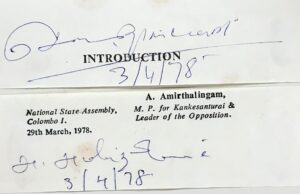
Autographs of S. Thondaman (top) and A. Amirthalingam (bottom) collected by Sachi in 1978
During the July 1977 general election, Amirthalingam campaigned for a plebiscite vote for a Tamil Eelam state, for the newly tagged collective Tamil United Liberation Front (TULF).On the numerical merit of votes received for TULF that exceeded the previously ruling SLFP, Amirthalingam, then became the first Tamil to hold the Leader of the Opposition position, between 1977 and 1983. After July 1983 anti-Tamil riots, he exiled himself to Madras. His fate was sealed when he became a pawn in the hands of Rajiv Gandhi regime from 1985 onwards, only to return to Sri Lanka in early 1989. In a power intrigue between Rajiv Gandhi and Ranasinghe Premadasa, manipulated by India’s intelligence agency, Amirthalingam became an assassination victim on July 13, 1989 in Colombo.
‘Amirthalingam Assault drama’ of 1981
8 years prior to his 1989 assassination, Amirthalingam was verbally assassinated within the premises of Sri Lankan parliament by eleven Sinhalese politicians, (all of them first time MPs) then representing the United National Party (UNP). The leader of this ‘parliamentary mugging’ was Dr. Neville Fernando (1931-2021), MP for Panadura, who himself was subsequently expelled from the party within two months!
45 years have passed since the infamous ‘Amirthalingam Assault Drama’ played out in the Sri Lankan parliament in July 1981. The producer of this drama (euphemistically called as ‘political strategist’) was Lalith Athulathmudali (see below). Now, records of this verbal assassination of Amirthaingam seems scattered here and there, and NOT reminisced in the digital media entries by the Sinhalese hypocrites. The Tamil hero Amirthalingam, who was reviled as ‘a traitor and despicable Sri Lankan who deserves death’ in 1981 by the Sinhalese politicians, journalists and commentators, surprisingly morphed into a ‘purported LTTE victim’ after his assassination in 1989. Even, Amirthalingam’s biographers in English (T. Sabaratnam) and Tamil (Kathir Balasundaram) also have obliterated many factual details of this ‘assault drama’. As an Eelam historian, it’s my onus to provide a near complete story and an analysis of this unusual 1981 event in Parliament.
The solitary defender of Amirthalingam’s right of speech on the two days (July 23 and 24, 1981) at the debate in Sri Lankan parliament was S.Thondaman Sr. (1913-1999) Prior to the beginning of this debate, Maithiripala Senanayake (1916-1998), the then leader of SLFP group in the parliament raised a Point of Order and solicited the Speaker’s ruling. As his request was deceptively tackled in favor of the debate by the then Speaker of the House, Senanayake and fellow SLFPers left the House. For this act, even Maithiripala Senanayake was also taunted by one of the UNP MPs as ‘Sinhala Tiger’, for a personal reason that Ranji Handy (Senanayake’s wife) was a Tamil! Ranji Handy was a sister in law of Prof. Christie J. Eliezer.
What happened in the Parliament on July 23 and July 24, 1981
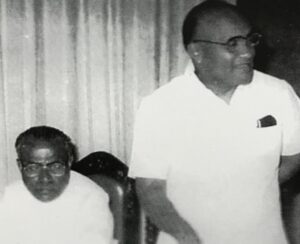
S. Thondaman (lt) and A. Amirthalingam (rt) at a meeting in Colombo 1982
As an after effect of the District Development Council (DDC) elections held in Jaffna during early June 1981, quite a few UNP politicians came to blame Amirthalingam and TULF for the disastrous electoral defeat of their party. First, I provide 5 paragraphs describing these events (incompletely) by J.R. Jayewardene’s biographer K.M. de Silva in 1994. He abbreviated Jayewardene with the initials JR.
“Since the normal machinery for the organization of the elections had broken down, emergency measures had to be taken to supervise the holding of the elections. The government made another decision they came to regret: two cabinet ministers were sent to Jaffna to organize the doomed UNP campaign, Gamini Dissanayake and Cyril Mathew, the latter as head of the UNP trade union, the JSS. The choice of Mathew for a politically and ethnically sensitive exercise of this sort was a major political blunder, given his reputation of being hostile to the TULF and, as the TULF saw it, to Tamils in general.
But they could do little to stop the violence. Instead the situation deteriorated further, compelling the postponement of the elections in the Jaffna district. Fortunately the violence was contained within the Jaffna district and did not spread, on this occasion, to other parts of the country.
In Colombo recriminations began. The police and security forces blamed Amirthalingam and the TULF for the violence in Jaffna. UNP parliamentarians were inclined to blame some of the TULF activists for complicity, at least, in these killings. JR heard many of these complaints himself from these parliamentarians who underlined the gravity of the political message that lay behind these killings: that this was the first time in the history of electoral politics in Sri Lanka under universal suffrage that the principal candidates of a major political party had either been physically eliminated or intimidated into withdrawing from an election after their candidature had been announced, to prevent the party from engaging in a legitimate political contest. Others, the JVP principally, were to learn this technique in years to come, but, for the moment, this was a unique and chilling event.
Many of them were inclined to blame Amirthalingam for this, and, while JR and Premadasa did not agree with this, they watched the anger of the parliamentarians boil over. They soon heard of plans afoot for a bizarre expression of their exasperation with the Leader of the Opposition, a vote of no confidence to be moved on Amirthalingam by the government parliamentary group. JR did little to prevent these parliamentarians from making fools of themselves by indulging in these tawdry antics. The motion they introduced for debate was an oddity in the annals of parliamentary democracy in any part of the world. The debate on this motion, moved by Dr Neville Fernando, a UNP backbencher, generated a great deal of heat. [Footnote 25: Three MPs were asked by the Speaker to withdraw some of the more offensive remarks they made on this occasion against Amirthalingam.] A number of UNP backbenchers participated in the debate, as well as three cabinet ministers, of whom one was K.W. Devanayagam, a Tamil himself, and the UNP’s Minister of Home Affairs who joined in the general criticism of Amirthalingam. The TULF was absent from the debate and the parliamentarians confined their criticism to two general issues: Amirthalingam’s advocacy of a separate state for the Tamils in contravention of his oath of allegiance to the constitution which embodied a unitary form of government, and secondly that Amirthalingam had engaged in criticism of the government while aboard and had misused his official position for that purpose. The parliamentarians carefully refrained from making any reference to the recent incidents in Jaffna because they were sub judice.
If JR believed that this debate, which took place on 23 and 24 July, was a political prophylactic against more violent forms of expression of hostility to Amirthalingam and the TULF he soon found that it was not adequate for that purpose.”
Though de Silva had offered a fair summary of the events that led to the No Confidence Motion on Amirthalingam in the Sri Lankan parliament, it appears to me that his prime focus was to ‘delink’ Jayewardene from the antics of UNP’s hostile backbenchers. A possibility that Jayewardene himself had used the anger of UNP’s backbenchers as an ‘exhaust valve’ to relief political tension of his party members and simultaneously to ‘beat’ Amirthalingam within the parliamentary ring had been side stepped. Also, the role played by M.A. Bakeer Markar (1917-1997), the Muslim Speaker of the Sri Lankan parliament, in permitting such an a debate had remained hidden. Did Bakeer Markar receive any ‘guidance’ from J.R. Jayewardene?
A variant version by attorney Satchi Ponnambalam published in 1983 presented these details:
“Unwilling and unable to understand Tamil separatist nationalism, the Sinhalese politicians regarded Amirthalingam, the TULF boss and Leader of the Opposition, as the principal villain in the demand for separation. He was accused of acting against the interests of the country during his foreign trips when he had advocated separation. They sought to remove him as Leader of the Opposition. To general amazement, they brought in a motion of no confidence in him,, on the grounds that he did not ‘enjoy the confidence of the Government.’
In the House, Amirthalingam was refused permission to make a personal explanation, and at this the TULF MPs walked out. The Speaker overruled a point of order by the SLFP, that the motion was not within the powers of the House, and at this the SLFP walked out. The CP member (elected in 1979 at a by-election in Ratnapura) contended that the motion, even if passed, would lead to nothing and also walked out.
Amidst the empty opposition benches, the UNP government Sinhalese MPs vilified Amirthalingam in the most despicable terms and suggested that he be tied to the nearest post and whipped. They also wanted all the Eelam separatists to be skinned and their bodies torn up. All this was dutifully carried as headline news by the press and repeated several times over the state radio. It was argued that Sri Lanka belonged to the Sinhalese and that the Tamils and Muslims were aliens; the Tamils had no right to a separate state; the Tamils would be sent back to India; the Sinhalese would be ready for war if the Eelam demand was not abandoned.”
The information about the by-election provided by Satchi Ponnambalam needs correction. Sarath Muttetuwegama was elected in a 1981 by-election to Kalawana constitutency. Previously, he had represented this constituency, from 1970 to 1977.
Tribune’s (Colombo) daily summaries from the Colombo Newspapers
For more details, I provide a compilation from the pages of Tribune’s daily summaries below:
July 13 Mon: Members of parliament of the Tamil United Liberation Front will not participate in the Parliamentary debate on the Vote of No Confidence on the Leader of the Opposition, scheduled for July 23 and 24; the motion has been moved by Dr. Neville Fernando, MP for Panadura and group of 36 other Government MPs. (Ceylon Daily Mirror)
July 23 Thr: Parliamentary strategists were busy yesterday mapping their plans for today’s motion of no confidence against the Leader of the Opposition Mr. A. Amirthalingam; the Ministers at the weekly cabinet meeting discussed the motion and it was decided that government MPs would be allowed a free vote at the conclusion of the debate; briefing newsmen at the end of the cabinet meeting, the Minister of State, Mr Anandatissa de Alwis, explained that the views expressed by government MPs whou would speak tomorrow would be their individual opinion and not that of the government there are no ministers among the 38 signatories to the motion, all of whom belong to the government parliamentary group. (Ceylon Daily News)
July 24 (Fri): The TULF, SLFP and the only Communist Party member who was present in the House walked out of Parliament yesterday without participating in the no confidence motion against the Leader of the Opposition Mr. Amirthalingam; the ULF led by the Opposition leader, Mr. A. Amirthalingam walked out first when his attempts to make a personal explanation failed as a result of protests from Government backbenchers; the SLFP members who were present and the Communist Party member Mr Sarath Muttetuwegama then walked out after the Speaker Mr. Bakeer Markar overruled a motion moved by Mr. Maithiripala Senanayake and Mr Mr. Muttetuwegama on a point of order that the no confidence motion against the Leader of the Opposition was not within the scope and ambit of the powers of the House and was ill conceived and therefore should be ruled out. Mr Muttetuwegama also said that by permitting this motion to be debated the House is being stultified because even if the Motion were passed it would lead to nothing. (Ceylon Daily Mirror)
July 25 Sat.: The motion of no confidence in Mr. A Amirthalingam, Leader of the Opposition, was passed yesterday with 121 voting for and two abstentions; Mr. S. Thondaman, Minister of Rural Industrial Development and Mr. Shelton Ranaraja, Deputy Minister of Justice did not vote; the TULF, SLFP and the Communist Party member in the House, Mr Sarath Muttetuwegama did not participate in this debate (Ceylon Daily News). The Government will not wholly ignore the opinions expressed by Parliamentarians on the No Confidence Motion against the Leader of the Opposition, Mr A Amirthalingam, Trade and Shipping Minister Mr Lalith Athulathmudali, regarded as the Government’s top political strategist, told a press conference yesterday that Parliament will treat the o Confidence Motion like any other motion passed by a majority vote in the House; right now it would be premature to foretell what exactly will follow from the motion but one thing was certain that the government will not ignore what has been said during the two day debate, the Minister said. (Ceylon Daily Mirror)
Other than providing the above summaries, S.P. Amarasingam (1914-1999), one of the ranking political commentators of his era, had tersely noted: “The no-confidence motion against Mr Amirthalingam in Parliament opened a Pandora’s box of chauvinist racialism – and the President [Jayawardene] has certainly frowned on some of the arguments and statements made in the course of the debate.” (Tribune, Sept 12, 1981)
Participants of the No Confidence Motion debate
Here is the list of UNP MPs, which I had culled from Tamil newspaper reports of July 1981.
Dr. Neville Fernando (MP for Panadura)
G.M. Premachandra (MP for Mawatagama)
W.M.J. Lokubandara (MP for Haputale)
D.M. Chandrapala (MP for Kundasale)
G.V. Punchi Nilame (MP for Ratnapura)
Merril Kariyawasam (MP for Agalawatte)
R.M. Karunaratne (MP for Uva Paranagama)
Dayaratne Walagambahu (MP for Mihintale)
Herath Banda Wanninayake (MP for Nikaweratiya)
Punchi Banda Dissanayake (MP for Gampola)
Rambanda Attanayake (MP for Uda Dumbara)
Two of the Cabinet ministers were, K.W. Devanayagam (MP for Kalkudah) and S. Thondaman (MP for Nuwara Eliya – Maskeliya). Both were Tamils. I couldn’t identify, the 3rd Cabinet minister, mentioned by Prof. de Silva.
Subsequent political fates of quite a number of these identified UNP MPs were rather unusual. Ironically, Dr. Neville Fernando and G.V. Punchi Nilame fell victims of J.R. Jayewardene’s ire. Dr. Neville Fernando was expelled from the UNP with immediate effect on Sept 16, 1981. Subsequently, he joined SLFP. Similarly, by first week of September 1981, G.V. Punchi Nilame was removed from his rank as the Deputy Minister for Regional Development. Primary reason for this decision was his involvement in the anti-Tamil violence, looting and arson in Ratnapura area against the Tamil estate workers, who constituted Minister Thondaman’s supporters. Even few other prominent participants were not spared. Here is a paragraph from the Editor’s notebook from Tribune weekly of Oct 3, 1981.
“On September 16, on the eve of his [Jayewardene’s] birthday, the UNP Working Committee adopted a tough line to ensure discipline in the party. The Ceylon Daily News of September 17 reported: “The UNP’s Working Committee yesterday decided to expel Dr Neville Fernando, the Panadura MP from the party with immediate effect. The expulsion decision taken at a meeting chaired by President J.R. Jayewardene at Sri Kotha last evening, can lead to Dr Fernando losing his parliamentary seat. Under the new Constitution of the Republic, a MP expelled from his party also loses his seat. A successor is nominated by the party. The affected MP, however, has an appeal to a Select Committee or the Supreme Court. Dr Fernando was present at the Sri Kotha yesterday but did not attend the meeting. It was evident that the UNP, which had required explanations from five party MPs for violating the party constitution and the code of conduct for MPs was taking a hard line to ensure discipline within its ranks. The MPs concerned – Dr. Fernando, Messers G.V. Punchinilame (Ratnapura), G. Premachandra (Mawathagama), Sunil Ranjan Jayakody (Polgahawela) and D.M. Chandrapala (Kundasale) – had been asked to show cause why they should not be expelled from the party for violating the UNP constitution and the MPs code of conduct. Three MPs Messers Premachandra, Jayakody and Chandrapala had agreed to withdraw in parliament certain remarks they had made there…”
Merril Kariyawasam was assassinated by JVP activists on Sept 5, 1989 – i.e, 54 days after Amirthalingam’s death. G.M. Premachandra also was killed in a suicide bomb blast on Oct 24, 1994, along with another noted Tamil baiter Gamini Dissanayake.
A vital detail of debate that had been ignored was this. A total of 14 hours were allocated for the No Confidence Motion debate. 8 hours for the government side, 6 hours for the opposition. But, as the Opposition (TULF, SLFP and the solitary Communist Party MP had walked out prior to the debate); due to this walkout, all 14 hours (excluding the time taken by Minister Thondaman, in defense of Amirthalingam) were gobbled by the government MPs in bad mouthing Amirthalingam.
A vote was taken on July 24th, 7:25 pm. 121 MPs of representing UNP supported the No Confidence Motion. Included in these 121 were, Cabinet Ministers K.W. Devanayagam, C. Rajadurai and Mrs Ranganayagi Pathmanathan and W. Dahanayake. Notably there were two abstentions – Cabinet Minister S. Thondaman and Deputy Minister Shelton Ranaraja. A prominent absentee on that day was Prime Minister R. Premadasa, as he had left on July 11, for a three nation tour to UK, East Germany and Yugoslavia. He returned to the island on July 31st. This fact is also another indicator now, that the mastermind behind the ‘Amirthalingam mugging drama’ was Minister Lalith Athulathmudali (Premadasa’s rival in the Cabinet), handpicked by Jayewardene.
My Perspectives and Hypothesis after 45 years
Considering the lop-sided majority UNP had in the then parliament (140+ MPs) in 1981 and TULF had only 16 MPs (Two who contested and won in TULF ticket, C. Rajadurai and M. Kanagaratnam subsequently joined UNP. Following Kanagaratnam’s demise, his sister Mrs Ranganayagi Pathmanathan, was nominated by UNP for the vacancy.), allocation of 6 hours to defend himself in the debate against 8 hours by the UNP MPs, was a good opportunity handed to Amirthalingam. But, he fumbled, by exiting the House with fellow TULF MPs. For a simple reason, that the Speaker Bakeer Markar didn’t permit him to make a statement, prior to the debate. Why? He could have taken all the 6 hours allocated to him to defend himself. Why, he failed to do so? Was he so scared that he had to hear catcalls and interruptions from the UNP backbenchers? He was not that type of a guy. Even if he was interrupted, suppose Amirthalingam had forcefully presented his case, it could have been his version of ‘I have a dream’ speech. But, Amirthalingam disappointed the Eelam Tamils by forfeiting the opportunity provided.
My enthusiasm for Amirthalingam as the Messiah who would lead us to a separate state of Eelam faded dismally with his performance at the No Confidence motion. For a silly reason, he ran away from the battle field, during those two days of July 1981. Subsequently, his primary focus was on negotiating the District Development Councils (DDC) for North and East with Jayewardene government, while pouting ‘Eelam’ slogan softly to the international journalists.
In ancient Tamil poetry, there is a derisive epithet for cowardice in the battlefield, about the behavior of a mother who rushed to the battlefield, after hearing the news that her son had died: ‘pura muthuku kaati oodal’ (i.e., cowardice-running act exposing one’s back, while being attacked). That the mother had turned the corpse of her son to see the location where her son had received the fatal wound, and was pleased to see that the wound was not in his back. The poem ends with the message that the mother was so pleased to see that the fatal wound was in the chest and she prided herself for that kind of valor, better than when she gave birth to him.
To be fair by all involved parties (UNP MPs who participated in the Act and the leadership which approved their Act, the Speaker of the House and TULF) in this No Confidence Motion debate, after 45 years, my hypothesis is this. Amirthalingam betrayed the trust Eelam Tamils placed on him in 1977, by running away from a debate about his political behavior, within the portals of the Sri Lankan parliament? What a disappointment for Tamils then? Certainly, this was not the type of leadership and valor that he bragged to young Tamils in 1977, which he would show to his rivals.
Amirthalingam – sedated and tongue-clipped
What was the eventual outcome of the No Confidence debate held during July 1981?
Following the disastrous events of bibliocaust of the Jaffna Public Library and the ‘UNP’s thug-handled’ DDC elections in May-June 1981, TULF had been boycotting the parliament for four months from June to September 1981. By gobbling the ‘carrot’ of DDCs offered (devoid of needed funds) by the UNP, Amirthalingam’s tongue was clipped. The ‘Eelam propagandist’ of parliamentary grade from 1977 became sedated. And he transformed into a ‘yes man’ to Jayewardene’s designs on blunting the Eelam campaign at the international stages. As expected, TULF returned to parliament in November 1981.
Here is a perspective offered by S.P. Amarasingam, in his ‘Editor’s notebook’ in Feb 27, 1982. “There is no doubt that the TULF now looks at some matters from a different angle from what it did some time ago. The Island in its issue of February 18 had a front page splash from its Batticaloa correspondent. The headline was an intriguing one: NO EELAM THROUGH MANGO TRICK – AMIR, and the report was revealing: ‘It would be foolish to believe that by a few people in London declaring the establishment of Eelam, that the Tamil speaking people here would overnight find Eelam in their laps. This type of wishful thinking smacks of the famous trick called the ‘mango tricks’, declared Mr. A. Amirthalingam the leader of the Opposition and TULF leader addressing a public meeting at the grounds of the Sri Murugan temple at Sittandi. ‘A lasting Eelam could not be ushered in by such fireworks set off in London’, Amirthalingam said. These were cogent reasons why the TULF did not support the declaration of Eelam but there were interested parties trying to disrupt the unity of the Tamil people by spreading the canard that the TULF today was veering away from the goal of Eelam. This propaganda was being spread especially among the Tamil youth. The TULF leader said it was worth remembering that when Subhas Chandra Bose tried to declare freedom for India from Singapore it did not prove successful…
UNP’s strategy is obviously to have a UNP-TULF-CWC front for the elections. The TULF may not (and probably will not) merge with the UNP as the CWC has done, but an understanding about mutual electoral cooperation is all that the UNP or the TULF will want.” (Note by Sachi: words in bold font, italics and large case format are as in the original.)
Thus, Amirthalingam’s campaign of ‘achieving Eelam state for Tamils via non-violence struggle’ became a proverbial ‘dead as a dodo’ bird in mid-1981.
Consulted Sources
S.P. Amarasingam: Editor’s notebook – The UNP. Tribune (Colombo), Sept 12, 1981, pp. 2-4.
P. Amarasingam: Editor’s notebook – milk, politics, UNP. Tribune (Colombo), Oct 3, 1981, pp. 2-4.
S.P. Amarasingham: Editor’s notebook – The Spectre. Tribune (Colombo), Feb 27, 1982, pp. 3-6.
Anon: No Confidence Motion against Amir today. President at Cabinet meeting – ‘The views of UNP MPs will not be that of the Government’. Eelanadu (Jaffna), July 23, 1981, pp. 1 and 6.
Anon: ‘This land is for Sinhalese. Tamils and Muslims are aliens. Jaffna crow is attempting to build a nest in Sinhalese head’ – the words of President Jayewardene’s disciples. Sutantiran (Colombo), Aug 15, 1981, p. 3.
Anon: ‘Due to minority issue, Indian subcontinent split into two nations’ – Thondaman’s opposing speech against the No Confidence Motion on Amirthalingam. Sutantiran (Colombo), Aug 23, 1981, pp. 2 and 6.
Anon: ‘While stating you are not against the Tamils, you indulge in bad mouthing the leader of Tamils’ – Thondaman’s response to Neville Fernando. Sutantiran (Colombo), Aug 30, 1981, p. 2.
Kathir Balasundaram: Amirthalingam sagaptham, Amirthalingam Memorial Foundation, London, 2004, pp.168-170 (in Tamil)
Mahalingasivam: ‘Ban the Party, Hang Aimr’ – Government MPs’ aggressive protest at the House. Joint walkout by TULF, SLFP and CP. Eelanadu (Jaffna), July 24, 1981, pp. 1 and 6.
Mahalingasivam: Shelton, Thondaman abstained from voting. ‘Tamils have the right to demand a separate state ‘ – Thondaman’s speech in the House. Eelanadu (Jaffna), July 25, 1981, pp. 1 and 6.
Satchi Ponnambalam: Sri Lanka – The National Question and the Tamil Liberation Struggle, Zed Books, London, 1983, pp. 208-209.
K.M. de Silva and Howard Wriggins: J.R. Jayewardene of Sri Lanka, vol. 2 – From 1956 to his retirement (1989), Leo Cooper Pen & Sword Books, London, 1994, pp. 445-447.
The sentence at the beginning, “On the numerical merit of votes received for TULF that exceeded the previously ruling SLFP, Amirthalingam, then became the first Tamil to hold the Leader of the Opposition position, between 1977 and 1983. ” needs a clarification.
‘On the numerical merit of votes received for TULF’ is somewhat misleading. As per the ‘first past the post’ election system used during July 1977 election, cumulatively SLFP received higher number of votes (than TULF) BUT less number of MPs were winners. Cumulatively, TULF received smaller number of votes (than SLFP) because it contested only in the Northern and Eastern provinces, plus the Puttalam constituency. But, TULF had higher number of MPs as winners. In the Parliament, the head count of the number of elected MPs decided the Leader of the Opposition, and Amirthalingam’s choice then was a fluke.