‘Harlots in Ancient Tamil Literature’ by V.T. Manickam
by Sachi Sri Kantha, August 28, 2026
Introductory Note by Sachi Sri Kantha
Sixty years had passed since the First International Tamil Research Conference was held at Kuala Lumpur, Malaysia between April 16th and 23rd in 1966. A total of 132 delegates and 40 observers attended. It was opened by Tunku Abdul Rahman (1903-1990), the then Prime Minister of Malaysia. Three prominent Eelam Tamil scholars, Rev Xavier S. Thani Nayagam(1913-1980), Prof.Christie J Eliezer(1918-2001) and Prof. Sinnappah Arasaratnam (1930-2018), then affiliated to the University of Malaya that sponsored the Conference were involved in the success of this Conference Seminar. A total of 132 delegates and 40 Observers attended this Conference. Quantitatively, India had the highest number of delegates (42), with Ceylon as second with 31 delegates. Host nation Malaysia had 14 delegates. I guess this is an under-estimate, because many (who were in the Organizing committees) were excluded from the delegate count. USA had 8 delegates.
I provide a re-formatted version of an interesting study presented by Mr. V.T. Manickam, at this Conference. The topic was ‘Harlots in Ancient Tamil Literature’. This is mostly considered as a naughty topic for research, due to prevailing Victorian era prejudice. Then, or even now, for reasons of false modesty, this is a theme which is rarely studied or debated and discussed. Even 20th century dictionaries were not immune to this false modesty. Words (technical, formal, euphemism, slang and vulgar) which are prevalent in the society to describe prostitutes are strictly screened for inclusion, and many are omitted.
Some early Tamil films with courtesan themes
Tamil talkies since 1931 for reasons of sex appeal occasionally covered harlotry (both appreciative and depreciative versions). For an appreciative version, producers and directors dipped into Sangam period literature – prominently Cilappathikaram epic, with a plot revolving around three characters: Kovalan (wealthy jewelry businessman), his chaste wife Kannaki, and courtesan-paramour Mathavi.
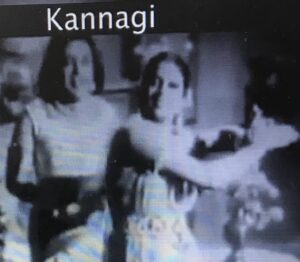
Courtesan Mathavi played by M.S. Saroja – screen grab from ‘Kannagi’ (1942) movie
As of now, this story had appeared in screen four times in Tamil. First two films were released in 1933 (one of 8 films released) and 1934 (one of 14 films released) with the name of hero Kovalan. Imperial Film Company produced the first version, and Royal Talkies released the second version. Both have been lost to history now. I couldn’t find out who played the courtesan Mathavi role in these two early Tamil talkies. Third and fourth versions were ‘Kannagi’ (1942) and ‘Poompuhar’ (1964). While Ilankovan scripted the 1942 movie, Karunanidhi scripted the 1964 movie. M.S. Saroja played the courtesan role in Kannagi movie and Rajasree repeated the same role in Poompuhar movie. I provide two related screen grabs of these movies nearby.
Dambachari Vilasam (1935, translated in English, as ‘Daliances of a Dandy’) offered a pejorative version of courtesan role. It was a contemporary social satire, originally well received in the drama stages. Film negatives are lost now. Sascha Ebeling of University of Chicago had written about this particular film, in a festschrift to Prof. E. Annamalai, published in 2025.
Another recognized courtesan-related Tamil film had three alternate titles, Dasi Penn or Jyothi Malar or Thumpai mahatmyam (1943); a folk tale with a mix of mythology, directed by Ellis Dungan, was one of MGR’s early movies. In this movie, MGR plays the role of Lord Shiva, blessing the ‘dancing girl’ and transforming her into a’thumbai’ plant for worship. ‘Thumbai’ is a plant used in siddha medicine for treatment. Hero of this film was singer-actor T.R. Mahalingam. This is also a lost film now. Film historian Randor Guy had recorded that this film was well received in box office, during its release. I guess the reason for three alternate titles for this movie was a business gimmick, to attract audiences of all age groups. A single title ‘Dasi Penn’ would have been considered as a bad omen in early 1940s for many women in religious households to entertain themselves in a movie theater.
In 1944, another courtesan film, with the name Dasi Aparanji (Courtesan Aparanji), produced by Gemini Studios was released. The plot was based on historical fiction of a noted courtesan called Aparanji during the reign of mythical king Vikramathithan. It was scripted by noted novelist Kothamangalam Subbu, who had written the lyrics, and also acted as a temple priest. Telugu actress Pushpavalli played the title role. According to reviews, when released, the film was well received. Even, this film is now lost to history, because original negatives haven’t survived the destructions caused during World War II in Chennai.
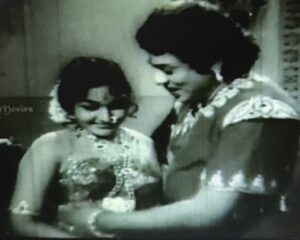
Courtesan Mathavi played by Rajasree – screen grab from ‘Poompuhar’ (1964) movie
Manickam’s treatment in 1966
Lujo Bassermann (pseudonym, b. 1920) wrote the history of prostitution in German. Titled ‘Das Alteste Gewerbe Eine Kulturgeschicht’, this work was first published in 1965. It’s English translation by James Cleugh ‘The Oldest Profession – a History of Prostitution’ appeared in 1967. Though this work covered the history of harlotry from ancient times to present, with chronology and bibliography, the materials were mainly from Europe and Middle East. Asian countries (India, China and Japan) were not touched. That’s why, V.T. Manickam’s 1966 study was a first of it’s kind, to appear in English. It has few merits, including identification of specific words used for prostitutes of grade, from the Sangam Tamil literature, combed by the author. The primary function of prostitutes as guardians of Tamil music, dance and traditional indoor games are noted. Demerits also need mention. The study was strictly based on the descriptions in the poems of Sangam Period poets. Thus, data on the demographics Tamil speaking population and the diseases prevalent of that era for which prostitutes have been functioning as vectors are missing. Also missing are the relationship between the prostitutes and pimps.
From what I had gathered, Mr. Manickam had subsequently received his PhD from the University of Madras in 1968 for a dissertation ‘A study of Maruta tinai in Tamil Literature’ and had served as the Professor of Tamil at Pachaiyappa’s College, Chennai. As of now, there is no Wikipedia entry for V.T. Manickam.
The original text appeared in the Proceedings of the Conference, vol. 1, edited by Xavier S. Thaninayagam et al., 1968, pp. 338-345. Subtitles and paragraph splits are given, as in the original text. For ease in reading, I have indicated the Tamil words/phrases in italics. Cited 65 references are assembled at the end. Subtitles, following a two paragraph introduction, are as follows:
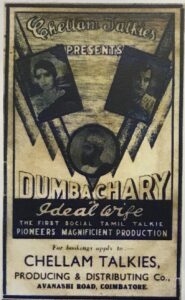
Dumbachary (1935) movie advertisement
Harlotry in the ancient Tamil society
Social necessity and harlotry
Three types of prostitutes
Characteristic features of the concubines
The role of courtesans
Part played by free lance prostitutes
Their aesthetic culture
Sports and other pastimes
Conclusion
Historian cum Epigraphist Ramchandran Nagaswamy’s (1930-2022) subsequent 1990 paper on devadasis of Tamil Nadu is also of interest in this regard. Now, to Manickam’s paper of 1966. Citations for this introductory note are provided at the end.
Harlots in Ancient Tamil Literature
by V.T. Manickam
Literature of the ancient Tamils presents mainly two types of women – the one group which is contended with a monogamous marriage strongly based on chastity and fidelity, whereas the other always longing for material benefit through relationship with many men and make it a commercial art of living. It is obvious that the former is excellently and elaborately extolled as ‘karputai makalir’ by Tamil savants. The latter class of hot-blooded women are generally known by the name ‘Potu makalir’, meaning ‘public women’ and they learnt and practiced many arts and were mainly responsible for the development of fine arts.
The aim of this paper is to present the institution of harlotry that existed in the good old days with a certain degree of decorum and restraint, the place of harlots in the society, the various grades of harlots, their different roles in the town-life, their inquisitiveness and artistry in fine arts like music and dance, their sports and other pastimes etc.
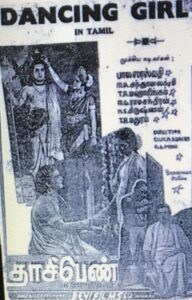
Dasi Penn (1943) advertisement. Note MGR, as Lord Shiva, in the top photo.
Harlotry in the Ancient Tamil Society
Harlotry, a profession of coaptation, has existed in almost all the civilized countries. From the earliest recorded time it has been closely linked with the civilization of the community (1). As Oswald Schwarz observes ‘Prostitution belongs essentially to civilization, as the shadow belongs to the light.’(2). Ever since and everywhere it has persisted in many forms, sometimes respectable, sometimes dull, sometimes fancy – but it has persisted, even now persists. It is deeply rooted in human society for more than two millennium. Hence, there is no shame for us to accept that in antiquity such a social evil was spread to some extent in our conventionally virtuous community also (3).
‘Literature is at bottom an expression of life’(4). It reflects the customs and civilization of the time. Our great poets who very well knew what literature is, tried not to obscure the truth of the existence of harlotry in the ancient Tamil society, where the standard of morality was strictly observed. Of course, they have described the harlots, their manners and customs, their life and longings in not less than forty verses in the anthologies of the ancient Tamil literature. But at the same time it must be pointed out here that they have neither approvingly depicted the institution of prostitution, nor have they gone to the extreme of portraying it so sordidly, meanly and vilely, as the poets of the later period, exceeding all the poetic limits, have expatiated, of their own free will, on the careers open to women of objectionable character, for the sole purpose of pleasing their patrons (5).
From the ancient works it is clear that harlotry was permitted to a degree without being very seriously questioned (6) during the early periods in the Tamil civilization. It was a feature more of cities than of villages (7). In practice concubinage prevailed among the richer classes. Only the kings and the bloated plutocrats took to this custom; but laity who deemed the vocation of these harlots infamous, practiced only monogamy (8). Anyhow, it is categorically true that the institution of harlotry existed in the past beyond all criticism and condemnation.
Social Necessity and Harlotry
In a growing society, it is true that there might be all sorts of people who follow their own way. There can be unruly persons too, in respect of sexual desire. Besides, there are others like soldiers and sailors who spent most of their life as bachelors. Such a group of unmarried young men will naturally seek the assistance of the public-women to quench their biological urge. These recalcitrant juveniles cannot be satisfied or controlled.
At this juncture, there arises a social necessity to make outlet for the salacious persons and thereby to redeem the society from such an evil. As a matter of fact, perhaps there might have been no other choice to safeguard the chastity of the housewives and to keep up a high standard of purity in the race than to allow half-heartedly the institution of harlotry to some extent. Analyzing the normal vindication of harlotry, Havelock Ellis observes that, ‘the social necessity of prostitution is the most ancient of all the arguments of moralists in favour of the toleration prostitutes (9). Only because of this obligation, perhaps the Tamil society, though it censured and cursed the institution of harlotry, had to yield assent hesitantly without finding any alternative. Accordingly the Tamil society set apart a certain group of women for the satisfaction of those masculine needs (10), only in the outskirts of the cities (11). Thus in the hoary past prostitution was the prevailing custom among the Tamils (12), though the high ideal of devotion to a single wife was held in the highest esteem (13).
Three Types of Prostitutes
Tamil poets have used many words and phrases to denote prostitutes. Expressions like parattai, kanikai, cillai, turttai, patiyilar, kuttiyar, nataka makalir, porut pentir, alavai pentir, pura vithi makalir, konti makalir, puvilai matantaiyar, varaivin makalir etc. refer to the various grades of prostitutes. Unbashfulness, profligacy, licentiousness, avarice, trickery, charm and braggartism – these are the common peculiarities of the harlots. But, taking into account their demeanour, heritage and the rank or the status, they are categorized into two big groups namely ‘il-parattaiyar (concubines) and ‘ceri-parattaiyar’ (harlots) (14). Again two sects are mentioned in the latter group, viz. (1) kathal-parattaiyar, and (2) varaivin-makalir (15). Almost all the katar parattaiyar were well versed in singing and dancing and hence they were also known as ‘atal-kuttiyar’ and ‘atalan-kanikaiyar’ (courtesans) (16). On the whole, there were three types of public-women namely concubines, courtesans and strumpets.
Characteristic Features of the Concubines
The daughters of the high class harlots entered into holy matrimony with the chiefs of their liking and became concubines (17). They were called ‘il-parattaiyar’ or ‘kama kilattiyar’ and they possessed the invaluable chastity (18). When compared with the other two groups of prostitutes who were unsheepish, these virtuous kept-women possessed true modesty and never thought of another life partner (19). They, thus being very fastidious about their feminine virtue, dignified themselves as illustrious and virtuous wives (20). This trait which permeated almost all the concubines, made the ancient Tamil grammarian, Tolkappiyanar extol them as comparable to the wedded wives (21).
They were the irreproachable wives and the excellent mothers. Although their lineage was that of the harlots they were aware of the duties of a wedded wife (22). They were faithful and obedient to their consorts. Devoting their whole time in doing everything for the welfare of their spouses, these faithful matrons acted in conformity with the wishes of their respective consorts (23). They lived a settled life with their consorts in a proper way stipulated in the moral codes and maintained a righteous conduct (24). They possessed many good qualities of a virtuous wife (25) and respected the Chief not for his riches but for his consortship and polished manners (26). They took great delight in seeing the young son born of the hero and his legally wedded wife (27). They fondled the child without any hatred and cherished him with solicitous care as if he were their own son. Moreover they adorned him with all their fine jewellery (28). Some of them willingly let the chief go to his own house at times on account of their good practice of moral duty (29). Rarely the concubines acted as mediators between the hero and his legal wife. They voluntarily came forward to restore harmony between these two (30). Thus by having a deep sense of loyalty towards the chief, they behaved exactly like a chaste woman, who does everything for the satisfaction of her husband. They were the roses among thorns and the valuable diamonds though they lay on the dunghill.
The role of courtesans
Besides the concubines who led the chaste life, there were another set of gay and uninhibited women called ‘ceri-parattaiyar’. Among them those who were full of fervor in many arts and had relationship with royal families and ducal circles, were fairly known by the name ‘atal-kuttiyar ‘(courtesans). These adolescent lais conjugated only with patricians and well-do-do persons, but the number of their customers was very much restricted to a minimum when compared with that of the public-women (31). These high-class harlots who were well-versed in various arts observed a certain degree of decorum and restraint. Since a courtesan’s importance was measured by the social rank of her clients and her tariff, she fixed her own tariff depending upon her birth, wealth, youth, sex appeal, artistic quality, rank at king’s Court and other high status in her circle (32). They employed their assistants for declaring their tariff in public. Matavi, the well-known courtesan was bought for high stakes by Kovalan, and she was priced at one thousand and eight hundred ‘kalancu’ of gold – a fact alluded to in the popular epic of the sage Ilanko (33).
Courtesans were the amusing confederates to their paramours. Among almost all the courtesans, we find a very considerable likeness especially in culture and influence. These ardent admirers of arts spent seven years in the study of music, dancing and other arts and became highly accomplished musicians and dancers (34). They increased their renown in consequence of their skill in fine arts. In the presence of the king, they appeared on the stage and showed themselves off in all their resplendent jewels, gorgeous dresses and other splendours. They received from the king the greatest title of the State – ‘Talaikkol arivai’ and a lump sum of gold for their artistic talent (35). They were worth of the honour they received and hence held in high esteem and respect by others (36).
Part played by Free-lance prostitutes
Freelance prostitutes were public-women who pledged their heart and soul to music and dance; longed for ecstasy and wealth, by offering their beauty and prime of life, and never in their life remained united permanently with a particular person (37). These low grade women recruited their clients from time to time, had freely and frequently connections with them and accepted monetary rewards for an essentially unsaleable commodity. Hence, they were variously known as ‘porul-pentir’, ‘porul-porular’, ‘vilai mahalir’ and ‘varaivin mahalir’ (38).
These gay girls wearing ornaments appeared very attractively in the dusky evening, stood at the doorway of their houses and attracted the onlookers (39). Sometimes they even loitered in the street, made indiscriminate advances to the strangers and solicited them in public places (40). To their customers, they were the visible beauties of the universe. Dressing themselves very provocatively, they gave each and every one of their clients the pleasure of sexual gratification according to their respective gusto (41). They tried their best to make the fastidious lovers feel happier than at their own home (42). In short, they appealed to the sexually hungry youths as the embodiment of many of the refinements and perversities of civilization.
Their Aesthetic Culture
Even though debauchable the life of these buxom girls, their sexual exploits and their incredible earnings very treacherous and deplorable on the one hand, if we look at the bright side of their life, certainly we do not fail to notice their inquisitiveness and artistry in fine arts. Emphasising the endurance of the public-women in the field of fine arts, Professor T.P. Meenakshisundaram says, ‘The free women who though yielding to love refuse to shoulder this duty of a family life, but willingly undertook the onerous burden of keeping the torch of the fine arts ever burning more and more gloriously, through themselves sacrificing to a life of art and beauty, of music and dance.’ (43).
Art was almost the means of livelihood of the harlots. Throughout the day and night their houses were resounded with songs and music roused, by striking up various drums (44). The terms ‘Ennen kalaiyor’, ‘Panniyal matantaiyar’, ‘kalaivalar’, ‘kalaiyunar mahalir’ and ‘kalaiyi kantiniya collar’ refer to the greater interest taken by them in arts than any other women in the ancient Tamil society (45). They became well versed in the sixty four arts, specially meant for them (46). Naturally they possessed a very nice and melodious voice (47). They sang merrily to the accompaniment of the various musical instruments (48). By producing the tuneful notes on the Ciriyaal, these gleeful girls gave their paramours the feeling of exaltation and excitement (49).
Along with the music they developed the art of dancing also to a high level. There were trained by expert (Talaikkol acan) for a period of seven years (50). At the age of twelve they exhibited their graceful maiden dance in the king’s court. Thus they freely breathed the fair air of the music and dance world. Singing and dancing enabled to come closer in social relations and to make acquaintance with desired men and to rise in their estimation. Hence they began to give exclusive attention to vocal songs, instrumental music and dancing.
Allied to dance was their art of decoration. Charming beauty was the hall-mark of their profession (51). Therefore they sought the assistance of artificial make up in order to keep themselves all the day fresh and smart. They intensified their gleaming personality by making use of various cosmetics, variety of costumes, valuable ornaments and vari-coloured garlands and flower strings. Their smooth foot work, quick body movements, special music and the art of decoration – all these helped them very much to make the bystanders walk into their trap.
Sports and other Pastimes
Naturally the harlots were the lovers of social life free from domestic trivialities. Always they liked to get themselves mixed up in emotional complexities of some sort or other. These capricious women (52) usually spent hours together romping and playing all sorts of tricks with young gallants (53). Dressing ;very exquisitely in gossamer clothes and putting the deliciously smelling thyme in their tresses these genial and buoyant beauties rode furiously in chariots with young dandies (54). They attended the festivals and other merriments for making acquaintance with desired men (55).
In the morning, these delightful damsels, riding on horse-back and elephant-back went to the water-sporting places (56). Wearing swimming suits (57), they merrily sported in the fresh spate for a long time (58), used rafts and canoes (59), and thus ravished the young coxcombs by exhibiting their youth and glamour (60). At noon these chatty bobbysoxers promenaded with the flattering beaux in the pleasure gardens, dandified with them on the banks of rivers and played on the swings hung from trees (61). At nightfall, sitting on the open terrace, they spent few hours in enjoying the cool moon-light (62). Then these connoisseurs amused their paramours by playing on musical instruments (63). Frequently drinking sweet wines and fermented liquors (64), they gambled with the gallants (65). ‘The music softened, the wine inspired, the dancing fired and the wanton pairs concealed themselves in the friendly shades of the night’. This was the usual routine of their daily work. Thus they passed the whole time in various mirth-making and agreeable diversions and gave their customers the feeling of rapture.
Conclusion
From what has been hitherto said, it is clear that monogamy was generally the order of the day, although we come across instances of concubinage and harlotry repeatedly. Harlotry was in practice mostly among the men of wealth and prestige, but it was not wholeheartedly acknowledged by the ancient Tamil society. Moreover it was not so sordid and depraved as pictured in the later works.
Of the three types of harlots, the concubine, who possessed a polished suavity, is given the superiority as a woman inasmuch as the greater degree of her chastity and sex’s softness, united with true love and respect for her dear Lord. The other two groups of lascivious women, though they were not respected to that extent, undoubtedly had a place in the field of arts in the ancient beau monde. Virtue had not been a dominant feature among them and they never possessed any sentiment for voluptuousness. Showing their jaunty countenance, and other feminine qualities, these ecstatic and elegant damsels enticed the gay young libertines, won their hearts and even exercised a mastery over them. Thus the gay-girls enlivened the social life of the sophisticated coxcombs by participating in their life of lust and luxury, with their art and artfulness.
Reference citations
- T. Srinivasa Iyengar, History of the Tamils, Coomaraswamy Naidu and Sons, Madras, 1929, p. 285.
- Oswald Schwarz, The Psychology of Sex, Pelican Books, 1956, p. 70.
- Varadarajan, Kalittokai Corpolivukal, South India Saiva Sidhanta Works Publishing Society, Madras, 1957, p. 90.
- H. Hudson, An Introduction to the study of Literature, Harrap & Company, London, 1961, p. 14.
- Viralivitu tutu, one of the later works of the 18th century AD.
- Iraiyanar akapporul 44, see Commentary. Tirukural, chapter 109, Introduction by Manakkutavar, V Sp. Manickam, The Tamil Concept of Love, South India Saiva Siddhanta Works Publishing Society, Madras, 1962.
- S. Thani Nayagam, Nature in Ancient Tamil Poetry, Tamil Literature Society, Tuticorin, 1953, pp. 105, 143.
- Purananooru, 73: 11-, 143-7, 365- 6-10. See E.S. Varadaraja Iyer, Tolkappiyam – Porul atikaram, English translation, vol.1, part II, Annamalai University, 1948, p. 359.
- Havelock Ellis, Studies in the Psychology of Sex, vol. II – Prostitution, Random House, New York, 1936, p. 282; U.V. Swaminatha Iyer, Kuruntokai, p. 79.
(10)Bertrand Russell, Marriage and Morals, Bantam Books New York, 1959, pp. 98-99.
(11)Cilappatikaram, 14: 118-119, Adiyarku Nallar commentary.
(12)Tolkappiyam – Porul atikaram 1097 (Iavalakanar edn.) Nampiakapporul, 65; Purananooru, 143-7.
(13) Purananooru, 73: 11-14.
(14) Nampiakapporul, 113-114.
(15) Civakacintamani, 372.
(16) Cilappatikaram 5:50; Manimekalai, 11:13.
(17) Nampiakapporul, 115.
(18) ibid, 113.
(19) Maturai kanci, 558, Narrinai, 150: 8-9.
(20) Maturai kanci, 578-579.
(21) Tolkappiyam, 1097.
(22) Tolkappiyam, Porul., 151; Nambiakapporul, 105.
(23) Kurunthokai, 370, vide explanatory notes by U.V.Swaminatha Iyer, Tolkappiyam – Porul 172.
(24) Kalittokai, 96: 33.
(25) Akananooru, 16, 376, 396; Narrinai 150.
(26) Kalittokai, 82.
(27) ibid, 84.
(28) Akananooru, 16; Kalittokai, 82, 83, 84.
(29) Narrinai, 176: 2-3.
(30) ibid, 290, 315.
(31) The Advanced Learner’s Dictionary of Current English (Oxford), vide, Courtesan.
(32) cf. Cilappatikaram, 14:157-159, Atiyarku Nallar commentary.
(33) ibid, 3: 164-171.
(34) ibid, 3: 8-10, 14: 18-154; Paripatal, 7: 77-80.
(35) Cilappatikaram, 3: 157-163.
(36) Paripatal, 7: 80.
(37) Tolkappiam, Porul, 149.
(38) Tirukural, 913-914; Manimekalai, 5:87; Tirukatukam, 39.
(39) Kuruntokai, 293; Kalittokai, 97:16; Maturaikanci, 419.
(40) Narrinai, 20:5-7, 320: 3-4; Kalittokai, 69-8-9
(41) Cilappatikaram, 1:131. Atiyarku Nallar commentary
(42) cf. Paripatal, 20:86.
(43) Philosophy of Tiruvalluvar, Madras University, 1963, pp. 68-69.
(44) Akananooru, 206: 11.
(45) Cilappatikaram, 14:167, 22:138-139; Civakacintamani, 372, 1625. 2107.
(46) Manimekalai, 2: 18-32.
(47) Tinaimalai nurraimpatu, 141.
(48) Cilappatikaram, 7: 24.
(49) Maturai kanci, 559-561.
(50) Cilappatikaram, 3:10.
(51) ibid, 3: 8-9.
(52) Naladiyar, 378.
(53) Paripatal, 10: 35-38.
(54) Akananuru, 316: 7-9, 336: 10-1; Kalittokai, 70: 17-18. 88:18, 98: 3-6.
(55) Kuruntokai, 31, 364; Akananooru, 176: 12-5; Kalitokkai, 66: 17-18. 70: 13-14, 73: 16.
(56) Paripatal, 10:29, Parimelalakar commentary 12: 26-27.
(57) Akananooru, 166: 13, 266:5; Kalittokai, 66:16.
(59) Akananooru, 6:6-11; Paripatal, 10:27; Cilappatikaram, 14: 70-75.
(60) Ainkurunuru, 76; Akananooru, 116: 6-10, 266: 5-9; Kalittokai, 66: 15.
(61) Narrinai, 90: 6-7.
(62) Cilappatikaram, 4: 27-32, 14: 102-103.
(63) Paripatal, 20:57.
(64) Akananooru, 346: 15; Paripatal, 10:75-78, 16:39; Kalittokai, 97:10; Cilappatikaram, 14: 132-133.
(65) Manimekalai, 16:7.
********
Citations for Sachi’s Introductory Note
Bassermann L. The Oldest Profession – A History of Prostitution, translated from German by James Cleugh, Dorset Press, New York, 1993, 300 pp.
Ebeling S. The scandal of the Devadasi in Nineteenth century Tamil theater and early Tamil cinema: Caitapuram kaci vicuvanata Mutaliyar’s drama Tampacari Vilacam.
In: For the Love of Tamil: Essays in Honor of E. Annamalai, ed. M. Trento, C.V.Nakassis, N. Govindarajan, S. Ebeling, Serie Orientale Roma, Napoli, n.s. 48, 2025, pp. 415-437.
Randor Guy: Cinema Plus. Dumbachary 1935. The Hindu (Chennai), .
Randor Guy: Cinema Plus. Dasi Aparanji 1944. The Hindu (Chennai), Sept 19, 2008.
Randor Guy: Cinema Plus. Dasi Penn (Jyothi Malar) 1943. The Hindu (Chennai), Feb 20, 2011.
Nagaswamy R. The devadasis of Tamil Nadu: a study. Sangeet Natak, July-Sept 1990, no. 97: 19-29.
Aranthai Narayanan: Thamizh Cinemavin Kathai, 3rd ed., New Century Book House, Chennai, 2008, pp. 194-195, 215-216.