A Conversation with Vindhya Buthpitiya
by University of Washington Press, Seattle, USA, June 22, 2026
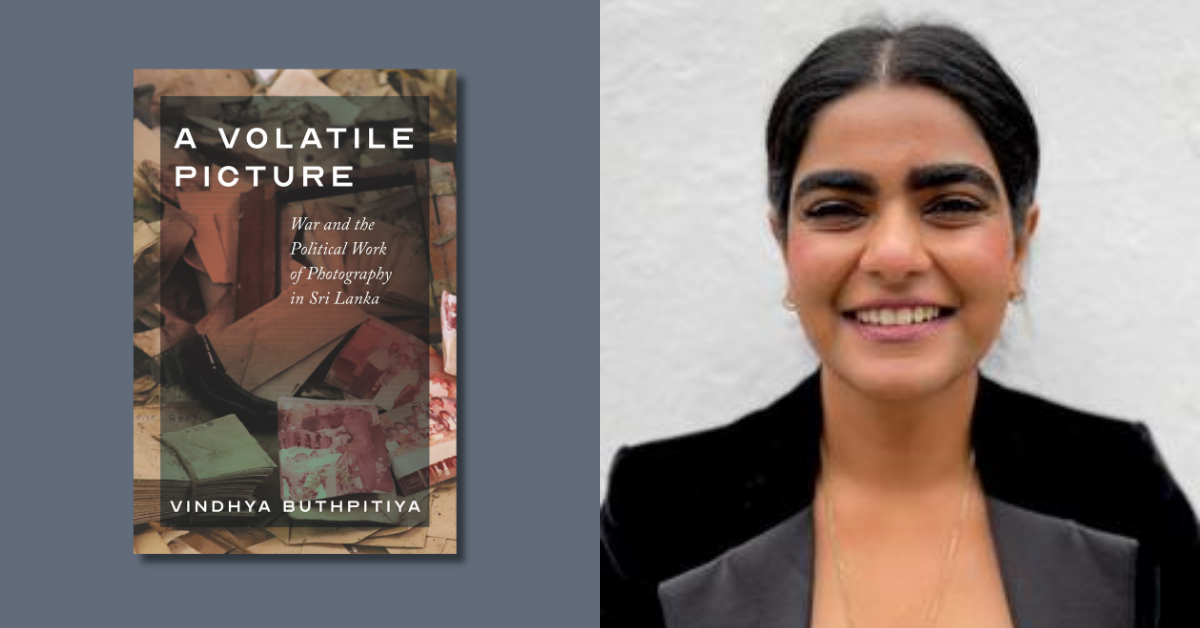
In A Volatile Picture: War and the Political Work of Photography in Sri Lanka, anthropologist Vindhya Buthpitiya explores photography as both witness and weapon amid civil war.
Throughout Sri Lanka’s protracted civil war and its turbulent aftermath, photography has become bound to the Tamil political imagination. Studio portraits, passport pictures, family albums, atrocity photography, social media posts, and more act not only as records of loss and horror but also as vital tools for protest, solidarity, and the realization of alternate political futures. In the Q&A below, Buthpitiya shares insights from the in-depth fieldwork behind her book, discusses how photographs are used in the fight for truth and justice, and reflects on the “volatile” nature of images, whose meanings and political uses shift over time.
What first led you to think about photography not simply as documentation, but as something that actively shapes the political life of war?
The social and political world of the Sri Lankan civil war (1983–2009) was densely populated with images extending from photographs documenting atrocity and the enactments and effects of state and anti-state violence to the portraits of the war dead and disappeared calling attention to the innumerable violations and losses that permeated through the everyday for decades. These images persist in the postwar, mobilized as a part of enduring demands for truth and justice for victims of mass violence, state crime, and enforced disappearance amid state denial and erasure.
It is the demonstrations of the Tamil families of the disappeared after the end of the war that motivated me to think more analytically about what photography was doing or, more specifically, what people believed photography was doing in the service of their claim, cause, or appeal. Remarkably, even amid immense hopelessness and despair, photography was multiply wielded in continued expectation.
The book opens with the story of Baby Photo studio and the destruction of its archive during the 1995 Jaffna exodus. Why begin with the loss of everyday photographs and photographic histories, rather than with more familiar images of war reportage?
Sri Lanka continues to be shaped by an external gaze rooted in its colonial casting as paradise. Through the war, this becomes one of paradise under siege, where harm and brutality is juxtaposed against idyll for effect, or invocations of nostalgia and longing for bucolic landscapes and communities untouched by post/colonial violence and modernization. This is especially prevalent in the photojournalistic or documentary photography capturing life and environment in postcolonial Ceylon/Sri Lanka.
One of the principal motivations of the research that underpins this book was to open up the frame of what constitutes a photography of and from the island beyond known tropes and repertoires formulated by a handful of elite photographers, and documentation and scholarship that had not ventured beyond colonial practitioners. It was also very important to me to foreground the kinds of photographic images that we are surrounded with every day, the people who produce these—like Baby Studio’s Rajaratnam mama—and their creativity, labor, and transmission of social, cultural, and technical knowledge through multiple upheavals of war.

Rajaratnam mama at Baby Studio (Jaffna, 2018). Photo by author.
A central idea in the book is “volatility”—the idea that photographs can shift meanings, circulate unpredictably, and be used for very different political ends. Did your own experiences growing up in Sri Lanka during the war shape this concept in any way?
Volatility speaks to the unexpected and the mutable. I chose to consider this hand-in-hand with the idea of serendipity, because it is the possibility that things can get better just as they can get worse. It is an astounding sense of conviction and anticipation pinned to the “better” that still buoys my community through times of immense hardship, desolation, and instability whether that’s war and insurgency or more recently devastating economic crisis. There’s something remarkable about how the people of Lanka have persevered especially given how much they have endured over multiple decades.
What challenges did you face in researching and writing about images that remain politically sensitive or dangerous?
The types of photographs which appear in the book cannot always be decoupled from the context or motivations of their making. To work with and foreground these images is to accept that writing about their making and moving is also a part of their volatile arc, and I do so in firm solidarity with and as a part of my responsibility to my community.

Mothers at the Tamil Families of the Disappeared protests (Kilinochchi, 2018). Photo by author.
Seventeen years after the end of the civil war, these pictures are still regarded as “incendiary” against a backdrop of the unresolved causes and consequences of war and immeasurable sorrow and injury. Sri Lanka’s political minorities, especially Tamils and Muslims, are deeply affected by constant direct and indirect violence, suppression, and censorship amid the socio-political effects of Sinhala Buddhist majoritarian ethno-nationalism compounded by postwar triumphalism and militarization. This has significant bearing on space for political expression, especially where state crime and violence is regularly denied or rationalized, or in discussions about the possibility for self-rule. Even so, people persist in demanding truth and accountability for wartime violations, and they are driven by a deep and unwavering sense of duty to do so despite the many risks and challenges.
This book was made possible by the trust, generosity, and support of many like this who continue to fight for justice. If anything, I hope this book serves as a record of their courage, resolve, and confidence in the political work of photography.
What possibilities do you see for photography to create forms of solidarity, belonging, or political imagination that move beyond the nation-state itself—or, as you write, be “freed from the syntax of state”?
The relationship between images and conflict or political violence have been all too often framed through the notion of iconic images propelling crucial political revelation or transformation. The possibility—for me and in the context of photography and the Sri Lankan armed conflict and its aftermath—exists, in fact, in the often overlooked everyday and undervalued minutiae of photographic practices. These are vivacious and politically generative not only in terms of allowing important insight into how people speak to and about their fears, resentments, desires, and aspirations through photographic images and how they are navigating the harms and stresses of the past and present, but also how they imagine their individual and collective futures, political and otherwise. It is in these interstices that belonging is articulated and solidarities are formed.
Vindhya Buthpitiya is a lecturer in the Department of Social Anthropology at the University of St Andrews, Scotland, and coeditor of Citizens of Photography: The Camera and the Political Imagination.