Fifth International Tamil Research Conference, Madurai – Jan 1981
by Sachi Sri Kantha, August 17, 2026
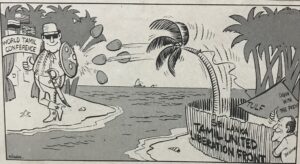
Ajit Ninan’s cartioon in ‘India Today,’ Feb.1, 1981
Kannan’s comment
Fellow MGR biographer and pal R. Kannan had sent me his thoughts on Part 88 on July 27. It was,
“I read Part 88 in one go; it was riveting. I wasn’t aware that a ferry had been arranged to bring delegates from Sri Lanka. The essay offered many new insights. I wasn’t aware of The Hindu article that quoted the Japanese and Russian scholar delegates, the rejection of Sivathamby’s article, which was later published as a booklet, etc. Avvai Natarajan played an important role in coordinating the conference’s activities and may have been involved in ghostwriting MGR’s article.
The PM’s message is a customary one, obviously penned by a Tamil scholar-bureaucrat, and I would not read too much into it. Also, unlike the first IATR conference in Kualalumpur and the third in Paris, the rest, hosted in Tamil Nadu, have had a popular element, and scholars have found themselves at sea because of the disconnect between the two. I am surprised that Noboru Karashima, who had attended all but one of these conferences, would choose to complain about this dichotomy. Similarly, there are different levels of Tamil proficiency among the overseas delegates. Some, like the Russian delegate, could be a budding scholar but had been roped in for representational purposes. I also find it difficult to believe that MGR didn’t wish for any reference to him in the research papers.
Other than the above, I found Part 88 to be a wealth of information. So do keep writing.”
My response to Kannan, sent the following day, was:
“All your comments are well taken. Among these, I will expand on two.
First, the issue of ghost writer(s). Your suggestion of Avvai Natarajan’s role as the coordinator is accepted and that he might have contributed to MGR’s introduction to the volume is a valid option. Subsequently, I thought that MGR’s ‘introduction’ could have been drafted/or polished by MGR’s own writing assistant K. Ravindar (aka Kaja Mohideen). MGR was good at choosing and delegating folks for what he considered as his ‘personal handlings’. He had delegated R.M. Veerappan for organizing the event, including bringing Jayalalitha to re-enter his circle, via this Conference. Ravindar was the other ‘personal’ guy. Vaali also had written (in his memoir) a little bit about MGR’s solicitation for his participation in the Conference.
Secondly, yes that ferry service was operating during January 1981. In fact, though initially, I had made a plane reservation from Tiruchi to Colombo for my return, while at Madurai, I changed my mind, and thought of returning by ferry from Rameswaram. As I had to return to Colombo immediately to receive my University of Illinois Professor who was visiting Colombo, I couldn’t take part in the post-Conference train tour for the delegates. As such, I wanted to view the Tamil Nadu landmass south of Madurai, and return via Rameswaram to Talaimannar. It happened like that.
For arriving at Madurai, we took a flight from Colombo to Trivandrum. Then, by bus, we went to Madurai, via Nagarkoil and Tirunelveli to Madurai. This was a night trip, and we couldn’t see any landmass.”
Now to the issue of Sri Lankan Tamils, that irked MGR, during that Conference days. Tamils plus thtee Sinhalese, (D.D. Nanayakkara, Dr. T.B.H. Abeyasinghe and Dr. R.D. Gunarathne) who had landed in Madurai, were formally recognized as registered Sri Lankan delegates and observers. There were only 194 registered Sri Lankan delegates. But, there were a dozen or more Tamils, who by-passed the official registration process via devious routes such as ‘press pass’ or simply tagging with their Tamil Nadu conduits or simply entering the podium without proper invitation. The activity of one imbecile intruder (identified as one K. Kumaradasan) who generated his ’15 minute Warholian world fame’ at the expense of MGR’s hospitality to foreign delegates was a cussed act, that pitted MGR with Amirthalingam, the leader of TULF. This K. Kumaradasan’s name was NOT in the registered Sri Lankan delegates list. More on this, will be described below.
Coverage of the Conference in the Lanka Guardian bi-weekly
I provide the texts of two reports: (1) Mervyn de Silva, the editor, wrote the following report for his ‘News Background’ column, (2) My rebuttal-clarification, as a participant Sri Lankan delegate.
First to Mervyn de Silva’s version. Of course, he was NOT an eye witness at Madurai. His version is a mix of what he had gathered from Sri Lankan Tamil journalists who were at Madurai and his ‘observant eye view’ of Colombo politics of that period.
“And now MGR has got into the act. Earlier it was Mrs Indira Gandhi whose several sympathetic comments on Mrs. B provoked an undeclared was of words across the Palk Straits between the UNP, the Indian Premier and the press on both sides. That ‘war’ slowly ground to a halt.
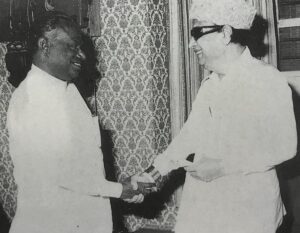
MGR with S. Thondaman Sr.
Recently pro-TULF youth burnt the effigy of the Tamil Nadu chief, the Sri Lanka-born film star M.G. Ramachandran. But it all started in Madurai, at the recent international conference on Tamil studies. The TULF and pro-TULF Tamil expatriates have sought to ‘internationalise’ the issue. To some extent, they have succeeded – from the UN, where the London based Mr Vaikunthavasan upstaged our Foreign Minister, to Boston, the London tea centre to the streets of Frankfurt and newspapers in Paris and the Scandinavian countries. But of course Tamil Nadu has traditionally been the main operational base of the Sri Lanka Tamils and the Tamil Conference has never been free of Tamil politics. In 1974 at the last conference several persons were killed in Jaffna when Police fired on demonstrators shouting slogans against the Bandaranaike government and demanding Eelam.
While Tamil politics has always been the sub-plot to the main drama of party rivalries in this island, President Jayewardene’s shrewd tactics of ‘co-optation’ have complicated even the sub plot. The Tamils of Sri Lanka (whether ‘Ceylon Tamils’ or ‘Indian Tamils’) no longer speak with one voice. Mr. S. Thondaman the big chief of plantation labour is a cabinet minister. Mr. C. Rajadurai, the veteran TULF leader from the Eastern Province is also a Minister in the UNP government. As a result the old Northern Province – Eastern Province – CWC alliance of ‘Tamil speaking peoples’ has been split in a way which has isolated the northern peninsula. What is more Mr Thondaman has long standing ties with both Mrs Gandhi and the Tamil Nadu chief, MGR. On the other hand the TULF has equally warm relations with Mr Karunanidhi of the DMK, which spearheaded the Tamil resurgence in South India. To complicate matters further, Mrs Gandhi’s Congress has friendly ties with Karunanidhi, rather than with MGR.
The UNP government has become increasingly sensitive to the anti-UNP campaign mounted abroad by pro-TULF groups. The Boston assembly even declared May 21st Eelam day and called on President Carter to intervene on behalf of ‘oppressed Tamils’ and their human rights. The campaign moved successfully to Europe. As a result the government persuaded the EEC countries to introduce visas for Sri Lankans. Many Eelamites have found political asylum in West Germany and sections of the Western press are extremely sympathetic to Tamil expatriate groups.
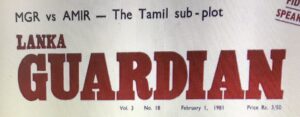 No wonder then that Commander in chief J.R. chose to include two Tamil ‘Generals’ in the Sri Lanka delegation, the largest that has ever left our shores. The leader of the delegation was the Speaker, the Tamil-speaking Moslem MP, Mr Bakeer Markar. Speaking for different communities (the Moslems, the Eastern province Tamils, and the plantation labour) each of these leaders could rebut charges of discrimination which Mr Amirthalingam, the Opposition and TULF leader was bound to level against the UNP. And that’s what happened. Mr Amirthalingam said that the legal and constitutional concessions given by the government did not actually amount to much, mainly because discrimination persisted in practice and at the administrative level. The TULF would never renounce their demand for Eelam. Elsewhere TULF supporters who had travelled from UK and US held an exhibition of posters and pictures. Amnesty International material was displayed to dramatise alleged atrocities of the armed forces, under emergency. (This stall the L.G. is informed, was demolished evidently on the instructions of the Tamil Nadu government). And MGR himself not only accused Mr Amirthalingam of trying to play politics but of disrupting good neighbourly relations between Sri Lanka and South India. As the war of words hotted up MGR charged the TULF leadership of ‘oppressing’ their own people (caste) and the Jaffna upper class of ignoring the grievances of the poor tea estate workers. He also spoke of the TULF and the Moslems. Obviously he was well ‘briefed’. The TULF reply was to burn the effigy of Tamil Nadu’s Chief Minister and leading actor who, it is now reported may visit Sri Lanka soon as the chief guest at another conference.” [Lanka Guardian, Feb 1, 1981]
An identical version, with some embellishments from events that happened in Jaffna also appeared in India Today bi-weekly, under Mervyn de Silva’s by-line with a caption ‘Tamil vs Tamil’.
To the report, which appeared in the Lanka Guardian, as one of the Sri Lankan delegates to this Conference, I submitted my rebuttal cum clarification. I did recognize the space permitted for such rebuttal, and tackled only the main issues, omitting the accessory elements. Mervyn de Silva did publish it, in the Mar 1, 1981 issue of Lanka Guardian (abbreviated as LG).
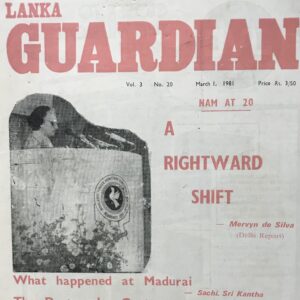
Lanka Guardian, (Mar 1, 1981) carrying Sachi’s rebuttal (1)
Sachi’s rebuttal cum clarification
“I write in reply to your comment under ‘news background’ on ‘MGR and Tamil sub-plot’ (LG, Feb 1, 1981). Since this comment contains so many inaccuracies, and as a Sri Lankan delegate who was an eye witness to many of the scenes which had been referred to in the comment, I am compelled to reply for the benefit of the LG readers.
Prior to commenting on the incidents which occurred in Madurai, I would like to draw the attention of the readers to a sentence which gives a serious misinterpretation of events which occurred in 197. I categorically deny your statement that ‘…In 1974 at the last Conference several persons were killed in Jaffna when Police fired on demonstrators shouting slogans against the Bandaranaike government and demanding Eelam’. Firstly, the columnist had erred in equating the incident of Jan 10, 1974 with the demand of Eelam. Eelam demand had not been originated at that time, if political records of this island have to be believed. This demand was first put forward vehemently by S.J.V. Chelvanayakam, the leader of the TULF, when he contested the KKS by-election, held on the 6th February 1975. Eelam demand was officially resolved and unanimously adopted for the first National Convention of the TULF held at Vadukoddai on 14th May 1976. [Note by Sachi: words in bold font, as in the original. I should note that bold fonts were inserted at the editorial desk. To type the manuscript in 1981, I had used a manual type writer, and there was NO specific key to type the bold font.]
Secondly, regarding the incidents of 10th Jan 1974, I would prefer to quote from the ‘Report of the Commission of Inquiry, on the Tragedy of January Tenth, 197’, published on 18th Feb 1974. The Commission consisted of Mr O.L. De Kretser, Mr V. Maicavasagar (both Former Judges of the Supreme Court) and the Rt. Rev. Dr. Sabapathy Kulandran (former Bishop in Jaffna). To uote the inferences made by this Commission,
‘The irresistible conclusion we come to is that the police on this night was guilty of a violent and quite an unnecessary attack on unarmed citizens. We are gravely concerned that they lacked the judgement which we expected of policemen in a civilian police force whose duties call for tactful handling even in the most difficult situation.
‘The evidence establishes that this was not all that took place that night. The police in their armed might roved the city assaulting whomsoever they came across for no better reason than that the people were doing what they were entitled to do.
‘We are of opinion that those who suffered physical injury and material damage, and those who lost their lives were the innocent victims of a chain of events set in motion by a completely wrong and unwise decision on the part of the police officer who made it. We can find no justification at all for the police assault on defenceless and innocent citizens.’
These inferences made by the learned Commission, do not vindicate the assertion made by the LG columnist that, ‘Police fired on demonstrators shouting slogans against the Bandaranaike government and demanding Eelam.’ I give the choice for the LG readers to pick out which is correct.
Regarding the events at Madurai Conference, being an eyewitness, I agree with the LG columnist, that ‘pro-TULF Tamil expatriates sought to ‘internationalise’ the issue, and to a greater extent they had succeeded.’. Though the exhibition stall organized by the Eelam supporters who travelled from UK and USA, was demolished on the instructions of Tamil Nadu government, the administration could not stop the activists pasting the posters depicting the ‘Jan 10 incidents of 1974 Conference’ all over the Madurai city, again on 7th night.
As a matter of fact, large crowds converging to Madurai city, gathered around the places where these posters were pasted; the posters themselves were different in colour, content and appeal. In fact most of the commoners were blaming the MGR administration, for not allowing them to know what had really happened in the 1974 Tamil Conference.
It is strange that LG columnist had not been informed of the speeches made by our two Tamil ‘Generals’ of J.R. Jayewardene. If Amirthalingam delivered a very restrained address at the Opening Ceremony on the 4th of January, it seemed to us, the Sri Lankan delegates, that Thondaman had played the role what Amir was expected to play. Thondaman’s address at this function was more political, exceeding the limits warranted for; and mind you, he was pleading for the Tamil minority community. He went to the extreme of quoting General De Gaulle’s sympathy towards the French-speaking Canadians in Quebec.
Though our Speaker of Parliament, had been recognized by the LG columnist, as the Tamil-speaking Moslem MP, in my humble opinion, he did not perform well to bring repute for this compliment. Bakeer Markar, made a smattering speech in Tamil, mainly reading a lengthy text with awkward accent and unwarranted pauses. Many of our colleagues commented that, Professor Asher from the University of Edinburgh delivered a better impromptu address in Tamil for a full fifteen minutes!”
For this contribution, I did receive quite many appreciative verbal compliments from few of the Sri Lankan Tamil delegates who were at Madurai (esp. Prof. S. Pathmanathan, later Chancellor of the University of Jaffna) and a couple of Tamil analysts (such as, K.S. Sivakumaran) who were not there.
A little embellished version (with the same nucleus) of Mervyn de Silva’s commentary did appear in the India Today bi-weekly. It was slanted in favor of UNP government, with MGR on the side of J.R. Jayewardene and rebuking Amithalingam, and the pro-Eelam activists. It was also accompanied with an Ajith Ninan cartoon. Excerpts:
“Although the UNP is a non-combatant, it is hardly nonaligned. To the accompaniment of loud applause by the Lake House and Times newspaper groups, the well-drilled cheer-squads of the [Sri Lankan] Government, MGR has been accusing Amirthalingam of trying to disrupt good neighbourly relations between south India and Sri Lanka. In UNP eyes, MGR is indisputably the ‘good injun’. Conversely, in the Tamil Northern Province, he is as treacherous a villain as any manufactured by the prodigious movie factories of Madras. On January 22, police could not stop a crowd of Tamil youth in Jaffna, the provincial capital, from burning his effigy. The pro-TULF press has poured out such venomous words in the past fortnight that no cinema manager is likely to screen one of MGR’s once highly popular films for some time…
Emotional ties between Sri Lankan Tamils and Madras were strengthened with the advent of the Dravida Munnetra Kazhagam (DMK). Resurgent nationalism in south India injected a new sense of self-confidence in the Tamils of the northern peninsula here. But Tamil Nadu politics soon proved a complicating factor too. The TULF picked Karunanidhi for its patron and the DMK’s ties with Mrs Gandhi were regarded as an important political asset to the TULF. On the other hand, S. Thondaman, the big chief of plantation labour is a very special friend of MGR and his All India Anna Dravida Munnetra Kazhagam (AIADMK). [Note by Sachi: This sure is a hyperbole by Mervyn de Silva, without solid proof. For proof, see below.] Thondaman too has had close dealings with Mrs Gandhi over the vexed issue of citizenship for the ‘stateless’ and repatriation to India of those who opted to go home…
It was Amirthalingam’s speech which angered the Tamil Nadu chief minister. The legal and constitutional ‘concessions’ granted by the UNP, he said, meant nothing in practice. Active discrimination continued. As long as it did, the Tamil struggle for ‘Eelam’ would continue and the TULF would never betray the responsibilities of leadership. MGR promptly charged Amirthalingam with dragging Sri Lankan politics into an academic discussion. The conference should not be used, he said, to spoil relations between good neighbours….
So appreciative was the [Sri Lanka] Government of MGR’s role that he is likely to be invited as the chief guest at a cultural conference to be held in Colombo shortly. He is certain to get an official welcome worthy of any movie idol. In the north, however, the Tamil press is going through the whole gamut of histrionic emotions from breast-beating and blood-curdling threats to tear-jerking songs on Tamil unity and promises of more swashbuckling acts of sacrifice for the cause.”
Eventually, it turned out MGR never visited Sri Lanka in 1981 or in the subsequent years. There were recurring news items of MGR’s ‘forthcoming visits’ as promotional balloons in the pro-government mouth pieces, indicating that the Sri Lankan government was keen to have a MGR visit. But, he never budged. This is where Mervyn de Silva’s hyperbole that MGR was a ‘very special friend of Thondaman’ was proved wrong. If that were so, MGR would have obliged a visit ‘as a chief guest for a cultural conference.’ Not only Thondaman, even C. Rajadurai (the only Sri Lankan politician, who retained a personal relationship to MGR) couldn’t bring MGR to Colombo and Kandy. 1980s were different from 1965, when MGR made his only visit to the land of his birth.
A Fact linking MGR’s 1979 gift to Batticaloa Tamils and Thondaman
For relevance, a vital fact linking MGR’s gift to Batticaloa Tamils and Thondaman deserves record here. It’s stated in Es. Po’s autobiography. Thondaman has joined UNP Cabinet on September 7, 1978 and was assigned the portfolio of the Minister of Rural Industrial Development. Then, on November 23, 1978, a big cyclone struck the east coast of Sri Lanka. Batticaloa region was badly affected. Es Po had written that the new house he had built and began living few weeks earlier was demolished. I give an English translation of Es.Po’s words below:
“As MGR was the Chief Minister at that time, to be helpful for the Tamils who were victims of this cyclone, he had instantly gifted veshtis and saris [traditional attire of Tamil folks]. In these gifted items, it was strictly printed ‘Not for sale’. But, not a single thread of this gift from Tamil Nadu citizens reached the hands of suffering Tamil victims. All were re-directed to [government-controlled] ‘Laksala’ sales stores. Not a single MP from the Eastern Province complained of this misdeed of J.R. Jayewardene government. Tamil United Liberation Front was also satisfied with the snoring comfort of their positions! [Additional Note by Sachi: This was one reason stated by C. Rajadurai, for quitting TULF and joining the UNP, as a Cabinet Minister in March 1979.]
I inquired about this misdeed of selling the gifted items from Tamil Nadu at the ‘Laksala’ stores. Then, ‘Laksala’ was under Thondaman’s ministry. The explanation given was: all the gifted items will be sold and the collected sum will be deposited to the Cyclone Fund. There was even the decorated excuse, that permission was granted by the Honorable President for this diversion.”
One may wonder whether MGR was ignorant about this misdeed perpetrated by Thondaman’s Ministry. Via his other confidential Tamil sources in the island, it can be safely assumed that MGR did recognize Thondaman’s political mischief.
Amirthalingam’s statement on Madurai events
After returning to Sri Lanka, TULF leader Amirthalingam clarified the Madurai events, with a statement, that was published in his party’s newspaper Uthayasooriyan. He placed the blame on Sri Lankan government’s propaganda machines (Sri Lanka Broadcasting Corporation, and pro-Government newspaper mouthpieces published from Colombo) for misleading the public with fake news. The details of Amirthalingam’s statement were:
“In the speech made by Tamil Nadu Chief Minister, reference was made to the Tamils in Sri Lanka, we should not misunderstand its contents, as some are propagating the message that its against Sri Lankan Tamils. Therefore, we should not take immediate unhealthy decisions to unnecessarily to create confusion among Tamil Nadu government, the people supporting the Tamil Nadu government and Eelam Tamils. This is the essence of a statement released by Amirthalingam, the Tamil leader.
It also expanded further. From 4th to 16th, quite many conflicting news stories related to the International Tamil Conference are being cavalierly spread in Sri Lanka by radio and few newspapers to confuse the public. On 4th Opening ceremony of the 5th International Tamil Conference, I spoke. During that speech, neither the Tamil Nadu Chief Minister nor anyone interrupted my speech. The news spread by the radio that I was interrupted was false. I have a recorded tape of that speech and I can prove the lie of that radio propaganda. At the end of the Opening ceremony, MGR spoke and expressed his views, including few of my thoughts. But these were of general nature. Only the Sri Lankan radio and Sri Lankan newspapers published the story that I was interrupted. But, none of the newspapers in Tamil Nadu reported such an event.
Two days later, at the Tholkapiyar Hall, MGR responded to the speeches of Kumaradasan of Ceylon Kamban Kazhagam, an elder from Malaysia, and Minister Mr Rajadurai’s speech on Kumari kandam (Virgin continent) and Kizhavi kandam (Crone continent). Though Tamil Nadu Chief Minister did mention about the prevailing situation in Sri Lanka, it is wrong to infer that he made an anti-Sri Lankan Tamil address. He was responding to a comment about lack of unity among political parties in Tamil Nadu. In reality, if we go to Tamil Nadu and preach there, we should recognize that Tamil Nadu Chief Minister has the responsibility to respond to accusations.
At the Valedictory function held on [Jan] 16th, at Valluvar Kottam, Chief Minister’s speech was clear. He said, wherever Tamils live in the globe, the objective of Tamil Sangam was to bring all in a small circle and this will offer protection to Tamils.
We should observe a big difference in what he spoke at 4th at Race Course pavilion [in Madurai] and at the Valedictory function on 16th [in Madras]. He also impressed that those who are holding ruling position cannot speak like those who are in the Opposition. That was his view at Madurai. Then, at the Valedictory function held in Madras, Chief Minister specifically addressed my concerns, to revert the false impressions cause by his earlier speech. At this moment, Eelam Tamils need the support of 45 million living in Tamil Nadu. We need to realize majority of those citizens support Anna DMK party and MGR. I reinforce here that I have a duty to stress that we cannot and should not hurt the sincere feelings of who are with us.
Prior to leaving Tamil Nadu, on 17th I did meet Finance Minister Nedunchezhian, Minister of Electricity Panruti S Ramachandran, General Secretary of Anna DMK P.U. Sanmugam, at Chief Minister’s residence. I was given an opportunity to clarify the mutual issues between Tamil Nadu and us. Sri Lankan radio and some newspapers functioning as government mouthpieces twist facts to cause friction in our harmonious relationship. I request that we shouldn’t fall prey to such destructive forces.”
Amirthalingam’s swift rebuttal of the fake news spread by the anti-Tamil elements in Colombo relieved the tension among Eelam Tamils, and also pointedly identified the real culprits. It’s unfortunate that quite a few Colombo Tamils, who had to curry favor with the UNP leaders were involved in such duplicitous deals. Writer Es Po (1932-2014) had identified one such Tamil academic dimwit by name, in his autobiography. This guy was Dr. Arumugam Kandiah (1928-2011). I do know him personally, because in 1960s, he was a Hinduism teacher at my alma mater Colombo Hindu College, Ratmalana. We students used to joke about his English illiteracy. At that time, he was simply a ‘Mr’. And Es Po also had pointedly identified Dr Kandiah’s English deficit and self-promotion tactics, though this academic dimwit promoted himself as the ‘English-Tamil translator’ to the leading figures of UNP in political stages. Then, even the Sri Lanka Broadcasting Corporation, had a few Tamil figure-heads, who were more keen on perfecting fart catching exercises to politicians, than providing decent programs and justifiable news service in Tamil. Mrs Ponmany Kulasingham, (the then Director of Tamil Service, Sri Lanka Broadcasting Corporation) was such a UNP-affiliated Tamil who receives mention in Es. Po’s autobiography.
It also revealed for the first time, the ploy of Sri Lankan government of using fake news as a weapon to promote confusion among Eelam Tamils. In 1982-83, there were such planted fake news stories in Colombo media, that MGR’s life is threatened by Tamil militants.
MGR’s ‘so-called criticism’ of Amirthalingam in Sri Lankan Parliament
Six months later, MGR’s ‘so-called criticism’ on Amirthalingam was raised by Dr. Neville Fernando, the lead proponent of the No Confidence in Member of Parliament for Kankesanthurai and Leader of the Opposition, in the Sri Lankan parliament debated on July 23 and 24, 1981. I cite the relevant passages below:
“I would like to mention what Mr. M.G. Ramachandran, Chief Minister of Tamil Nadu, had to say about the Tamil United Liberation Front:
‘Jaffna Tamils are selfish, says MGR’, meaning the TULF Tamils –
‘The Jaffna Tamils have no policy and they are a selfish lot. While they are suppressing the minority Tamils in their own country they attempt to advise us, said Tamil Nadu’s Chief Minister M.G. Ramachandran lashing out at the TULF at a ceremony connected with the 5th Tamil Conference.
The Chief Minister’s outburst followed remarks made by K. Kumaradasan of Jaffna representing a Literaty Association in Sri Lanka. He criticized Tamil Nadu leaders on questions of disunity.
Mr Ramachandran said the Jaffna Tamils are not only suppressing the minority Tamils but also disregarding the Muslims. There are differences between the Jaffna, Batticaloa and the upcountry Tamils in Sri Lanka. Before they come here to advise us they should correct themselves first, he added’
That is what Mr. M.G. Ramachandran had to say about the TULF. This was reported to the ‘Sun’ of 10th January 1981, by K.T. Sivagurunathan in Madurai.”
As I had indicated in my July review of ‘Amirthalingam assault drama in the Sri Lankan Parliament – after 45 years’ [the link is https://sangam.org/amirthalingam-assault-drama-in-the-sri-lankan-parliament/], Amirthalingam was NOT present to defend his honor, as well as that of Jaffna Tamils, to the accusation of Dr. Neville Fernando.
Mr. Kartigesu Kumaradasan, the uninvited individual at the podium on January 8, 1981, who irked MGR’s anger at an inappropriate moment was identified as a ‘journalist’ activist representing Kamban Kalai Kazhagam of Jaffna, promoting the glory of 12th century Tamil epic poet Kambar.
Novelist Dominic Jeeva’s critical comments
Like S. author Ponnuthurai (Es Po) whose thoughts I had presented in the previous chapter, novelist Dominic Jeeva was also present in Madurai. Though I hardly agreed with his political slant (which is Pro-Moscow Communism), I had respected his tenacity and hard work of publishing a monthly magazine Mallikai in Tamil for 47 years since Aug 1966. He was also a virulent critic of Dravidian brand politics and MGR movies in Tamil Nadu. Due to his Communist Party sympathies, like Prof. K.Sivathamby, Jeeva also boycotted the 1974 Tamil Conference in Jaffna. But, in January 1981, he was at Madurai, to enjoy the hospitalities offered by MGR government. I provide below, excerpts from writer Dominic Jeeva’s column. Respectfully, he had omitted mentioning names of personalities, but for clarity I have provided the omitted names here.
“Opportunities were not offered for discussion of research papers to observers, because copies of complete texts of such were not distributed before-hand. Foreign Tamil delegates had the impression that instead of research, what they were hearing were stage speech (oratory).
Hundreds of thousands of public folks participated in the Madurai Conference. One could see the enthusiasm from the public that they had never witnessed such a Tamil festival until then. Whatever criticism and complaints remain, this is indeed a mega Conference. As such, it is simply impossible to organize a function without faults.
The comments made by Chief Minister [MGR] on 9th (sic: Jan. 8th) at Tolkappiyar Hall had caused storm here [i.e., in Sri Lanka]. However, our Leader of the Opposition [Amirhalingam] had calmed the storm by offering an acceptable explanation. At the same time, we should take notice of the point emphasized by the Chief Minister. ‘Even now, a segment of community is prevented from entering temples for prayer. In addition, majority of the Hill country Tamils are also suffering from human rights issues. We need to fight for the human rights of these folks equally.’
Initially, it was named ‘International Tamil Research Conference’. At the beginning, ‘International’ was stripped. Then, ‘Research’ was also side stepped, and it ended simply as Tamil Conference. This is clearly visible in the wall posters released by the Tamil Nadu government.
Instead of listening to the opinions of foreign scholars, the stage was predominantly used by the ‘local drums’ to promote their talents. One could also see that a few had used the occasion to promote their political prospects in the future.”
Coda
Truth in the final two sentences of Dominic Jeeva needs notice. An acrimonious discussion session at the Plenary session between two bharata natyam dancers – Ms Sudharani Raghupathy (b. 1944) and Ms Padma Subramaniam (b. 1943) was somewhat unpleasant to watch. After Sudharani completed her presentation, Padma Subramaniam exploited the time, in promoting her view on the origin of bharata natyam, because her submission was rejected in preference to that of Sudharani.
The inference by Dominic Jeeva of a few ‘fishing’ for future political prospects was prophetic too. Two other bharata natyam dancers- who were more popular multi-lingual film heroines, than the two mentioned above; Vyjayantimala Bali (b. 1933) and Jayalalitha (1948-2016). These two were featured in the evening programs on Jan. 5 and Jan. 9 respectively. Both entered Tamil Nadu politics. Vyjayantimala was elected as a Congress party MP for Lok Sabha in Dec 1984 elections. And Jayalalitha made her political entry, ‘on the invitation of MGR’ on June 2, 1982, as a Anna DMK party member.
About Jayalalitha, please check my review of her English biography by Vaasanthi, published in this site, ten years ago. The link is, [https://sangam.org/english-biography-jayalalitha-vaasanthi/]. At the end of this book review, I have compared the careers of Vyjayanthimala and Jayalalitha passingly.
Sources
Amirthalingam A: ‘MGR did not insult Eelam Tamils’ – Amir’s statement. Uthayasooriyan (Jaffna), Jan 23, 1981, pp. 1 and 8.
Arunachalam M.(ed). Proceedings of the Fifth International Conference-Seminar of Tamil Studies, Madurai – Tamil Nadu-India, vol. 1, International Association of Tamil Research, Madras, 1981, pp. lxx –lxxv (complete list of delegates from Sri Lanka)
Mervyn de Silva: Tamil vs Tamil. India Today, Feb 1-15, 1981, pp. 81-82.
Es. Po: Varalatril Vaazhthal (Living through History), vol. 2, Mithra Arts & Creations, Chennai, 2003, pp. 1403-1430.
Dr Neville Fernando: No Confidence in Member of Parliament for Kankesanthurai and Leader of the Opposition. Parliamentary Debates (Hansard), Colombo, July 23, 1981, columns 1120-1121.
Sri Kantha S. Observations on the Madurai Tamil Conference. Lanka Guardian (Colombo), Mar 1, 1981, p. 15.
Unsigned (Mervyn de Silva): MGR and Tamil sub-plot. Lanka Guardian (Colombo), Feb 1, 1981, p. 3.
Unsigned (Dominic Jeeva): Madurai Conference – its background and echoes. Mallikai (Jaffna), Jan-Feb 1981, pp. 2-3. (in Tamil)
Another episode of World Tamil Conference – 1981 provides a detailed sequence of events which is so interesting to read, thanks to Dr. Sachi. It is amazing to to see the political posture of MGR concerned about good relationship between south India and Sri Lanka to the extent that his effigy was burnt by Eelam supporters to his later evolution as backbone of initial phase of Eelam struggle.
Also it is disgusting to learn about political opportunist Thondaman’s justification of swindling of aid materials given to flood victims of Eelam Tamils by the Sri Lankan Government. It is amazing to read historical records like Mervyn de Silva’s coverage of the conference and Dr. Sachi’s rebuttal to that. In one sense, I wonder at Mervyn de Silva’s journalistic culture of publishing dissenting opinions which is unimaginable in current media houses of India.
The thoroughness of information coverage by Dr. Sachi is evident from including view point of Dominic Jeeva even though he does not agreed with his political slant.