Inside Project Drishti and India’s hidden architecture of Sri Lanka’s final air war
Two Indians were wounded in a night attack on a radar station at Vavuniya. Both governments described them as civilian engineers. Eleven years later, a promotion dispute would reopen the story.
Tamil edition: வன்னியை நோக்கிய கண், Ezhuna, 20 October 2026; print edition, Ezhuna no. 52, November 2026, pp. 49–73
यदि त्विच्छसि सङ्ग्रामे द्रष्टुमेनं विशां पते ।
चक्षुर्ददानि ते हन्त युद्धमेतन्निशामय ॥
If you wish to see the battle, O king,
I shall give you sight. Come—behold the war.
Mahābhārata, Bhīṣmaparvan 2.6
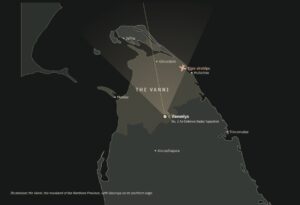
Vavuniya woke in the small hours of 9 September 2008 to the sound of gunfire. It came from the Wanni Security Forces Headquarters and the air force base beside it. Shortly before three, Tamil Tiger commandos wearing fatigues resembling the Sri Lankan Army’s had crossed private land and entered the military complex towards barracks occupied by Special Forces. Vavuniya was a garrison town on the southern edge of Sri Lanka’s northern Vanni region. Within minutes, artillery shells were falling on the base. Then came the bombs. Two light aircraft appeared overhead and dropped their loads.
The raiders had a specific target. Not the runway, and not the fuel. They wanted the radar, an Indian-made set on a low hill. In Iqbal Athas’s reconstruction, published in The Sunday Times five days later, men carrying assault rifles and rocket-propelled grenades pushed towards the set while others detonated their suicide belts. The radar was usually the first to pick up a Tiger aircraft leaving the Vanni. Destroying it could open a route through Sri Lanka’s air defences.
Athas reported that the radar was damaged and replaced, although Sri Lanka’s air force said it was untouched. Two Indians working there were wounded and taken to Colombo for treatment. Both governments described them as civilian maintenance engineers employed by Bharat Electronics, the Indian state-owned company that built the equipment, according to The New Indian Express.
The civilian explanation had been unstable from the day of the attack. Bharat Electronics’ spokesman said he knew of none of its engineers being there. The following day, B. Raman, a retired senior officer of India’s Cabinet Secretariat, wrote that two Indian radar technicians had been wounded. He could not establish whether they were permanently attached to the station or visiting for maintenance.
Eleven years later, a promotion dispute would reopen the story.
The file
One of those men was a serving member of the Indian Air Force. His name was Chintamani Rout. He had been posted to Sri Lanka nineteen months before the attack, under a mission called Project Drishti, and was crew chief of the radar squadron at Vavuniya. A splinter struck the back of his left leg. The Indian Air Force would later recognise him as a battle casualty.
Rout joined the Indian Air Force in May 1989. His case before the Armed Forces Tribunal, the body that hears military service disputes, records his deputation to Sri Lanka from 8 February 2007 to 10 October 2008. It identifies his post as crew chief of No. 2 Air Defence Radar Squadron at the Sri Lanka Air Force base in Vavuniya. At about 3.20 a.m. on 9 September, during an attack from the air and the ground, he suffered the splinter wound.
Rout’s long posting now answers that question for one of them.
The case file was Chintamani Rout v Union of India and Others, Original Application No. 531 of 2019, before the Armed Forces Tribunal, Principal Bench, New Delhi, decided on 21 November 2019.
The injury followed him home. A permanent low medical classification excluded him from promotion to junior warrant officer in successive rounds between 2011–12 and 2018–19. He challenged the bar and asked for his seniority to be restored. He also sought a battle casualty certificate: formal recognition of how he had been wounded.
He sent a legal notice; the Air Force rejected it in a letter dated 18 February 2019. That year he filed his application before the Principal Bench of the Armed Forces Tribunal in New Delhi, asking for three things: the rejection quashed, the medical bar on his promotion waived with his seniority restored alongside his batchmates, and a formal battle casualty certificate for his wound.
By the time the tribunal decided his case on 21 November 2019, the government had supplied that certificate. It was dated 31 July and signed at Air Headquarters. The Air Force continued to resist his promotion claim, but his military status and Sri Lankan posting were admitted facts. The opening sentence of the judgment names Drishti.
The case came up before a division bench: Justice Rajendra Menon, a former Chief Justice of the Delhi High Court who had taken charge as the tribunal’s chairperson only a fortnight earlier, sitting with the administrative member B.B.P. Sinha. The advocate V.S. Kadian argued for Rout, V.S. Tomar for the government.
The state still fought the claim, down to arguing that Rout had waited too long to bring it, an objection the bench threw out.
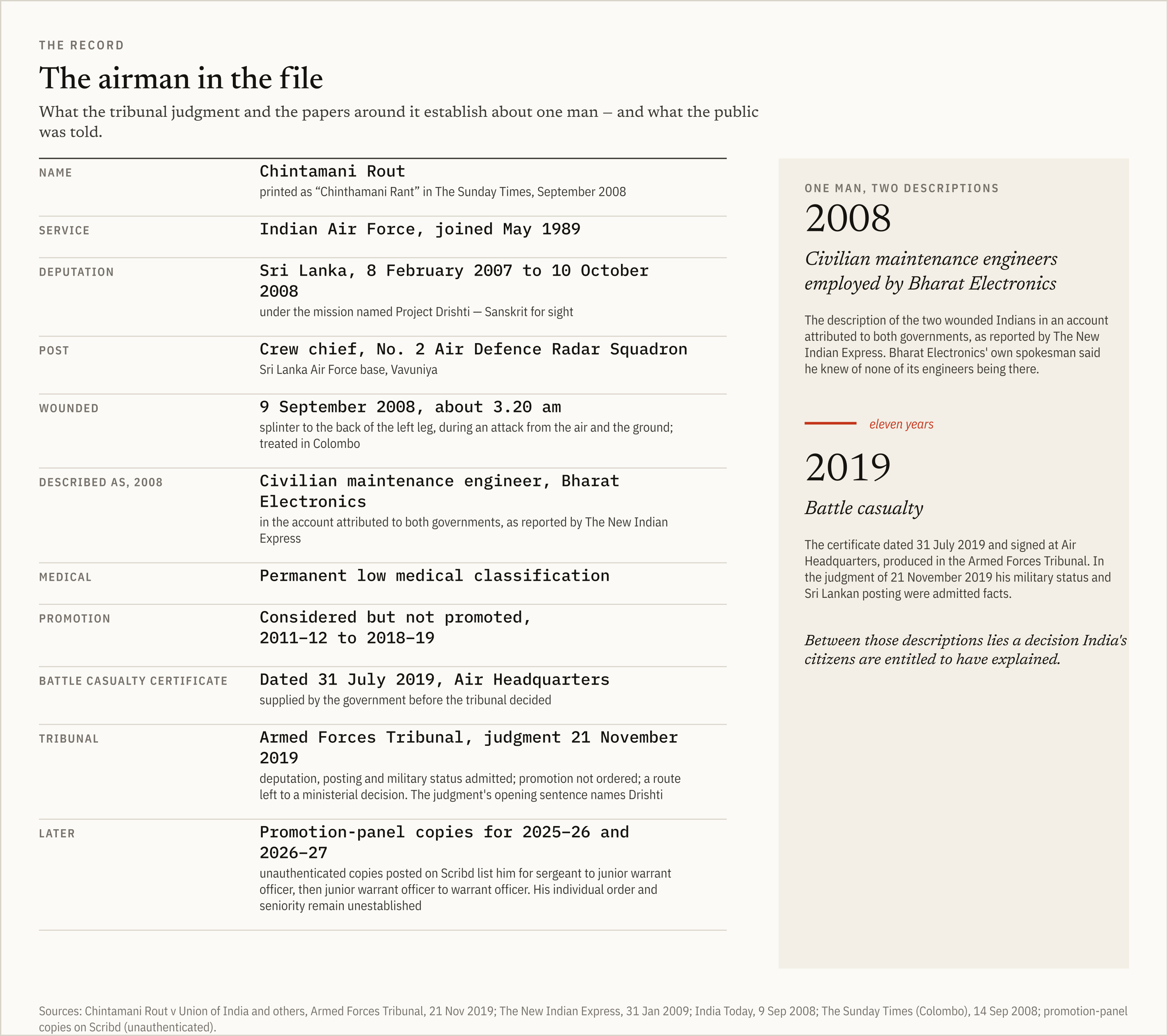
The tribunal did not order his promotion. It left him a route to seek a ministerial decision, preferably within six months of his representation. Later records suggest that he did advance. Two unauthenticated promotion-panel copies posted on Scribd carry his name and a service number matching the tribunal’s official cause list. The 2025–26 copy lists him for sergeant-to-junior-warrant-officer promotion; the 2026–27 copy lists him for junior-warrant-officer-to-warrant-officer promotion. If genuine and correctly compiled, the later entry indicates that he had reached junior warrant officer. His individual promotion order, effective date and any restoration of seniority remain unestablished.
His service record matters because India’s contribution reached into the conduct of that war. Its radars and personnel helped Sri Lanka detect the aircraft that threatened military bases, the international airport and the capital’s power supplies. The assistance strengthened the defences of a state whose final offensive, ending in May 2009, would subject Tamil civilians to mass killing. A United Nations investigation later documented repeated shelling of hospitals and areas where civilians had been told to seek safety. For Tamil citizens in India demanding that Delhi stop supporting Colombo, the difference between a manufacturer servicing equipment and Indian airmen working inside an operational squadron was a question of their own government’s participation.
Project Drishti, Sanskrit for sight, gave India a military presence at the radar screens.
Two dry service terms carry the weight in all this. Rout was not a repairman flown in for a short visit; the judgment records a long deputation as crew chief of the squadron. A battle casualty is a man wounded in operations, not in an accident on a servicing contract. Put those beside the 2008 story of civilian technicians and the story does not survive.
Athas printed the wounded men’s names as A.K. Thakur and Chinthamani Rant, apparently a misspelling of Rout. Raman also cited a website he identified as run by Sri Lankan naval intelligence, which described two Indian nationals operating the radar. On 21 September, Athas reported the appointment of a court of inquiry, headed by the Vavuniya base commander, Group Captain Romesh Fernando. Its findings have not been located.
Tamil Guardian’s contemporary report, citing TamilNet and other press accounts, described the radar as Indian-supplied and manned, and called the wounded men its operators. Those were contemporary claims, not independent confirmation of both men’s military identities. In the civilian account, one word was missing: uniform.
The question also reached India’s Parliament. On 21 October, C. Krishnan, the MP for Pollachi in Tamil Nadu, urged the government to take back the radars it had supplied to Sri Lanka, “along with the experts who have been deputed to operate the radars”. Krishnan belonged to the MDMK, a Tamil nationalist party. His demand distinguished the equipment from the men sent to work it. The tribunal would later record just such a deputation.
“How can we advise them?”
The following day, a senior Ministry of External Affairs officer was asked whether Indian military advisers were helping the Sri Lankan Army. “How can we advise them?” he replied. Asked about civilian Tamil deaths, he said that “in war some damage was expected”.
By January 2009, Rout was back in India. When a fresh report alleged that four Indian military experts had been wounded in the Vanni, an Indian High Commission official denied it, saying there were no Indian military personnel there. The public insistence on distance continued as the war approached its bloodiest months.
Indian military assistance was already being reported. In May 2007, Athas had described the arrival of an Indian Air Force team aboard a special aircraft, alongside another radar delivery. But when two Indians were wounded at an operational base, the account attributed to both governments turned them into company employees. The concealment lay in that false description of a serving airman.
Before the first bombs
India began supplying the radar network before the Tigers’ air wing, known as the Sky Tigers, flew its first combat raid. In early 2005, reports emerged that the Liberation Tigers of Tamil Eelam, the separatist movement fighting for a Tamil state in Sri Lanka’s north and east, had acquired Czech-built Zlin light aircraft. They had reportedly been dismantled, shipped to the Mullaitivu coast and reassembled in the Vanni. Small civilian aeroplanes, fitted with improvised bomb racks, gave the movement a means of striking far beyond its front lines.
The discovery reached the top of the Indian government. A US diplomatic cable of 13 June 2005 records Manmohan Singh discussing the Tigers’ air capability with President Chandrika Kumaratunga during her visit to Delhi earlier that month and offering assistance to upgrade Sri Lanka’s air force. Foreign Minister Natwar Singh repeated the offer in Colombo the following week.
A proposed defence cooperation agreement was politically harder to deliver. The same cable records opposition from the MDMK and the PMK, pro-Tamil parties in India’s governing coalition, as Tamil Nadu approached a state election. Vaiko, the MDMK leader, met the prime minister on 5 June to oppose the agreement. Delhi stalled the treaty while continuing to provide military supplies, training, intelligence and naval cooperation. The public agreement could be delayed without stopping the work it was meant to formalise.
India supplied its first two radar sets in December 2005, before Mahinda Rajapaksa’s first visit to Delhi as president. Sri Lanka’s air force dates the formation of the Vavuniya radar squadron to 10 March 2006. Rout joined it the following February. When the Zlins bombed Katunayake on 26 March 2007, Indian equipment was already in place and an Indian airman was already serving with the squadron.
The Hindu’s report contained two details that matter here. The radars were dispatched ‘on behalf of the Indian Air Force’ from a military base outside Delhi, and that base was the one from which helicopters had once flown, via Thanjavur, to lift Velupillai Prabhakaran out of the army’s Vadamarachchi encirclement in 1987. The paper also recorded Delhi’s motive: India supplied the radars because it did not want Chinese or Pakistani surveillance equipment installed within sight of its own coast.
India had reasons of its own to watch the sky over the island. The June 2005 cable relayed press reports about the aircraft’s possible reach into southern India and an alert at Cochin airport. Years later, Shivshankar Menon, foreign secretary during the final campaign, described India’s objectives: limiting separatism that could spread to Tamil Nadu and keeping hostile powers from gaining influence in Sri Lanka. Supporting Sri Lanka’s territorial unity was a settled Indian policy.
The Center for Naval Analyses study puts seventy million Tamils across the Palk Strait in Tamil Nadu, and an armed non-state air force operating that close to the Indian coast was a problem Delhi wanted gone for reasons of its own.
An aircraft was a particularly visible expression of the Tigers’ challenge to that unity. The movement already held territory, administered courts, collected taxes and operated naval forces. Now it could fly over the capital of the state it was fighting. In April 2007, its spokesman Rasaiah Ilanthirayan invoked the air wing when he declared, “we are a state!” A handful of aeroplanes gave a much larger political claim a form that Colombo could neither ignore nor reliably stop.
India’s military records also show concern for its own southern approaches. Air Marshal Yashwant Rao Rane commanded Southern Air Command from February 2007 until March 2008. His Param Vishisht Seva Medal citation credits him with integrating civilian and military radars over the southern peninsula and coordinating air-defence sensors to cover Sri Lankan and coastal airspace against anticipated threats. Watching Sri Lanka’s sky was part of defending India’s.
Colombo, meanwhile, sought help beyond India. After the first Tiger raid in March 2007, Gotabaya Rajapaksa told the American ambassador that Vavuniya had detected an unidentified aircraft but Sri Lanka’s existing defences were inadequate. In a US cable later reproduced by The Sunday Times, he asked for American assistance alongside the Indian equipment and a Chinese radar then being installed. Sri Lanka was assembling its defences from several suppliers, with India already occupying a central position.
Gokhale, drawing on Jane’s, identified the Chinese purchase as a five-million-dollar JY-11 three-dimensional radar. No official document cited here confirms the type.
The record
Before the first raid
| Date | What the record establishes | Record |
|---|---|---|
| December 2005 | India supplies its first two radar sets to Sri Lanka. | Indian foreign-relations record |
| 10 March 2006 | The Vavuniya air-defence radar squadron is formed. | Sri Lanka Air Force history |
| 8 February 2007 | Rout’s deputation to Sri Lanka begins. | Armed Forces Tribunal judgment |
| 26 March 2007 | The Sky Tigers bomb Katunayake in their first combat air raid. | Contemporary reporting |
The Indian foreign-relations record is document 264, printed p. 741.
Finding the Sky Tigers
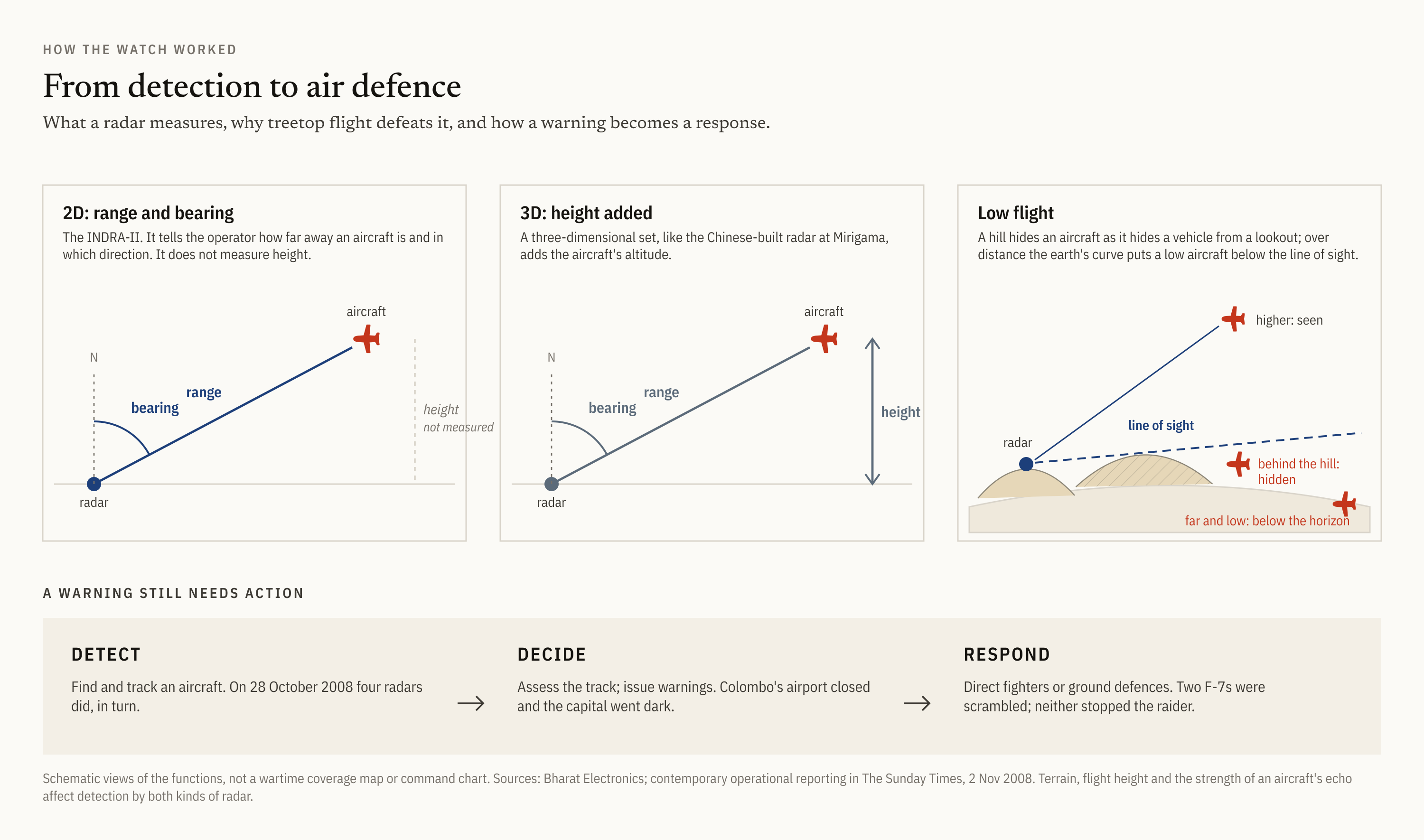
A radar works by sending out radio pulses and listening for the echoes that bounce back from objects in the sky. The return time tells the operator how far away an aircraft is; the direction of the antenna tells them where to look. Successive readings show its movement.
Low flight makes that job harder. A hill can hide an aircraft, just as it hides a vehicle from a lookout. Over longer distances, the earth’s curvature puts low aircraft below the radar’s line of sight. A crew may therefore detect a raider only after it has come dangerously close. Additional radars placed along its likely route give the defenders more chances to find it earlier.
The Indian set, the INDRA-II, was built for low-flying targets. It was a two-dimensional radar: it measured an aircraft’s distance and direction, but not its height. A three-dimensional radar adds altitude. Terrain, flight height and the strength of the aircraft’s echo affect detection by both kinds of radar.
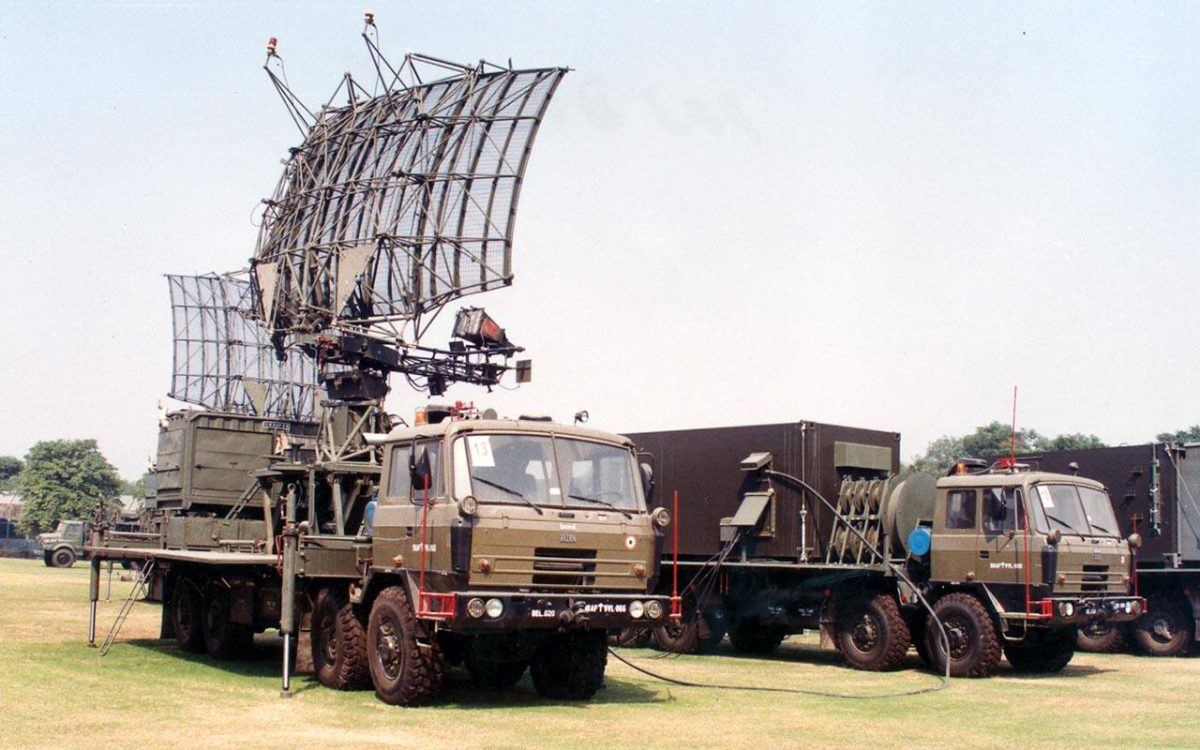
An INDRA-II low-level radar of the type India sent across the strait.Bharat ElectronicsBharat Electronics
Sri Lanka needed that warning early enough to send fighters from Katunayake and alert gun crews along the approach. A radar did not have to fire a shot to contribute to an interception. It gave the defenders time and a position on which to act. The aircraft it found could then be engaged by another part of the system.
The Zlins had shown what happened when that system failed. The first Katunayake raid killed three airmen and wounded sixteen, closed the international airport for several hours and shook the Colombo stock market. During a raid on oil and gas installations on 29 April 2007, the capital lost power, the airport shut and thousands of cricket spectators watching Sri Lanka in the World Cup final fled through the blackout. The bombs caused limited damage; the disruption reached well beyond the blast sites.
The Sky Tigers made the government decide which lights to extinguish, which flights to divert and which installations to guard. Their effects spread through the response: an aircraft could interrupt an international airport even when its bombs missed valuable targets. Each successful return left the government facing the possibility of another raid. A state with fast jets could destroy much more than the Tigers could, yet still fail to prevent those public demonstrations of its vulnerability.
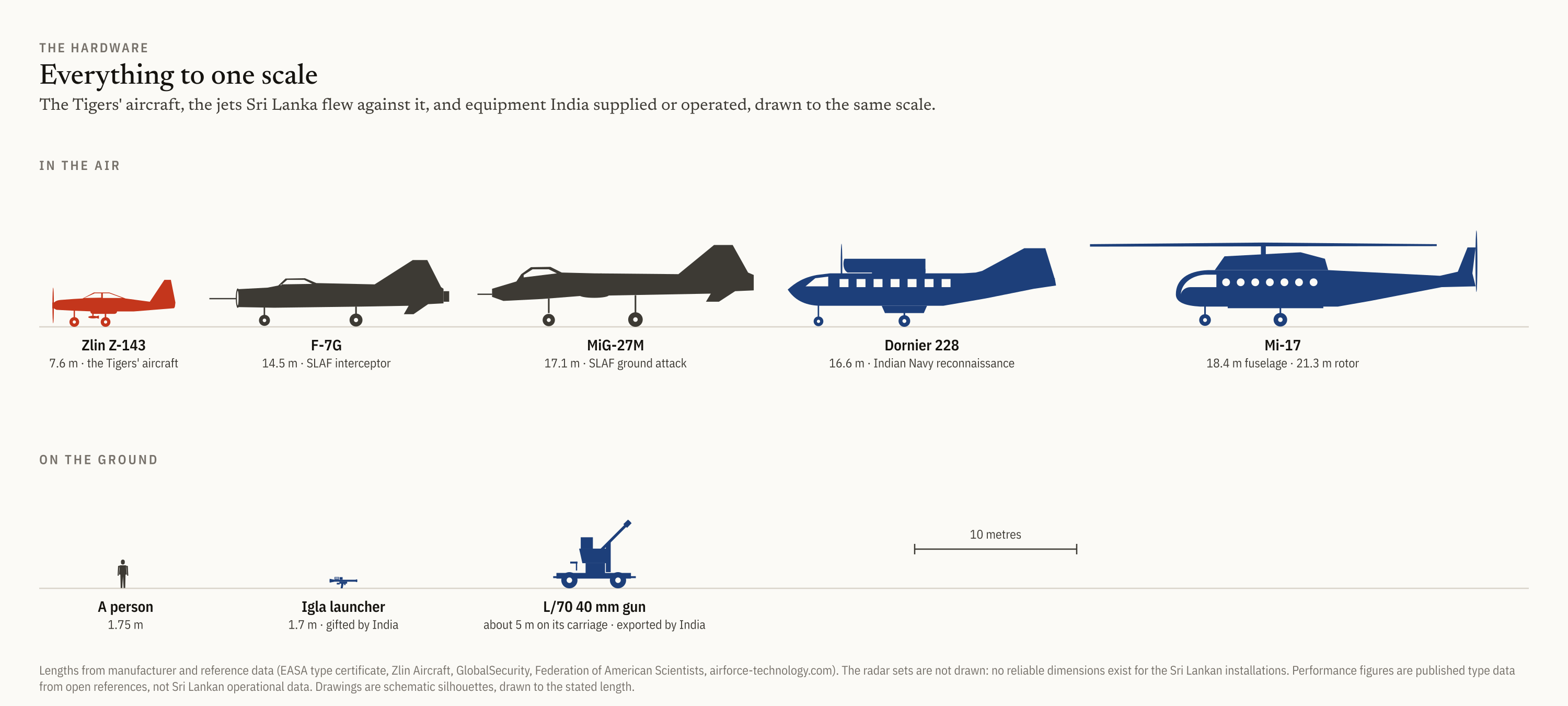
In a comparative study of insurgent aviation, US Air Force officer John Bunnell argued that a small air wing could impose costs on the defender: investment in warning and interception, and resources committed to protecting installations far from the ground war. A Sri Lankan air force officer interviewed for a West Point study later described the air wing’s value as principally psychological.
Aircraft also tied the insurgents to the ground. They needed airstrips, fuel, repairs, trained crews and supplies to replace what wore out. In Looking Up, a study of insurgent airpower, Ryan Olish and William Morgan identify secure bases and the capacity to sustain operations as essential conditions. Their framework exposes a tension in the Tigers’ project: the territory that allowed an air wing to develop contained assets the movement now had to protect.
At Vavuniya, that contest ran in both directions. The government could threaten the Tigers’ aircraft on the ground; the Tigers could attack the equipment that warned of their flights. In September 2008 they sent commandos, artillery and aircraft against a radar position that watched their departure routes. Rout’s posting placed him at a site the movement considered important enough to attack with all three.
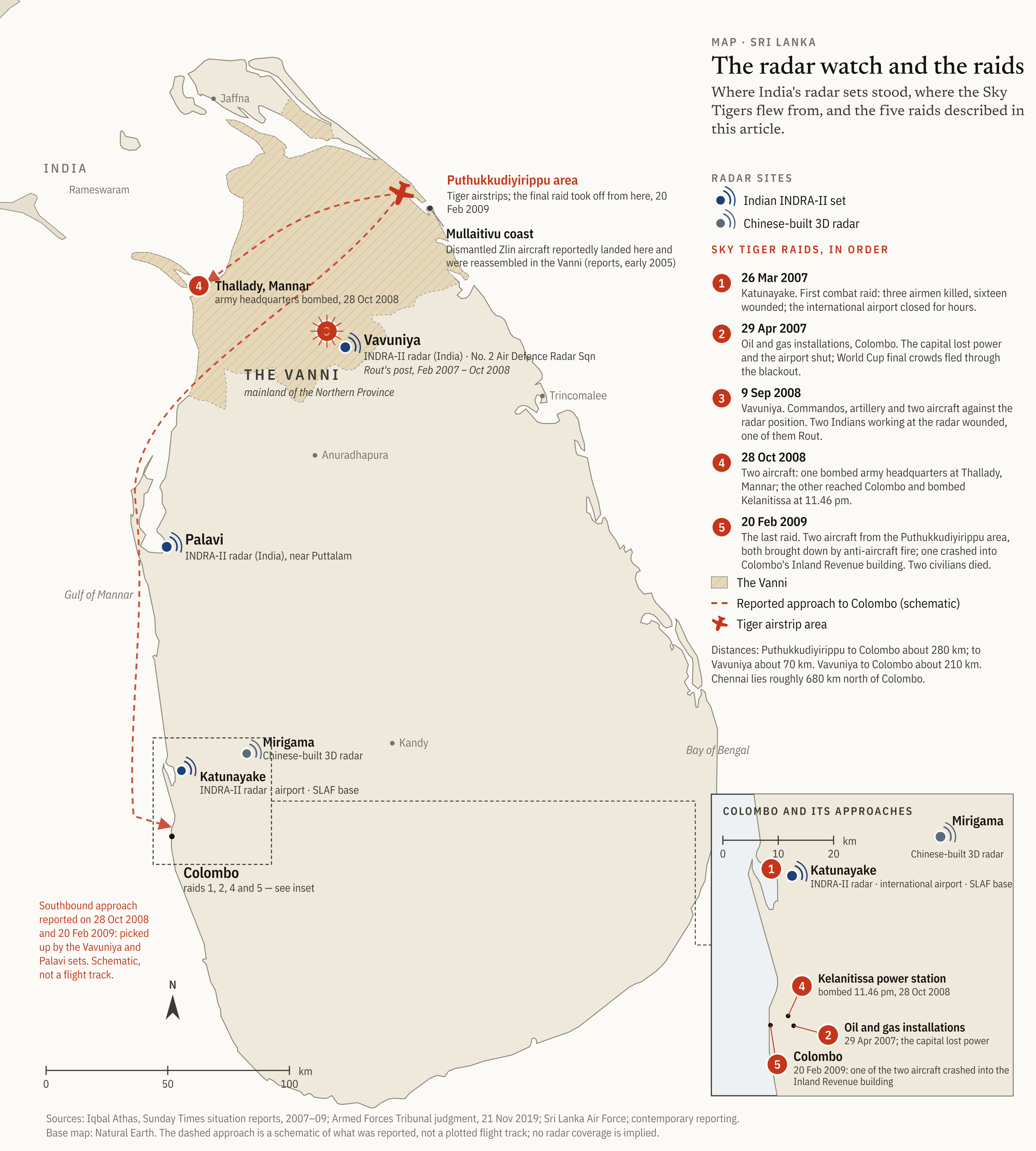
Sri Lanka’s air force claimed that a Chinese-supplied F-7G interceptor shot down one of the Zlins on its return from that raid. The Tigers said both aircraft came home. Athas reported the pilot’s account of a missile launch and a ball of fire, but also the air force’s admission that it had no photographs of the interception or wreckage. The September shootdown remains a contested claim.
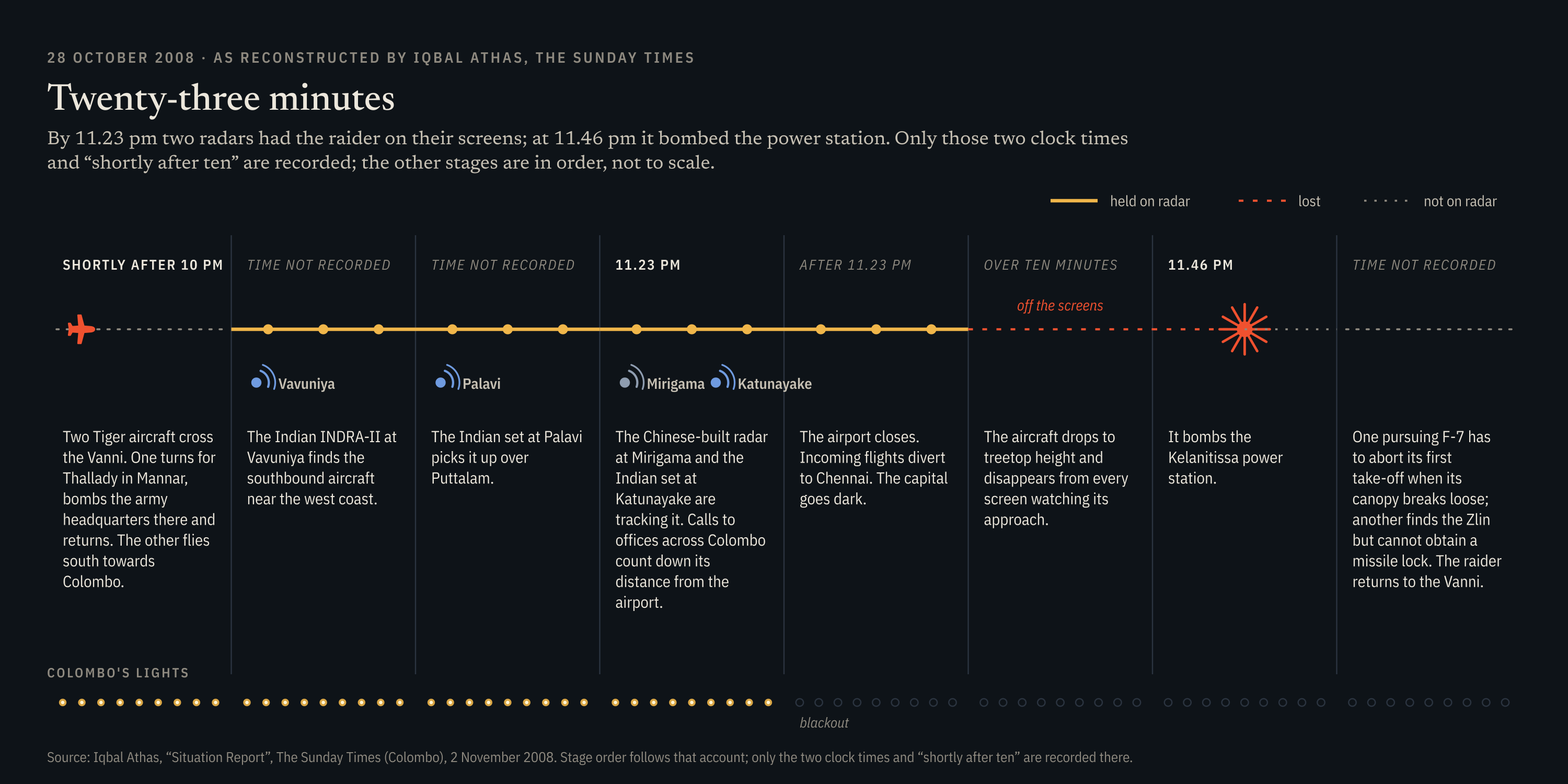
Seven weeks later, a further raid demonstrated both the reach and the weaknesses of the radar network. Shortly after ten on the night of 28 October, two Tiger aircraft crossed the Vanni. One bombed the army headquarters at Thallady in Mannar and returned. The other flew south towards Colombo.
In Athas’s account, the Indian radar at Vavuniya found the southbound aircraft near the west coast. Another Indian set at Palavi picked it up over Puttalam. By 11.23 p.m., the Chinese radar at Mirigama and the Indian set at Katunayake were tracking it. Calls to offices across Colombo counted down its distance from the airport. The airport closed, incoming flights diverted to Chennai and the capital went dark.
Then the aircraft disappeared from the screens. It had dropped to treetop height and, for more than ten minutes, evaded the radars watching its approach to Colombo. At 11.46 p.m., it bombed the Kelanitissa power station. According to Athas, one pursuing F-7 had to abort its first take-off after its canopy broke loose; another located the Zlin but failed to obtain a missile lock. The raider returned to the Vanni.
The final raid came on 20 February 2009, as the Tigers were losing the ground around their remaining airstrips. Two aircraft took off from the Puthukkudiyirippu area. Contemporary reporting describes their detection first at Vavuniya and then at Palavi, followed by a blackout and defensive action. Both came down under anti-aircraft fire, one crashing into Colombo’s Inland Revenue building. The military said they had been packed with explosives for suicide attacks. Two civilians died, including a child reportedly struck by a stray bullet from the defensive fire, and dozens were injured. The radar position the Tigers had tried to destroy five months earlier had helped give warning of their last sortie.
The air wing’s dependence on territory helps explain its vulnerability as the army advanced. It does not explain the Tigers’ defeat by itself. In Size Still Matters, Sameer Lalwani challenges the argument that their turn towards conventional warfare accounts for the outcome. They had long combined regular formations with guerrilla attacks and suicide operations, and continued to do so. He places greater weight on the Sri Lankan state’s expansion of its own forces. Aircraft added reach and obligations within a much larger contest over resources and endurance.
Analysis
What a small air force could achieve
| Effect | What the Sky Tigers demonstrated | The constraint |
|---|---|---|
| Reach | Attacks on the capital and installations beyond the northern front | Penetration did not amount to control of the sky. |
| Disruption | Blackouts, airport closures and repeated defensive mobilisation | Disruption did not halt the government’s ground offensive. |
| Political visibility | An air wing publicly invoked as evidence of statehood | Displaying statehood did not secure diplomatic recognition. |
All three effects depended on airstrips, fuel, maintenance and trained crews. Sources: contemporary raid reporting; the LTTE’s public claim; Olish and Morgan, pp. 13–14.
Air defence was intended to protect the bases and equipment with which Colombo fought that wider war. Military doctrine calls this defensive counterair: detecting and defeating aerial attacks to preserve forces, equipment and infrastructure. In Sri Lanka, the installations under threat included the bases from which government aircraft flew against the Tigers. Protecting them could preserve offensive capacity. Sri Lanka’s air force describes the work of its INDRA-equipped squadron at Palavi as surveillance, early warning and control of interceptors. Ahmed Hashim’s military history, When Counterinsurgency Wins, describes the increased integration of air support with the final ground campaign.
The INDRA helped detect incoming aircraft and make a defensive response possible. Its value to the wider offensive lay in the protection the system was meant to provide, even as the raids exposed gaps between finding an aircraft and stopping it.
Rout’s posting documents Indian participation in that work. The records do not show how his crew’s work related to particular attacks in the Vanni.
[Continued in Part 2]